 by Tom Gurney
Tom Gurney BSc (Hons) is an art history expert with over 20 years experience
Published on July 26, 2026 / Updated on September 6, 2026
Email: tomgurney1@gmail.com / Phone: +44 7429 011000
Great Blue Heron: Introduction
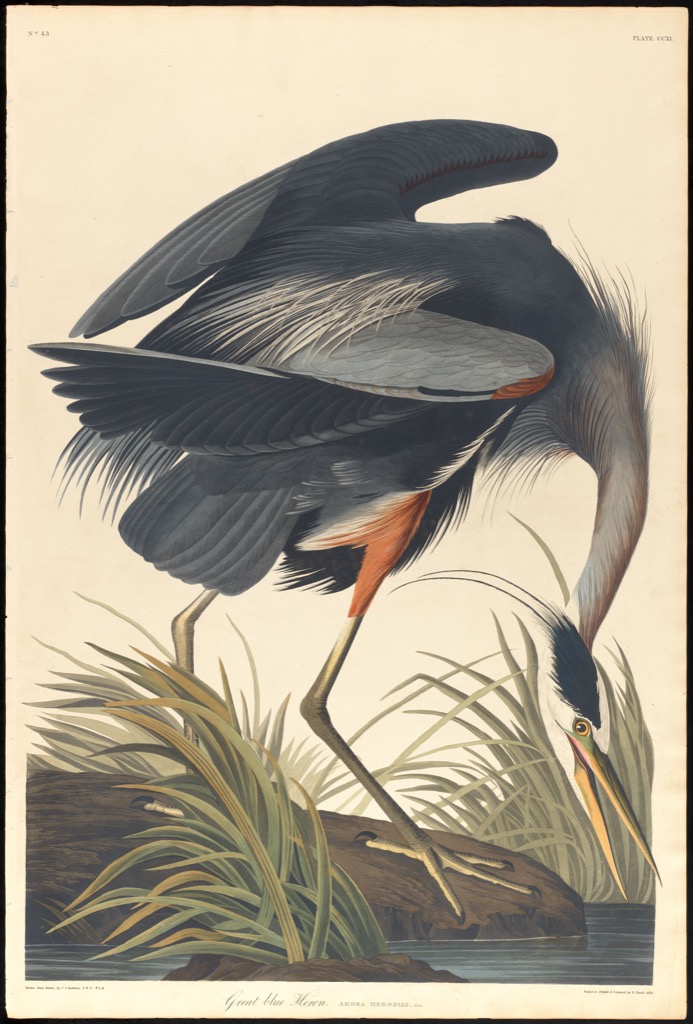
John James Audubon's Great Blue Heron is one of the most elegant wading-bird plates in The Birds of America. The subject is the Great Blue Heron, now identified as Ardea herodias, a large gray-blue heron familiar across much of North America. Audubon presents the bird standing near water, its long neck curving upward, its bill extended, and its legs planted with poised, deliberate balance. The image is quiet, but it is not static. Everything about the bird suggests attention: the pointed bill, raised head, folded neck, alert eye and disciplined vertical body. [1], [6]
The plate is identified as The Birds of America number 211, or Plate CCXI. The Boston Public Library and DPLA/Digital Commonwealth record describes the work as Great blue heron Ardea herodias. Male. c.1 v.3 plate 211, drawn from nature by J. J. Audubon and engraved, printed and coloured by R. Havell in 1834. Those details matter because the image belongs to a specific printed object, volume and copy history, not only to the broad modern category of Audubon bird prints. [1]
The Great Blue Heron is a superb Audubon subject because it turns bird anatomy into line. Its body is large, but its shape is made from slender parts: long legs, long toes, long bill, long neck and extended plumes. Cornell's All About Birds describes the species as a stately heron with subtle blue-gray plumage, often standing motionless near water before striking quickly at prey. Audubon's plate understands that tension between stillness and sudden movement. [6]
At a Glance
- Public titleGreat Blue Heron
- SeriesThe Birds of America, Plate CCXI [1]
- Catalogue referenceBirds of America, no. 211 [1]
- Date1834 [1]
- Maker linedrawn from nature by J. J. Audubon; engraved, printed and coloured by R. Havell [1]
- Holding routeBoston Public Library / DPLA / Digital Commonwealth [1], [2]
- Copy noteAppleton copy, volume 3, set 43 [1]
- Current species nameArdea herodias [6], [7]
- Image statusBPL/DPLA no-copyright United States route [1]
Contents
- Introduction
- Object Facts
- What the Plate Shows
- Posture, Neck and Bill
- Blue-Gray Plumage and Long Lines
- Wetland Hunter
- Place in The Birds of America
- Related Herons and Water Birds
- Institutional Access and Image Caution
- Natural History and Modern Meaning
- Why This Plate Matters
Object Facts
Great Blue Heron belongs to The Birds of America, Audubon's double-elephant folio publication of North American birds. The BPL/DPLA record identifies the subject as Great blue heron Ardea herodias. Male. c.1 v.3 plate 211, from volume 3. It also notes that the item was issued in set number 43 and carries plate number CCXI, or 211. [1]
The maker line preserved in the record is precise: drawn from nature by J. J. Audubon and engraved, printed and coloured by R. Havell, 1834. This is the collaborative structure that defines many of the great folio plates. Audubon supplied the bird design and naturalist image. Robert Havell translated that design into the finished printed object through engraving, printing and hand coloring. [1], [3]
The Boston Public Library copy is also historically useful because it comes from the Appleton copy of The Birds of America, donated to the library in 1855. Digital Commonwealth describes the broader BPL collection as preserving the Appleton copy and related Birds of America material. This gives the plate a real institutional context rather than leaving it as an anonymous historic bird image. [1], [2]
What the Plate Shows
Audubon's heron stands in profile, but the pose is not a flat side view. The long neck rises in an S-like curve, the bill points outward, the body settles back over thin legs, and the feet hold the ground near water. The bird's head, neck and bill create a sharp directional line. The body and wing feathers provide a darker mass behind it. The legs stretch downward like supports for a living structure.
This anatomy is the plate's drama. The Great Blue Heron is not shown plunging its bill into a fish or opening its wings in flight. Instead, Audubon concentrates on the poised moment before action. The viewer can imagine the strike because the whole body seems ready for it. The bill is a spear, the neck is a coiled spring, and the legs are the silent platform that lets the bird wait. [6], [7]
The surrounding setting reinforces that reading. Herons live by edges: river banks, marshes, lakeshores, estuaries, ponds and shallow coasts. Audubon's plate places the bird in a watery world without allowing the landscape to overwhelm the subject. The setting gives context; the body carries the main argument.
Posture, Neck and Bill
The Great Blue Heron's posture is one of the reasons the species is so recognizable. Cornell emphasizes the bird's slow, deliberate walking and its ability to stand motionless while scanning for prey. Animal Diversity Web describes the species as the largest heron in North America and records its long body, large bill, yellowish-green to dark gray legs, blue-gray upperparts and long plumes. [6], [7]
Audubon's plate depends on the same features. The long neck is not merely decorative. It is a hunting mechanism. Cornell notes that the species can strike quickly thanks to specially shaped neck vertebrae. The plate makes this physical potential visible by showing the neck curved but ready, held between rest and release. [6]
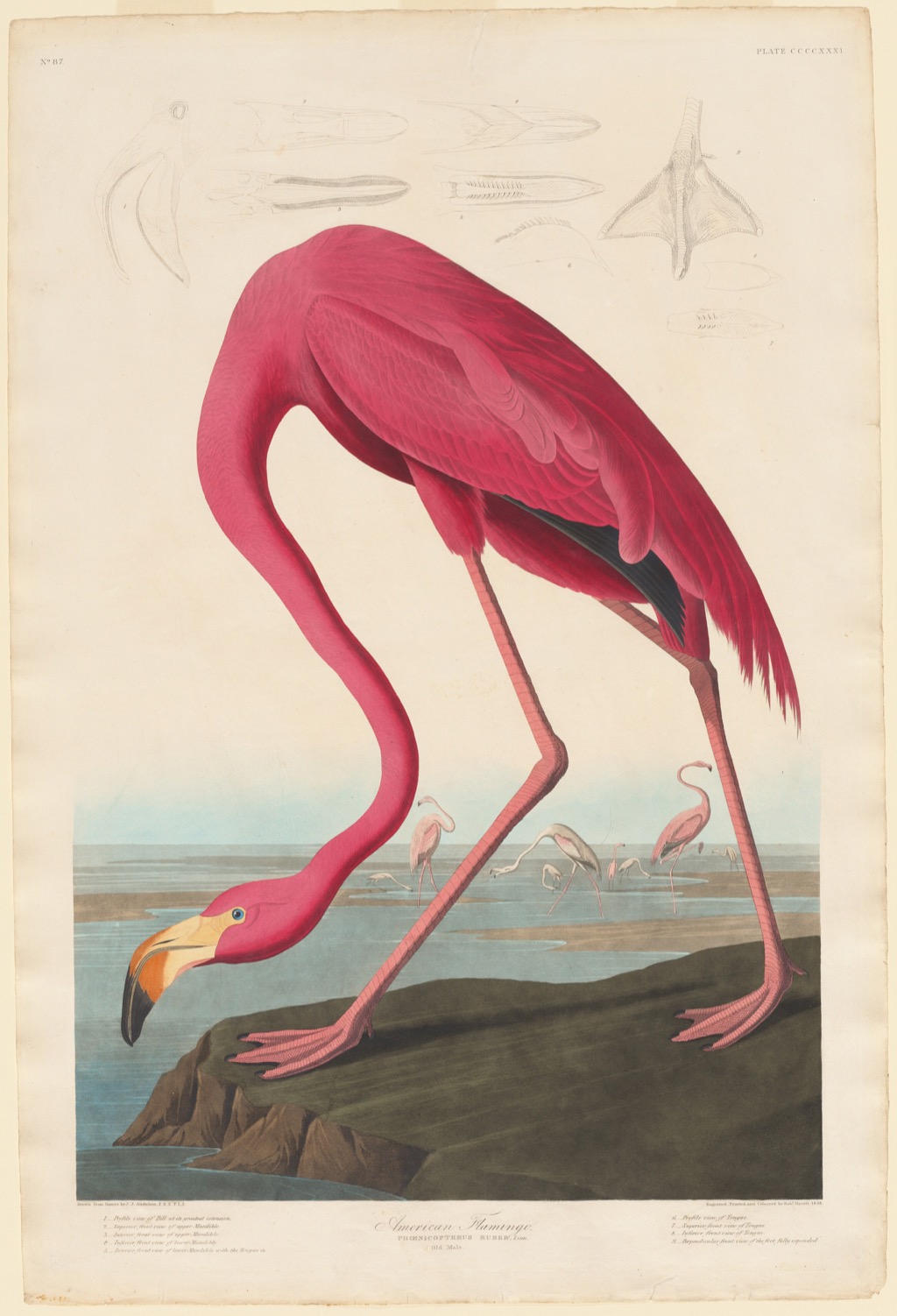
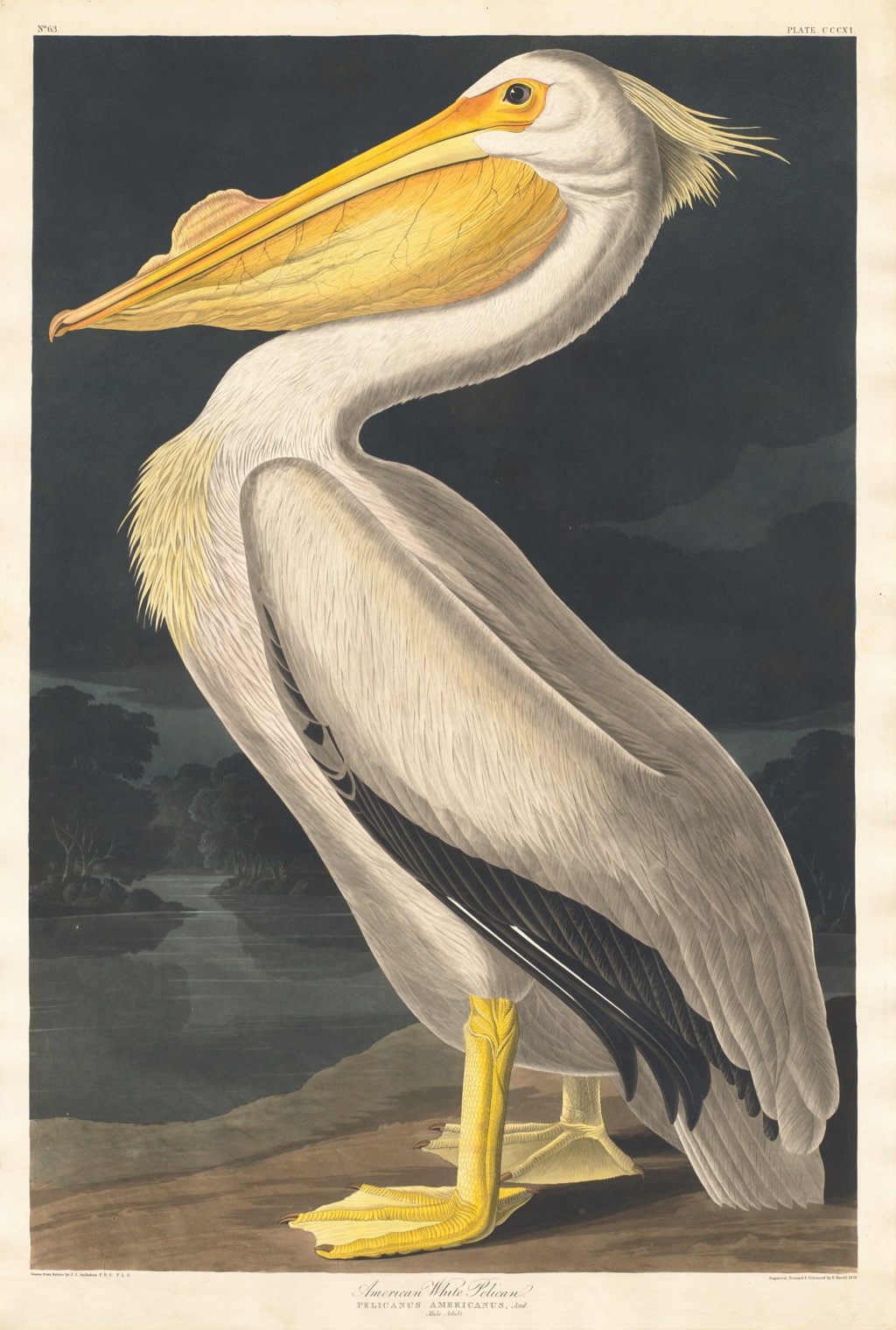
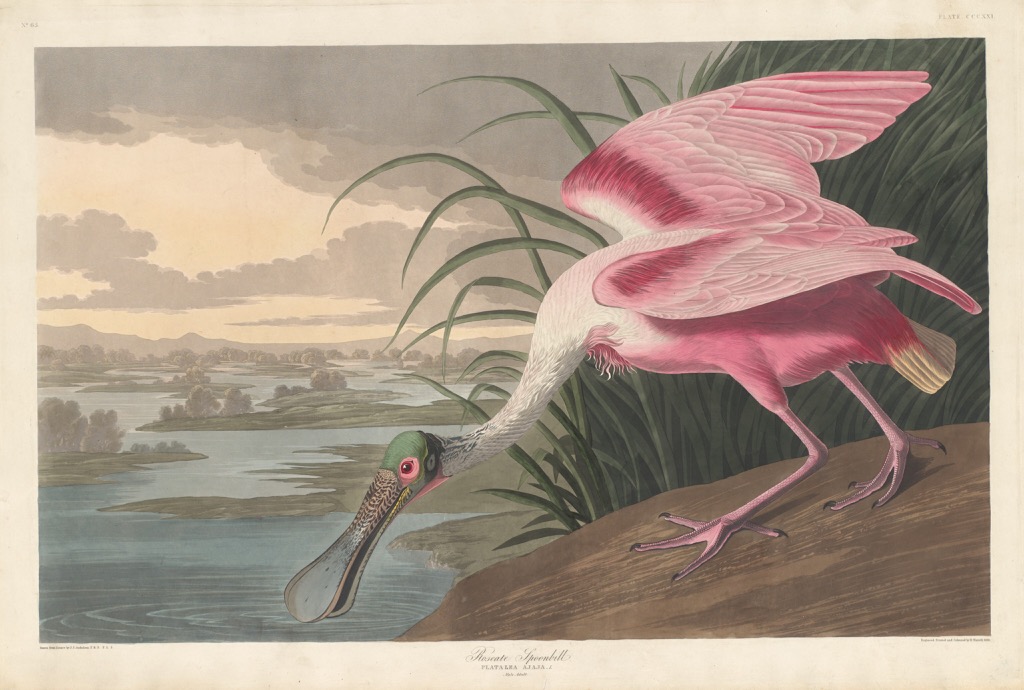
The bill is just as important. It projects forward with a pointed, linear force that differs from the scoop of the American White Pelican or the flattened sweep of the Roseate Spoonbill. A pelican bill gathers. A spoonbill sweeps. A heron bill strikes. Audubon's composition lets that difference be felt in the shape of the bird.
Blue-Gray Plumage and Long Lines
The common name can be misleading if it makes a reader expect a bright blue bird. Cornell describes the plumage as subtle blue-gray, and Animal Diversity Web gives a more detailed account of blue-gray upperparts, pale neck tones, white or pale head markings, darker face stripe and long plumes. The bird's beauty is not a single strong color. It is a harmony of gray, blue, black, white, buff and chestnut accents. [6], [7]
Audubon's print has to organize those quiet colors across a tall, narrow body. The long neck needs tonal variation so it does not become a plain stripe. The wing and back need enough darker mass to hold the body together. The face markings and plumes need clarity without overloading the head. The legs and feet need to feel thin but strong.
This is where Havell's print process matters. Engraving gives structure to feathers, bill, eye and leg. Hand coloring gives the plate its tonal softness. The heron is not spectacular in the same way as the flamingo or spoonbill. Its spectacle is controlled, almost austere. The image rewards slower looking.
Wetland Hunter
Modern bird sources describe the Great Blue Heron as a widespread and adaptable hunter. Cornell places it around shorelines, rivers, marshes, estuaries and ponds across much of the United States, and notes that it may also feed in meadows, farmland and other open fields. Animal Diversity Web similarly describes the species near rivers, lake edges, marshes, saltwater coasts and swamps, with nesting in tall trees near water. [6], [7]
The diet is broader than a casual viewer might expect. Cornell identifies fish as the main food association, but its description also notes that Great Blue Herons can take other prey. Animal Diversity Web describes a predator that uses visual perception, patient movement and a sharp bill to capture food. The plate does not need to show prey to communicate this. The heron's body is enough. [6], [7]
That is one of Audubon's strengths here. He avoids a cluttered hunting scene and lets the bird's anatomy imply behavior. The poised neck, pointed bill and long legs tell the viewer how the animal works. The Great Blue Heron becomes a figure of patience and sudden violence held inside a graceful outline.
Place in The Birds of America
Plate 211 belongs to the third volume of The Birds of America and was issued in set number 43, according to the BPL/DPLA record. Yale's Beinecke Library notes that an opening display of volume III included Plate CCXI, Great Blue Heron, alongside Brown Pelican. That institutional context places the heron among the large and medium water-bird subjects that tested Audubon's folio ambitions. [1], [4]
The double-elephant folio format was essential to Audubon's project. Yale describes the paper as approximately 38 by 26 inches and explains that Audubon wanted birds to appear life-sized where possible. The Natural History Museum in London describes the original work as 435 color plates bound into four volumes, in double-elephant folio size. A heron is exactly the kind of bird that needs such a format. Its height, legs and neck are difficult to compress without making the animal seem cramped or false. [4], [5]
Audubon's solution is to make the plate a study in vertical poise. The heron is tall, but the curve of the neck and placement of the body keep it within the sheet. The bird fills space without seeming awkwardly folded. It is less flamboyant than the American Flamingo and less massive than the pelican, but it is just as dependent on the folio scale.
Related Herons and Water Birds
The Great Blue Heron sits naturally beside several other Audubon water-bird pages. The Louisiana Heron, now commonly connected with the Tricolored Heron, offers a more slender, delicate comparison. The spoonbill brings pink color and a tactile feeding bill. The pelican brings whiteness, bulk and a pouch. The flamingo brings height, compression and theatrical curve.
Together, these works show that Audubon's water birds are not interchangeable. Each species creates a different artistic problem. The Great Blue Heron is a problem of restraint. How do you make a mostly gray-blue, patient, long-legged bird as compelling as more colorful subjects? Audubon's answer is to trust line, posture and watchfulness.
The plate also connects to the wider publication hub for The Birds of America and to the broader John James Audubon Works overview. The publication hub explains the folio system, subscription model and printmaking context. The works hub places the plate among Audubon's drawings, paintings, prints and book projects.
Institutional Access and Image Caution
The Great Blue Heron has a more complicated image pathway than some NGA-backed Audubon plates. The strongest record route traces through Boston Public Library, DPLA and Digital Commonwealth. The rights statement associated with that route is No Copyright - United States, with an explicit caution that copyright status outside the United States was not determined. [1], [2]
That distinction matters because the public-domain status of a nineteenth-century artwork is not the same thing as permission to reuse every modern digital file found online. The safest reading keeps the image attached to its BPL/DPLA/Digital Commonwealth provenance, where title, maker line, plate number, copy history and rights language can be checked together.
For the reader, the practical lesson is simple: a good Audubon image should come with a strong source record. The Boston/DPLA description supplies title, creator information, plate number, volume, set number, Appleton copy notes and rights language. That gives the image a much firmer foundation than an unsourced reproduction. [1], [2]
Natural History and Modern Meaning
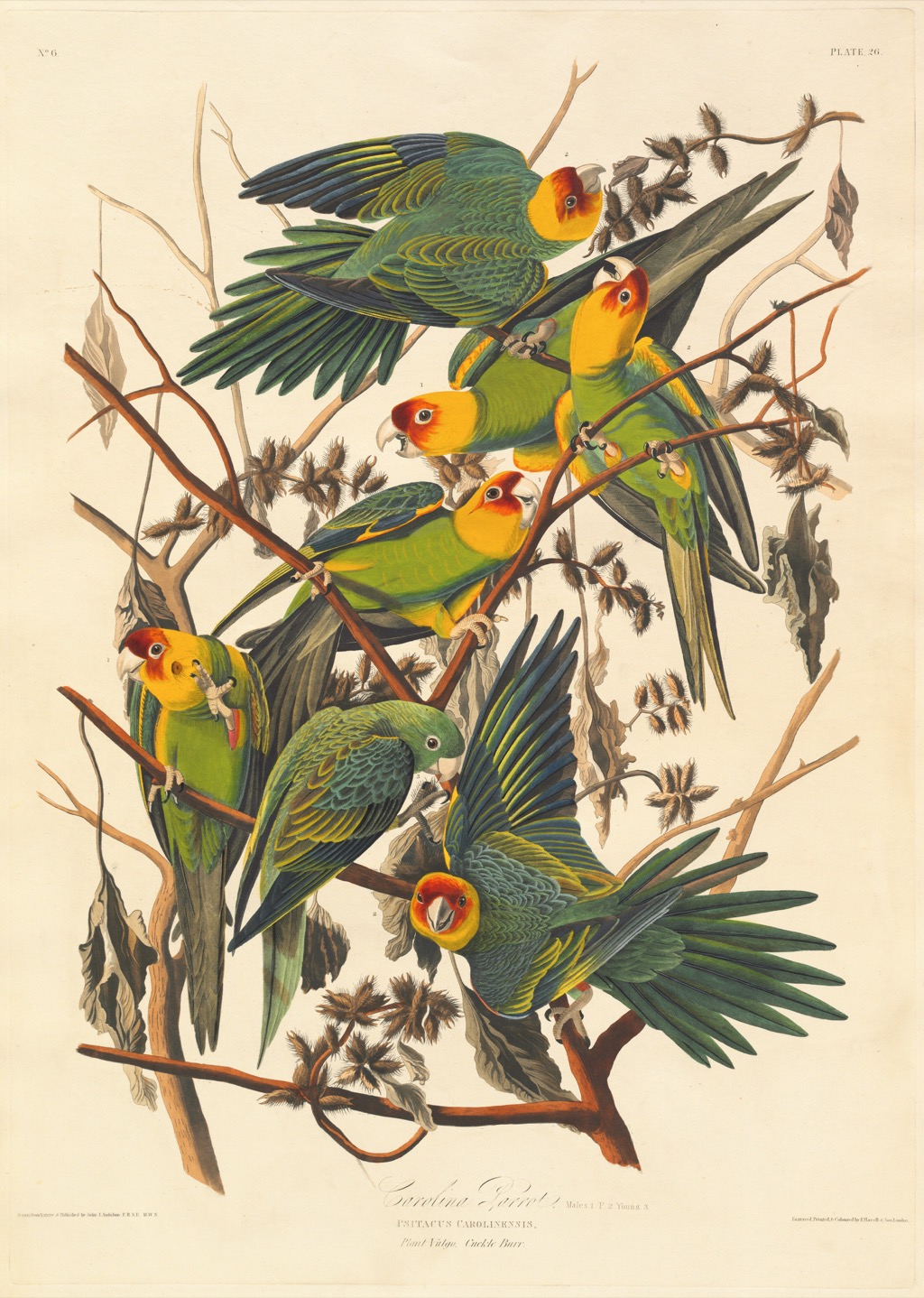
The Great Blue Heron is currently listed by Cornell as Low Concern, and it remains widespread and familiar. That makes it different from Audubon's Passenger Pigeon or Carolina Parakeet, whose plates are now read through extinction. The heron is still a living presence in marshes, rivers, ponds and coasts. [6]
Yet the plate still has modern ecological force. Great Blue Herons depend on wetlands, nesting trees, shorelines and prey-rich water. Cornell notes that some colonies, or heronries, use bulky stick nests high in trees. Animal Diversity Web emphasizes the need for tall trees near water for nesting. A modern viewer can therefore read Audubon's plate as more than a beautiful bird portrait. It is also an image of a habitat relationship. [6], [7]
The bird's continued familiarity may even make the plate stronger. Many viewers have seen a Great Blue Heron standing motionless by a pond or lifting into slow flight. Audubon's image connects that everyday encounter to the monumental format of The Birds of America. It makes a recognizable bird feel grand without making it untrue.
Why This Plate Matters
Great Blue Heron matters because it shows Audubon achieving drama through restraint. There is no bright pink plumage, no enormous pouch, no extinct-species tragedy and no violent prey scene. The plate depends on line, posture, anatomy and the viewer's knowledge that stillness can precede action.
It also shows why The Birds of America cannot be reduced to a set of decorative bird pictures. The heron is beautiful, but its beauty is functional. Long legs place it in shallow water. A long neck stores striking power. A long bill becomes a weapon. Blue-gray plumage and patient posture suit a bird that hunts by waiting.
Within the Audubon cluster, this page is a strong bridge between art and natural history. It belongs with the pelican, spoonbill, flamingo and Louisiana Heron as part of a wetland-bird sequence, but its mood is its own: quiet, vertical, watchful and exact. Audubon's plate makes the Great Blue Heron feel like a living measure of the water's edge.
Frequently Asked Questions
Discussion
Great Blue Heron turns patience, long anatomy and wetland watchfulness into a disciplined folio image.
Use the prompts below to think about stillness, line and the difference between decorative bird art and natural-history structure.
Reader Insights
How does Audubon make a waiting bird feel full of possible movement?
Which line matters most: the bill, the neck, the legs or the body?
How does the setting help the heron's posture make sense?
Join the Conversation
Share your reading of Audubon's Great Blue Heron and its balance of restraint and drama below.
References
- Digital Public Library of America, Great blue heron Ardea herodias. Male. c.1 v.3 plate 211, accessed 26 July 2026.
- Digital Commonwealth source catalog record, Great blue heron Ardea herodias. Male. c.1 v.3 plate 211, accessed 26 July 2026.
- Biodiversity Heritage Library, The Birds of America, accessed 26 July 2026.
- Yale Beinecke Library, The Double Elephant Folio, accessed 26 July 2026.
- Natural History Museum, London, The Birds of American Animals, accessed 26 July 2026.
- Cornell Lab of Ornithology, All About Birds, Great Blue Heron overview, accessed 26 July 2026.
- Animal Diversity Web, Ardea herodias, accessed 26 July 2026.