


 by Tom Gurney
Tom Gurney BSc (Hons) is an art history expert with over 20 years experience
Published on June 19, 2020 / Updated on October 14, 2023
Email: tomgurney1@gmail.com / Phone: +44 7429 011000
Introduction
Masaccio’s surviving paintings form an unusually small but exceptionally concentrated body of work. Because he died in his twenties, almost every securely attributable panel or fresco carries disproportionate importance, while lost works, dismantled altarpieces and collaborative commissions make reconstruction essential to understanding the career as a whole. The paintings are best approached chronologically rather than as a simple list of masterpieces.
The San Giovenale Triptych establishes the young artist’s early interest in bodily mass and perspectival order; collaborations with Masolino reveal how quickly his visual language diverged from late-Gothic elegance; the Brancacci Chapel develops monumental fresco narrative; the Pisa Polyptych transfers these innovations into a complex panel ensemble; and the Holy Trinity pushes perspective into one of the most audacious architectural illusions of the century. This sequence also reveals that Masaccio did not abandon older artistic conventions overnight. Gold grounds, polyptych structures and traditional sacred subjects remain present, but they are transformed by a new insistence that figures possess weight, that space obey coherent visual rules and that light acts consistently across bodies and architecture.
At a Glance
- Earliest known workSan Giovenale Triptych, 23 April 1422
- Important lost early workSagra, Santa Maria del Carmine
- Major collaborationSant’Anna Metterza with Masolino
- Principal fresco cycleBrancacci Chapel
- Major Brancacci worksTribute Money, Expulsion from Eden, Baptism of the Neophytes, Saint Peter Healing the Sick with His Shadow, Distribution of Alms and Death of Ananias
- Major documented panel commissionPisa Polyptych, 1426
- Pisa central panelVirgin and Child, National Gallery, London
- Pisa upper panelCrucifixion, Capodimonte, Naples
- Pisa predella fragmentsGemäldegalerie, Berlin
- Major independent frescoHoly Trinity, Santa Maria Novella
- Important private devotional workMadonna Casini
- Final phaseRoman work associated with Santa Maria Maggiore
- Recurring artistic concernsbodily volume, coherent light, perspective, emotional immediacy and integration with real viewing conditions
Contents
- Early Paintings
- Selected Masaccio Paintings
- The Lost Sagra
- Masaccio’s Virgin and Child in Sant’Anna Metterza
- Expulsion from the Garden of Eden
- Distribution of Alms and Death of Ananias
- Pisa Polyptych
- Saint Andrew
- Holy Trinity
- Holy Trinity after Masaccio
- Santa Maria Maggiore Altarpiece
- Bodies
- Emotion
- Why Masaccio’s Paintings Matter
- Frequently Asked Questions
- References and Research Sources
Early Paintings
The earliest secure evidence of Masaccio’s painting belongs to 1422, when he was only twenty years old. The works of this opening phase already show the fundamental tension that would define his career: inherited gold-ground and multi-panel formats coexist with a new concern for physical bodies and rational space. Because no securely documented apprenticeship survives, these early paintings are especially important. They provide the best surviving evidence for how rapidly Masaccio entered the professional Florentine world and how developed his visual thinking already was.
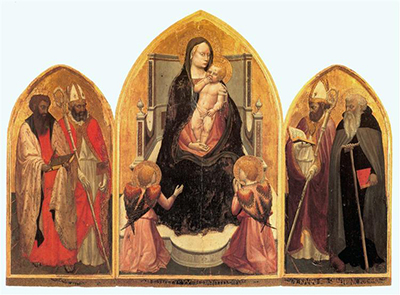
San Giovenale Triptych. The San Giovenale Triptych is dated precisely to 23 April 1422 and is regarded by Museo Masaccio as the artist’s first known work. The exact date gives the painting exceptional value because it establishes a fixed point only a few months after Masaccio’s admission to the Florentine painters’ guild. The triptych retains a traditional gold-ground devotional structure, but the central throne and figures already signal something new.
Mary and Christ possess unusual solidity, while the throne is organised around a central recession that begins to make sacred space measurable rather than merely symbolic. The Christ Child holds or interacts with grapes, connecting naturalistic bodily action with Eucharistic meaning. This combination becomes characteristic of Masaccio: theological symbolism is strengthened by the fact that Christ appears physically convincing.
Saints in the San Giovenale Triptych. The flanking saints occupy individual panels in accordance with the traditional triptych format, yet their bodies are already conceived with substantial weight. Drapery hangs around figures rather than forming decorative patterns independent of anatomy. This makes the work useful for understanding Masaccio’s transition from inherited forms. The structure is still Gothic in several respects, but the figures no longer behave according to a purely Gothic visual logic.
Selected Masaccio Paintings
Browse Masaccio's principal surviving works, from the San Giovenale Triptych and the Brancacci Chapel frescoes to the Pisa Polyptych and smaller devotional panels.
The Lost Sagra
Masaccio’s next important work may have been the now-lost Sagra, a green-earth fresco commemorating the consecration of Santa Maria del Carmine. Later descriptions suggest that it included a procession of contemporary Florentines arranged with striking naturalism and spatial coherence. The fresco no longer survives, so its appearance has to be reconstructed through written testimony and drawings. It remains important because it suggests Masaccio was already applying his interest in physical presence to contemporary groups rather than limiting that realism to conventional sacred figures.
Collaborative Paintings with Masolino. Masolino da Panicale was Masaccio’s most important artistic collaborator, and their surviving joint works give a rare opportunity to see two distinct pictorial languages operating together. Masolino’s figures often preserve greater linear grace and courtly refinement, while Masaccio increasingly builds figures through mass, shadow and physical relation to space. This difference should not be reduced to a competition between old and new. Their repeated collaboration indicates that the two painters could work productively within the same commissions even while developing visibly different styles.
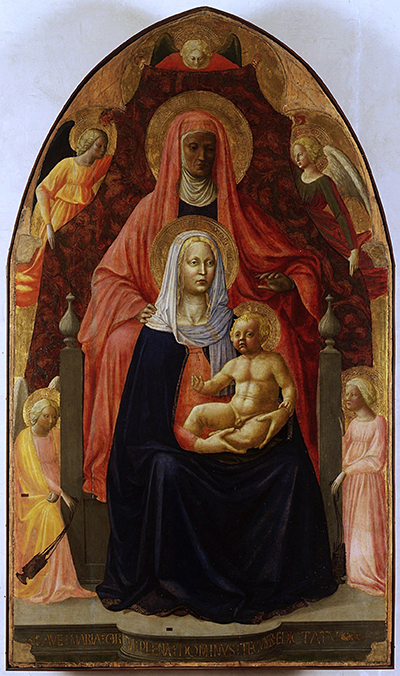
Sant’Anna Metterza. The Uffizi’s Sant’Anna Metterza, painted around 1424–25 for Sant’Ambrogio in Florence, is one of the clearest surviving examples. The work was commissioned by Nofri Del Brutto Buonamici and combines Saint Anne, the Virgin, Christ and angels within one carefully ordered sacred hierarchy. Modern attribution generally gives Saint Anne largely to Masolino while assigning the Virgin and Child to Masaccio.
The contrast is particularly revealing because Masaccio’s Mary and Christ possess dense, sculptural mass, making their physical relationship more convincing than the more linear figure of Anne behind them. The painting is therefore not merely collaborative in authorship but historically useful as a visual record of artistic change. Two approaches to sacred presence occupy the same panel.
Masaccio’s Virgin and Child in Sant’Anna Metterza
Mary’s knees project beneath her garment, and the Christ Child appears physically supported by her body rather than simply positioned in front of it. This treatment transforms the throne group into a three-dimensional structure whose forms seem to press outward from the painted surface. The connection with contemporary sculpture is especially strong. Masaccio’s figures appear conceived in volumes, which helps explain why Donatello became such an important artistic point of comparison.
The Brancacci Chapel. The Brancacci Chapel in Santa Maria del Carmine contains the largest surviving concentration of Masaccio’s fresco painting. Commissioned by Felice Brancacci after 1423 and begun within a collaborative campaign involving Masolino, the chapel was devoted principally to Saint Peter and the history of the early Church. The surviving cycle is incomplete because parts of the original upper register were destroyed and the fifteenth-century campaign itself was left unfinished. Filippino Lippi returned decades later to complete several sections, creating a remarkable ensemble spanning multiple generations.
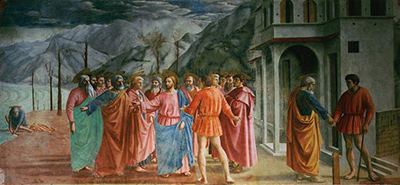
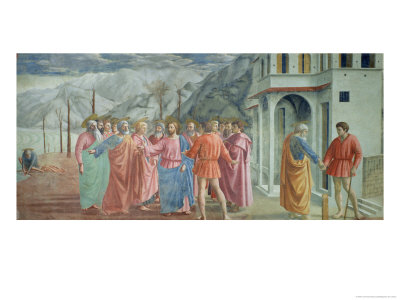
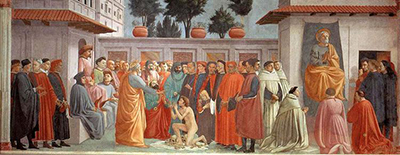
Tribute Money. The Tribute Money is one of Masaccio’s greatest narrative achievements. Several moments from the Gospel episode occur within one landscape and architectural setting, yet the story remains easy to follow because gesture, gaze and spatial organisation guide the viewer between actions. Christ stands at the centre surrounded by apostles while the tax collector confronts the group.
Peter appears again at the edge finding the coin in the fish and finally paying the tax, allowing chronological sequence to unfold within a single coherent visual world. The figures are unified by a consistent source of light, which models bodies through shadow and helps them occupy the same atmosphere. This integration of narrative time, bodily volume and natural light became one of the fresco’s most influential features.
Expulsion from the Garden of Eden
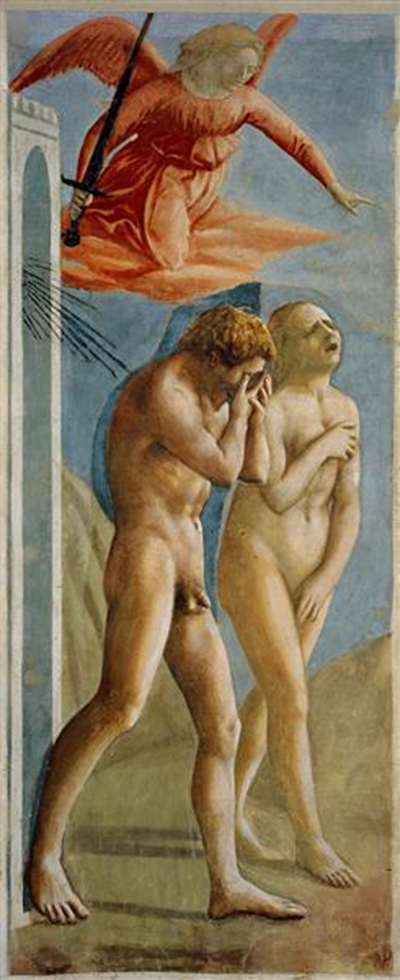
The Expulsion from the Garden of Eden is among Masaccio’s most emotionally direct paintings. Adam covers his face in grief while Eve cries out, and their exposed bodies make shame and loss visible with an intensity that transformed the traditional subject. The scene contains almost no distracting detail because Masaccio concentrates everything on bodily emotion.
Architecture and landscape are reduced, allowing the figures themselves to carry the theological meaning of exile. Later additions covered parts of their nudity, but modern restoration removed those interventions. Recovering the original bodies restored an essential part of Masaccio’s expressive conception.
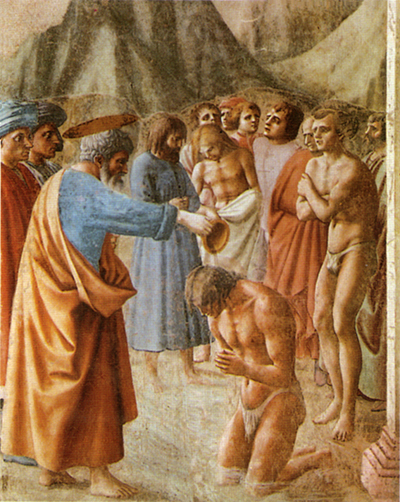
Baptism of the Neophytes. In the Baptism of the Neophytes, Masaccio turns a sacramental scene into an observation of real human bodies exposed to water and cold. A waiting convert visibly shivers, while another kneels to receive baptism with remarkable physical immediacy. The shivering figure is especially significant because the detail is not necessary to identify the biblical event. Masaccio includes it because human beings inhabit environments, and that physical observation makes sacred history feel lived.
Saint Peter Healing the Sick with His Shadow. This fresco places Peter within a convincingly urban setting as sick people wait to be healed by the passing of his shadow. The architecture resembles a real contemporary city closely enough that the miracle seems to enter ordinary social life rather than occur within an abstract biblical world. The poor and disabled figures receive the same bodily seriousness as the apostle. Their presence reinforces the Carmelite emphasis on charity and the active life of the early Church, making social reality part of the sacred narrative.
Distribution of Alms and Death of Ananias
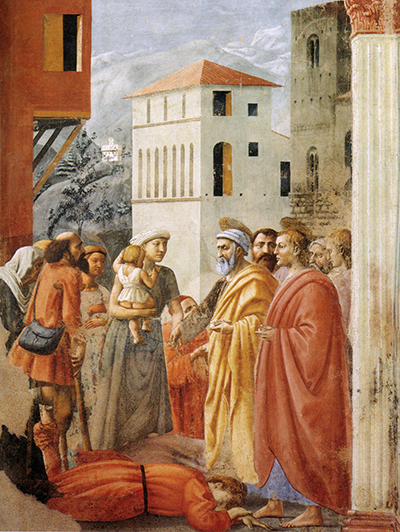
The Distribution of Alms and Death of Ananias combines charity and judgement in a single composition. Peter distributes resources to the poor while Ananias lies dead after dishonestly withholding part of the proceeds from property that was supposedly offered to the Christian community. Masaccio treats this theological narrative as a social event involving wealth, poverty and moral responsibility. The poor appear as recognisable human beings rather than generic symbols, giving the scene particular force within the Oltrarno environment surrounding Santa Maria del Carmine.
Raising of the Son of Theophilus and Saint Peter Enthroned. This large scene combines a miracle with an image of Peter enthroned as an institutional figure. Masaccio began the composition, but Filippino Lippi completed unfinished areas decades later, making the fresco one of the most visible records of the chapel’s interrupted history. The surviving wall therefore contains two Renaissance moments rather than one. Filippino had to negotiate the authority of Masaccio’s earlier design while completing a coherent scene for a later audience.
Lost Brancacci Frescoes. The chapel originally extended above the surviving register with lunettes and vault decoration, including further Peter narratives and Evangelists. These sections were destroyed during eighteenth-century remodelling, although sinopie preserve traces of the earlier compositions. The surviving cycle should therefore never be mistaken for the complete original project. Its modern fame rests on a fragment that survived fire, architectural alteration and centuries of restoration.
Brancacci Restoration. The major restoration undertaken from 1981 to 1990 changed the appearance of the frescoes significantly by removing later dirt, additions and altered protective layers. A further diagnostic and conservation programme from 2022 to 2024 continued to examine the paintings with contemporary methods. These campaigns are important because Masaccio’s reputation depends strongly on light, colour and modelling. Surface alteration can flatten precisely the qualities that made his frescoes revolutionary.
Pisa Polyptych
The Pisa Polyptych was commissioned in 1426 for Giuliano degli Scarsi’s burial chapel in Santa Maria del Carmine in Pisa. Detailed payment records document Masaccio’s work and the participation of assistants, making the project unusually valuable for reconstructing his professional practice. The original ensemble was later dismantled, and surviving parts are scattered across several institutions. Its fragmented state has transformed the polyptych into one of the major reconstruction problems in Masaccio scholarship.
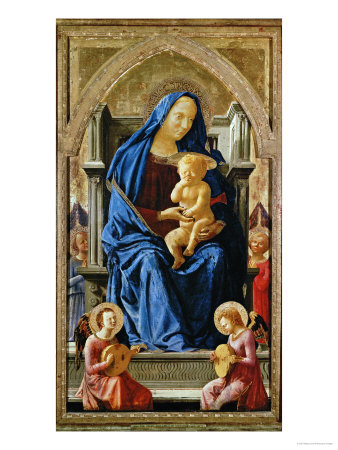
Virgin and Child — Pisa. The central Virgin and Child is now in the National Gallery in London. Mary sits on a monumental throne while Christ eats grapes, and both figures are modelled with shadows that give their bodies a sculptural presence unusual in contemporary panel painting. The grapes carry Eucharistic associations, but the symbolism is convincing because Christ behaves like a real child handling and eating fruit.
Masaccio repeatedly makes theological meaning stronger through bodily credibility. The lost original frame would have integrated this central image with surrounding saints, upper panels and the predella. Modern museum display isolates the panel, so reconstruction is necessary to understand its original scale and hierarchy.
Lost Flanking Saints. Four large saints originally flanked the central Madonna: Peter, John the Baptist, Julian and Nicholas. These panels are lost, leaving a major gap in the reconstruction. Their identities demonstrate how the altarpiece was tailored to its chapel and patronage. The current surviving fragments preserve only part of that original sacred community.
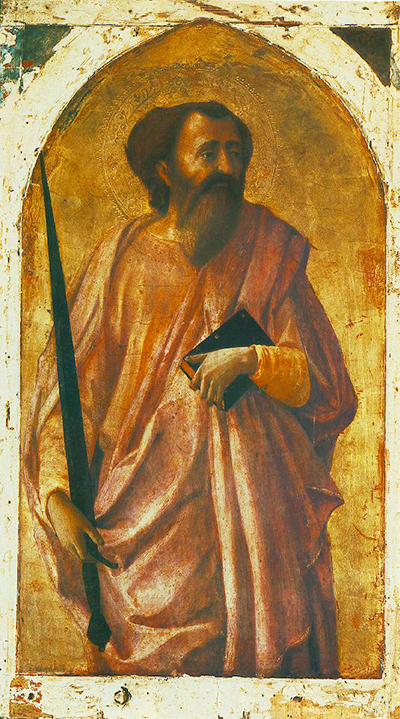
Saint Paul. A surviving Saint Paul belongs to the Pisa ensemble and is now preserved in Pisa. The figure demonstrates Masaccio’s ability to translate monumental bodily presence into a narrow individual panel. Its original architectural position affected how the figure was designed and viewed. A detached museum panel can therefore be understood fully only in relation to the lost structure around it.
Saint Andrew
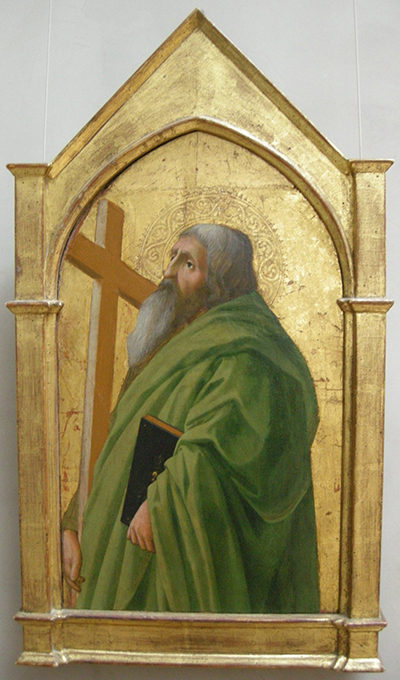
The surviving Saint Andrew, now at the Getty Museum in Los Angeles, provides another important fragment. Its severe foreshortening has encouraged comparison with Donatello’s sculptural solutions for figures placed high above spectators. This connection is particularly valuable because it reveals Masaccio adjusting anatomy and drapery to actual viewing conditions. Perspective here is not only about constructing rooms; it governs how a body should look from below.
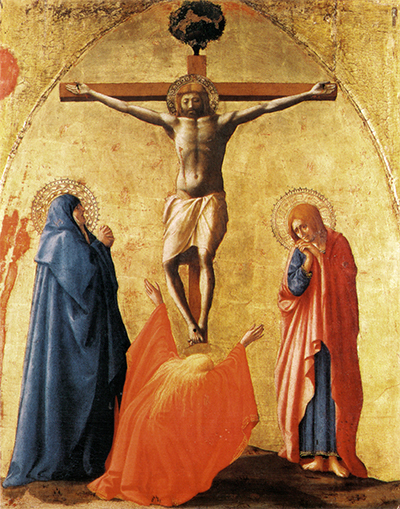
Crucifixion — Pisa. The Crucifixion, now in the Museo e Real Bosco di Capodimonte in Naples, originally occupied an elevated position above the central tier. Christ’s shortened body responds to that high viewpoint, making its seemingly unusual proportions intelligible when reconstructed within the polyptych. Mary, John and Mary Magdalene surround the Cross with restrained but powerful grief. The image demonstrates how Masaccio could compress intense emotional action into a narrow upper panel without losing bodily force.
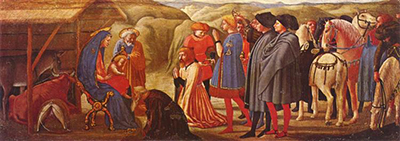
Adoration of the Magi — Pisa Predella. The surviving Adoration of the Magi in Berlin was part of the predella. Its low horizontal format requires a denser narrative arrangement than the central Madonna, and Masaccio responds by coordinating procession, architecture and figures with remarkable economy. This scene reveals another dimension of his skill. Monumentality is not dependent on large scale, because even small predella figures remain convincingly grounded within one coherent world.
Martyrdom Predella Panels. Additional surviving predella scenes represent martyrdom narratives connected with saints from the altarpiece. These panels extend the sacred identities of figures shown above by giving them historical biographies below. This relationship between principal tier and predella was fundamental to Renaissance altarpieces. The upper images offer stable sacred presence, while the lower strip unfolds action through time.
Holy Trinity
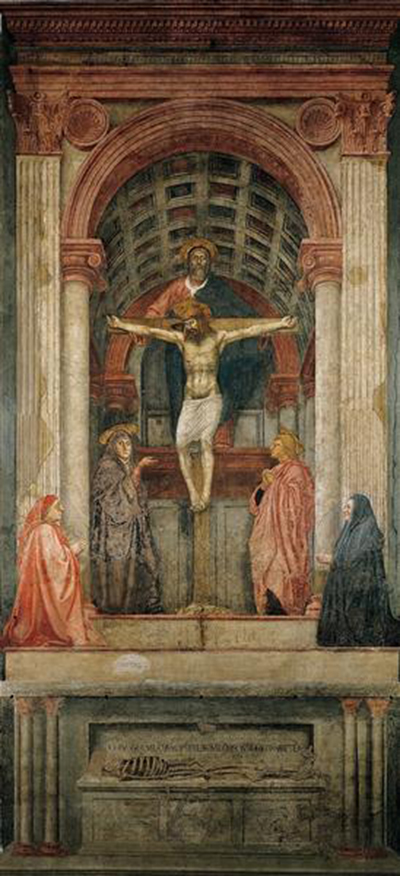
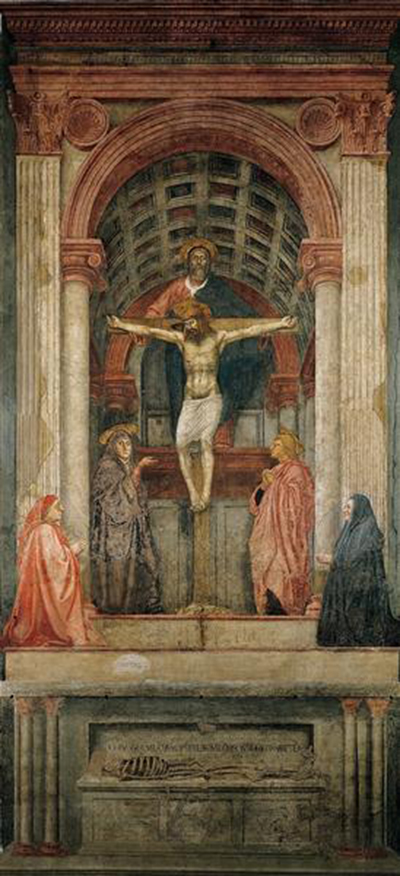
The Holy Trinity at Santa Maria Novella is Masaccio’s most complete surviving demonstration of illusionistic perspective. Santa Maria Novella dates it to 1425–26, while conservation scholarship has proposed a somewhat earlier 1424–25 chronology, so the exact relation to the Brancacci campaign remains open. The fresco creates a fictive barrel-vaulted chapel in which God the Father supports the crucified Christ, with the Holy Spirit, Mary and Saint John arranged within a rigorous theological hierarchy.
Kneeling donors appear at the threshold, creating a bridge between the sacred architecture and the viewer’s real church space. The vanishing point is closely related to the spectator’s position, which makes the illusion dependent upon actual movement and viewing. Masaccio therefore uses perspective not as an abstract technical demonstration but as a means of controlling devotional experience.
The Skeleton and Memento Mori. Below the principal Trinity group is a painted skeleton accompanied by a memento-mori inscription reminding viewers of their own future death. This lower zone transforms the fresco from a statement of divine geometry into a direct confrontation with mortality. The theological movement is vertical. Death lies below, Christ’s sacrifice occupies the centre and divine eternity rises above, allowing architecture itself to organise the path from mortality towards salvation.
The Donors. The identities of the kneeling donors remain uncertain, although the Lenzi family has often been proposed. This should remain qualified because the fresco survives more securely than the documentation explaining its patronage. Their visual role is nevertheless clear. They occupy the viewer’s world rather than the deepest sacred zone, creating a model for how real worshippers can approach the mystery represented beyond them.
Holy Trinity after Masaccio
Vasari covered the fresco with a new altar in 1570, removing it from ordinary sight while inadvertently preserving parts of the surface. Later rediscovery and detachment complicated its condition, while the lower skeleton remained hidden until 1952. The twentieth-century reunion of the sections restored the full theological design. The object history is therefore essential because modern viewers now see a composition that had been physically and conceptually fragmented for centuries.
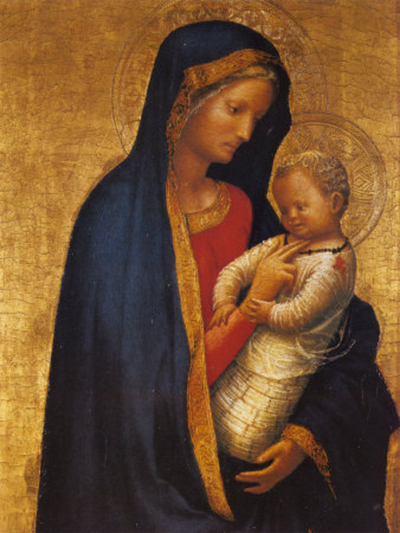
Madonna Casini. The small Madonna Casini, or “Tickling Madonna”, provides a striking contrast with the monumental public commissions. Mary and Christ interact through touch and play, allowing maternal intimacy to become the principal emotional content of a private devotional image. The child’s bodily response is spontaneous enough to make the sacred relationship feel domestic without becoming trivial.
Masaccio’s interest in physical reality therefore operates just as powerfully within a small panel intended for close personal viewing. The reverse carries heraldic evidence associated with Cardinal Antonio Casini. This provides an important connection between private elite patronage and Masaccio’s more intimate visual language.
Roman Works. Masaccio’s final phase took place in Rome, where he again worked in association with Masolino. The surviving evidence is sparse, partly because Masaccio died before the Roman projects could develop into a substantial late career. The most important reconstructed enterprise is an altarpiece associated with Santa Maria Maggiore. Surviving panels are divided between collections and artists, and Masolino appears to have completed the work after Masaccio’s death.
Santa Maria Maggiore Altarpiece
The Santa Maria Maggiore ensemble seems to have been double-sided, making reconstruction particularly complex. Individual panels now have to be understood through questions of original orientation, saints, framing and division of hands. This final collaborative commission reinforces an important point about Masaccio’s career. His relationship with Masolino continued until the end, and the artistic revolution associated with the younger painter developed within collaboration rather than permanent isolation.
Lost Paintings. Masaccio’s known surviving corpus is only part of what he produced. The Sagra is lost, substantial Brancacci material has disappeared, and several Pisa Polyptych panels are missing. This makes any paintings list provisional by nature. Masaccio’s artistic identity has to be reconstructed from surviving fragments, documents, later descriptions and works that no longer occupy their original contexts.
Collaborative Attribution. Masaccio’s corpus also contains works in which attribution is shared or debated. Sant’Anna Metterza, Brancacci sections and the Santa Maria Maggiore project all require attention to Masolino or later collaborators such as Filippino Lippi. This complexity should not be treated as an obstacle to appreciating Masaccio. Renaissance authorship frequently operated through workshops and partnerships, and collaborative objects often reveal artistic development more clearly than isolated works.
Gold and Renaissance Naturalism. Several Masaccio panels retain gold grounds, especially in altarpiece contexts. Their presence shows why it is misleading to define Renaissance painting simply as the replacement of gold by naturalistic landscape or architecture. Masaccio could use inherited sacred materials while transforming the bodies placed against them. The revolution occurs through weight, light and spatial logic as much as through background.
Bodies
The human body provides the strongest continuity across Masaccio’s paintings. Virgin, Christ, apostles, poor people, martyrs and sinners all possess physical presence, even when scale and medium change. This bodily seriousness is not identical to ideal beauty. Adam and Eve suffer, a convert shivers, sick people wait for healing and Christ’s crucified body is adjusted for a viewer below.
Light. Masaccio’s consistent treatment of light is equally important. In the Brancacci Chapel, illumination crosses groups and architecture coherently, giving separate figures the sense of belonging to the same atmosphere. Light therefore performs structural work. It creates volume, establishes spatial relationships and contributes to emotional unity.
Perspective. Perspective appears from the San Giovenale throne onward but reaches its most ambitious form in the Holy Trinity. It also governs the architectural streets of Brancacci and the viewpoint-sensitive figures of the Pisa Polyptych. The technique should therefore be understood broadly. Masaccio does not use perspective only to draw receding lines; he uses viewpoint to determine how entire bodies and spaces should be perceived.
Narrative. Masaccio’s fresco narrative is unusually economical. Multiple episodes can share one field, as in Tribute Money, without becoming confusing because gestures and group structure direct attention precisely. His predellas reveal the same discipline at miniature scale. The difference between monumental fresco and small panel lies in density rather than fundamental clarity.
Emotion
Masaccio’s emotional power emerges from bodies rather than exaggerated facial detail alone. Adam hides his face, Eve’s whole posture becomes grief, the poor wait physically for help and apostles respond through stance as much as expression. This gives his paintings an immediacy that later artists found extraordinarily influential. Emotion belongs to anatomy and movement.
Paintings as Objects in Space. Perhaps the most important lesson across Masaccio’s corpus is that his works were designed for real architectural settings. The Pisa Crucifixion changes when viewed from below, the Holy Trinity depends upon a spectator standing within Santa Maria Novella and the Brancacci frescoes form one environment rather than independent framed pictures. Modern museums preserve many fragments magnificently but inevitably alter these relationships. Reconstruction is therefore not optional background information; it is part of understanding how Masaccio expected paintings to work.
Why Masaccio’s Paintings Matter
Masaccio’s paintings matter because they made the human body and the surrounding world operate according to one convincing visual order. Earlier painters had already created powerful figures and spatial experiments, but Masaccio brought mass, light and perspective together with unusual consistency. The achievement is especially remarkable given the small corpus. From the San Giovenale Triptych of 1422 to the final Roman works only a few years later, Masaccio repeatedly solved different artistic problems without losing the central conviction that sacred figures should occupy believable space. His surviving works also demonstrate range rather than one formula.
A monumental fresco, gold-ground polyptych, tiny devotional Madonna and perspectival wall illusion can all belong unmistakably to the same artistic intelligence because each is built around physical presence. The paintings therefore form one of the most concentrated bodies of innovation in European art. Their later influence was immense not because Masaccio left hundreds of examples but because a few works altered what succeeding painters thought a body, a room and a sacred narrative could become.
Frequently Asked Questions
Discussion
Use this space to discuss Masaccio Paintings, its source evidence and how it fits into Masaccio's wider cluster.
Keep comments focused on close looking, attribution language, object evidence and page-specific caveats.
Reader Insights
Which detail on this page most changes how you read the work?
How does this page connect to Masaccio's paintings, fresco technique or Florentine setting?
Where should the wording stay cautious because the source evidence is qualified?
Join the Conversation
Share your reading of Masaccio Paintings below.
References and Research Sources
- Museo Masaccio, San Giovanni Valdarno, San Giovenale Triptych. View Source
- National Gallery, London, Masaccio artist biography. View Source
- Uffizi Galleries, Masaccio and Masolino, Sant’Anna Metterza. View Source
- Comune di Firenze / Musei Civici Fiorentini, Brancacci Chapel history and restoration. View Source
- MUS.E Firenze, Brancacci Chapel iconographic and social context. View Source
- National Gallery, London, Virgin and Child from the Pisa Polyptych. View Source
- National Gallery, London, scholarly reconstruction of the Pisa Polyptych. View Source
- J. Paul Getty Museum, Pisa Polyptych technical and reconstruction studies. View Source
- Santa Maria Novella, Masaccio’s Holy Trinity. View Source
- Opificio delle Pietre Dure, technical research on the Holy Trinity. View Source
- Uffizi Galleries, Madonna Casini. View Source
- National Gallery, London, Santa Maria Maggiore altarpiece reconstruction. View Source