by Tom Gurney
Tom Gurney BSc (Hons) is an art history expert with over 20 years experience
Published on June 19, 2020 / Updated on October 14, 2023
Email: tomgurney1@gmail.com / Phone: +44 7429 011000
Introduction
Masaccio’s final years are among the least securely documented parts of his career. After transforming Florentine painting through the Brancacci Chapel, the Pisa Polyptych and the Holy Trinity, he moved into a Roman phase that was cut short by his death at only about twenty-six or twenty-seven. The most important surviving project from this final period is the large double-sided altarpiece made for Santa Maria Maggiore in Rome. National Gallery scholarship reconstructs the ensemble as a collaboration between Masaccio and Masolino, generally around 1428–29, with Masolino completing the work after Masaccio’s death.
This final collaboration is important because it corrects a simplistic narrative in which Masaccio rapidly surpassed Masolino and then left him behind. The two painters remained professionally connected to the end, working together on one of the most prestigious Roman church commissions available to artists of their generation. Masaccio’s death itself remains less certain than later biography often suggests.
The National Gallery gives 1428/9 and says he probably died of plague in Rome, while its scholarly catalogue notes debate over whether the death should be placed in 1428 or 1429. The most responsible conclusion is therefore one of controlled uncertainty. Masaccio died extraordinarily young in Rome, probably during an epidemic, but the exact date, circumstances and cause cannot be reconstructed with complete confidence.
At a Glance
- ArtistMasaccio
- Final major locationRome
- Approximate Roman phase1427/28–1428/29
- Major final projectSanta Maria Maggiore altarpiece
- CollaboratorMasolino da Panicale
- Altarpiece typelarge double-sided ensemble
- Masaccio surviving panelSaints Jerome and John the Baptist, National Gallery, London
- Masolino surviving panelA Pope (Saint Gregory?) and Saint Matthias, National Gallery, London
- CompletionMasolino continued or completed the altarpiece after Masaccio’s death
- DeathRome, 1428/9
- Ageabout 26–27
- Probable causeplague, according to National Gallery interpretation
- Important cautionexact chronology and cause remain uncertain
- Historical significanceMasaccio’s career ends while still expanding into prestigious Roman patronage
Contents
- Leaving Florence
- The Santa Maria Maggiore Altarpiece
- Assumption of the Virgin
- Saint Jerome
- A New Descriptive Interest?
- Division of Hands
- Masaccio’s Death
- Vasari
- What Might Rome Have Changed?
- Historical Irony
- Comparison with the Pisa Polyptych
- Saints and Flowers
- Why Saints Jerome and John the Baptist Matter
- Rome as an Ending without Closure
- Why Masaccio in Rome Matters
- Frequently Asked Questions
- References and Research Sources
Leaving Florence
Masaccio appears to have left Florence for Rome by the later 1420s. Metropolitan Museum material on Fra Angelico notes that by the time Masaccio left Florence for Rome in 1427, Angelico had become the leading painter in Tuscany, providing a useful broad chronological marker for the transition. The move therefore belongs after Masaccio’s decisive Florentine breakthroughs rather than before them. He arrived in Rome as an artist who had already helped redefine painting in Florence.
Why Rome Mattered. Rome offered a very different artistic environment from Florence. Ancient monuments, early Christian basilicas, papal patronage and major aristocratic families created opportunities for painters working at the highest level. For an artist interested in architecture, perspective and bodily monumentality, the city would also have offered direct exposure to antiquity on a scale impossible elsewhere. Masaccio’s death came too quickly for us to know how deeply Rome might have transformed his mature style.
The Roman Artistic World. The 1420s were an important period in the re-establishment of papal Rome after instability and absence. Major church commissions had political as well as devotional significance because the papacy and elite families sought to renew the city’s religious monuments. Masaccio’s participation in a major Santa Maria Maggiore altarpiece therefore suggests rising status. He was no longer simply a young Florentine experimenter; he had entered a prestigious Roman patronage network.
Santa Maria Maggiore. Santa Maria Maggiore was one of Rome’s principal basilicas. A major altarpiece there would have placed Masaccio and Masolino within one of the most important sacred settings in the city. The Metropolitan Museum describes the project as the first large-scale altarpiece commissioned for a Roman church in more than a century, underscoring its historical significance.
The Santa Maria Maggiore Altarpiece
The altarpiece is now dismantled, and its original appearance has to be reconstructed from surviving panels, historical evidence and technical study. National Gallery scholarship describes it as a double-sided ensemble associated with Masaccio and Masolino. This double-sided structure made the commission unusually complex. Paintings were intended to be viewed from more than one direction and had to function as parts of a larger architectural object.
A Double-Sided Altarpiece. Double-sided altarpieces could serve spaces in which different faces were visible from different liturgical zones. This makes reconstruction dependent not only on subject and dimensions but on understanding how panels related physically front-to-back. The Santa Maria Maggiore project therefore resembles the Pisa Polyptych in one important respect: modern museum fragments preserve only pieces of an object whose original architecture has disappeared.
The Colonna Connection. The Metropolitan Museum associates the Santa Maria Maggiore commission with the Colonna family, probably even Pope Martin V himself, and describes a programme including the Assumption of the Virgin on one side and the miraculous foundation of the basilica on the other. This patronal context would make the altarpiece an exceptionally prestigious commission. It also connects the painting with Rome’s political and ecclesiastical elite rather than with a modest private chapel.
The Foundation Legend of Santa Maria Maggiore. The basilica’s famous foundation legend recounts a miraculous snowfall in Rome during summer, indicating where the church should be built. The story became central to Santa Maria Maggiore’s identity. An altarpiece representing that miracle would therefore be intensely site-specific. Unlike a generic Madonna, it would tell the sacred history of the basilica itself.
Assumption of the Virgin
The Assumption on the opposite side would have reinforced Santa Maria Maggiore’s strong Marian identity. Mary’s glorification and the church’s miraculous foundation could therefore form complementary themes. This kind of programme demonstrates how sophisticated large Renaissance altarpieces could be. Architecture, local legend, Marian theology and patronage were integrated within one object.
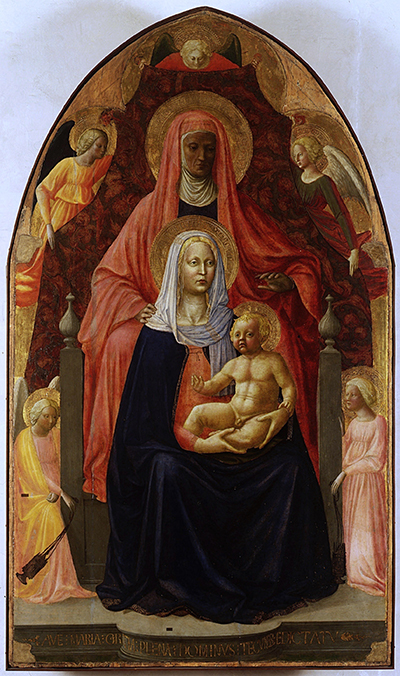
Masaccio and Masolino Together Again. The Roman altarpiece is especially important because it reunites Masaccio and Masolino professionally near the end of Masaccio’s life. Their collaboration had already included Sant’Anna Metterza and the Brancacci Chapel. The partnership therefore spans almost the whole of Masaccio’s known mature career. It should be understood as a recurring professional relationship rather than one youthful episode.
Why Their Continued Collaboration Matters. Traditional art history often makes Masolino the elegant older painter whom Masaccio rapidly surpasses. The Santa Maria Maggiore project complicates that model because the two were still capable of sharing a major Roman commission at the end. Different styles did not prevent collaboration. Patrons could value both artists within one ensemble.
Saints Jerome and John the Baptist. The National Gallery’s Saints Jerome and John the Baptist is securely attributed to Masaccio and formed one component of the Santa Maria Maggiore altarpiece. The panel is particularly important because it represents Masaccio’s final phase directly. Rather than relying only on documents about Rome, we can still examine a surviving work connected with the commission.
Saint Jerome
Saint Jerome appears with his traditional lion. The saint was particularly important to learned Christian culture because of his role in translating the Bible into Latin. Masaccio gives him the same bodily seriousness found in earlier saints. Monumentality remains central even in the final Roman period.
Saint John the Baptist. John the Baptist stands beside Jerome and is identified through his camel skin, scroll and cross-topped staff. The National Gallery describes the sturdy physical details of his figure, including toes interrupting a carpet of wildflowers. This kind of observation is characteristically Masaccian. Sacred identity remains compatible with small naturalistic detail.
Flowers. The wildflowers around the saints provide a striking contrast with Masaccio’s often severe reputation. Dandelions, violets and strawberries create a carefully observed natural ground. The detail suggests that the Roman panel should not be imagined as a simple continuation of Brancacci austerity. Masaccio’s final style may have been developing additional descriptive richness.
Monumentality in Rome. The saints still possess substantial bodily weight. Their forms do not abandon the sculptural seriousness that defines Masaccio’s earlier work. This continuity indicates that Rome did not immediately overturn his artistic identity. The mature Florentine language travelled with him.
A New Descriptive Interest?
At the same time, floral detail and the richly specific setting raise the possibility of subtle development. Masaccio may have been responding to new artistic environments or to the demands of the Roman commission. Because the career ended so quickly, such possibilities remain frustratingly incomplete. We see hints rather than a fully developed Roman period.
The Masolino Panel. The National Gallery also preserves Masolino’s A Pope (Saint Gregory?) and Saint Matthias, painted on one side of a panel from the same ensemble. The survival of works by both painters allows the collaboration to be studied materially. Their styles remain distinguishable even within one reconstructed altarpiece.
Saint Matthias. Saint Matthias had particular significance at Santa Maria Maggiore because relics associated with him were kept there. The National Gallery points to his importance within the basilica’s sacred identity. This confirms how site-specific the iconography was. Saints were chosen in relation to the church rather than assembled generically.
The Pope Figure. The papal saint has traditionally been identified as Gregory, though the National Gallery preserves uncertainty in its title. That caution is a useful model for the entire Roman project. Reconstruction is sophisticated, but not every identification is equally secure.
Division of Hands
Scholars have debated exactly how the altarpiece was divided between Masaccio and Masolino. National Gallery catalogue research records several competing reconstructions of who initiated the commission and which artist painted particular panels. The safest approach is therefore to distinguish secure surviving attributions from broader hypotheses about project leadership.
Did Masaccio Begin the Altarpiece? Some scholars have argued that Masaccio initiated the commission, while others have reconstructed a more genuinely collaborative beginning. The National Gallery catalogue records this debate rather than presenting one solution as universally settled. This uncertainty is important because chronology affects how we understand Masaccio’s final professional status. A principal commission led by him would suggest one trajectory; a shared enterprise with Masolino suggests another.
Masolino Completes the Work. What is much clearer is that Masolino continued and completed the altarpiece after Masaccio’s death. The National Gallery states this directly in its collection entries. The project therefore became posthumously collaborative. Masolino had to preserve unity after his younger colleague disappeared suddenly.
Completion after Death. This situation mirrors the Brancacci Chapel in an intriguing way. Masaccio left major work unfinished in Florence, where Filippino Lippi completed it decades later; in Rome, Masolino appears to have completed the shared altarpiece almost immediately after his death. Masaccio’s short life therefore leaves two major monuments finished by others. Incompletion becomes part of his historical identity.
Masaccio’s Death
The National Gallery dates Masaccio’s death to 1428/9 and says he died in Rome at around twenty-seven, probably from plague. This is stronger than saying the cause is entirely unknown, but “probably” remains important. The evidence supports a likely explanation rather than absolute certainty.
1428 or 1429? National Gallery catalogue scholarship notes continuing chronological debate. Some traditions place the death in 1428, while later research has argued for 1429, possibly shortly before a November record in Florence noting that he had died. The most cautious dating remains 1428/9. This avoids pretending that the surviving evidence yields an exact day or month.
Plague. The National Gallery’s public biography says Masaccio probably died from plague in Rome, and its Santa Maria Maggiore material likewise connects the death with a plague epidemic. Plague was a recurrent danger in fifteenth-century cities, making the explanation historically plausible. It should nevertheless remain qualified rather than stated as an incontrovertible medical diagnosis.
Later Speculation. Later biographies and popular accounts have sometimes suggested poisoning or other dramatic causes. Such stories have little secure evidential basis. Masaccio’s early death is dramatic enough without embellishment. Responsible biography should resist turning uncertainty into mystery theatre.
Vasari
Giorgio Vasari helped shape the later image of Masaccio as a prodigious genius whose life ended prematurely. His biographies were written more than a century after the painter’s death, however, and are most reliable when used carefully alongside contemporary documentation. Vasari is especially important for reception. By the sixteenth century, Masaccio’s reputation as a foundational Renaissance painter was firmly established.
The Age Problem. Whether Masaccio died in 1428 or 1429, he was only about twenty-six or twenty-seven. This remains one of the most astonishing facts in Renaissance art. His entire mature career fits into the years when many artists are still emerging from apprenticeship. The speed of his development radically alters how we judge the surviving corpus.
Six or Seven Extraordinary Years. The San Giovenale Triptych is securely dated 23 April 1422. From that point to Masaccio’s death, only about six or seven years remain. Within that span he produced or contributed to the Brancacci Chapel, Pisa Polyptych, Holy Trinity, Sant’Anna Metterza, Madonna Casini and the Roman altarpiece.
A Career Still Expanding. Nothing in the Roman evidence suggests an artist withdrawing or declining. On the contrary, Masaccio was participating in a major commission for one of Rome’s most important basilicas. His death therefore interrupts expansion. The mature career never reaches a natural conclusion.
What Might Rome Have Changed?
It is tempting to speculate how ancient Roman architecture, sculpture and papal patronage might have changed Masaccio had he lived. His existing interest in classical architecture and bodily monumentality suggests enormous potential. Such speculation should remain clearly hypothetical. The surviving Roman panel gives only a glimpse of what might have followed.
Antiquity. Rome offered direct access to ancient monuments on a scale far greater than Florence. Artists could study columns, arches, reliefs and ruins in situ. Masaccio’s Holy Trinity had already demonstrated deep engagement with classical architectural language. A longer Roman career might have intensified that interest, but we cannot know in what direction.
Early Christian Rome. Santa Maria Maggiore also placed Masaccio within an early Christian rather than merely classical environment. Mosaics, relics and basilical architecture offered another historical layer. This could have broadened the relationship between antiquity and Christianity already visible in his Florentine work. The Roman commission itself demonstrates that local sacred history mattered.
Masolino’s Longer Life. Masolino survived Masaccio and continued working into the 1430s. The contrast between their careers became increasingly striking. The older painter had time to develop further, while the younger painter’s reputation became concentrated around a tiny body of revolutionary works.
Historical Irony
Masolino may originally have appeared the more established professional, yet later art history placed Masaccio at the centre of Renaissance innovation. The reversal illustrates how reputation can diverge from contemporary career length. Historical influence does not simply follow longevity.
Fra Angelico after Masaccio Leaves Florence. The Metropolitan Museum notes that by the time Masaccio left Florence for Rome, Fra Angelico was effectively the leading painter in Tuscany. This transition is important because Masaccio’s innovations did not leave Florence with him. They had already entered the city’s wider visual language.
Florence after Masaccio. Fra Angelico, Filippo Lippi and others continued developing bodily and spatial naturalism after Masaccio’s departure. The Brancacci Chapel remained available as a teaching site. Masaccio’s physical absence therefore did not reduce his influence. In some ways, the surviving frescoes became more powerful precisely because they remained.
The Roman Altarpiece and Collaboration. The Santa Maria Maggiore project also reminds us that Masaccio’s final career remained collaborative. The myth of the isolated genius fits poorly with the evidence. Masolino, patrons, church officials, carpenters and workshop assistants all belonged to the production environment. Renaissance innovation operated through networks until the very end.
Comparison with the Pisa Polyptych
The Roman altarpiece resembles Pisa in being a large complex ensemble later dismantled. Both projects now survive as dispersed fragments requiring scholarly reconstruction. This repeated loss is central to Masaccio studies. We often know the painter through parts of missing wholes.
Difference from Pisa. The Pisa commission is exceptionally well documented through Giuliano degli Scarsi’s payment records. The Roman project is less secure chronologically and patronally. The difference teaches an important methodological lesson. Not every masterpiece permits the same level of certainty.
Comparison with the Brancacci Chapel. The Brancacci Chapel remains a fixed architectural environment, while the Roman altarpiece was portable and eventually dispersed. These different material histories shaped survival. Fresco preserves location but suffers architectural alteration; panel survives movement but loses ensemble.
Comparison with The Holy Trinity. The Holy Trinity appears like the mature culmination of Masaccio’s Florentine perspective, while the Roman saints suggest a more descriptive sacred naturalism. Because the final phase is so small, we cannot know whether this represents a new direction or simply the requirements of one altarpiece. The evidence should remain open.
Saints and Flowers
The small natural details around the National Gallery saints are especially intriguing in this respect. Masaccio’s sturdy figures stand among flowers observed with care. This combination of monumentality and detail could have supported many later developments. The career ended before they could be tested.
Death and Artistic Myth. Artists who die young often acquire myths of unrealised genius. Masaccio is particularly vulnerable to this because his actual achievement is already enormous. The safest historical approach is to separate what he demonstrably transformed from what he might have done. His surviving work needs no hypothetical masterpieces to justify his importance.
The Unfinished Renaissance. Masaccio’s death also gives his career a strangely unfinished historical shape. The Brancacci Chapel is completed by Filippino, the Roman altarpiece by Masolino and the Pisa Polyptych is later dismantled. Much of the surviving corpus therefore carries interruption within its object history. Completion and reconstruction repeatedly belong to other hands and later generations.
Why the Roman Phase Matters. The Roman phase matters because it proves Masaccio’s career had expanded beyond Florence and Pisa into one of Europe’s great religious centres. Santa Maria Maggiore was a prestigious commission, not a marginal final work. It also demonstrates the persistence of Masolino collaboration. Masaccio’s final professional identity remains connected with the older painter who had accompanied much of his development.
Why Saints Jerome and John the Baptist Matter
The National Gallery panel is precious because it gives tangible access to Masaccio’s last phase. The figures preserve his monumental physical language while introducing detailed natural observation. Without it, the Roman period would be far more abstract. One fragment keeps the final career visible.
Why the Death Date Matters. The 1428/9 uncertainty may seem minor, but one year is substantial within a six- or seven-year mature career. It changes the amount of time available for Roman work and affects the chronology of the Santa Maria Maggiore project. Careful dating therefore matters disproportionately for Masaccio. His life is too short for years to be treated casually.
Why the Cause of Death Should Remain Qualified. The plague explanation is plausible and currently used by the National Gallery, but the word “probably” should be preserved. This is an important editorial principle for the entire cluster. Strong art history distinguishes secure evidence from reasonable inference.
Why Masaccio’s Early Death Matters. Masaccio’s death matters because it turns one of the most revolutionary careers in European painting into a fragment. The surviving works record a painter still moving into larger commissions and new environments. He did not die after a long period of repetition. He died during acceleration.
Rome as an Ending without Closure
The Santa Maria Maggiore altarpiece therefore functions as an ending without being a conclusion. Masaccio’s contribution survives, Masolino finishes the ensemble and the younger artist disappears from the record. There is no late style in the conventional sense. The Roman works are simply the final evidence available.
Why Masaccio in Rome Matters
Masaccio’s Roman phase matters because it reveals a career still expanding at the moment it ended. After transforming Florentine fresco and panel painting, he entered a major commission at Santa Maria Maggiore, one of Rome’s most prestigious basilicas. The surviving Saints Jerome and John the Baptist shows that his monumental naturalism remained intact.
Bodies are weighty, sacred figures occupy real ground and small details such as flowers and Saint John’s feet suggest an observational richness that could have developed further. The project also closes the circle of his relationship with Masolino. They had collaborated in Florence, diverged professionally and then worked together again in Rome, where Masolino completed the altarpiece after Masaccio’s death.
Masaccio probably died of plague in Rome in 1428/9, at only about twenty-seven, but the exact chronology remains uncertain. What is not uncertain is the scale of the achievement already completed. In little more than half a decade, Masaccio had helped redefine bodies, light, perspective and sacred narrative, leaving later generations to develop a revolution whose originator never reached thirty.
Frequently Asked Questions
Discussion
Use this space to discuss Rome Santa Maria Maggiore Final Works and Early Death | Masaccio, its source evidence and how it fits into Masaccio's wider cluster.
Keep comments focused on close looking, attribution language, object evidence and page-specific caveats.
Reader Insights
Which detail on this page most changes how you read the work?
How does this page connect to Masaccio's paintings, fresco technique or Florentine setting?
Where should the wording stay cautious because the source evidence is qualified?
Join the Conversation
Share your reading of Rome Santa Maria Maggiore Final Works and Early Death | Masaccio below.
References and Research Sources
- National Gallery, London, Santa Maria Maggiore Altarpiece, scholarly catalogue, for the reconstructed double-sided commission, chronology, division of hands and debate over Masaccio’s death date. View Source
- National Gallery, London, Masaccio: Saints Jerome and John the Baptist, for the surviving Masaccio panel, its subjects, natural details and Masolino’s posthumous completion of the altarpiece. View Source
- National Gallery, London, Masolino: A Pope (Saint Gregory?) and Saint Matthias, for the corresponding Masolino panel and the statement that Masolino completed the altarpiece after Masaccio’s death. View Source
- National Gallery, London, Masaccio artist biography, for the 1428/9 death date, age and probable plague interpretation. View Source
- Metropolitan Museum of Art, Rome and Southern Italy, 1400–1600, for the Colonna/Martin V patronal context, Santa Maria Maggiore programme and status as a major Roman altarpiece commission.
- Metropolitan Museum of Art, Fra Angelico exhibition materials, for the broad chronological statement that Masaccio left Florence for Rome in 1427.