


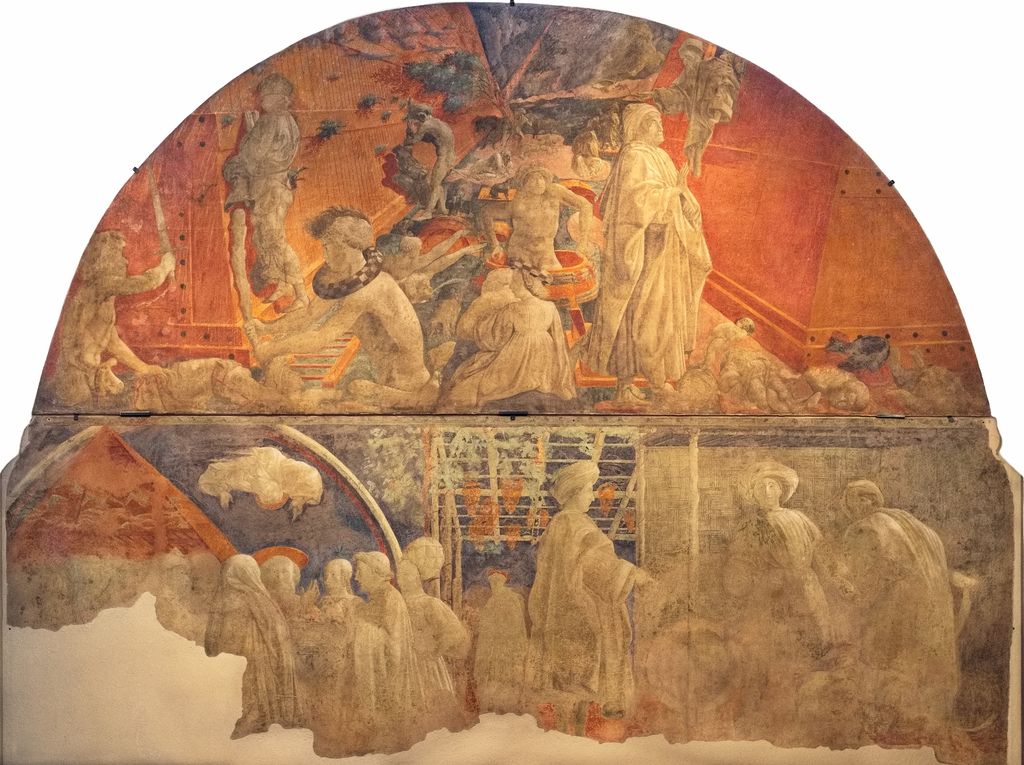
The Flood and Recession of the Waters above the lower episodes from Noah’s story, Santa Maria Novella. Photograph by Armin Kleiner. Image source. CC BY-SA 4.0. Resized for the web. This derivative is available under the same licence.
 by Tom Gurney
Tom Gurney BSc (Hons) is an art history expert with over 20 years experience
Email: tomgurney1@gmail.com / Phone: +44 7429 011000
Noah and the Flood: Introduction
A man braces a staff against the rush of water. Around his neck is a ring of light and dark squares, each one turning with the curve. Just behind him, a figure clings to a wall of red planks. Follow those planks upwards and they narrow towards the dark opening at the centre of Paolo Uccello’s fresco. Another wall of the same ark races away on the opposite side. The two views belong to different moments in the story, but they seem to make a single passage through the storm. At over five metres wide, the lunette gives the bodies in that passage almost the scale of people beside us. [1] [2] [3]
Uccello painted The Flood and the Recession of the Waters for the fourth bay of the Green Cloister’s east walk at Santa Maria Novella in Florence. The rectangular painting below follows Noah out of the ark, through his offering to God and into a painful scene with his sons. Seen together, the two paintings take him from a world overwhelmed by water to one in which people can plant vines again. Much of the lower surface has been lost. The first things to look for are the broad red hulls above and the grid of the vine trellis below. Both show how much of the story survives in its setting. [1] [2] [4]
At a Glance
- Original settingFourth bay of the Green Cloister’s east walk, Santa Maria Novella, Florence
- SubjectsFlood and recession in the lunette, with Noah’s sacrifice and drunkenness below
- On viewRefectory, Museo di Santa Maria Novella, Florence
Contents
- The ark in the storm
- The waters go down
- Noah’s sacrifice and drunkenness
- The cloister and the date of the paintings
- What survives, and where to see it
- Annotated details
The ark in the storm
On the left, the side of the ark presents a formidable obstacle. Rows of dark nailheads and the long edges of the boards give it the solidity of a building. At the near end, people reach for the wood or try to keep their heads above the water. The ship in Genesis has already received Noah, his family and the animals. Uccello makes us spend much of our time among the people outside. Their struggle has no corresponding sequence of individual incidents in the biblical account. It comes from the painter’s efforts to imagine what it would be like to find every route to safety closing at once. [2] [3] [5]
Look from the figure pressed against the hull to the floating barrel nearer the centre. A man inside it holds his elbows out to steady himself, while the hoops around him make the angle of the vessel easy to see. Lower down, a ladder goes almost straight into the picture, its bright rungs shortening in quick succession. One man twists as he reaches across the debris. Other bodies lie low against the edge. Vasari, writing in the sixteenth century, noticed the drowned child and a corpse drawn in steep foreshortening. He also dwelt on the storm itself, with lightning and trees torn from the ground. Although the surviving paint leaves some of the incidents difficult to make out, small sprays of leaves still flash against the timber, and the red wall makes the pale figures particularly exposed. [2] [6] [7]
The ring in the foreground is a mazzocchio, the faceted form associated with a Florentine headdress. The art historian Anna Vinogradova notes that the underlying shape, normally covered by cloth, appears exposed here. Its checks are broad near the front and shorten as they turn out of view. In the middle of the commotion this is a form you can understand by looking at it for a second or two. The man inside it is harder to read. His torso turns across its axis, his head is in profile and his hands are occupied with the staff. The clarity of the ring makes the strain in his body easier to feel. [1] [8]
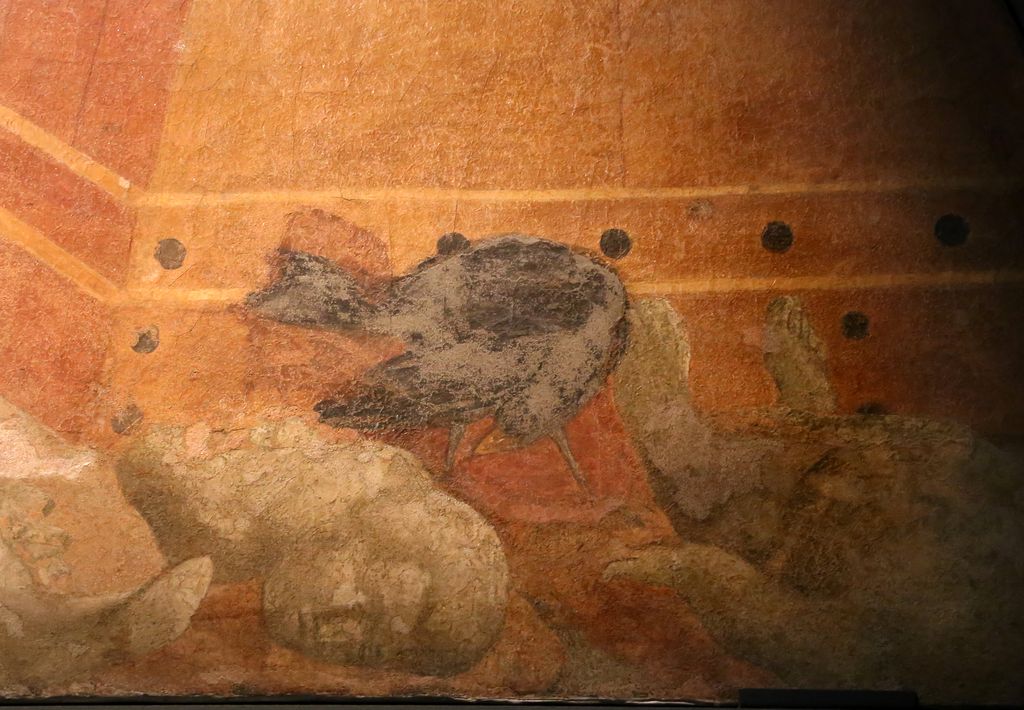
A bird among the bodies in the Flood lunette. Photograph by Sailko. Image source. CC BY 3.0. Resized for the web.
The waters go down
The second view of the ark begins on the right. Look up the red hull to the window where Noah leans out. The episode is the return of the dove with an olive leaf, the sign in Genesis that the waters have abated. The huge cloaked figure below is much closer to us. His clasped hands and long upright folds give the eye a place to rest, while the figures at his feet remind us what the recession of the water has exposed. The identity of this foreground man has been debated. The sanctuary of the ark and the survival of the person near it are visible features of the painting, distinct from any proposed name for him. [1] [2] [4] [5]
The two hulls give the half-circle a firm structure. They also make it difficult to tell, at first glance, where the storm ends. The eye can follow a plank towards the middle without making any leap, even though the second view comes later in the story. Genta Okamoto, discussing the fresco alongside the French theorist Louis Marin, describes convergences on either side of the central storm and reads the recession of the hulls as a way of giving the passage of time a visible form. The small ladder pulls the gaze along a different line. Try following the rungs back towards the foreground after tracing either hull into the distance. For a moment the depth built by the red walls seems to tip towards you. Frank Fehrenbach describes a related reversal in the storm itself. The far end draws the eye in, while wind and water seem to burst out of it. [1] [7] [9] [10]
Those diagonals were planned on the wall. Conservators found perspective lines incised into the surface and could distinguish about ten giornate, sections of plaster prepared for separate spells of fresco painting. Smaller incisions helped to set out details of figures and animals. At the Uffizi, technical study by Lorenza Melli found reused fragments bearing geometric studies in a sheet that also contains a mounted rider. Some of the drawn corners reminded her of the painted arks, especially when the sheet is turned around. The likeness gives us an idea of the kinds of drawings Uccello had at his disposal. The lines traced in the plaster are the direct evidence for how he laid out this particular wall. More examples of the painter adjusting recession to suit a subject appear in Uccello’s use of perspective. [1] [11] [12]
Donatello provides another way into the picture. The National Gallery draws a connection between the sculptor and Uccello’s use of perspective to heighten the drama. In Donatello’s bronze Feast of Herod for the Siena Baptistery, cast in 1427, the space between the foreground figures opens onto a series of receding rooms. That passage leads the eye through incidents in the story. Uccello’s passage works with the two successive positions of a vessel, but you can see how each artist uses an arrangement of solid surfaces to control when we notice a detail. The weight of the upright cloaked figure, with his dark folds and sharply lit profile, has also invited comparison with Donatello’s sculpture. These parallels help us look at the fresco without settling its date or identifying a particular relief as its model. [2] [13] [14]
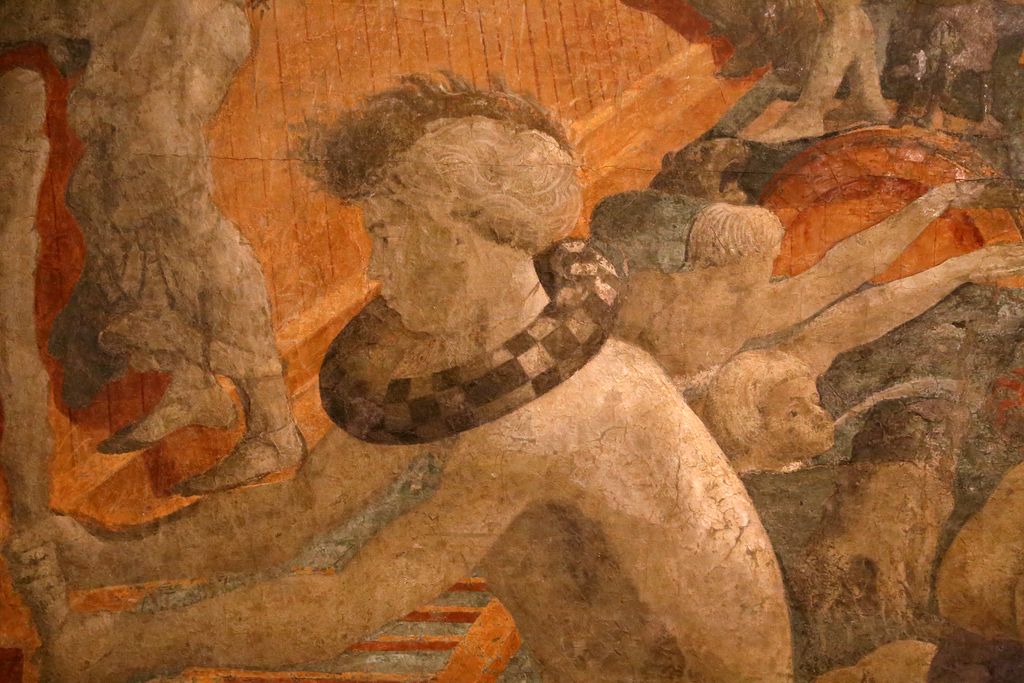
A detail of the Flood with the patterned headgear prominent in the foreground. Photograph by Sailko. Image source. CC BY 3.0. Resized for the web.
Annotated Details from Noah and the Flood
The numbered points identify visible features discussed in this article. Return from each detail to the numbered overview. The Flood and Recession of the Waters above the lower episodes from Noah’s story, Santa Maria Novella. Photograph by Armin Kleiner. Image source. CC BY-SA 4.0. Numbered overview and cropped details from the original photograph. This overview and these details are available under CC BY-SA 4.0.
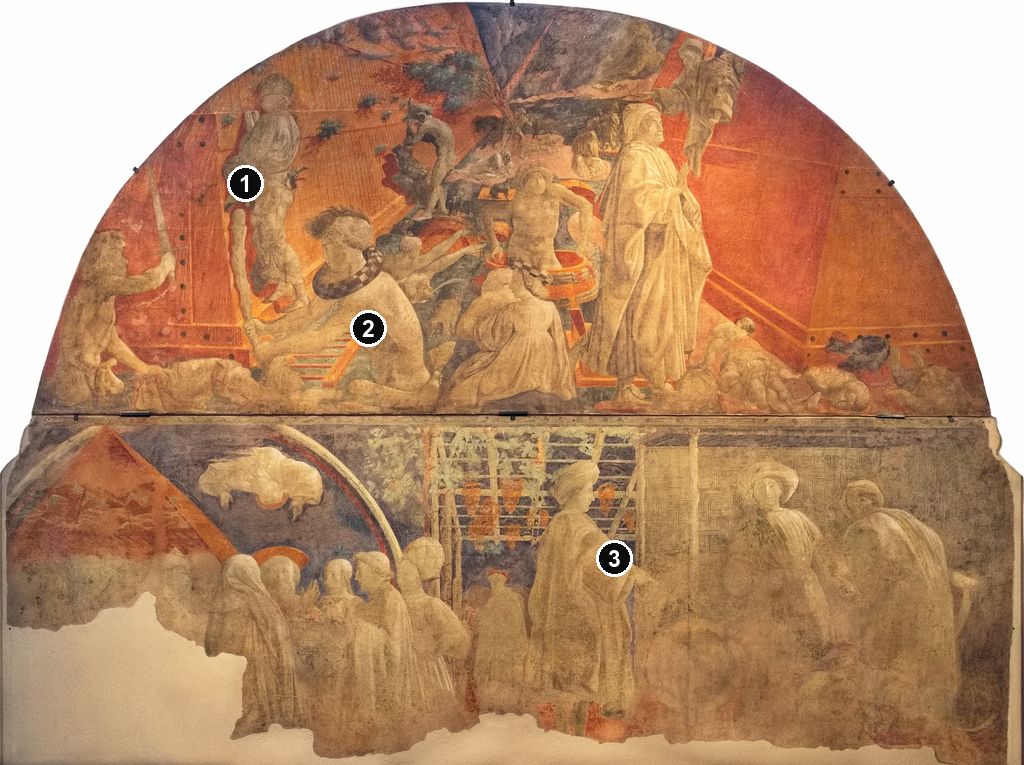
Details from NOAH AND THE FLOOD
Compare the cropped details with the source images above. Notice how their colours, shapes and positions contribute to the larger compositions.
The ark in the storm
The left-hand plank wall runs sharply away from the left edge. Human bodies crowd the painted plane where the ship’s direction converges with the space given to the figures.
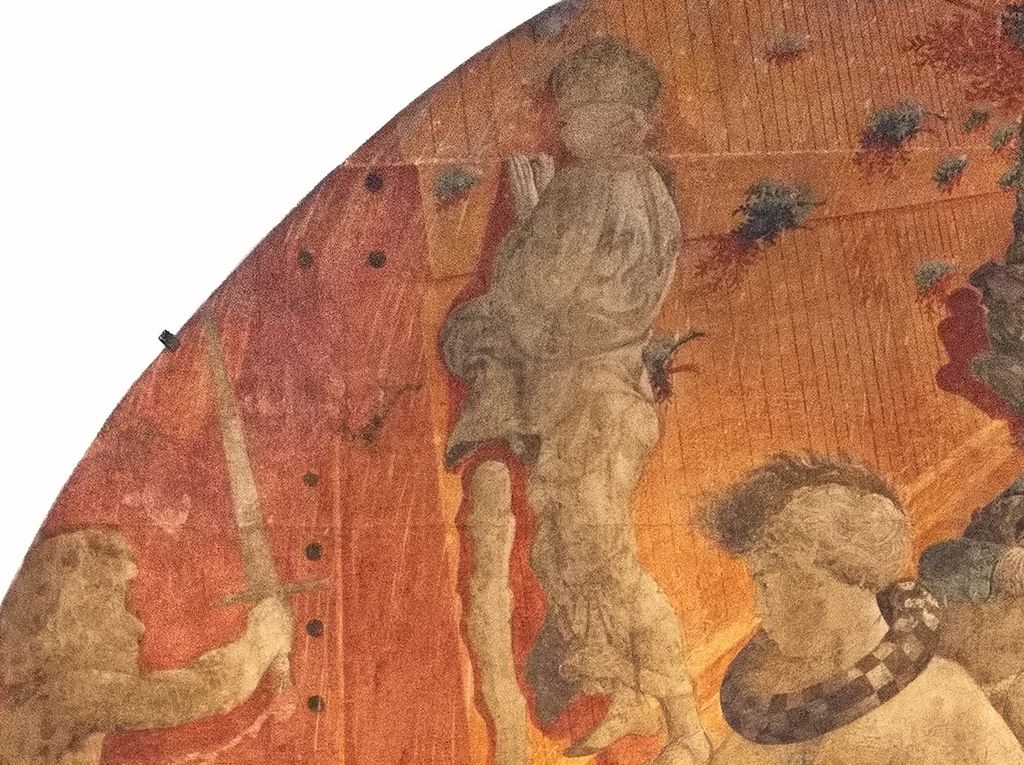
Headgear, bodies and the receding waters
The patterned headgear around the large figure’s neck stands out from the worn paint. Figures at different scales overlap the receding geometry around them.
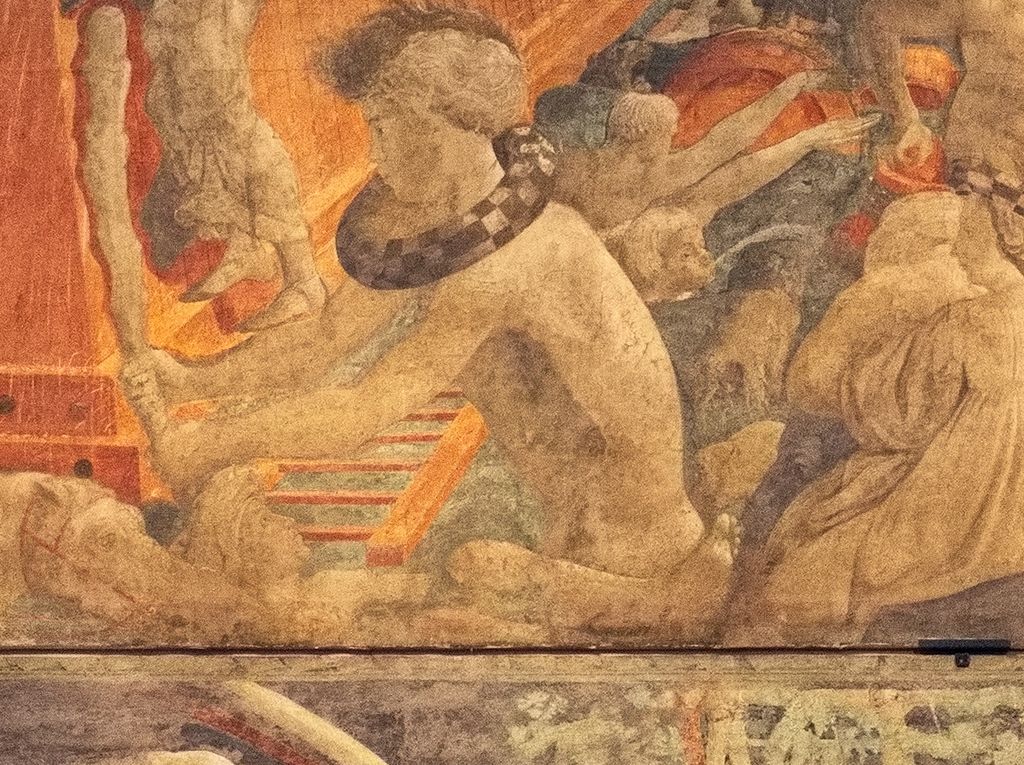
Episodes beneath the Flood
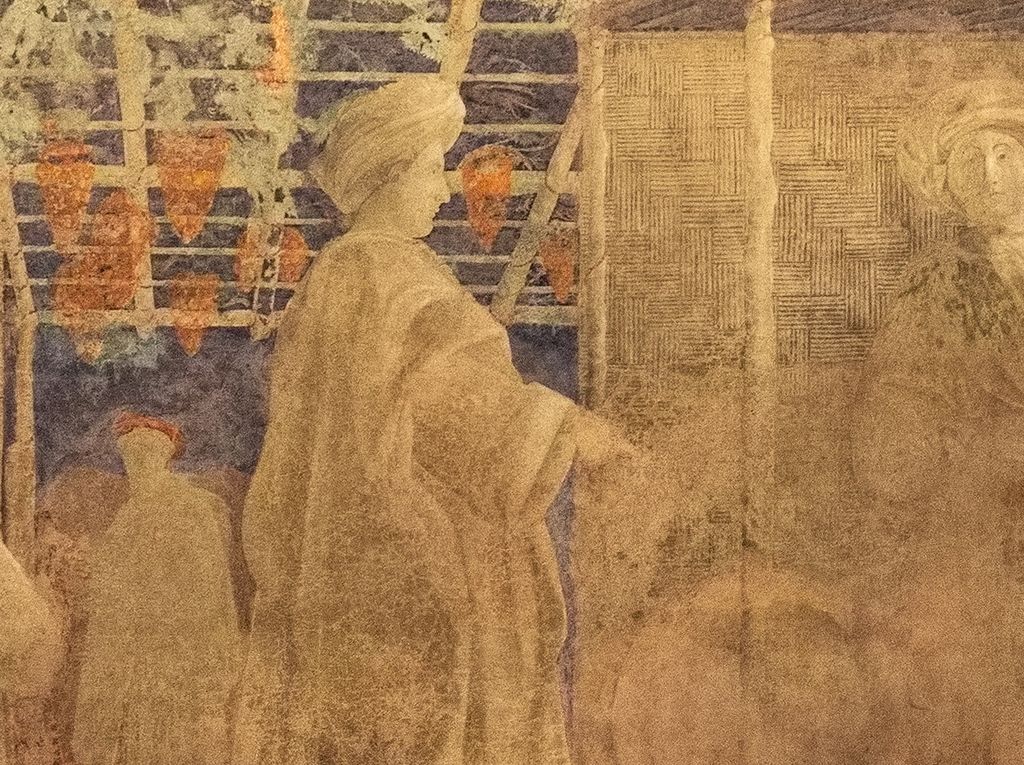
The lower mural develops Noah’s story after the Flood. A trellis marks the space above the figures on the right, while losses in the paint leave sections of the scene incomplete.
Noah’s sacrifice and drunkenness
The damaged painting below brings the hull back into view at the left. The surviving group of pale figures gathers beneath the foreshortened figure of God the Father. From below, God’s head projects forward while his arms seem to open across the darker field. Vasari admired the daring angle. In Genesis, Noah offers a sacrifice after leaving the ark, and God makes a covenant with him and with the living creatures that came out of it. The curve above the gathering recalls the rainbow named as the sign of the covenant. Look for that span of colour above the heads before moving across to the trellis. [1] [5] [6] [15]
The trellis takes us to the vineyard planted by Noah. Its structure is still plain against the more worn parts of the wall. Crosspieces taper into the distance, and patches of reddish colour break up the gaps. Uccello scored the straight lines of the trellis and other constructed features into the surface. Under it the story turns from public thanksgiving to a family crisis. Noah drinks wine and lies exposed. His son Ham sees him and tells his brothers, Shem and Japheth, who go in backwards to cover their father. Vasari reads mockery in Ham’s gesture. He also complains that the figures, the trellis and a barrel do not agree in their recession. His account is valuable for the details it preserves and for the glimpse it gives of what a later Renaissance painter expected a picture’s lines to do. [1] [6] [15]
Vasari also believed Uccello had given Ham the features of the Florentine painter Dello Delli. The Italian state catalogue records a proposed date around 1446–48 that leans in part on that identification and Dello’s return from Spain. The claim depends on a portrait reported more than a century after the painting. Today the shape of Ham’s heavy cloak and his place under the trellis are far clearer than any evidence of who sat for him. [1] [6] [16]
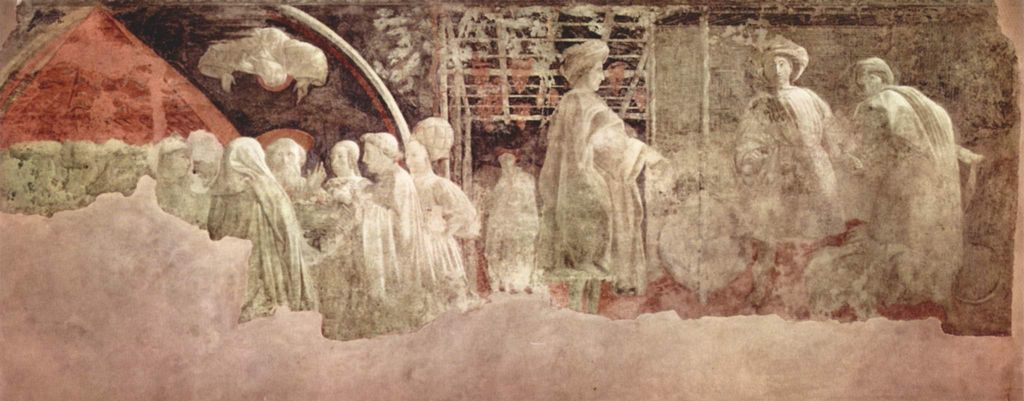
The lower scenes of the Noah bay, showing the Sacrifice and Drunkenness of Noah. Image source. Public domain.
The cloister and the date of the paintings
The Green Cloister was already standing when the Genesis cycle was painted in the fifteenth century. Across its bays the story starts with The Creation of the Animals and the Creation of Adam, in the first bay by the approach from the church. Between that beginning and the two paintings discussed here, nearer events include the Expulsion and the building and loading of the ark. The civic museum attributes the first four eastern bays collectively to Uccello and his workshop, with a collective range of 1431–46. Giovanni Giura distinguishes the hands of two other painters in the intervening bays. Uccello’s return in the fourth bay can be felt in the difference between the building of the ark and the huge surfaces that almost shut us in with it during the storm. [1] [4] [17]
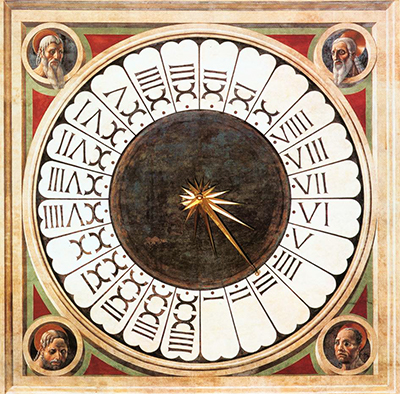
Giura dates the Flood and the lower Noah episodes to around 1439. He compares the placement of objects and emphatic recession to The Battle of San Romano, which he situates near the end of the 1430s. He finds the relationship less close to the more exaggerated faces Uccello painted for the cathedral clock in 1443. Palazzo Strozzi’s exhibition catalogue gives about 1439–40, while the National Gallery uses 1447 and the state catalogue records the argument for about 1446–48. The debates concern the style of the two paintings and the weight to give historical clues, from Dello’s possible likeness to the presence of the pope nearby. [2] [4] [13] [16]
The Council transferred from Ferrara to Florence in 1439 and met at Santa Maria Novella. The agreement announced that July sought union between the Eastern and Western Churches. Giura discusses the suggestion that the two views of the ark allude to those Churches. Katharine Stahlbuhk develops the reading of the upright man as Pope Eugenius IV, with the dove and olive branch carrying a contemporary message of peace. The contrast between the storm and the figure’s composure gives that interpretation a visual basis. The identity remains open, as does the question of whether the painting anticipated the gathering or commemorated it. [2] [4] [18]
Florentines also had their own experience of floods. The researcher Michela Ramadori reads the fresco in light of the Arno and the city that depended on it. Mills, weirs and other structures occupied parts of the river, which sustained work and commerce while repeatedly inundating the streets. In Uccello’s lunette, a ladder and a cask are suddenly worth as much to the people clinging to them as any building. The connection with Florence’s river helps explain how a biblical disaster could feel familiar to a local audience. The painting leaves open which, if any, particular flood Uccello had in mind. [2] [19]
The figures had a life beyond the cloister. Wolfgang Brassat compares the boxlike ark, the rider and the man using the open barrel in Uccello’s fresco with motifs in a Flood drawing attributed to Maso Finiguerra. He proposes that the drawing helped carry these inventions into the tradition of Florentine prints. A red chalk sheet in the Louvre preserves a more direct encounter with the lunette. Its maker copied the cluster at the lower left, studying how the bodies overlap around the ladder even without the sweep of the whole wall. [7] [20]
What survives, and where to see it
Green earth predominates across the cloister’s cycle and gave the cloister its name. In the fourth bay there are also red and yellow ochres, with traces of blue recorded in the lower mural’s sky. Laboratory examination found a grain of the green mineral glauconite mixed with other pigments in a sample from the tunic or drapery of the central turbaned figure under the trellis. The greens, ochres and grays belong to a deliberate range of paint, now seen through the effects of wear and intervention. Some details were added or adjusted after the plaster had dried. The missing areas in the lower mural leave rough edges where parts of the narrative once continued. [1] [17] [21]
According to the Opificio delle Pietre Dure’s conservation history, Domenico Fiscali detached the Flood lunette in 1907 and the lower Noah painting in 1909. The lunette’s preparatory drawing on the plaster beneath, known as a sinopia, was lost. Both works were therefore already on movable supports decades before the 1966 Arno flood. The Opificio records further treatment of both paintings by Leonetto Tintori after that disaster. In the recent work on the Flood, conservators removed its heavy wooden framework and mounted the surviving mural on a lighter support. They inserted a flexible layer to accommodate irregularities at the back of the painting. What we see today is a fragile painted surface carried by a structure that can be moved again. [1] [22]
In 1983 the detached paintings were remounted in their original positions in the Green Cloister. The open walk continued to expose them to conditions that affected the paint. Following work by the Opificio begun in 2011 on the first four bays, eight paintings were exhibited in the museum’s Refectory in 2016. The Flood travelled separately to Palazzo Strozzi in 2017 for Electronic Renaissance, where it was shown with Bill Viola’s work. The October 2026 programme by Florence’s civic museums and their partners still places the paintings by Uccello and his collaborators in the Refectory at Santa Maria Novella. In the cloister you can trace the route for which the Noah scenes were made. In the Refectory you can stand much closer to the scored lines, the surface breaks and the tiny shifts of colour that would once have been high above you. [2] [17] [22] [23] [24]
Watch the Green Cloister frescoes
See the paintings in the setting of the conservation display.
Restored Paolo Uccello frescoes on display in Santa Maria Novella refectory
A short report on the exhibition of restored Green Cloister frescoes in Florence.
Watch on YouTubeArtworks directory
Browse paintings, drawings, stained-glass designs and other objects connected with Uccello. Cycles and their surviving components may have separate entries. The collection or catalogue’s wording is retained where a date, attribution or subject is debated.
| Name | Date | Medium, attribution and collection |
|---|---|---|
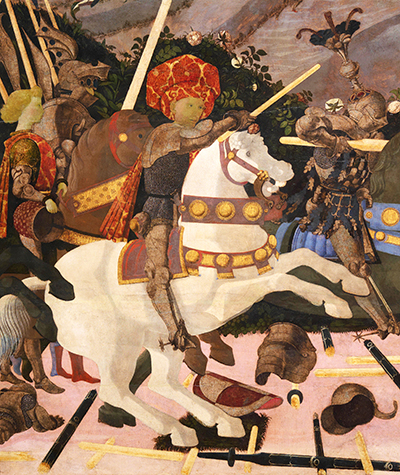
| Niccolò da Tolentino at the Battle of San Romano · London | Probably c.1438–40 | Tempera and oil on wood, with metallic decoration · National Gallery Catalogue. |
| Bernardino della Carda Unhorsed · Florence | c.1435–40 | Tempera on panel · Uffizi Galleries Catalogue. |
| The Counterattack of Micheletto da Cotignola · Paris | 1450–75 in the Louvre catalogue | Tempera (possibly) on wood · Musée du Louvre Catalogue. |
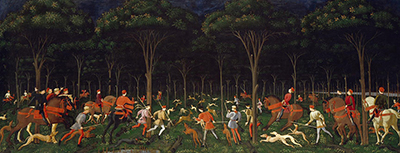
| The Hunt in the Forest | c.1465–70 | Tempera and oil with traces of gold on panel · Ashmolean Catalogue. |
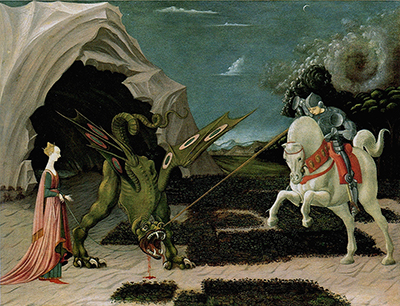
| Saint George and the Dragon · London | c.1470 | Oil on canvas · National Gallery Catalogue. |
| Saint George Slaying the Dragon · Melbourne | c.1430 | Oil, tempera and silver leaf on wood · National Gallery of Victoria Catalogue. |
| Saint George and the Dragon · Paris | 1430–35 in the museum catalogue | Painted wood panel · Musée Jacquemart-André Catalogue. |
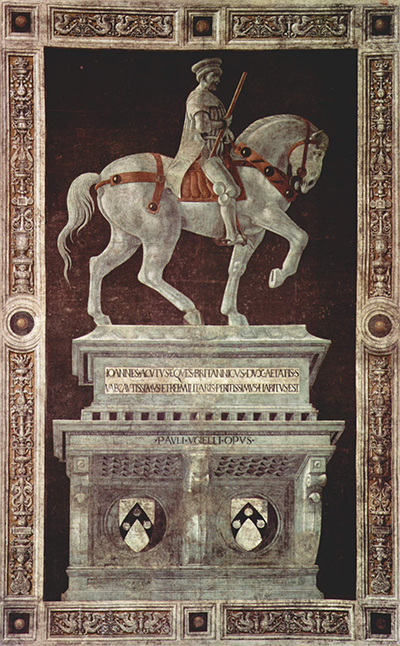
| Equestrian Monument to John Hawkwood | 1436 | Transferred wall painting · Florence Cathedral Catalogue. |
| Study for the John Hawkwood Monument | 1436 | Study on prepared paper · Uffizi Catalogue. |
| Monumental Clock Face | 1443 | Painted dial · Florence Cathedral Catalogue. |
| Resurrection of Christ | 1443–44 | Stained glass · Uccello design · Florence Cathedral Catalogue. |
| Nativity | 1440s | Stained glass · Uccello design · Florence Cathedral Catalogue. |
| Creation of the Animals and Creation of Adam | Third to fourth decade of the 15th century | Detached fresco · Green Cloister, Santa Maria Novella Catalogue. |
| Creation of Eve and the Fall | Third to fourth decade of the 15th century | Detached fresco · Green Cloister, Santa Maria Novella Catalogue. |
| Flood and Recession of the Waters | 15th century; dating debated | Detached fresco · Green Cloister, Santa Maria Novella Catalogue. |
| Sacrifice and Drunkenness of Noah | 15th century; dating debated | Detached fresco · Green Cloister, Santa Maria Novella Catalogue. |
| Stories of the Virgin and Saint Stephen · Assunta Chapel | 1430s, with later completion | Fresco cycle · Paolo Uccello and Andrea di Giusto · Prato Cathedral Catalogue. |
| Blessed Jacopone da Todi | 1436 in the diocesan museum | Detached fresco · Museo dell’Opera del Duomo, Prato Catalogue. |
| Adoration of the Child · Bologna | 1430s; inscription incomplete | Detached fresco · San Martino Maggiore, Bologna Catalogue. |
| Adoration of the Christ Child · Karlsruhe | c.1436 | Painted panel · Attribution to Uccello · Staatliche Kunsthalle Karlsruhe Catalogue. |
| Annunciation · Oxford | Early 15th century | Tempera and gilding on panel · Ashmolean Catalogue. |
| Allegory of Monastic Life (Thebaid) | c.1460–65 | Tempera on canvas · Galleria dell’Accademia, Florence Catalogue. |
| Miracle of the Profaned Host | 1467–68 | Tempera on wood · Galleria Nazionale delle Marche, Urbino Catalogue. |
| Triumphal Entry into Rome of Titus and Vespasian(?) | c.1430–35 | Tempera, gold and silver on panel · Yale University Art Gallery Catalogue. |
| Crucifixion with the Virgin and Saints | c.1460–65 | Painted panel · Museo Nacional Thyssen-Bornemisza Catalogue. |
| The Crucifixion · Met triptych | Probably mid-1450s | Tempera on wood with gold ground · Metropolitan Museum of Art Catalogue. |
| Perspective Study of a Chalice | 1450–75 | Pen, ink and stylus on paper · Attributed to Uccello · Uffizi Catalogue. |
| Study of a Mazzocchio | 15th century | Perspective study · Attributed to Uccello · Uffizi Catalogue. |
| Mazzocchio Seen in Perspective | Uncertain | Drawing · Attribution debated · Musée du Louvre Catalogue. |
| Head of a Man in Profile | 15th century | Pen, ink and wash · Musée du Louvre Catalogue. |
| Five Masters of the Florentine Renaissance | 1500–50 | Oil on wood · Anonymous Florentine school · Musée du Louvre Catalogue. |
| Madonna and Child from the Del Beccuto House | 15th century | Detached fresco · Museo di San Marco, Florence Catalogue. |
| Man of Sorrows with the Virgin and Saint John · Avane Predella | 15th century | Predella · Museo di San Marco, Florence Catalogue. |
| Calling of Saint Paul the Hermit · San Miniato | After 1447 to c.1454 in state catalogue | Sinopia · Attributed to Uccello or collaborator Catalogue. |
| The host changes hands · Urbino predella, scene 1 | 1467–68 | Tempera on wood · Component of DE 231 · Galleria Nazionale delle Marche Catalogue. |
| The figures at the door · Urbino predella, scene 2 | 1467–68 | Tempera on wood · Component of DE 231 · Galleria Nazionale delle Marche Catalogue. |
| The procession approaches the altar · Urbino predella, scene 3 | 1467–68 | Tempera on wood · Component of DE 231 · Galleria Nazionale delle Marche Catalogue. |
| The condemned woman and the ladders · Urbino predella, scene 4 | 1467–68 | Tempera on wood · Component of DE 231 · Galleria Nazionale delle Marche Catalogue. |
| Persecution of the family · Urbino predella, scene 5 | 1467–68 | Tempera on wood · Component of DE 231 · Galleria Nazionale delle Marche Catalogue. |
| Angels and demons at the bier · Urbino predella, scene 6 | 1467–68 | Tempera on wood · Component of DE 231 · Galleria Nazionale delle Marche Catalogue. |
| Birth of the Virgin · Prato Cathedral | 1430s; dating debated | Fresco · Assunta Chapel, Prato Cathedral Catalogue. |
| Presentation of the Virgin · Prato Cathedral | 1430s; dating debated | Fresco · Assunta Chapel, Prato Cathedral Catalogue. |
Discussion
Look again at the images and ideas explored in Noah and the Flood. These editorial prompts invite your observations.
Reader Insights
When you follow the red sides of the ark towards the centre, what do you notice first that tells you the left and right belong to different moments?
How does the ordered framework of the vineyard trellis change the way you read the argument and gestures beneath it after looking at the crowded flood scene?
Join the Conversation
Share a detail, comparison or question about Noah and the Flood below.
References
- Andrea Vigna and Alberto Felici. Contributions on the execution and conservation of the fourth bay, in Cecilia Frosinini, ed., Paolo Uccello a Santa Maria Novella. Restauro e studi sulla tecnica in terraverde, 2021, pp. 173–179 and 189–191. View source.
- Anna Bisceglia, Fondazione Palazzo Strozzi. “The Flood and Recession of the Waters,” object entry in the Bill Viola. Electronic Renaissance exhibition press kit, 2017. View source.
- Fondazione Federico Zeri, Università di Bologna. Paolo di Dono, Diluvio Universale, photographic and catalogue record no. 13518. View source.
- Giovanni Giura. “La seconda età della pittura in Santa Maria Novella,” in Andrea De Marchi, ed., Santa Maria Novella. La Basilica e il Convento, vol. II, 2016, especially pp. 124–137. View source.
- Genesis. Chapter 8, especially verses 6–22, USCCB text. View source.
- Giorgio Vasari. “Paolo Uccello,” Lives of the Most Excellent Painters, Sculptors, and Architects, French translation by Charles Weiss, 1903, vol. I, pp. 290–295. View source.
- Musée du Louvre. Le Déluge, INV 1971, Recto, red chalk copy of the lower left of Uccello’s lunette. View source.
- Anna G. Vinogradova. “Трактат Пьеро делла Франческа в его связи с искусством мастера. Геометрия Евклида в творческом наследии художника” [Piero della Francesca’s treatise in relation to his art], State Institute for Art Studies, especially p. 124, note 3. View source.
- Genta Okamoto. “パオロ・ウッチェッロを見るアンドレ・ブルトン” [André Breton looking at Paolo Uccello], The Journal of Kokugakuin University 124, no. 8, 2023, especially pp. 10–11. View source.
- Frank Fehrenbach. “Sfondare. Landschaft als Kraftraum,” in Kraft, Intensität, Energie: Zur Dynamik der Kunst, 2018, especially p. 116. View source.
- Lorenza Melli. “Nuove indagini sui disegni di Paolo Uccello agli Uffizi,” Mitteilungen des Kunsthistorischen Institutes in Florenz 42, no. 1, 1998, pp. 21–22, Uffizi inv. 14502 F. View source.
- Diego Suárez Quevedo. “En los inicios del Renacimiento. La cúpula brunelleschiana y reflexiones sobre Paolo Uccello,” Anales de Historia del Arte 25, 2015, pp. 75–103. View source.
- National Gallery, London. Paolo Uccello (about 1397–1475), artist entry. View source.
- Opera della Metropolitana di Siena. “Baptistry of San Giovanni,” catalogue information on the baptismal font and Donatello’s Feast of Herod. View source.
- Genesis. Chapter 9, especially verses 8–27, USCCB text. View source.
- Ministero della Cultura, Catalogo Generale dei Beni Culturali. Episodi della Genesi, record no. 0900281149-0, attribution and dating discussion. View source.
- Comune di Firenze, Musei Civici Fiorentini. “Visita il museo,” Green Cloister and Refectory. View source.
- Katharine Stahlbuhk. “Dipinti in ‘terraverde’ per il Papa. Una nuova interpretazione delle storie della Genesi nel Chiostro Verde,” in Paolo Uccello a Santa Maria Novella. Restauro e studi sulla tecnica in terraverde, 2021, discussion of Eugenius IV and the council. View source.
- Michela Ramadori. “Tra racconto biblico e cronaca di un evento naturale nella Firenze del XV secolo,” abstract from the Second Study Day on Geology and the History of Art, ISPRA, 2022. View source.
- Wolfgang Brassat. “Ein kunstvolles Katastrophenbild: Hans Baldung Griens Die Sintflut und die Renaissance in Italien,” especially pp. 123–124. View source.
- Carlo Galliano Lalli and Federica Innocenti. “La Terra Verde: Glauconite o Celadonite? Confronti su casi studio,” in Paolo Uccello a Santa Maria Novella. Restauro e studi sulla tecnica in terraverde, 2021, pp. 269–278, especially fig. 5. View source.
- Fabrizio Bandini, Alberto Felici and Andrea Vigna. Chapters on the historical detachments and treatment of the supports, in Paolo Uccello a Santa Maria Novella. Restauro e studi sulla tecnica in terraverde, 2021, pp. 163–172 and 245–252. View source.
- Comune di Firenze. “Gli affreschi di Paolo Uccello nel Chiostro Verde di Santa Maria Novella,” 2016 announcement of the temporary Refectory installation. View source.
- Città Metropolitana di Firenze, Comune di Firenze and Fondazione MUS.E. “Il 4 ottobre torna la Domenica Metropolitana,” October 2026 guided itinerary, Santa Maria Novella cloisters and Refectory. View source.
More PAOLO UCCELLO Artworks

Noah and the Flood
The Flood and Recession of the Waters above the lower episodes from Noah’s story, Santa Maria Novella. Photograph by Armin Kleiner. Image source. CC BY-SA 4.0. Resized for the web. This derivative is available under the same licence.
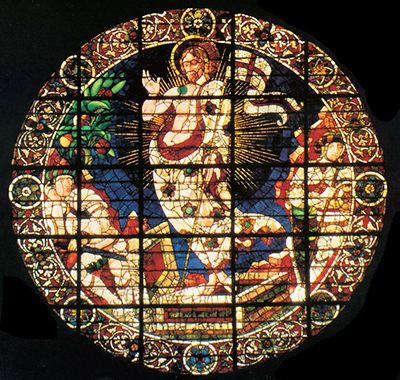
The Resurrection of Christ Stained Glass Window
The Resurrection window in Florence Cathedral, designed by Paolo Uccello and made by Bernardo di Francesco. Photograph by Sailko. Image source. CC BY 3.0. Resized for the web.