


 by Tom Gurney
Tom Gurney BSc (Hons) is an art history expert with over 20 years experience
Email: tomgurney1@gmail.com / Phone: +44 7429 011000
Saint George and the Dragon (Paris): Introduction
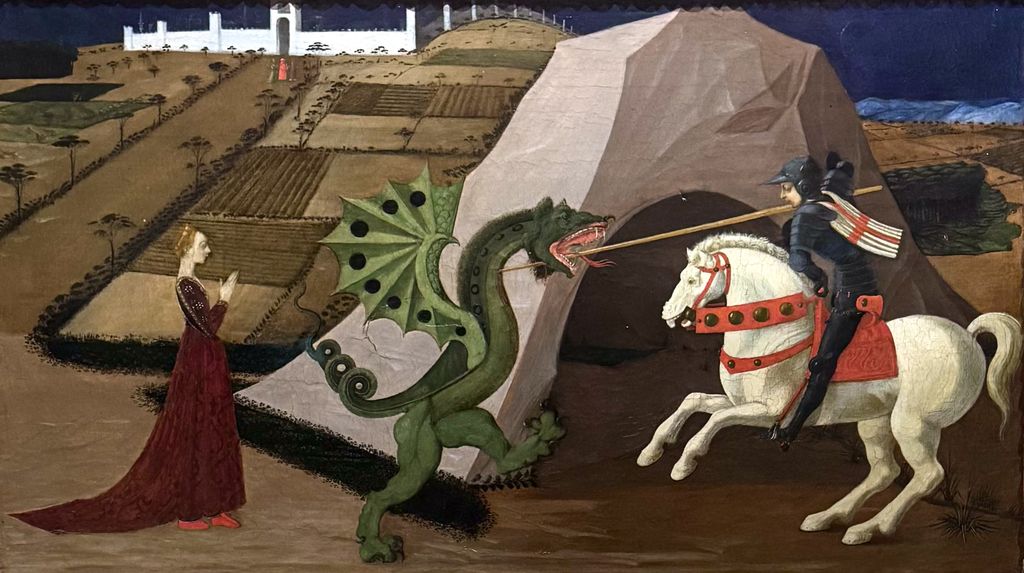
A white horse rears at the right of Paolo Uccello’s Saint George and the Dragon. Its rider drives a lance into the monster’s open jaws while the princess, in a dress patterned with flowers, stands at the left. Further back, a road leads through ploughed fields to a walled city. This is the painted wood panel in the Musée Jacquemart-André, Paris, inventory MJAP-P 2248. The museum dates it to 1430–35, one of several dates proposed for the picture. [1] [2] [3]
At a Glance
- Date1430–35 (Musée Jacquemart-André dating)
- SupportPainted wood panel
- CollectionMusée Jacquemart-André, Paris, MJAP-P 2248
Contents
- The moment the lance strikes
- Fields, hills and a city gate
- When and for whom was it painted?
- From Bardini’s collection to the Florentine Gallery
- What the 2017 conservation revealed
- London and Melbourne
- Annotated details
The moment the lance strikes
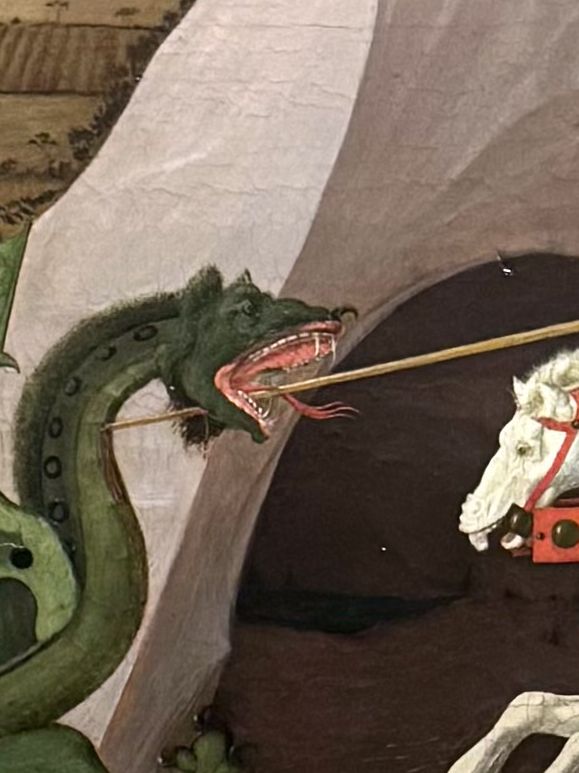
Follow the lance from the rider to the dragon’s mouth. The line runs across the lively contours of armour, horse and wings and ends at a small detail, the monster’s three-pronged tongue. The horse lifts both front legs and the dragon spreads its wings at the point of impact. George’s cross is visible on the surcoat over his armour, which lifts behind him as he attacks. The cross marks the rider as a Christian knight at the same moment that the lance makes his purpose plain. [1] [3]
The princess has a different kind of presence. Her profile and the long outline of her robe have the precision of a figure on a medal, as the Paris museum suggests. The flowers continue over the folds and sleeves of what the Fondazione Giorgio Cini describes as patterned velvet. Her stillness makes the encounter easier to take in. The eye can move from the rose and green of the dress to the jagged dragon and on to the hard surfaces of the knight’s equipment. The museum likens the dragon to a creature from a Gothic coat of arms. Its curved outline is compelling even when you look away from the lance and lose sight of the action. [1] [3]
In the Golden Legend, a dragon terrorises a city in Libya and its residents offer it first sheep and then their children. When the king’s daughter is chosen, George rides out against the creature. He wounds it, asks the princess to put her girdle around its neck and accompanies her back to the city, where the episode ends with conversion and the dragon’s death. The Paris picture concentrates on the attack outside the walls. The road makes it easy to imagine where the action will move next. For Christian audiences the story could stand for the defeat of paganism and the deliverance of the Church, a reading the Jacquemart-André gives alongside the account of the princess’s rescue. [1] [4]
Fields, hills and a city gate
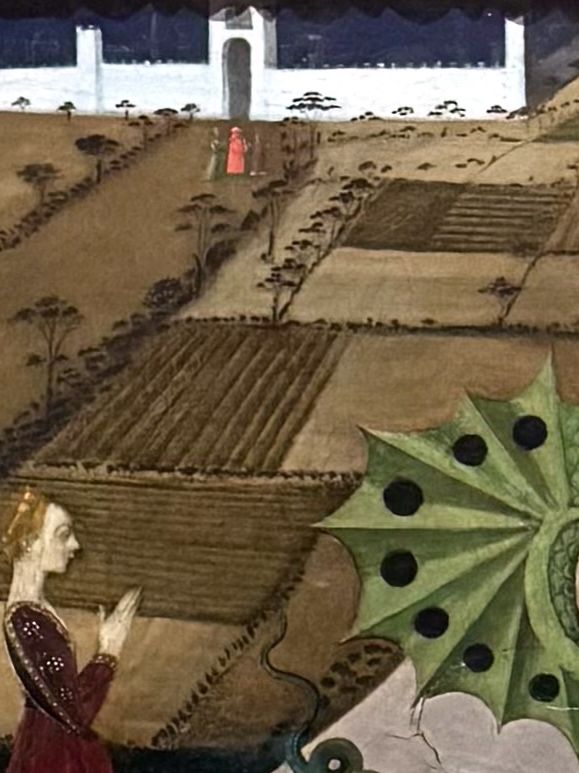
The great rock at the centre gives the foreground combat a backdrop and divides the country behind it. On the left, the ridges of the fields and the road draw the eye towards the pale defences of the city. Tiny people on the route register how far away the walls are. The hills to the right invite a higher, more sweeping view. The eye rises across the slope as if it were looking down over the terrain from above. The museum and the Cini exhibition both call attention to this change in viewpoint. Following the road into the painting and looking over the hills are two different ways of judging distance. The art historian Diego Suárez Quevedo compares the nearly frontal arrangement of the combat to a stage and sees an affinity between the view from above and Ambrogio Lorenzetti’s geometrically organised landscapes. The wide format gives the main players room to stand apart while the fields behind them draw the eye into the picture. [1] [3] [5]
The fields add something to the story as well as to the space. Art historian Emanuele Lugli points out that their furrows resemble a Tuscan way of laying out land to help water drain. He identifies the city as Florence, citing what he reads as the silhouette of the cathedral dome and the form of the Porta a Pinti, a city gate since demolished. He also proposes identities for the figures near the gate, including the princess’s parents and a Florentine official, drawing on features of their dress. In his interpretation the rescue protects a place whose life depends on the land beyond its walls. The reading gives a reason to dwell on those strips of ploughed earth, which take up considerable space for a story that could have been told entirely with the three figures in front. [6]
Annotated Details from Saint George and the Dragon (Paris)
The numbered points identify visible features discussed in this article. Return from each detail to the numbered overview. Saint George and the Dragon, Musée Jacquemart-André, MJAP-P 2248. Image source. Public domain.
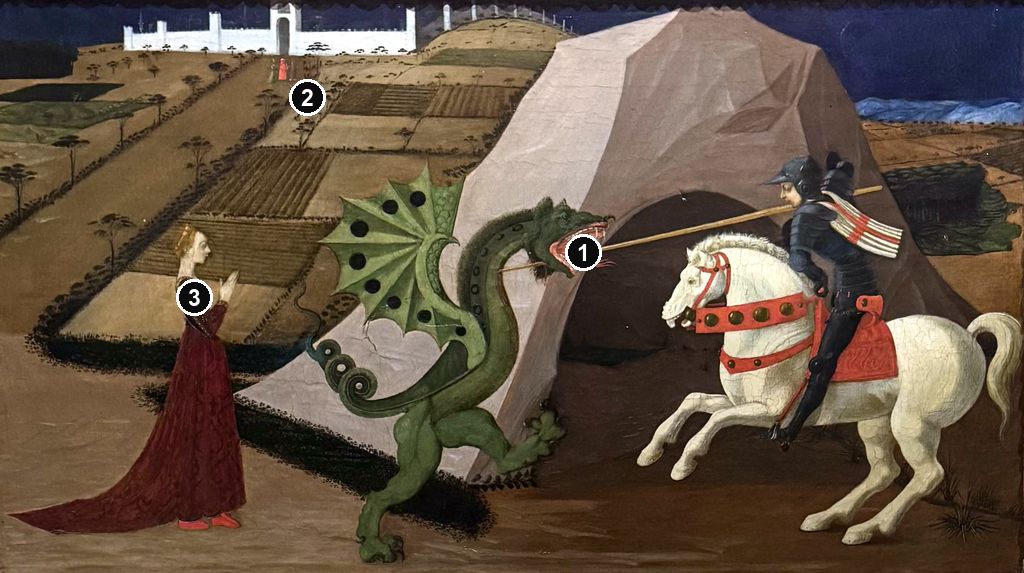
Details from SAINT GEORGE AND THE DRAGON (PARIS)
Compare the cropped details with the source images above. Notice how their colours, shapes and positions contribute to the larger compositions.
The lance enters the dragon’s mouth
The lance crosses the cave opening and meets the open jaws. The dragon’s lip and the red harness direct attention to two sharply defined edges.
Cultivated land and a distant gate
Field boundaries lead uphill towards the gate. Beyond the broad painted rock, they create a separate passage into depth.
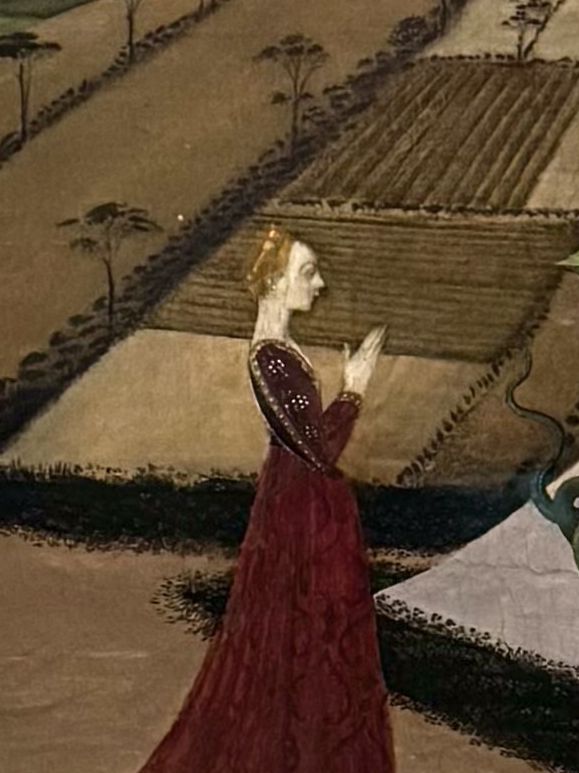
The princess’s raised hands
The princess raises her hands and watches the encounter from the left. Her contained gesture contrasts with the projecting dragon wing and the horse’s spring.
When and for whom was it painted?
The Fondazione Giorgio Cini dated the panel to about 1440 when it borrowed the work in 2021. The French Institut national d’histoire de l’art catalogues it under a hypothetical date of about 1465 and records the wide range of dates proposed in the literature. The Fondazione Federico Zeri gives a span from 1439 to 1460. [7] The later dating has a documentary argument behind it. James Beck published records concerning Uccello in 1979, including evidence for a Saint George painted for the Florentine Lorenzo di Matteo Morelli in 1465. The Morelli identification also appears in the INHA record through a proposal by Marzia Benassi. It would put the Paris painting late in Uccello’s career, several decades after the date on the museum website. [1] [2] [3] [6] [8]
Art historian Lorenzo Sbaraglio considers the link plausible. The record concerns the right painter and subject and describes a panel with a carved frame. He also notes discrepancies in the measurements, which leave the identification open. The wide picture has prompted suggestions about how it once fitted into a room. Sbaraglio considers a spalliera, a decorative panel set into or against furniture or wall panelling. The INHA also records a wall-panel proposal by Berti and John Pope-Hennessy’s suggestion that the painting adorned part of a bed. The panel’s shape makes those ideas worth considering. Its first setting and the precise function of its frame remain uncertain. [2] [8]
The published descriptions agree on a wooden support. Their figures and terms for the painting itself vary. The Paris museum gives 131 × 103 cm and calls it a painted wood panel. The Cini loan entry and INHA give 62 × 102 cm, consistent in width and close in height to the approximately 60 × 102 cm listed in the 1899 sale catalogue. The Zeri catalogue gives the smaller measurement of 52 × 90 cm. [7] The Cini caption specifies tempera, lake pigments and resin varnishes. The Arcanes conservation account lists oil on wood and repeats the museum’s measurement. The discrepancies in measurement and paint medium remain unexplained in these summaries. [1] [2] [3] [9] [10]
From Bardini’s collection to the Florentine Gallery
The secure ownership trail begins with the Florence dealer Stefano Bardini at the end of the nineteenth century. Charles Loeser attributed it to Uccello in 1898, an attribution the INHA describes as accepted. The Paris museum recalls that Nélie Jacquemart saw the painting at the dealer’s Florentine palace but could only acquire it later in London. The 1899 Bardini sale catalogue lists it under Uccello’s name as lot 488, with the distant town and cultivated middle ground prominent in the description. The printed catalogue identifies Christie, Manson & Woods as the auctioneer and places the lot on the third day, 7 June, of the sale that opened on 5 June. [1] [2] [3] [9]
Jacquemart acquired the work in London in 1899, five years after Édouard André’s death. She continued to build the collection they had assembled and left it with their Paris house to the Institut de France in 1912. The house opened as a museum in 1913, the year Émile Bertaux’s first catalogue recorded the painting under number 1038. The collection still identifies it with the Florentine Gallery on Boulevard Haussmann, where a work once discussed as bedroom or wall decoration hangs in the former home of a pair of collectors. [1] [2] [3] [11]
In 2013 the panel went back to Florence for a Villa Bardini exhibition on the Italian Renaissance holdings of the Jacquemart-André. The show brought works from the Paris collection back to the city where the collectors’ relationship with Bardini had begun. [12]
The State Hermitage presented the panel in the Apollo Hall of the Winter Palace in Saint Petersburg from April to July 2019. In Venice it was the guest work at Palazzo Cini from 28 May to 1 November 2021, the foundation’s seventieth anniversary year. The Venice loan brought the painting into a collection with a strong Florentine section and coincided with arrangements for Botticelli’s Judgement of Paris to travel from that collection to the Jacquemart-André. [3] [13]
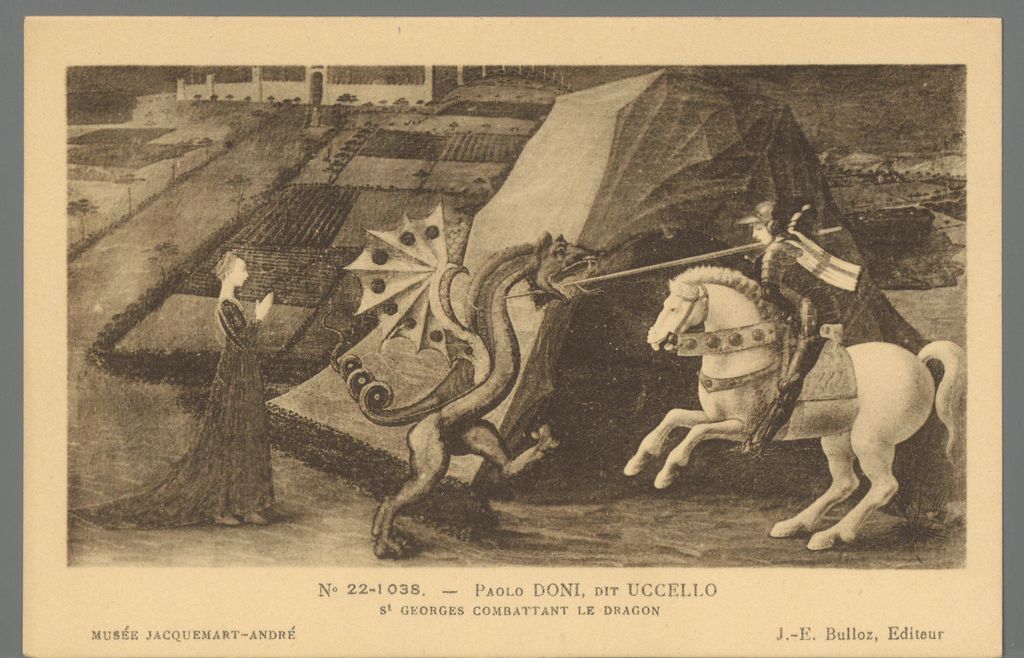
Léon Marotte’s early twentieth-century collotype postcard of the Paris Saint George, Rijksmuseum RP-F-00-21078. Image source. Public domain.
What the 2017 conservation revealed
The restorers found the picture in generally good condition, with a grey cast caused by several coats of varnish and an old protein-based coating. Arcanes used close-up photography in direct light, infrared reflectography and ultraviolet examination to study the surface and the design below it. A second phase of analysis took place at the Centre de recherche et de restauration des musées de France in Versailles. Cinzia Pasquali treated the paint surface in February 2017. That work included cleaning, retouching and applying a final varnish. The INHA also records the removal of later repainting at the horse’s neck. Work on the framing included adapting the frame and providing a protective microclimate enclosure for the wooden support. [2] [10]
The treatment and imaging revealed two different kinds of change. Removal of later coatings and repaint made the colour relationships easier to see and brought out incisions associated with the preparatory drawing. Infrared examination also exposed changes in the design itself, including revisions to George’s face and helmet. The veil on the surface and the altered lines under the paint tell separate stories. One belongs to the panel’s later care and presentation. The other lets us see the painter adjusting the head of a rider whose final outline looks so assured. [10] [14]
London and Melbourne
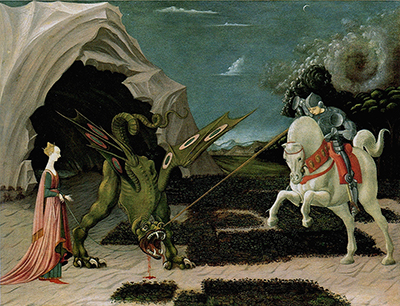
In the London version, dated about 1470 by the National Gallery, the princess already holds the dragon by a tether as George strikes. Oil on canvas gives that work a different support, and the spiral cloud and the dark opening of the cave crowd the action in a much smaller field. Paris leaves room for the road, the planted ground and the people near the city. Its princess holds the left side of the image by the strength of her silhouette. The London painting gives her a more explicit part in bringing the dragon under control. [1] [3] [15]
The Melbourne painting has a narrow, upright wooden panel with oil, tempera and silver leaf, dated about 1430 by the National Gallery of Victoria. George fights on foot there, his lance broken and his horse behind him, with God the Father above the action. The Paris picture keeps the hero mounted and gives the land around the fight a scale and detail of its own. The galleries’ dates are useful guides, even as the proposed Morelli connection leaves the exact interval between the pictures open. [2] [8] [16] [17]
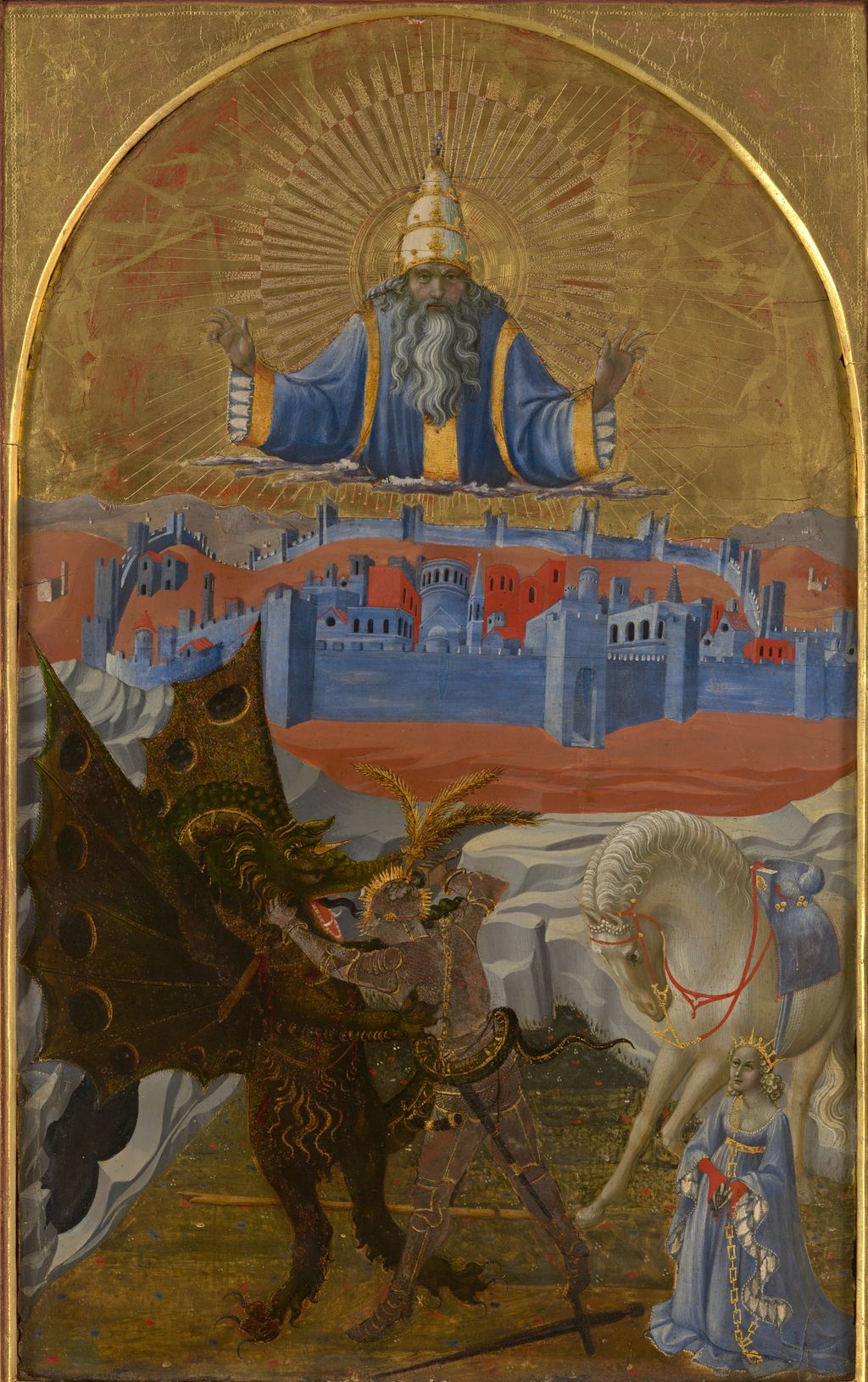
Saint George Slaying the Dragon, National Gallery of Victoria 2124-4. Image source. Public domain.
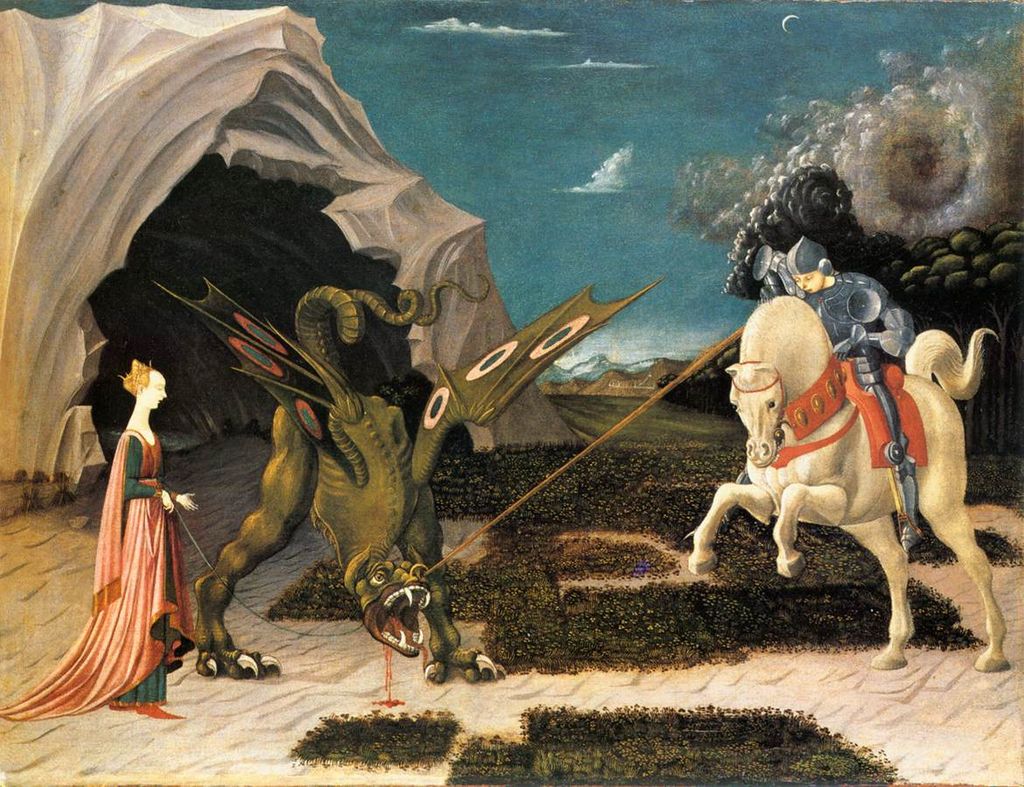
The London Saint George and the Dragon, National Gallery NG6294. Image source. Public domain.
Artworks directory
Browse paintings, drawings, stained-glass designs and other objects connected with Uccello. Cycles and their surviving components may have separate entries. The collection or catalogue’s wording is retained where a date, attribution or subject is debated.
| Name | Date | Medium, attribution and collection |
|---|---|---|
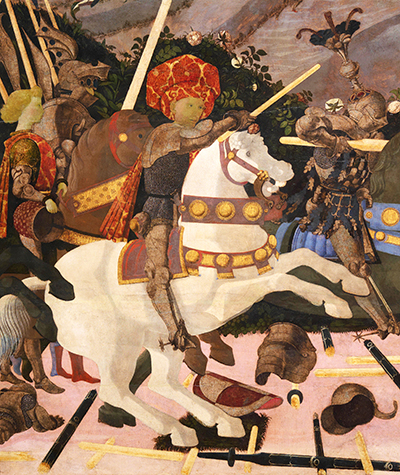
| Niccolò da Tolentino at the Battle of San Romano · London | Probably c.1438–40 | Tempera and oil on wood, with metallic decoration · National Gallery Catalogue. |
| Bernardino della Carda Unhorsed · Florence | c.1435–40 | Tempera on panel · Uffizi Galleries Catalogue. |
| The Counterattack of Micheletto da Cotignola · Paris | 1450–75 in the Louvre catalogue | Tempera (possibly) on wood · Musée du Louvre Catalogue. |
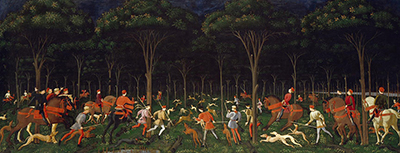
| The Hunt in the Forest | c.1465–70 | Tempera and oil with traces of gold on panel · Ashmolean Catalogue. |
| Saint George and the Dragon · London | c.1470 | Oil on canvas · National Gallery Catalogue. |
| Saint George Slaying the Dragon · Melbourne | c.1430 | Oil, tempera and silver leaf on wood · National Gallery of Victoria Catalogue. |
| Saint George and the Dragon · Paris | 1430–35 in the museum catalogue | Painted wood panel · Musée Jacquemart-André Catalogue. |
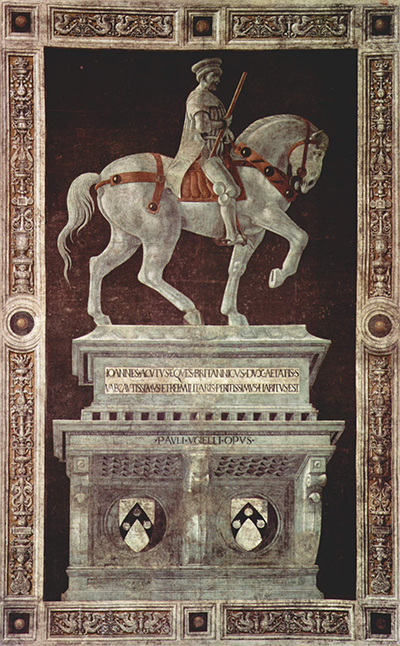
| Equestrian Monument to John Hawkwood | 1436 | Transferred wall painting · Florence Cathedral Catalogue. |
| Study for the John Hawkwood Monument | 1436 | Study on prepared paper · Uffizi Catalogue. |
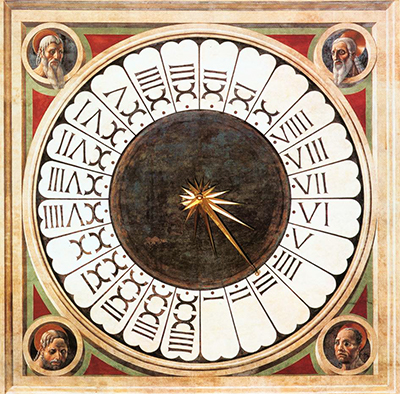
| Monumental Clock Face | 1443 | Painted dial · Florence Cathedral Catalogue. |
| Resurrection of Christ | 1443–44 | Stained glass · Uccello design · Florence Cathedral Catalogue. |
| Nativity | 1440s | Stained glass · Uccello design · Florence Cathedral Catalogue. |
| Creation of the Animals and Creation of Adam | Third to fourth decade of the 15th century | Detached fresco · Green Cloister, Santa Maria Novella Catalogue. |
| Creation of Eve and the Fall | Third to fourth decade of the 15th century | Detached fresco · Green Cloister, Santa Maria Novella Catalogue. |
| Flood and Recession of the Waters | 15th century; dating debated | Detached fresco · Green Cloister, Santa Maria Novella Catalogue. |
| Sacrifice and Drunkenness of Noah | 15th century; dating debated | Detached fresco · Green Cloister, Santa Maria Novella Catalogue. |
| Stories of the Virgin and Saint Stephen · Assunta Chapel | 1430s, with later completion | Fresco cycle · Paolo Uccello and Andrea di Giusto · Prato Cathedral Catalogue. |
| Blessed Jacopone da Todi | 1436 in the diocesan museum | Detached fresco · Museo dell’Opera del Duomo, Prato Catalogue. |
| Adoration of the Child · Bologna | 1430s; inscription incomplete | Detached fresco · San Martino Maggiore, Bologna Catalogue. |
| Adoration of the Christ Child · Karlsruhe | c.1436 | Painted panel · Attribution to Uccello · Staatliche Kunsthalle Karlsruhe Catalogue. |
| Annunciation · Oxford | Early 15th century | Tempera and gilding on panel · Ashmolean Catalogue. |
| Allegory of Monastic Life (Thebaid) | c.1460–65 | Tempera on canvas · Galleria dell’Accademia, Florence Catalogue. |
| Miracle of the Profaned Host | 1467–68 | Tempera on wood · Galleria Nazionale delle Marche, Urbino Catalogue. |
| Triumphal Entry into Rome of Titus and Vespasian(?) | c.1430–35 | Tempera, gold and silver on panel · Yale University Art Gallery Catalogue. |
| Crucifixion with the Virgin and Saints | c.1460–65 | Painted panel · Museo Nacional Thyssen-Bornemisza Catalogue. |
| The Crucifixion · Met triptych | Probably mid-1450s | Tempera on wood with gold ground · Metropolitan Museum of Art Catalogue. |
| Perspective Study of a Chalice | 1450–75 | Pen, ink and stylus on paper · Attributed to Uccello · Uffizi Catalogue. |
| Study of a Mazzocchio | 15th century | Perspective study · Attributed to Uccello · Uffizi Catalogue. |
| Mazzocchio Seen in Perspective | Uncertain | Drawing · Attribution debated · Musée du Louvre Catalogue. |
| Head of a Man in Profile | 15th century | Pen, ink and wash · Musée du Louvre Catalogue. |
| Five Masters of the Florentine Renaissance | 1500–50 | Oil on wood · Anonymous Florentine school · Musée du Louvre Catalogue. |
| Madonna and Child from the Del Beccuto House | 15th century | Detached fresco · Museo di San Marco, Florence Catalogue. |
| Man of Sorrows with the Virgin and Saint John · Avane Predella | 15th century | Predella · Museo di San Marco, Florence Catalogue. |
| Calling of Saint Paul the Hermit · San Miniato | After 1447 to c.1454 in state catalogue | Sinopia · Attributed to Uccello or collaborator Catalogue. |
| The host changes hands · Urbino predella, scene 1 | 1467–68 | Tempera on wood · Component of DE 231 · Galleria Nazionale delle Marche Catalogue. |
| The figures at the door · Urbino predella, scene 2 | 1467–68 | Tempera on wood · Component of DE 231 · Galleria Nazionale delle Marche Catalogue. |
| The procession approaches the altar · Urbino predella, scene 3 | 1467–68 | Tempera on wood · Component of DE 231 · Galleria Nazionale delle Marche Catalogue. |
| The condemned woman and the ladders · Urbino predella, scene 4 | 1467–68 | Tempera on wood · Component of DE 231 · Galleria Nazionale delle Marche Catalogue. |
| Persecution of the family · Urbino predella, scene 5 | 1467–68 | Tempera on wood · Component of DE 231 · Galleria Nazionale delle Marche Catalogue. |
| Angels and demons at the bier · Urbino predella, scene 6 | 1467–68 | Tempera on wood · Component of DE 231 · Galleria Nazionale delle Marche Catalogue. |
| Birth of the Virgin · Prato Cathedral | 1430s; dating debated | Fresco · Assunta Chapel, Prato Cathedral Catalogue. |
| Presentation of the Virgin · Prato Cathedral | 1430s; dating debated | Fresco · Assunta Chapel, Prato Cathedral Catalogue. |
Discussion
Look again at the images and ideas explored in Saint George and the Dragon (Paris). These editorial prompts invite your observations.
Reader Insights
How does following the road all the way to the city change what you think is at stake in the fight at the front of the painting?
What changes in the scene as your eye moves from the frontal view of the fight to the higher view across the fields and hills?
Join the Conversation
Share a detail, comparison or question about Saint George and the Dragon (Paris) below.
References
- Musée Jacquemart-André. Saint George and the Dragon. Object entry, museum date, display and interpretation. View source.
- Institut national d’histoire de l’art. Saint Georges combattant le dragon. RETIF, MJAP-P 2248. Inventory, dating, historical catalogues, provenance and treatment notes. View source.
- Fondazione Giorgio Cini. A Guest at the Palace | Saint George and the Dragon by Paolo Uccello. 2021 exhibition entry with object data and analysis of the composition. View source.
- Jacobus de Voragine. The Golden Legend, chapter 58, “George”. English translation presented in Daniel Ogden’s University of Exeter source collection. View source.
- Diego Suárez Quevedo. “En los inicios del Renacimiento. La cúpula brunelleschiana y reflexiones sobre Paolo Uccello”, Anales de Historia del Arte 25, 2015, pp. 92–94. Landscape, stage-like foreground and comparison with London. View source.
- Emanuele Lugli. “Wastelands and dragons: On Paolo Uccello’s London Saint George”, Res: Anthropology and Aesthetics 77–78, 2022, especially pp. 96–99, fig. 13 and nn. 99–104, 110. View source.
- Fondazione Federico Zeri. Paolo di Dono, San Giorgio e il drago, catalogue entry 11145. Older dimension and dating records for MJAP-P 2248. View source.
- Lorenzo Sbaraglio. “Paolo di Dono, detto Paolo Uccello”, Dizionario Biografico degli Italiani, vol. 81, 2014. Discussion of Loeser, the Morelli document and the potential domestic setting. View source.
- Christie, Manson & Woods. Catalogue of a Choice Collection … from the Collection of Signor Stephano Bardini of Florence, London, 5–7 June 1899, pp. 52 and 72, lot 488. View source.
- Arcanes. Paolo Uccello – Saint Georges terrassant le dragon. Documentation of the February 2017 conservation treatment. View source.
- Musée Jacquemart-André. History of the Place. Édouard André’s death, Nélie Jacquemart’s collecting and the foundation of the museum. View source.
- Ministero della Cultura, Italy. Trenta capolavori reduci da un secolo di esilio. Villa Bardini exhibition announcement, 2013. View source.
- State Hermitage Museum. The State Hermitage Museum Annual Report 2019, p. 51. Exhibition history. View source.
- Arcanes. Saint Georges terrassant le dragon, Paolo Uccello / Musée Jacquemart-André. Conservation team’s published account of the incisions and infrared findings, 27 February 2018. View source.
- National Gallery, London. Paolo Uccello, Saint George and the Dragon, NG6294. View source.
- National Gallery of Victoria. Saint George Slaying the Dragon, 2124-4. View source.
- Hugh Hudson. “A Knight in Shining Armour, a Virgin – Uccello’s Melbourne Saint George and the Dragon and Oxford Annunciation”, Art Bulletin of Victoria 46, 2006. View source.
More PAOLO UCCELLO Artworks

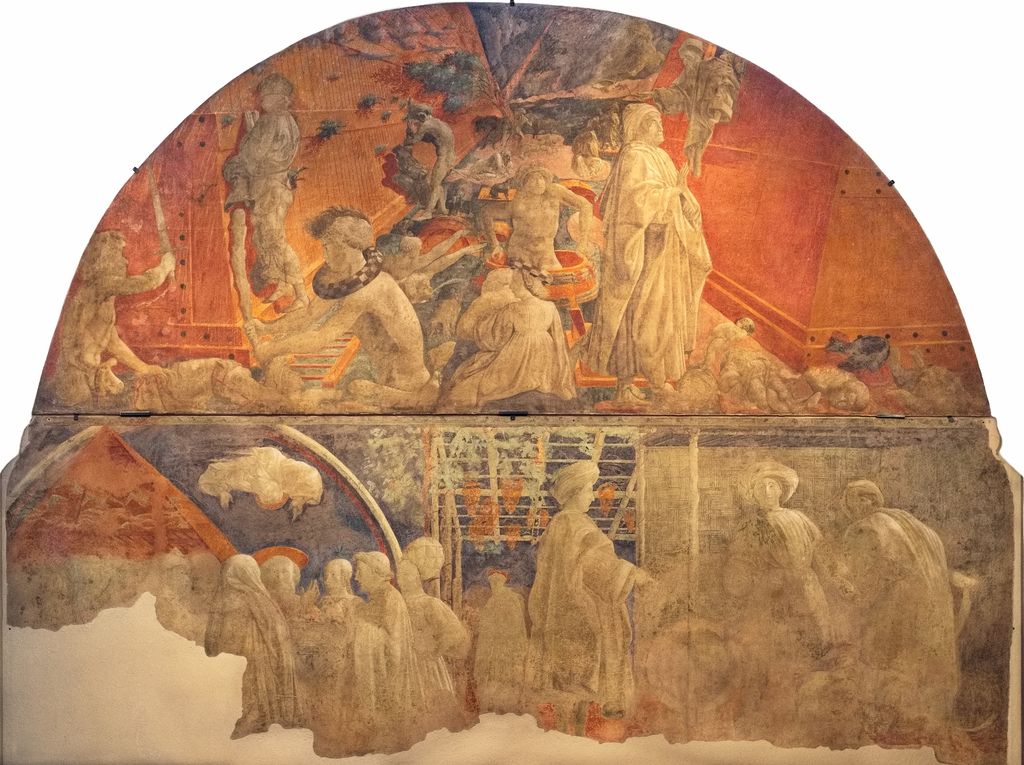
Noah and the Flood
The Flood and Recession of the Waters above the lower episodes from Noah’s story, Santa Maria Novella. Photograph by Armin Kleiner. Image source. CC BY-SA 4.0. Resized for the web. This derivative is available under the same licence.
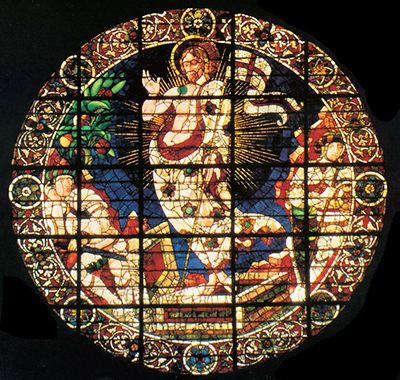
The Resurrection of Christ Stained Glass Window
The Resurrection window in Florence Cathedral, designed by Paolo Uccello and made by Bernardo di Francesco. Photograph by Sailko. Image source. CC BY 3.0. Resized for the web.