by Tom Gurney
Tom Gurney BSc (Hons) is an art history expert with over 20 years experience
Published on June 19, 2020 / Updated on October 14, 2026
Email: tomgurney1@gmail.com / Phone: +44 7429 011000
A palace gallery built around one royal life
Peter Paul Rubens's Marie de' Medici cycle consists of 24 monumental canvases made for a gallery in the queen's Luxembourg Palace in Paris. They tell a version of Marie's life through historical episodes, portraits, classical gods and personified ideas. The paintings were made from 1622 to 1625 and are now in the Louvre. Their account is not a neutral illustrated diary: the Louvre reads the series as a political defence of a queen whose authority and relations with her son, Louis XIII, were contested.
The sequence originally occupied a particular architectural space. Three portraits were on the entrance wall, ten narrative paintings lined each long side, and a large picture stood at the far end. A visitor moved through the queen's story rather than encountering isolated canvases in alphabetical order. The Louvre's March 2026 restoration dossier gives the clearest current account of that layout and of the contracts, workshop production and later history. Its cautious language is important: no contemporary view of the original gallery survives, and the precise making of some passages remains incompletely documented.
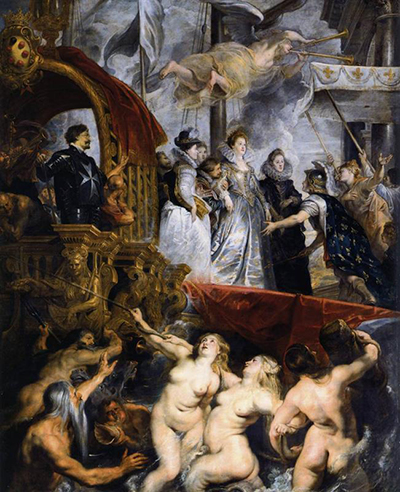
Four individual canvases already have verified pages in this cluster: Marie's arrival at Marseille, her meeting with Henri IV at Lyon, the capture of Jülich, and her triumphant-queen portrait. Each has a separate Louvre catalogue record, material and size. They give entry points into the programme without pretending that four paintings are the whole series. A separate unfinished Prado portrait of Marie is not one of these Louvre gallery canvases.
At a Glance
- Cycle24 canvases: 21 episodes and three portraits [1]
- Contract26 February 1622; delivered 1625 [1]
- Original settingMarie de' Medici's Luxembourg Palace [1][2]
- Current collectionMusée du Louvre, Paris [1][2]
Marie, patronage and the 1622 contract
Marie de' Medici was the widow of Henri IV and mother of Louis XIII. After Henri's assassination in 1610, she became regent for her young son. Her power and later conflict with him made her public image politically charged. The Louvre's historical essay treats the cycle as part of her effort to establish legitimacy and narrate her reign favourably. That is an interpretation of a patronal programme, supported by its choices of events and allegory; it should not be written as though the canvases were independent witnesses to everything they show.
Preliminary discussions between Rubens and the French crown began in summer 1621. The Louvre dossier dates the two gallery contracts to 26 February 1622. One gallery was to tell Marie's life; the other was intended for Henri IV. The Marie series was painted in Antwerp by Rubens and his workshop and delivered in 1625. This resolves a common chronological shorthand: a source that says the commission began in 1621 may refer to negotiations, while 1622 names the signed agreements. Neither date is the year of every historical event painted in the pictures.
The commission was exceptionally large for Rubens. The Louvre describes nearly 293 square metres of painted surface across the cycle and identifies it as the largest commission he and his workshop delivered. The scale explains why organisation, transport and architectural fit mattered. These were canvases intended to occupy wall bays in a royal residence, not a stack of interchangeable easel paintings. The workshop and collaborators guide explains why “Rubens and his workshop” can be a more accurate production description than either a single hand for every passage or an anonymous factory.
How the original gallery was read
According to the Louvre's 2026 dossier, the entrance lay at the south end of a gallery running north. A visitor met three portraits at the entrance, then ten paintings on each long wall, before a larger canvas at the far end. The two long walls together formed a narrative passage through Marie's life. This arrangement places the portraits in a framing role: the queen and her family identities introduced the story before the visitor walked through episodes of marriage, regency, rule and reconciliation.
The exact original experience cannot be recreated from a surviving eyewitness view. The dossier explicitly says no contemporary image of the Luxembourg gallery survives. Its plan draws on surviving works, documents and architectural evidence. The present Louvre gallery aims to restore a narrative order, but its room is not the same narrow palace corridor with the same window and wall conditions. A modern photograph of the Louvre hang therefore cannot be captioned as “the gallery as Marie saw it.”
The count of 24 is also easy to misunderstand. The Louvre describes 21 episodes and three portraits. The portraits are part of the cycle, not additional works beyond the 24. The intended Henri IV series was a separate project and should not be added to this count. The distinction matters when an overview claims “24 scenes from Marie's life”: three canvases were portraits that framed the narrative rather than episodes of one event.
History presented through allegory
Rubens used a language in which gods, sea beings, Fame, Victory and personified cities interact with historical people. The results present Marie's rank, marriage, regency and political claims in heroic terms. The Louvre interprets this mingling of history and mythology as part of a defence of her legitimacy. It is not enough to identify the goddesses and stop there; we must ask what the arrangement says about a patron's version of events.
Allegory can transform an arrival into a civic welcome, a marriage into a union endorsed by gods, or a military success into a statement of sovereign command. The represented date in a title names an event in Marie's life. The canvas itself was made years later, in 1622–25. A viewer should keep those two clocks in mind. The passage of time allowed the queen's court to shape a retrospective story, selecting moments and giving them a visual meaning suitable for a palace gallery.
This does not mean the underlying events were fictional. Marie did arrive in France, marry Henri IV and exercise power. The paintings ask viewers to interpret those events through royal iconography and political self-presentation. The diplomacy and courts guide places Rubens's other court work on its own timeline. This series is a major political commission, but it is not the same thing as his later 1628–30 peace missions.
Marseille: an arrival at sea, painted later
The Marseille landing canvas represents Marie's 3 November 1600 arrival in France. The Louvre catalogues it as INV 1774 / MR 965, oil on canvas, 394 × 295 cm. A Medici-armorial galley, the queen, welcoming personifications of France and Marseille, and Fame turn a port arrival into a ceremonial introduction. Sea divinities and Nereids fill the foreground, presenting the voyage as an event endorsed by forces beyond ordinary civic protocol.
The Louvre calls one sea being probably Proteus. “Probably” is part of the present interpretation, not a detail to smooth away. The precise identity of every creature is less essential than the function of the group: it enlarges Marie's arrival into a mythic spectacle. The 1600 in the event title is not the date of Rubens's painting, which belongs to the 1622–25 cycle. Keeping that distinction prevents an impossible claim that Rubens painted the Louvre canvas as an eyewitness report of her landing.
The panel's original place in the gallery mattered too. As part of a sequence it helped explain how a Florentine princess came to the French court. In isolation, the sea scene may first look like an exuberant mythological picture. Beside other episodes it introduced a dynastic and political narrative. The present Louvre object record supplies the title, dimensions and iconographic interpretation; it does not make every later summary of the event equally reliable.
Lyon: a royal meeting among gods
The Lyon canvas represents the meeting of Henri IV and Marie after her arrival in France. The Louvre's alternate title dates the represented meeting to 9 December 1600. It catalogues the canvas as INV 1775 / MR 966, again oil on canvas, 394 × 295 cm. Rubens depicts Henri with the attributes of Jupiter and Marie as Juno; Hymen carries a marriage torch. Historical union and divine marriage language are made to support each other.
The personified city of Lyon sits on a chariot drawn by lions, a visual pun on its name. The Louvre explicitly identifies this figure as Lyon, not Cybele, a label repeated in older descriptions. The correction matters because a city welcoming the royal couple has a different political function from an ancient goddess appearing in a generic myth. The actual city also appears in the background. These layered signs connected a specific French place to the queen's dynastic story.
The 1600 event and 1622–25 canvas are again separate dates. Rubens was not simply painting a record of a marriage encounter as it unfolded. He was designing a retrospective gallery for Marie. The Lyon picture makes the marriage look auspicious, ordered and celebrated by divine and civic witnesses. That is a statement about how the patron wished viewers to understand the past.
Jülich: a regent's victory staged as command
The Jülich canvas is currently identified by the Louvre as The Capture of Jülich, 1 September 1610, INV 1781 / MR 972, oil on canvas, 394 × 295 cm. The local URL preserves an older spelling and title for continuity, while the page uses the Louvre's present identification. The represented event occurred during Marie's regency; the canvas was made with the cycle in 1622–25. That gap allowed the military event to become an argument for her political ability.
Marie appears in armour with a command baton. Victory crowns her; Fame sounds a trumpet. The Louvre identifies Generosity at the left with a lion. These personifications turn an episode in a campaign into a royal triumph. They present Marie as an active source of authority even though the painting's making came well after the event. The old title “Triumph of Juliers” captures the celebratory tone but is less precise than the museum's current object title.
This picture also illustrates a limit in authorship claims. The Louvre notes that the background surrender scene may involve another hand, perhaps the battle painter Pieter Snayers. It does not present that assignment as certain. A short summary of the series as entirely by Rubens would erase the possible specialist contribution here; naming Snayers without qualification would go too far in the other direction. The painting belongs to a cycle that the Louvre describes as largely autograph but made by Rubens and his workshop.
A triumphant queen at the entrance
The triumphant-queen portrait is one of the cycle's three portraits, not a fifth historical episode. The Louvre catalogues it as Portrait of Marie de Médicis as a Triumphant Queen, INV 1792 / MR 983, oil on canvas, 276 × 149 cm. The museum's individual date field is broad, while the cycle's production is 1622–25. Its record says the portrait originally hung above a fireplace on the gallery's entrance wall.
Marie holds a Victory figure and a royal sceptre, while butterfly-winged cupids crown her with laurel. The image frames her as a sovereign associated with triumph and peace. Older writers called her Bellona or Minerva, but the Louvre now favours the description of a triumphant queen on the basis of the Baluze memorandum. The retained local route includes “Bellona” for continuity; the public title and interpretation follow the museum's current catalogue. She should not be described as literally transformed into the Roman war goddess.
This entrance portrait establishes a key for the narrative paintings. Before the visitor reaches a landing, marriage or victory, Marie is presented in an elevated royal guise. The portrait's placement and attributes make the programme's point of view visible. It is a queen's story told for the queen's palace, and its historical episodes are chosen and arranged within that act of self-presentation.
Making, incompletion and survival
The 2026 Louvre dossier describes the Marie cycle as largely autograph, while also stating that Rubens and his Antwerp workshop realised it and that surviving process documents leave gaps. The older Louvre gallery guide says Rubens made the series “singlehandedly,” a compressed description in tension with the newer research. The more careful account is that Rubens directed and substantially painted an enormous commission with workshop participation whose exact distribution is not fully known. Individual object records may add qualified possibilities, as for Jülich.
The intended Henri IV gallery was separate. The Louvre says work on it barely began in 1628–31 and was abandoned after Marie's 1631 exile. It is not a second completed 24-canvas pendant, and it does not alter the count of Marie paintings. The existing Marie cycle survived even though it left its original Luxembourg Palace setting. Its later Louvre display preserved the canvases but changed the architectural encounter through which the narrative was first meant to unfold.
In March 2026, the Louvre announced a multi-year conservation programme for the 24 canvases, planned in the present Galerie Médicis. Its gallery page currently marks the room temporarily closed. This is dated visitor information, not a promise about access when this article is read later; consult the Louvre gallery page[2] for current conditions. Conservation may sharpen future understanding of materials and participation, so this guide should be reviewed against new object records when that work is published.
Reading the cycle through four objects
The four local Louvre pages show four different jobs within the programme. Marseille presents entry into France, Lyon presents royal union, Jülich makes a claim for regency command, and the triumphant-queen portrait establishes royal identity at the entrance. They are not interchangeable illustrations of “Marie de' Medici.” Each has its own Louvre inventory number, dimensions, represented event or portrait function and place in the sequence. The separate Prado portrait should remain separate too.
Read the cycle with two questions together: What historical claim is being made, and how does Rubens's allegory make it persuasive? The Louvre's dossier supports an account of the commission and original display, while the current object records anchor individual claims. That combination respects the paintings as both political images and physical works made, moved, studied and conserved across four centuries.
The political story Marie wanted to tell
The Louvre's historical introduction to the cycle[1] asks readers to consider Marie's reputation as well as the painted events. She faced questions about dynastic legitimacy and about her exercise of power after Henri IV's death. Rubens's canvases answer those pressures visually: France receives the foreign bride, the royal marriage becomes a union favoured by heaven, the regency becomes prudent government, and moments of military or diplomatic policy become triumphs. The sequence is thus evidence of how a patron wished to be seen. It is a poor substitute for an impartial chronicle of French politics between 1600 and the 1620s.
One decisive political commitment was Marie's preference for closer ties with the Habsburg monarchies. The Louvre relates this to the double marriage alliance between France and Spain. In the painting of the exchange of the two princesses at the Bidassoa, the mother who advanced that policy is not represented in the scene. The two young women and personifications of the kingdoms carry the message. Their passage across a river stages peace between powers and dynastic continuity; it also lets the gallery attribute a consequential diplomatic achievement to Marie's regency without depicting her in every picture. That omission is useful evidence against reading the series as a literal, scene-by-scene visual diary.
The Louvre dossier[1] also cautions against treating Cardinal Richelieu's absence from the paintings as an accidental gap. At the time of the 1622 commission his later dominance was not yet the settled outcome of court politics. In the narrative designed for Marie, her own authority remains central. Events after the delivery of the cycle would change the political balance: the 1630 struggle between mother and son ended with Louis XIII choosing Richelieu and Marie leaving France. The paintings do not foresee that defeat. Their purpose was to formulate a persuasive account at the moment the queen commissioned them.
A turning point at the end of the first wall
The great canvas at the far end of the original gallery brought two moments together: Henri IV's death and Marie's proclamation as regent on 14 May 1610. The Louvre's detailed account[1] describes a two-part composition. Above, the dead king is received in an apotheosis; below, the widowed queen takes up government with figures of wisdom and providence around her. This is more than a decorative climax. The first long wall moved toward the loss of Henri IV, while the visitor's return along the other side followed Marie's political agency. The picture at the turn made grief and succession operate as one argument.
The portraits at the entrance performed another kind of framing. Images of Marie's parents flanked her own triumphant portrait above the central fireplace. They introduced a dynastic lineage before the historical sequence began, while the triumphant queen could be encountered again on leaving the gallery. The Louvre describes this as a story that departed from, and ultimately returned to, Marie's elevated image. To read the paintings only as 21 individual episodes misses this architectural logic: the gallery made the queen's person both the source and the conclusion of its narrative.
Not every painting in the eventual sequence simply fulfilled a fixed list drawn up in 1622. The Louvre records that The Felicity of the Regency was devised in Paris in 1625 in place of a politically awkward subject about Marie's departure from Paris after the killing of Concino Concini. Rubens explained the replacement to Nicolas-Claude Fabri de Peiresc in a letter dated 13 May 1625, according to the dossier. A change in subject required a change in the order of the pictures. The case is unusually revealing because it connects political sensitivity, artist-patron negotiation and the material arrangement of the gallery. A later viewer should be careful about describing the finished sequence as the untouched execution of a single original programme.
What the surviving canvases can and cannot tell us
The complete 24-canvas series has survived, but no contemporary picture of its original Luxembourg Palace installation is known. The Louvre's reconstruction rests on documentary and architectural evidence, including the shape and location of the gallery's doors, fireplace and windows. Its present room is a later museum installation. Even when the canvases are placed in narrative order, the light, movement and sightlines are different from those a visitor to Marie's palace encountered. A photograph of today's gallery can show the paintings together; it cannot recover exactly how the queen, a courtier or a foreign ambassador experienced the first hang.
Nor is every question of artistic participation closed. The Louvre's 2026 account says the cycle is largely by Rubens's own hand, correcting a convenient assumption that a vast commission must have been delegated wholesale. It also acknowledges workshop production and patchy records of the making. These statements belong together. One can credit Rubens with designing and painting the central achievement without pretending to know the precise distribution of brushwork across nearly 293 square metres. The possible battle specialist in the Jülich background remains a qualified hypothesis, not a signed contribution.
Surviving sketches offer glimpses of choices before the final canvases. The Louvre dossier names studies in Munich, Saint Petersburg, Copenhagen and elsewhere for selected subjects. A sketch may be smaller, monochrome, reversed or differently arranged; its existence does not make the final painting a simple copy. The lost sketch for one scene is known through a later copy, a further distinction. Such evidence helps trace a design process, but each study needs its own collection record before a close visual comparison is made. The object pages in this cluster focus on the four canvases whose local images and Louvre catalogue identities have been checked.
The cycle's later life and conservation
The history of the series did not stop when it left its first gallery. The Louvre's 2026 chronology[1] traces ownership through Marie's son Gaston d'Orléans and his heirs before the palace and pictures entered the royal domain in 1696. The gallery was open to the public for a period in the eighteenth century. The canvases moved to the Louvre in 1790, returned to the Luxembourg Palace from 1802 to 1815 in a different wing, and were definitively installed in the Louvre in 1816. Later galleries could not always show all 24 together; an integral display in the Richelieu wing dates from 1993. Each move changed the setting and sometimes the practical conditions of display, even though the paintings remained the same series.
A sequence of this size also has a physical history. The Louvre records preventive measures in the eighteenth century, including efforts to manage winter heating and strong sunlight in the Luxembourg Palace. Restorations are documented from the 1730s onward. By the time of the recent studies, the 24 canvases had all undergone structural work of one sort or another: some were lined with additional canvas, while others had been transferred from their original support to a replacement. The last comprehensive treatment of their paint layers took place in 1950–51. These interventions may affect how present viewers see colour, surface and even the edges of a composition. A reader should not assume that the appearance of an aged, varnished canvas is an untouched record of Rubens's original paint.
The Louvre's planned multi-year restoration follows a 2016 condition survey and detailed studies in 2020 and 2023. The museum reports lifting paint in some works, aged varnish and earlier retouching that has become visually disruptive. The 2023 investigation used visible, raking, ultraviolet and infrared photography, X-rays and targeted pigment analysis. The purpose is both to stabilise the large canvases and to learn more about their materials and the way the cycle was made. The proposed treatment is to take place in the gallery itself because moving the largest paintings repeatedly presents its own risks. These are the museum's stated plans and condition findings as of October 2026; they are not claims that a treatment has already produced particular discoveries. For current public access, consult the Louvre's room notice[2], which presently says the gallery is closed.
Frequently Asked Questions
There are 24 canvases: 21 episodes and three portraits. They were made for the queen's Luxembourg Palace gallery and delivered in 1625. The incomplete Henri IV gallery was a separate project.
Discussions began in summer 1621; Rubens signed the gallery contracts on 26 February 1622. The Marie paintings were made from 1622 to 1625. Dates such as 1600 or 1610 in individual titles refer to depicted events.
The Louvre's 2026 dossier calls the cycle largely autograph while stating it was realised by Rubens and his workshop. The detailed division of work is incompletely documented, and possible specialist help in the Jülich background remains qualified.
In a gallery at Marie's Luxembourg Palace in Paris: three portraits at the entrance, ten paintings on each long wall and a larger work at the far end. No contemporary view of that original gallery survives.
The established route retains that older name, but the Louvre now identifies INV 1792 / MR 983 as Portrait of Marie de Médicis as a Triumphant Queen. It is one of the three entrance portraits, not a narrative event.
Discussion
Which canvas best shows the cycle's political argument?
Share a Louvre record that sharpens an object identification.
Reader Insights
How does the entrance portrait shape the sequence?
Which event date is most easily confused with a painting date?
What can conservation clarify about the cycle's making?
Join the Conversation
Add a specific observation or source below.
References
- Louvre, March 2026 restoration dossier for the Marie de Médicis cycle. View source
- Louvre, Galerie Médicis overview. View source
- Louvre, The Disembarkation of the Queen at Marseille , INV 1774. View source
- Louvre, The Arrival of the Queen at Lyon , INV 1775. View source
- Louvre, The Capture of Jülich , INV 1781. View source
- Louvre, Portrait of Marie de Médicis as a Triumphant Queen , INV 1792. View source