 by Tom Gurney
Tom Gurney BSc (Hons) is an art history expert with over 20 years experience
Published on June 19, 2020 / Updated on November 5, 2026
Email: tomgurney1@gmail.com / Phone: +44 7429 011000
Study for Charity
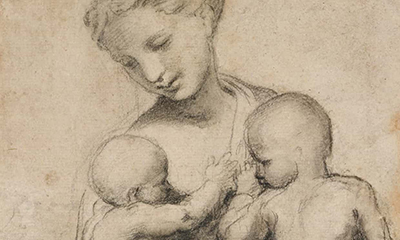
A woman inclines her head towards the children gathered against her body. Their close contact gives the group an immediate human meaning: one small figure reaches towards her breast, while another turns inward beneath her attentive gaze. The image makes care visible through the direction of heads, the placement of hands and the nearness of bodies.
The drawing is the Ashmolean Museum's Charity, WA1846.294, catalogued by the museum as Raphael in black chalk heightened with white on off-white paper. The image displayed here is a detail of its upper group. The full sheet continues below this crop into the seated woman's drapery and legs. [1]
At a Glance
Two dated points of context
Contents
The downward turn of the head
The woman's head establishes the group's principal inclination. It does not face outwards towards the viewer. Its downward angle directs attention into the space occupied by the children, making her apparent engagement with them more important than an independent portrait likeness.
Small shadows around the eyelids, nose and mouth help give the face its volume. The hair receives a more active pattern of marks above it. Between these passages, the relatively pale forehead and cheek remain readable without a continuous dark border enclosing every feature.
The effect is especially clear in the cropped detail. Here the head occupies a large part of the image, so its tilt can initially seem to determine the whole composition. Following that movement downwards reveals how it answers the children's positions. The expression becomes part of a bodily relationship rather than a separate emblem of feeling.
Touch and the children's movement
The children introduce different directions within the same small space. One rounded head appears in profile against the woman's chest; another is seen at a different angle. Their bodies do not repeat one another mechanically. Each contributes a particular contact, turn or reach.
A child's extended arm provides an especially direct connection. Its small hand approaches the woman's body, making the action of feeding or seeking nourishment part of the design. Beside it, the other child's inward turn reinforces the sense that attention is concentrated within the group.
Notice how little surrounding narrative is needed. There is no elaborate room or landscape explaining who has arrived or what will happen next. The relations between the figures carry the action. Their closeness gives the drawing an intimacy that remains legible even when the composition is viewed through the surviving upper detail.
Chalk, softness and emphasis
The museum's medium description identifies black chalk with white heightening. The dark material supplies both contours and areas of tone. Some outlines are reinforced, while others soften into the surrounding paper. This variation allows the figures to emerge without the uniform hardness of an equally emphatic edge around every body. [1]
Compare the stronger passages around the woman's neck and clothing with the more gently developed children's heads. The differences help separate forms that occupy a crowded space. A dark area can give weight to an overlap; a lighter contour allows another surface to turn more gradually towards the light.
The drawing therefore combines closeness with distinction. The bodies touch, but they remain individually readable. Look first at the dark connections between them and then at the pale areas inside their contours. The group depends on both. Its tenderness is supported by a clear organisation of forms, rather than an absence of structure.
From the detail to the full sheet
The Ashmolean's full-sheet reproduction shows how the upper group belongs to a larger seated figure. Drapery broadens below the children, and the arrangement of the legs continues the composition towards the bottom of the paper. The crop concentrates attention on the faces and feeding gesture, while the full drawing gives those actions a more substantial bodily setting. [1]
This difference matters when judging the design. In the detail, the figures seem tightly pressed against the picture's edges. On the complete sheet, the woman's lower body provides a broader support. The inclination of her head belongs to a figure whose weight extends beyond the immediate meeting of faces and hands.
Neither view exhausts the drawing. The detail makes small expressions and contacts easy to study; the full sheet clarifies the relation between the intimate upper group and the seated body as a whole. Moving between them helps distinguish the emotional concentration of the subject from the physical organisation that sustains it.
The connection with the Hall of Constantine
The Royal Collection records a closely corresponding Ashmolean drawing under WA1846.294 in its catalogue entry for an engraving of Charity, dated 1643. That print follows the allegorical figure painted by Raphael's workshop beside Pope Urban I in the Vatican's Hall of Constantine. It is a later reproductive object, distinct from the drawing itself. [2]
This connection places the maternal group within an allegorical setting. A woman caring for children can convey a virtue through recognisable human action. In the drawing, the name Charity gives a broader meaning to gestures that can first be understood simply as nourishment, attention and protection.
The relationship should remain carefully expressed. The collection record establishes a close correspondence; it does not supply a precise date for the Ashmolean sheet. Nor does the engraving's date become the drawing's date. Each object belongs to its own material form and history, even when their figures are strongly related.
Raphael's drawings and his workshop
The Vatican Museums explains that the Hall of Constantine was decorated by Raphael's school using his drawings, with the work continuing after his death in 1520. Its account distinguishes that workshop decoration from the two oil-painted figures now confirmed as Raphael's own work, Comitas and Iustitia. Charity should not be confused with either of those figures. [3]
The distinction allows us to value a drawing without treating every related wall painting as the work of the same hand. Raphael's designs and his pupils' execution belong to connected activities, but they are not interchangeable descriptions. The Ashmolean's wider drawing research likewise examines invention and design across works by Raphael and his school. [4]
Returning to the sheet brings that larger history back to a few visible actions. The woman's head bends, a child reaches, and adjacent bodies find their place against one another. These are modest movements, yet their coordination makes an abstract virtue approachable. The drawing's strength lies in allowing an allegorical subject to remain inseparable from the physical experience of giving and receiving care.
Selected Raphael drawings
Four individually documented Raphael drawings, with recto and collection numbers distinguished. This is a selected directory, not a complete catalogue.
| Name | Date | Medium |
|---|---|---|
| Portrait of a Youth | c. 1500–1 | Black chalk with white heightening, largely lost Object source. |
| Virgin with the Pomegranate | c. 1504 | Black-grey chalk Object source. |
| Seated Male Nude — recto | c. 1511–14 | Black chalk on off-white paper Object source. |
| Charity | Not dated in the cited museum record | Black chalk heightened with white Object source. |
Frequently Asked Questions
No. It shows an upper detail. The full Ashmolean drawing includes more of the seated woman's drapery and legs. [1]
No. It is the date of the separate engraving catalogued by the Royal Collection, which records a closely corresponding Ashmolean drawing. [2]
Discussion
Consider how the heads, hands and overlapping bodies make care visible.
Reader Insights
Which contact between the figures most clearly conveys care?
How does the cropped detail change the emphasis of the full seated group?
Where do softer and stronger chalk marks help distinguish overlapping bodies?
Join the Conversation
Share a detail, comparison or question about Study for Charity below.
References
- Ashmolean Prints, Charity, Raphael, accession WA1846.294. Museum object metadata and full-sheet reproduction. View source.Splash image: Charity, detail of the upper group. Black chalk heightened with white on off-white paper. Ashmolean Museum, Oxford, WA1846.294. The full sheet continues below the displayed crop.
- Royal Collection Trust, Seated woman with three children [Charity], RCIN 852978, engraving dated 1643. The catalogue identifies the workshop wall figure and explicitly records the closely corresponding Ashmolean drawing WA1846.294. View source.
- Vatican Museums, Hall of Constantine. Room decoration, workshop execution and the distinct autograph oil figures. View source.
- Ashmolean Museum, Drawings by Raphael and his School at the Ashmolean Museum. Museum research programme and the collection's evidence for invention and design. View source.