 by
Tom Gurney
Tom Gurney BSc (Hons) is an art history expert with over 20 years experience
Email:
tomgurney1@gmail.com
/ Phone:
+44 7429 011000
Life and Career: Introduction
Sanford Robinson Gifford built an international career around a sustained interest in landscape, light and atmosphere. Born in New York State in 1823, he grew up in Hudson, studied briefly at Brown University and trained in drawing in New York City. The mountains and waterways near his childhood home remained important throughout a working life that also took him to Europe, Egypt and the American West. [1]
His career joined travel with a stable studio practice and a close network of artists. He could make a detailed drawing during a journey, retain it for years and later develop a substantial canvas. Professional institutions, collectors and friendships helped those paintings circulate. His story therefore belongs to the history of places encountered and to the urban artistic world in which those encounters became public works.
Gifford died in 1880, aged 57. The paintings and records he left reveal a painter whose apparent serenity depended on active choices of viewpoint, format and emphasis. They also place his work within a life marked by military service, family loss, companionship and continuing professional commitments.
At a Glance
- Born July 10, 1823, Greenfield, Saratoga County, New York.
- Died August 29, 1880, New York City, aged 57.
- Raised Hudson, New York.
- Education Brown University, followed by New York drawing instruction.
- Principal field Landscape painting.
- Professional base New York, notably the Tenth Street Studio Building.
- Full National Academician 1854.
- Major journeys abroad 1855–1857 and 1868–1869.
- Western journeys Colorado and Wyoming in 1870; Northwest in 1874.
- Marriage Mary Cecilia Canfield, 1877.
- Memorial exhibition Metropolitan Museum of Art, 1880–1881.
Sanford Robinson Gifford in context
Bars show approximate historical periods. c. means circa (about).
Notes and sources
Hudson River School. A shared landscape tradition. Gifford worked among painters connected by scenery, travel, exhibitions and professional relationships. Their methods and subjects differed. [1]
Luminism. A retrospective category. The term was introduced in later scholarship for earlier painting concerned with light and atmosphere. It was not a formal group Gifford joined. [2]
American landscape painting. New York institutions and wider travel. An American career could encompass the Northeast, Europe, Egypt and the West, with observations developed in the New York studio. [1]
Each bar runs from the artist’s birth to their death.
J. M. W. Turner
1775–1851 · Birth–death [28]Thomas Cole
1801–1848 · Birth–death [29]Emanuel Leutze
1816–1868 · Birth–death [30]Sanford Robinson Gifford
1823–1880 · Birth–death [31]Eastman Johnson
1824–1906 · Birth–death [32]Frederic Edwin Church
1826–1900 · Birth–death [33]Albert Bierstadt
1830–1902 · Birth–death [34]Notes and sources
J. M. W. Turner. Paintings studied in Britain. Gifford examined Turner’s work and spoke with Ruskin during the first European journey. This was study of paintings, not a meeting with Turner. [1]
Thomas Cole. An influential predecessor. Cole’s example helped turn Gifford toward landscape. Gifford was not his formal pupil. [1]
Emanuel Leutze. Düsseldorf encounter, 1856. Gifford met Leutze among Americans abroad. Their contact belongs to a professional network extending beyond landscape subjects. [1]
Sanford Robinson Gifford. Open the key works view to follow selected paintings across his career. [1]
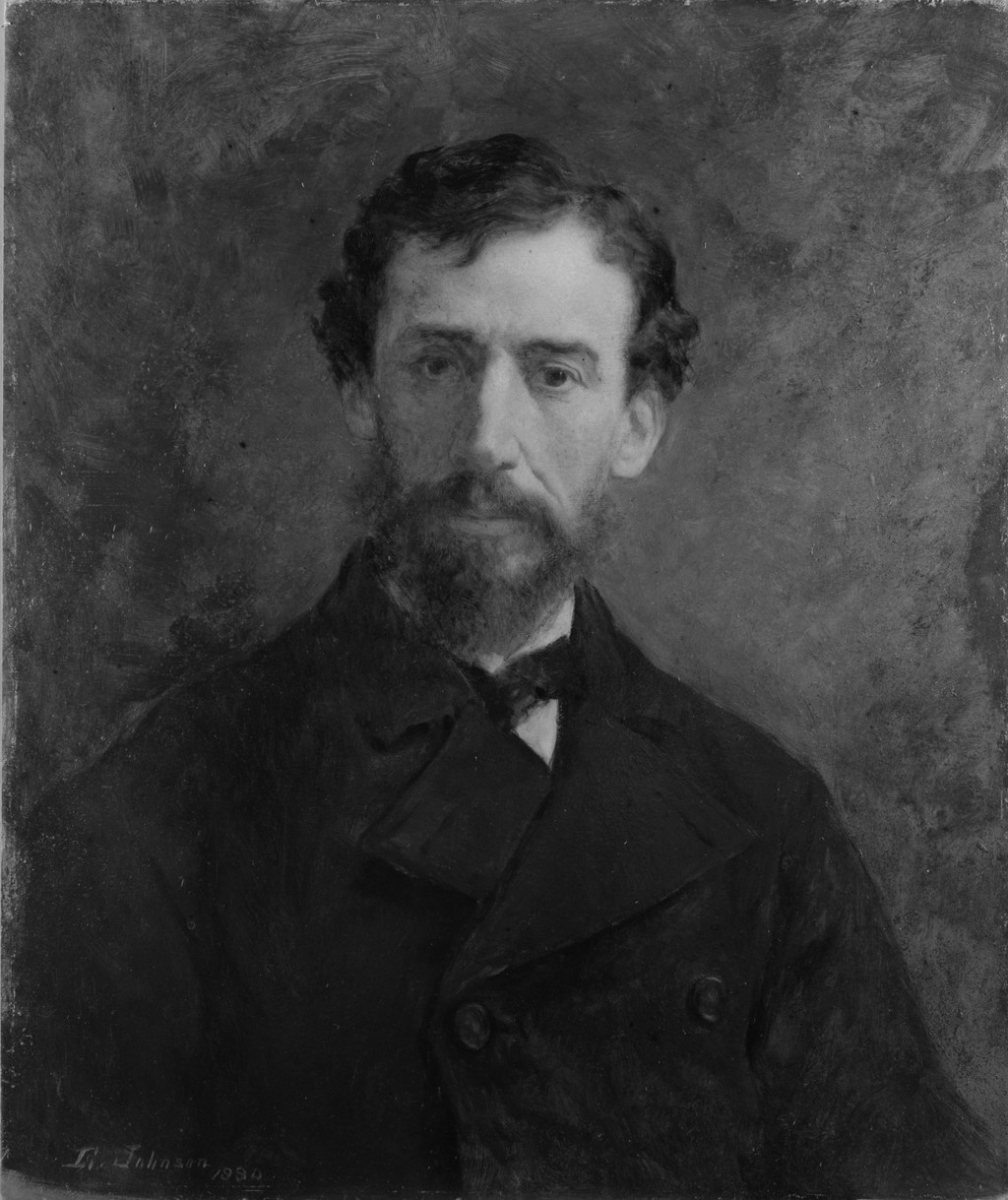
Eastman Johnson. Portrait dated 1880. Johnson’s oil portrait represents Gifford near the end of his life. The supplied monochrome reproduction is a painting image, not a photograph. [3]
Frederic Edwin Church. A contemporary colleague. New York professional life and encounters abroad connected the two landscape painters. Church was a peer, not Gifford’s documented teacher. [1]
Albert Bierstadt. Shared Italian travel, 1857. Travel in Italy connected Gifford with another American landscape painter whose later western subjects invite comparison. [1]
A Coming Storm
1863; retouched and redated 1880The Wilderness
1860Lake Nemi
1856–1857Tivoli
1870Siout, Egypt
1874Hook Mountain
1866Notes and sources
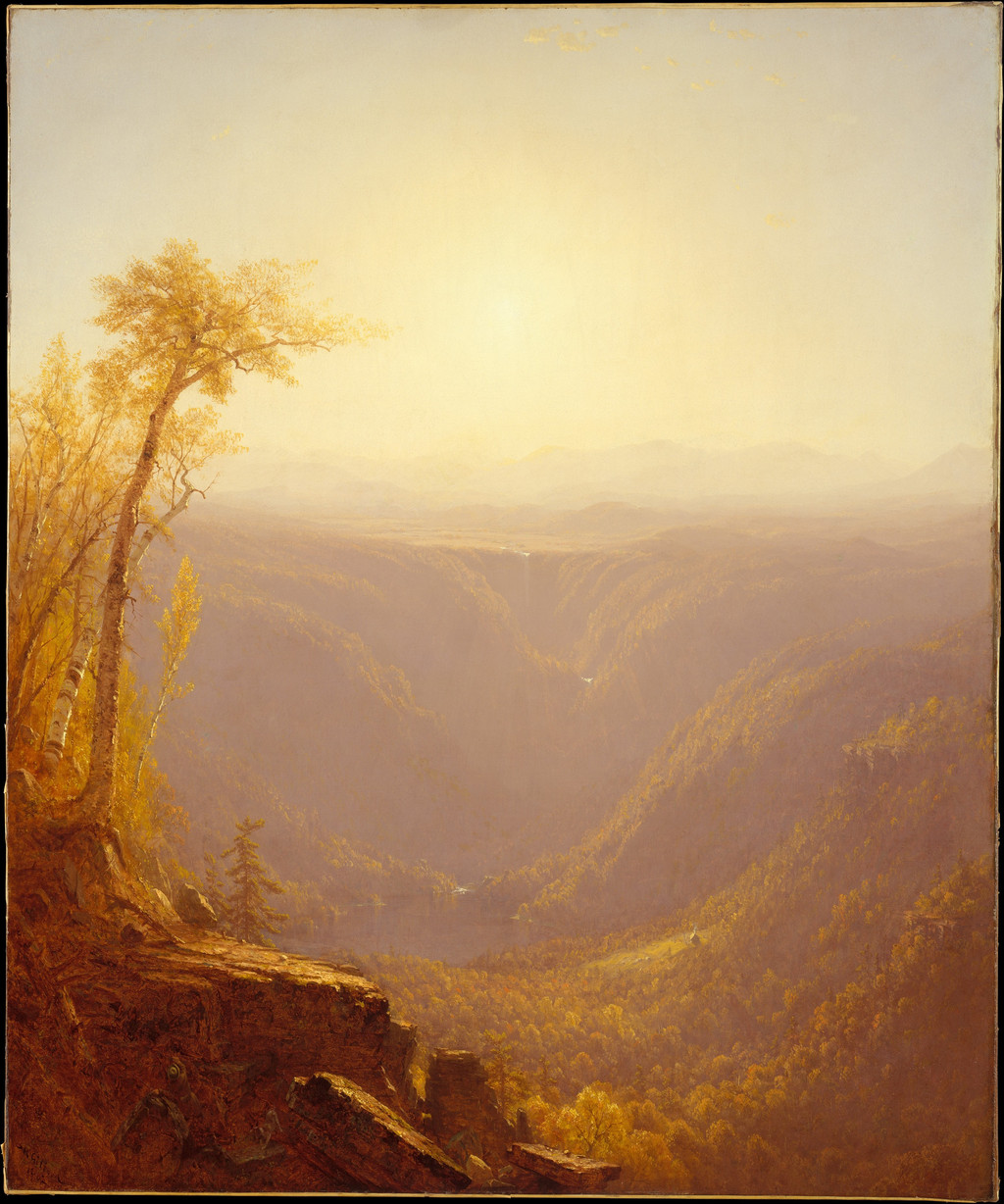
A Gorge in the Mountains (Kauterskill Clove). A dark lookout and framing tree direct attention into a luminous Catskill valley; the small hunter and dog establish scale. [4]
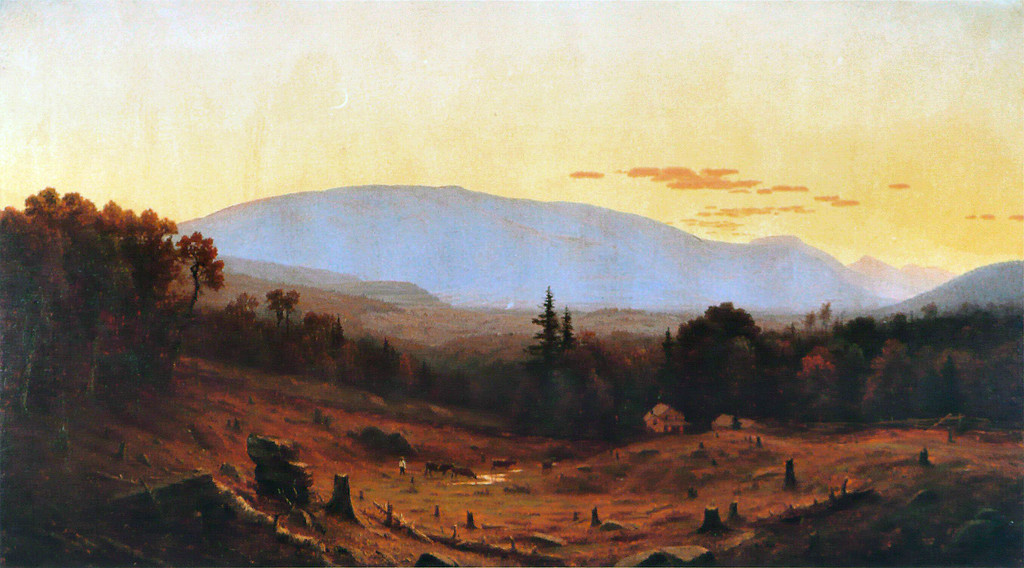
Hunter Mountain, Twilight. A broad clearing, farmhouse and cattle sit below the ridge. The cut ground makes human alteration part of the scene. [5]
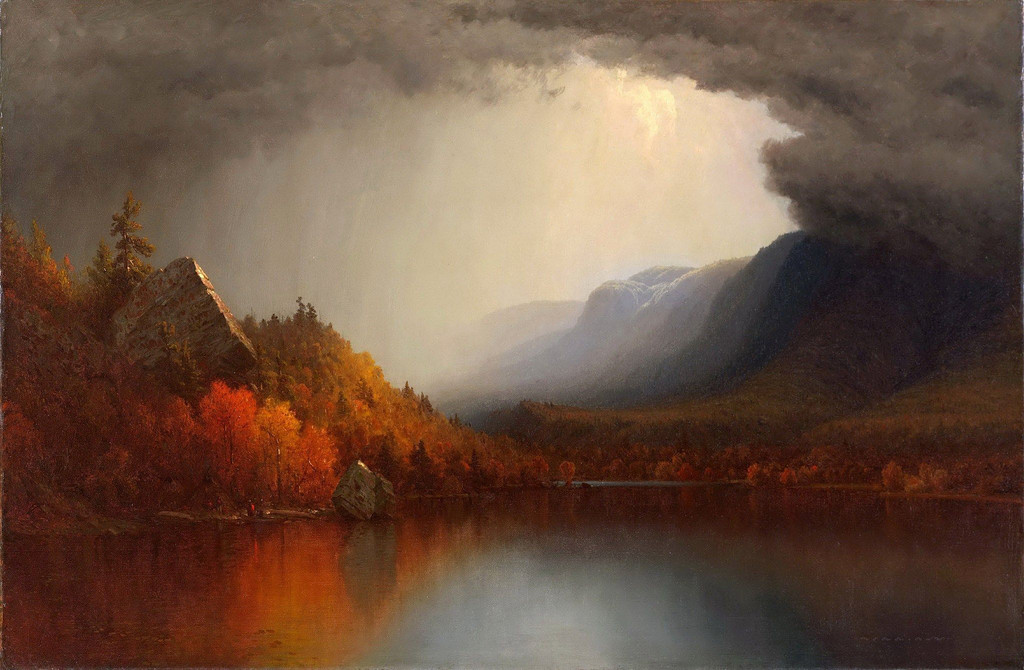
A Coming Storm. Cloud and remaining light organize Lake George. The band marks initial execution in 1863, not continuous work through the 1880 revision. [6]
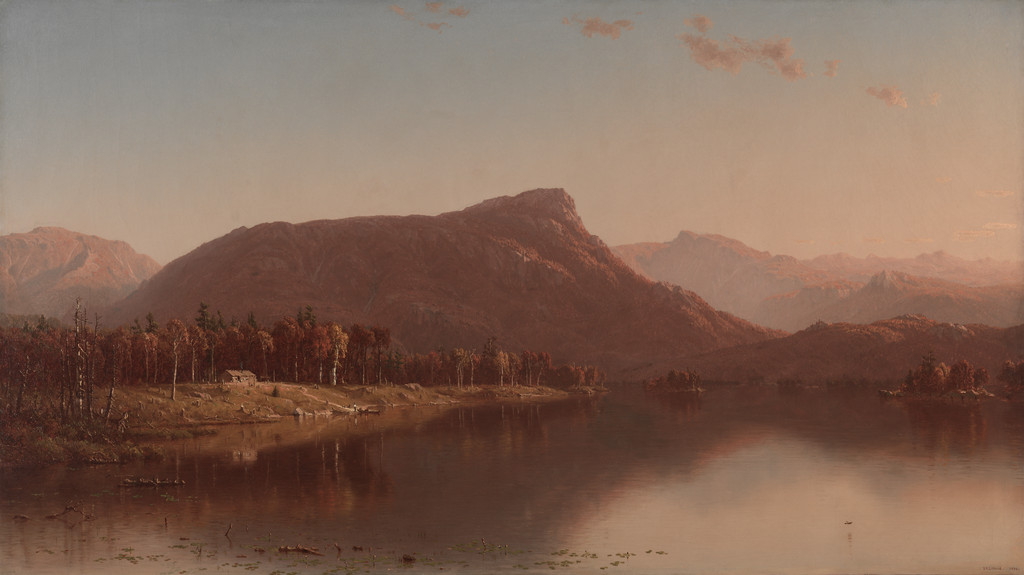
A Home in the Wilderness. The cabin, canoe and Mount Hayes setting develop drawings and an oil study into a larger inhabited landscape. [7] [1]
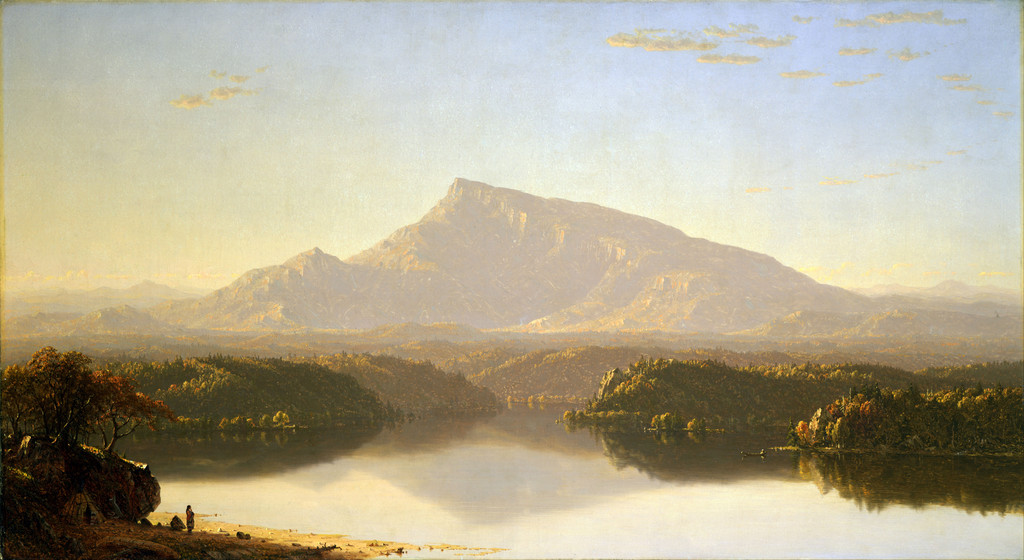
The Wilderness. Small travelers and a canoe occupy an extensive lake-and-mountain scene. The title does not establish an uninhabited place. [8]
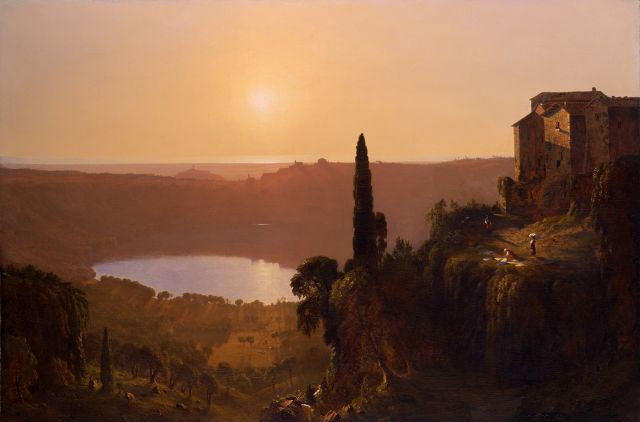
Lake Nemi. The ambitious Italian canvas belongs to the first European journey; 1858 is its New York exhibition year, not its creation date. [9] [1]
Tivoli. Town, cliffs and distant land become one atmospheric prospect; architecture contributes to the landscape’s organization. [10]
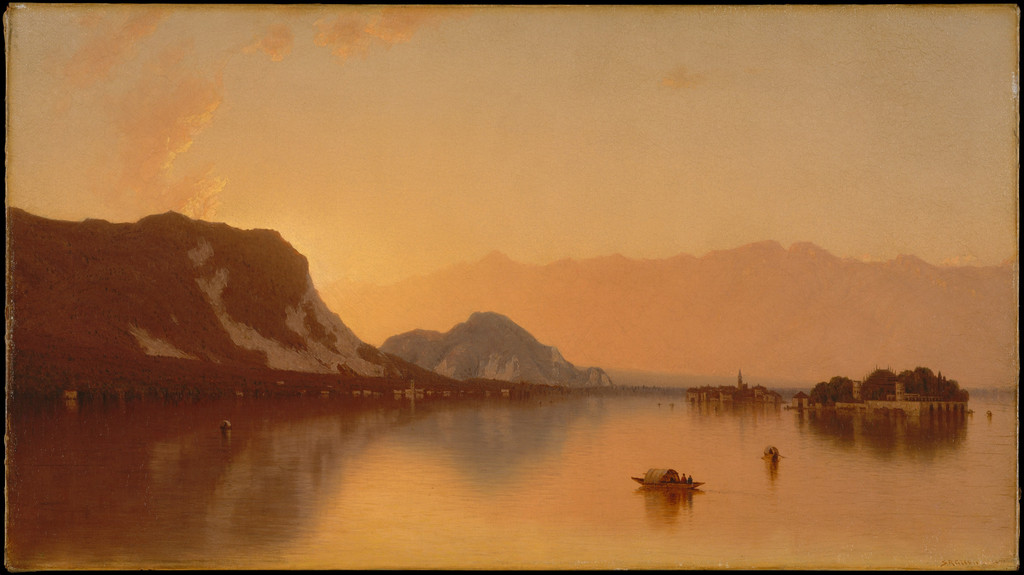
Isola Bella in Lago Maggiore. A Maggiore subject developed from recollection, including a study painted at Bellagio on Lake Como. [11] [1]
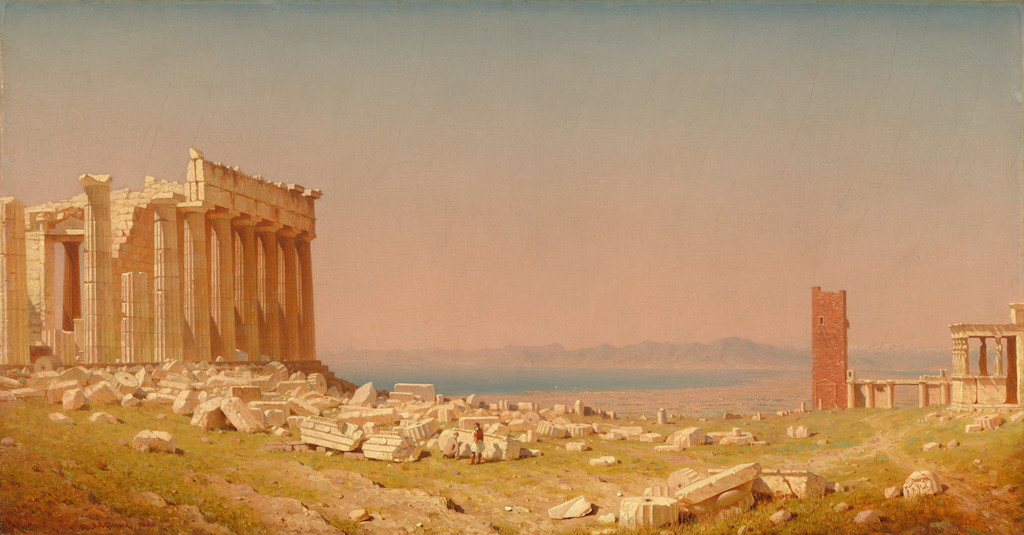
Ruins of the Parthenon. The 1880 canvas develops the detailed Acropolis drawing of 1869, with further decisions about sky and foreground. [12] [1]
Siout, Egypt. The 1874 canvas develops observations from the 1869 Nile journey, with people, fields, a foreground tent and settlement. [13] [1]
The Artist Sketching at Mount Desert, Maine. A seated painter, likely Gifford, appears among coastal rocks with working equipment; the self-portrait remains probable. [14]
Valley of the Chugwater, Wyoming Territory. A small Wyoming oil concentrates on rock formations and atmospheric distance. Jackson’s photograph provides separate fieldwork context. [15] [1]
Autumn, a Wood Path. A winding path, nearby trunks and a distant walker create depth within a more enclosed woodland. [16]
Mount Rainier, Bay of Tacoma—Puget Sound. The 1875 New York canvas develops 1874 northwestern observations; the canoe figures are not individually identified. [17] [1]
Hook Mountain. The wide Yale canvas is the 1866 horizontal work, distinct from later upright treatments of the related subject. [18] [1]
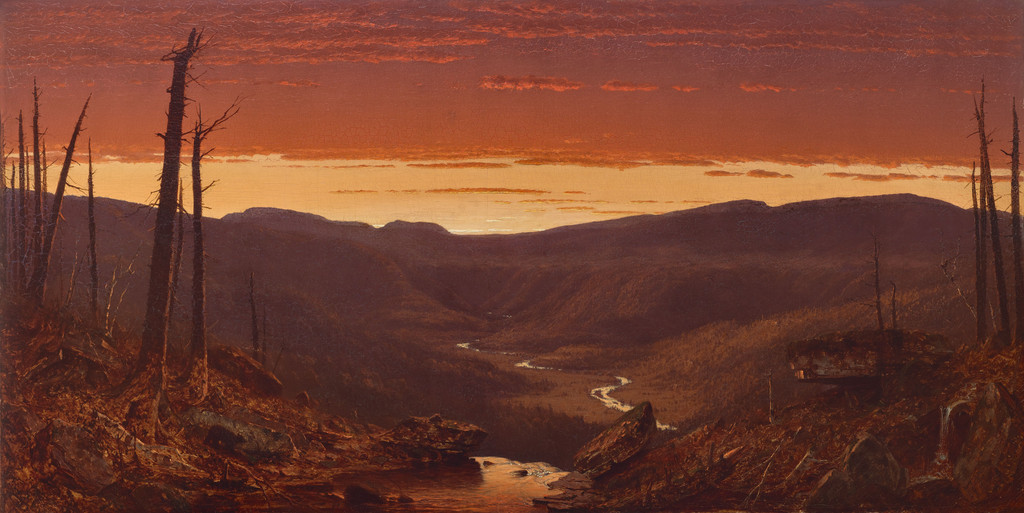
Twilight in the Catskills. Damaged or withered foreground trees contrast with luminous distance. Yale proposes a Civil War reading, not a fixed symbolic code. [19]
Contents
- A Hudson childhood
- Brown University and the decision to study art
- Choosing landscape and learning from Cole
- Establishing a professional identity
- The first European journey, 1855–1857
- The Tenth Street studio and a circle of colleagues
- Military service and family loss
- Mature landscapes and growing recognition
- The second journey: Europe, Egypt and Greece
- Collectors, institutions and public life
A Hudson childhood
Gifford was born in Greenfield to Elihu and Eliza Starbuck Gifford, the fourth of eleven children. The family moved to Hudson during his infancy. His father’s interests in iron founding and banking placed the household within a prosperous business community, giving Sanford a different starting point from the image of an artist entirely unsupported by family resources. [1]
Hudson also placed him near landscapes already attracting painters and travelers. The Catskills lay across the river, and Thomas Cole’s work helped give the region a growing artistic identity. Gifford’s eventual choice of landscape did not require him to discover an unknown setting. It developed in a place where scenery, tourism and painting were already becoming closely connected.
The household provided an early introduction to pictures. Franklin Kelly describes the importance of the engravings collected by Gifford’s older brother Charles. Looking at reproductions preceded the professional encounter with paintings in museums and studios. It allowed the young Gifford to become interested in visual art before the decision to make it his occupation. [1]
He attended Hudson Academy before enrolling at Brown. The connection with his earlier school persisted: in 1879 he gave it a painting of sunset on the Hudson. That later gift joins a public artistic career with the community in which his education began, without making every Hudson subject an autobiographical statement.
Four stages of Sanford Robinson Gifford’s career
These periods group related developments; painting, travel and local work overlap across their boundaries.
Choosing landscape
Drawing instruction and Academy classes preceded Gifford’s commitment to landscape. Northeastern sketching, the example of Cole and early exhibitions led toward full Academy recognition in 1854. [1]
Looking abroad and returning to work
The first European journey brought encounters with paintings, collections and fellow artists. After returning in 1857, Gifford took a Tenth Street studio and developed subjects gathered abroad and in the Northeast. [1]
Service, observations and major canvases
Military service interrupted the working year while landscape production continued. Gorge, Home and Hunter Mountain belong to this period of mature compositions, with the latter two shown in Paris in 1867. [1]
New journeys and retained memories
Europe, Egypt and Greece were followed by western journeys. Travel records supported later paintings, including the 1880 Parthenon canvas developed from a drawing made in 1869. [1]
Brown University and the decision to study art
Gifford entered Brown University in Providence in 1842. He attended for three semesters and officially withdrew in October 1844. He did not graduate. The move away from college was consequential because it preceded a deliberate period of artistic instruction in New York, rather than an immediate assumption that enthusiasm alone would make a professional painter. [1]
Accounts of possible early instruction from the Hudson painter Henry Ary remain qualified. Ary belonged to the regional artistic environment and may have helped Gifford, but the evidence does not justify presenting a fully documented apprenticeship. The distinction matters in a career whose influences were substantial even when the precise circumstances of teaching remain uncertain.
In 1845 Gifford moved to New York to study with John Rubens Smith. His instruction included drawing, perspective and anatomy. He also drew from antique casts and from life at the National Academy of Design. The Archives of American Art finding aid places these studies within his early development, while the 2003 catalogue provides a fuller account of the training and its context. [1] [20]
These skills remained relevant after landscape became his principal field. A mountain’s contour, the apparent recession of a riverbank and a figure’s proportion all depend on decisions that drawing can clarify. The early study of form did not disappear when his subject changed; it supplied tools that could be redirected toward a different kind of painting.
Choosing landscape and learning from Cole
Gifford initially worked with portraits and figure studies, but walking and sketching in the Catskills and Berkshires during the mid-1840s helped determine his direction. Kelly relates this change to Gifford’s own later account of finding greater freedom in landscape. The testimony is retrospective, yet the early exhibition record confirms the rapid importance of scenery to his public work. [1]
Cole supplied a powerful example. His paintings showed how American mountains, valleys and rivers could sustain ambitious art, while his foreign subjects offered another model of travel and recollection. Gifford admired that example, but he was not Cole’s formal pupil. Frederic Edwin Church’s documented study with Cole should not be transferred to Gifford merely because both belonged to the following generation.
The distinction allows influence to be understood more fully. A painter could learn from another’s compositions, reputation and choice of subjects without sharing a studio as an apprentice. Gifford’s early landscapes occupied terrain associated with Cole, while his mature pictures developed different relationships among atmosphere, detail and overall unity. Affinity did not require identical results.
His first National Academy exhibition contribution appeared in 1847. He also sent a Kauterskill Creek view to the American Art-Union. Titles such as The Past and The Present suggest early interest in the kinds of associations prominent in Cole’s work. Some of these paintings are now unlocated, so the titles cannot support a detailed reconstruction of their appearance. [1]
Establishing a professional identity
During the early 1850s Gifford continued sketching in the Northeast and exhibiting in New York. White Mountain and Adirondack journeys extended his range beyond the immediate Catskill setting. The work developed through repeated looking at different terrain, alongside the demands of making paintings that could hold attention in an exhibition. [1]
The National Academy became an important professional institution for him. He was elected a full Academician in 1854. His relationship with the organization continued through exhibitions and later disputes over policy. It supplied recognition and a community of colleagues, while also requiring choices about how art should be selected and presented publicly.
Critical approval was neither immediate nor unanimous. Kelly discusses early responses that recognized Gifford’s interest in space and light but questioned his handling of detail. These comments illuminate a developing disagreement about what a landscape should do. An effect admired as poetic unity by one spectator could appear insufficiently particular to another. Gifford’s reputation grew within those debates, rather than outside them. [1]
The first European journey, 1855–1857
In 1855 Gifford began an extended European journey. Britain provided opportunities to examine paintings associated with J. M. W. Turner and to meet the critic John Ruskin. Gifford had encountered Turner through reproductions before traveling; seeing paintings and collections brought that earlier interest into a new setting. The journey expanded both the scenery available to him and the art against which he could assess his own ambitions. [1]
Paris and the international exhibition introduced another range of painting. Kelly emphasizes Gifford’s growing concern with the unity of a picture, including responses to French work. His attention to detail therefore existed beside an interest in how all parts might contribute to one effect. This concern would remain central to his mature landscapes.
Travel brought contact with other Americans abroad. In Düsseldorf he met Emanuel Leutze, and in Italy he spent time with Albert Bierstadt. Rome offered a studio base during the winter of 1856–1857. The itinerary reveals an artist participating in an international professional network, with American friendships and European encounters interwoven.
Lake Nemi emerged from this first journey and became an important ambitious canvas. Its creation in 1856–1857 preceded exhibition in New York in 1858. The distinction captures the larger pattern of the trip: experience abroad could be transformed into a picture whose reception belonged to the returning artist’s American career. [1]
The Tenth Street studio and a circle of colleagues
Gifford returned to the United States in 1857 and took working quarters in the Tenth Street Studio Building. The building provided more than a room in which to paint. Other artists worked nearby, and studio receptions connected production with a public interested in seeing and discussing pictures. The urban base supported a career often associated with remote-looking landscapes. [1]
The finding aid identifies his studio as Number 19. That room number is distinct from the street address appearing in a surviving sketchbook. Archival details such as these place portable drawings within a working life that joined travel with a continuing New York address. The artist could leave for the mountains and return to the same professional neighborhood. [20]
Jervis McEntee and Worthington Whittredge were recurring companions, while John Frederick Kensett and other colleagues shared parts of his artistic world. Friendship could involve sketching, fishing, studio conversation, exhibitions and practical assistance. These connections help explain how landscape painting functioned as a social practice even when a finished picture emphasizes solitude.
Gifford’s membership in the Century Association and participation in artists’ organizations extended that network. He also worked with the Artists’ Fund Society, whose activities supported artists’ families. The chronology records him donating paintings and serving on its board in 1861. Such commitments add an institutional dimension to a life that cannot be represented by journeys and canvases alone. [1]
Military service and family loss
Gifford served with New York’s Seventh Regiment during the Civil War, returning to duty in successive summers from 1861 through 1863. His service took him to the Washington and Maryland region. Drawing and painting continued around these interruptions, and military subjects became part of his output alongside landscapes. [1]
The Camp Cameron photograph introduces this period with unusual immediacy. Gifford stands holding a rifle, while a seated African American man works beside him and other people remain visible inside the tent. The Library of Congress identifies the scene with 1861 and the surviving print with the 1880s. It is a later print of a wartime scene, rather than a photograph taken during the memorial decade. [21]
The photograph also makes the social setting wider than the biography of its named artist. The worker is not identified in the record used here. His visible labor belongs to the scene, but the image does not establish his name, age or legal status. Keeping him within the full composition preserves evidence that a tighter portrait of Gifford would remove.
The war years brought serious family losses. Gifford’s older brother Charles died in 1861, and his brother Edward died in 1863. These events formed part of his experience, but they should not become an automatic explanation for every evening landscape. The chronology of a particular painting and its exhibition needs to be established before a memorial purpose can even be proposed. [1]
Twilight in the Catskills was exhibited in spring 1861, before Charles’s death. Yale’s later Civil War reading is an interpretation of a work made within that historical moment, not proof that it was painted as a response to the subsequent bereavement. Biography can supply context while leaving an image’s meaning open to evidence and discussion. [19]
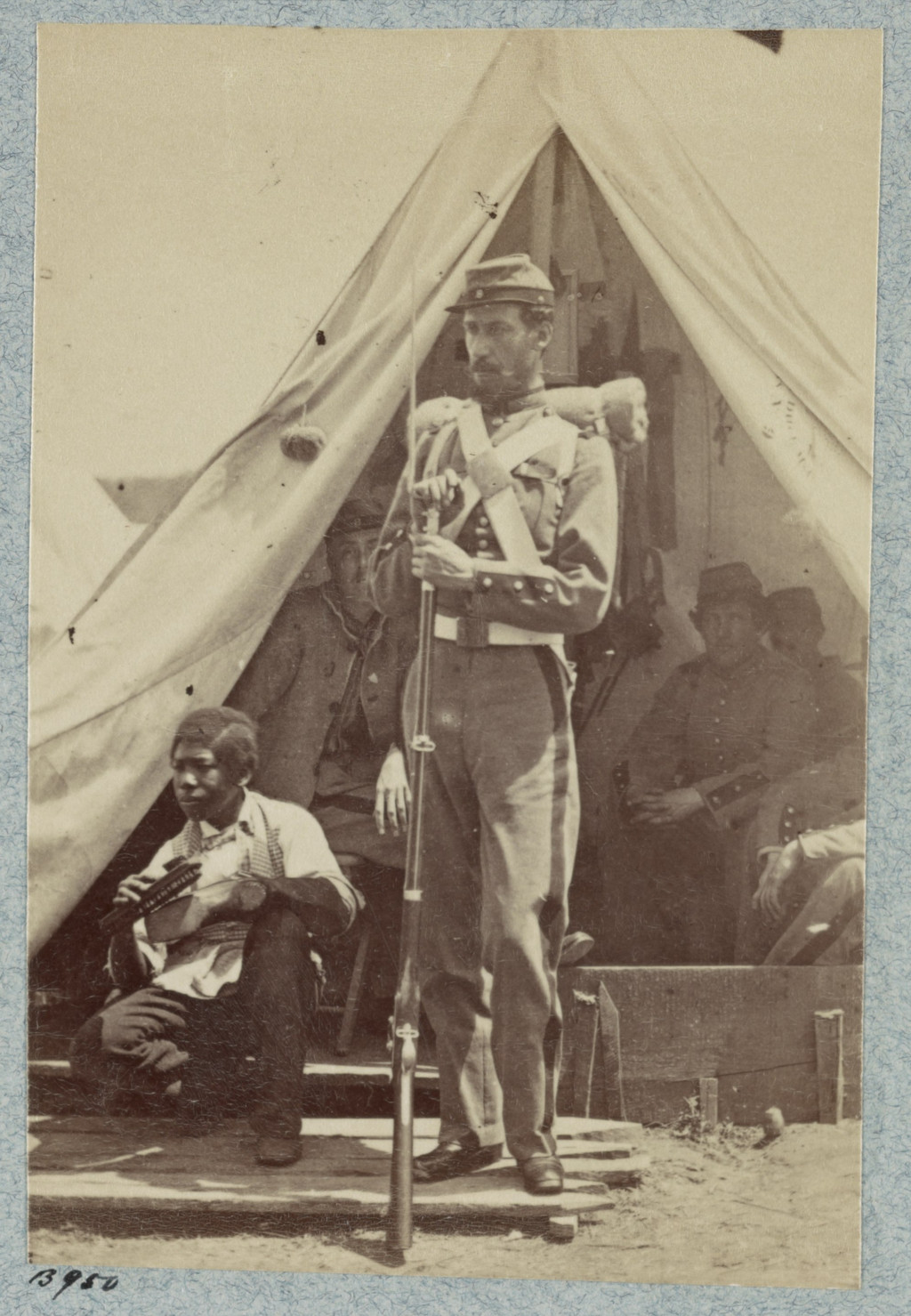
Unidentified photographer, 7th N.Y. State Militia, Camp Cameron, D.C., 1861. Photographed 1861; this albumen half-stereograph print dates between 1880 and 1889. Gifford stands beside an unnamed African American man shining shoes. Library of Congress Prints and Photographs Division, LOT 4189, no. 19; LCCN 2013648449. No known restrictions on publication; public-domain mirror. Whole supplied print and mount proportionally resized.
Image source
.
No known restrictions on publication
. Whole supplied image retained; resized proportionally only.
Mature landscapes and growing recognition
Gifford produced major landscapes during and after his military service. A Gorge in the Mountains , dated 1862, concentrates the spectator’s attention through a dark rocky foreground toward glowing distance. It combines close observation with deliberate changes of format and arrangement, making clear that his mature landscape practice involved construction as well as recording. [1]
New England trips supplied further material. The preparation of A Home in the Wilderness involved studies near Gorham and Mount Hayes. The eventual Cleveland canvas of 1866 develops a cabin, clearing, water and mountain into a broad composition. The documented sequence offers a more precise account of its making than an assumption that the whole image was painted directly before the view.
Hunter Mountain, Twilight , also dated 1866, shows a cleared and inhabited landscape. The Terra Foundation’s account connects its patronage with James W. Pinchot and discusses the earlier use of surrounding trees for tanning. Its historical interpretations add environmental and Civil War contexts without reducing the painting to one proven intention. [5]
Hunter Mountain and Home were shown in Paris in 1867. Their presence there marks an important stage in Gifford’s international reputation. The same artist who had traveled abroad to learn now sent mature pictures to an international audience. The two works shared aspects of scale and inhabited subject matter, although that does not establish that he conceived them as a formal pair. [1]
Watch: Sanford Robinson Gifford
Choose a film to explore the artist’s work, its interpretation and its wider setting.
Sanford Robinson Gifford, Twilight in the Adirondacks
Smarthistory and Art Bridges discuss light and distance in Twilight in the Adirondacks.
Watch on YouTubeThe second journey: Europe, Egypt and Greece
Gifford traveled abroad again in 1868–1869. He spent part of the journey with the McEntees and met Church and his family in Rome. The trip revisited familiar European places while extending his experience into Egypt and the eastern Mediterranean. Friendship continued to shape the journey without determining every subject he chose. [1]
The Nile journey in early 1869 supplied drawings and observations for later pictures. Siout, Egypt , completed in 1874, belongs to the subsequent development of that material. Its long interval between visit and finished canvas reveals the usefulness of retained studies and recollection. A painting’s date is not always the date of the travel it represents.
In Athens Gifford made a detailed Parthenon drawing in May 1869. It would become the basis of one of his final major works. Venice and the Italian lakes also remained productive subjects after his return. The foreign scenes occupied a continuing place in his studio practice rather than forming a sealed episode that ended when he sailed home.
This working relationship between place and memory is particularly clear in Isola Bella in Lago Maggiore . The picture developed a recollection painted at Bellagio on Lake Como, a different lake from the represented subject. The sequence demonstrates an artist actively carrying and transforming experience, rather than mechanically transferring one view to a larger canvas. [1]
Collectors, institutions and public life
Gifford’s success depended partly on the movement of pictures through exhibitions, studios and collections. The catalogue’s patronage discussion connects Tivoli with Robert Gordon and the overlapping worlds of artists’ clubs and the new Metropolitan Museum. These relationships gave paintings audiences and durable institutional histories, while collectors could return for further works by an artist they admired. [1]
Family resources also need to be understood across time. The prosperous Hudson household supported Gifford’s early opportunities, but family business conditions did not remain static. The chronology records a loan he made to his family in 1875 when its foundry was in financial difficulty. That episode complicates a simple account of lifelong financial ease without establishing that his own career had failed. [1]
His continuing family ties also appear in travel. His sister Mary accompanied parts of the 1864 New England journey, and Hudson remained a recurrent destination. The family was therefore present in practical arrangements and obligations, as well as in the losses that biographical accounts often emphasize. Reading those relationships together gives a fuller picture of the circumstances within which he worked.
Gifford was a founder of the Metropolitan Museum of Art in 1870. His involvement places him within the creation of an institution that would subsequently display, collect and study his own work. The later memorial exhibition therefore belonged to a museum with which he had a living connection, rather than an institution encountering his art only after his death. [22]
Institutional belonging could also involve disagreement. In 1875 he objected to an Academy policy restricting previously exhibited works, attempted to resign and sent no pictures to its spring annual exhibition. His resignation was not accepted. The episode reveals an active participant in decisions about professional presentation, alongside the familiar image of a quiet landscape painter. [1]
Western journeys and a widening range
In 1870 Gifford traveled through Colorado with fellow painters before joining Hayden’s field party in Wyoming. William Henry Jackson’s Chugwater photograph shows him seated beside an unnamed companion among the formations. The photograph and Valley of the Chugwater place painted observation within a fieldwork setting, while remaining different records of the experience. [1]
His northwestern journey followed in 1874. It included the Pacific coast and a wider circuit through Washington, Oregon, Vancouver Island and Alaska. Fishing and sketching appear together in the travel record. Recreation was therefore one setting in which the attention of a working painter continued, rather than an entirely separate activity with no relation to his pictures.
Mount Rainier, Bay of Tacoma—Puget Sound dates to 1875 and develops material gathered during that journey. Its remote mountain and broad water differ markedly from the closer Wyoming formations. These western subjects expand the geographical range of his work while preserving the importance of decisions about distance, format and atmosphere.
The western journeys did not replace the Northeast. Gifford continued returning to the Catskills, New England and familiar waterways. The chronology records visits to Church’s Maine camp in 1877 and 1879. His later career combined new experience with the revisiting of established relationships and places. [1]
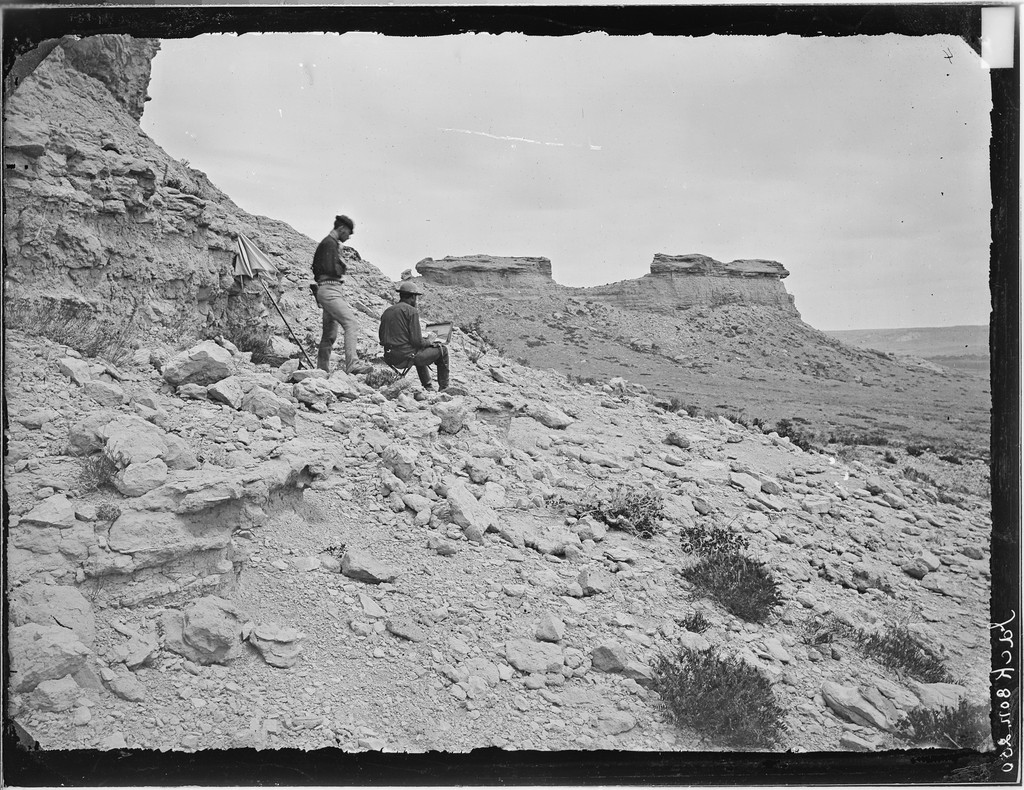
William Henry Jackson, Castellated rocks on the Chugwater. S.R. Gifford, artist, on right, 1870. Gifford is seated to the right of the unnamed standing companion. National Archives and Records Administration, 516859, via Wikimedia Commons. Public domain; whole supplied photograph, including documentary edges, proportionally resized.
Image source
.
Public domain
. Whole supplied image retained; resized proportionally only.
Marriage and the final studio years
In June 1877 Gifford married Mary Cecilia Canfield. The chronology records a private ceremony and a move to a New York apartment, followed by the announcement of the marriage to family and friends later in the year. The facts can be stated without adopting anecdotal explanations of his private motives. [1]
Travel with friends and family continued. In 1879 he visited Church’s Lake Millinocket camp with his wife and other companions. These later visits belong to the same sustained pattern of sociability, fishing and landscape observation seen earlier in his life. Marriage added another relationship within that pattern rather than marking a clearly documented break in his art.
The studio remained productive. Ruins of the Parthenon was completed in 1880 from the drawing made eleven years before. The survival of that connection demonstrates how long an encounter could remain available for artistic development. The painting’s late date need not make it a conscious farewell; it is a substantial final work without an established testamentary program. [1]
Death and the memorial record
Gifford’s health deteriorated during the summer of 1880. He visited Lake Superior in July in an effort to restore it, returned to New York and died on August 29. He was 57. The chronology provides a firmer account of that sequence than treating the fishing journey itself as a proven explanation of the illness. [1]
Artist friends and patrons attended the funeral in Hudson. The professional community soon organized exhibitions and memorial meetings. Eastman Johnson’s portrait, dated 1880, belongs to this final period of representation. The Metropolitan’s supplied image is a monochrome reproduction of an oil painting on academy board, not a photographic portrait from Gifford’s life. [3]
The Metropolitan’s memorial exhibition ran from autumn 1880 into March 1881 and included 160 paintings and oil sketches. The museum published the memorial catalogue in 1881. Its 731 ordinary entries and eight starred additions produce 739 separate records, while its ownership information refers to February of that year. The exhibition and catalogue are related undertakings with different counts and functions. [1] [23]
The Parthenon canvas was purchased from the estate in 1881 for the Corcoran collection and is now at the National Gallery of Art. Such changes illustrate how the paintings continued to acquire histories after Gifford’s death. A memorial catalogue owner and a current museum collection describe different moments in the same object’s life. [12]
Reading the career today
Gifford’s work can be followed through both major canvases and less imposing records. A small oil, a faint sketchbook page or a photograph of fieldwork can explain something a celebrated landscape does not show by itself. Taken together, they reveal the observation, retention and revision behind the appearance of an effortless atmospheric whole.
Later scholarship has restored that working history to view. The 2003 Metropolitan Museum and National Gallery catalogue brings critical reception, travel, drawings and individual objects into conversation. The Thomas Cole National Historic Site’s 2017 exhibition then focused specifically on Gifford in the Catskills and on the significance of Cole’s example. These are past research and exhibition projects, rather than current display promises. [1] [24]
His place within the Hudson River School is therefore best approached through relationships and individual decisions. He shared journeys, institutions and interests with other landscape painters while developing his own treatment of unity and light. The wider history of American artists supplies a setting for that career; the paintings and drawing studies make its particular choices visible.
Historical and current object records
Browse 739 records from the consulted 1881 memorial catalogue, followed by 21 separately identified modern object records: sixteen paintings, one additional oil study and four sketchbook leaves. Three leaves contain drawings; the fourth is an address document. Some historical and modern records concern the same object, so 760 records do not mean 760 different works. Historical titles, conjectural or absent dates and starred identifiers are preserved; historical owners are not current collection facts. Current object dates are stated separately. Links lead to the source catalogue or our object discussion. This is a sourced historical directory, not a modern catalogue raisonné or a definitive lifetime total.
Frequently Asked Questions
He was born in Greenfield, Saratoga County, New York, on July 10, 1823, and grew up in Hudson. [1]
Cole was an important influence, but Gifford was not his formal pupil. His documented New York training included study with John Rubens Smith. [1]
Yes. He served with New York’s Seventh Regiment in successive summers from 1861 through 1863. [1]
He was 57 when he died on August 29, 1880. [1]
Discussion
Look again at the images and ideas explored in Life and Career. These editorial prompts invite your observations.
Reader Insights
Which professional relationship most clearly connects a journey with later studio work?
How does the Tenth Street studio change your picture of a career associated with remote landscapes?
What does comparing the memorial exhibition with the historical catalogue reveal about the different purposes of those records?
Join the Conversation
Share a detail, comparison or question about Life and Career below.
References
- Kevin J. Avery and Franklin Kelly , with Heidi Applegate and Eleanor Jones Harvey, Hudson River School Visions: The Landscapes of Sanford R. Gifford, 2003. Complete chronology, printed pp. 243–255; Kelly essay; consulted artwork sequences and bounded Harvey patronage discussion. Historical quotations and archival material are discussed through this scholarship. View source
- Grove Art / Oxford University Press, Luminism: credited overview through Google Arts & Culture. View source
- Metropolitan Museum of Art , Eastman Johnson, Sanford Robinson Gifford, 1880, 88.16. Object identity, medium, credit and public-domain monochrome reproduction. View source
- Metropolitan Museum of Art: A Gorge in the Mountains (Kauterskill Clove), 1862, 15.30.62. View source
- Terra Foundation for American Art , Hunter Mountain, Twilight, 1866, 1999.57. Patronage and attributed historical/ecological interpretation. View source
- Philadelphia Museum of Art: A Coming Storm, 2004-115-1. View source
- Cleveland Museum of Art: A Home in the Wilderness, 1866, 1970.162. View source
- Toledo Museum of Art: The Wilderness, 1860, 1951.403. View source
- Toledo Museum of Art: Lake Nemi, 1856–1857, 1957.46. View source
- Metropolitan Museum of Art: Tivoli, 1870, 12.205.1. View source
- Metropolitan Museum of Art: Isola Bella in Lago Maggiore, 1871, 21.115.1. View source
- National Gallery of Art , Ruins of the Parthenon, 1880, 2014.79.20. Current Corcoran Collection identity and 1881 estate-purchase provenance. View source
- National Gallery of Art: Siout, Egypt, 1874, 1999.7.1. View source
- National Gallery of Art: The Artist Sketching at Mount Desert, Maine, 1864–1865, 2004.99.1. View source
- Amon Carter Museum of American Art: Valley of the Chugwater, Wyoming Territory, 1870, 1970.67. View source
- Cleveland Museum of Art: Autumn, a Wood Path, 1876, 1922.220. View source
- Seattle Art Museum: Mount Rainier, Bay of Tacoma – Puget Sound, 1875, 90.29. View source
- Yale University Art Gallery: Hook Mountain, near Nyack, on the Hudson, 1866, 1969.113.3. View source
- Yale University Art Gallery , Twilight in the Catskills, 1861, 2007.178.1. Current identity and qualified Civil War interpretation. View source
- Stephanie Ashley , Finding Aid to the Sanford Robinson Gifford Papers, Archives of American Art, Smithsonian Institution, PDF pp. 3–5. Used for training and studio/archival context, with conflicting chronology details resolved through other evidence. View source
- Library of Congress , 7th N.Y. State Militia, Camp Cameron, D.C., 1861, LCCN 2013648449. Object identification, summary, scene date and later print date. View source
- Kevin J. Avery , Metropolitan Museum of Art, Sanford Robinson Gifford (1823–1880), 2009. Used for the artist’s founding connection with the museum; the catalogue chronology controls age and memorial exhibition dates. View source
- A Memorial Catalogue of the Paintings of Sanford Robinson Gifford , N.A., first thousand, 1881, Thomas J. Watson Library, Metropolitan Museum of Art. Introductory conventions and complete historical title/year directory. View source
- Thomas Cole National Historic Site , Sanford R. Gifford in the Catskills, 2017 exhibition overview and captions. Used as a past regional research/exhibition project. View source
- Splash image source.
Eastman Johnson, Sanford Robinson Gifford, 1880. Oil on academy board, 67.9 × 56.2 cm. The Metropolitan Museum of Art, 88.16. Monochrome museum reproduction of the painting. The Metropolitan Museum of Art, Gift of Richard Butler, 1888. Public domain; whole supplied image proportionally resized. Public domain . Whole supplied image retained; resized proportionally only.
View source - Kevin J. Avery, “The Hudson River School”, Metropolitan Museum of Art (2004). Origins in 1825 and decline in the 1870s–1880s; c. 1825–1880 is an approximate comparative range. View source
- John Wilmerding et al., American Light: The Luminist Movement, 1850–1875 (National Gallery of Art, 1980). A retrospective historical category. View source
- National Gallery, London, J. M. W. Turner: 1775–1851. Artist life dates. View source
- Smithsonian American Art Museum, Thomas Cole: 1801–1848. Artist life dates. View source
- Smithsonian American Art Museum, Emanuel Leutze: 1816–1868. Artist life dates. View source
- US National Park Service, Sanford Robinson Gifford: 1823–1880. Artist life dates. View source
- New Britain Museum of American Art, Eastman Johnson: 1824–1906. Artist life dates. View source
- Amon Carter Museum of American Art, Frederic Edwin Church: 1826–1900. Artist life dates. View source
- National Gallery of Art, Albert Bierstadt: 1830–1902. Artist life dates. View source