 by Tom Gurney
Tom Gurney BSc (Hons) is an art history expert with over 20 years experience
Published on June 19, 2020 / Updated on August 29, 2026
Email: tomgurney1@gmail.com / Phone: +44 7429 011000
Overview
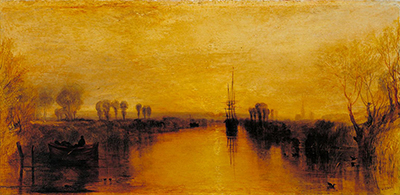
J. M. W. Turner's Chichester Canal is the Tate work catalogued as N00560 and dated c.1828.[1] Tate Images gives its material form as oil paint on canvas, records a 654 x 1346 mm support, and links the picture to the Turner Bequest accepted in 1856.[2] Art UK corroborates the Tate accession and gives the scale as 65.4 x 134.6 cm.[3]
The painting is long, low and unusually quiet. A canal runs into glowing distance. A masted vessel stands almost on the central axis. Low banks, dark trees, a rowboat, birds and the faint towers of Chichester Cathedral are held inside a broad field of yellow-orange light. Turner does not make the waterway a plain topographical record. He makes it a place where commerce, patronage, local improvement and atmosphere meet.
The stillness is deceptive. The waterway had been made to serve movement, yet Turner paints it at a moment when motion seems delayed. The central craft appears fixed in reflection; the rowboat on the left is closer to the viewer but hardly interrupts the hush. This tension between use and suspension gives the painting its particular character.
That combination needs careful handling. The Tate picture must be kept separate from the National Trust and Petworth House version of Chichester Canal, NT 486626, which has different measurements and its own later allocation history.[5] Petworth matters strongly as context, but the Tate work under discussion here remains N00560.
The canal itself was a recent structure when Turner painted it. The Chichester Ship Canal Trust explains that the Chichester Canal was part of the former Portsmouth and Arundel Canal, opened in 1822 as part of an inland link between London and Portsmouth.[4] By c.1828, Turner was therefore painting a waterway that still belonged to recent schemes of transport and improvement, even if its commercial promise was already unstable.
The result is one of Turner's most restrained modern subjects. It is not a dramatic shipwreck, not a storm at sea, not a railway image, and not a display of machinery. It is a canal at evening, where a modern waterway becomes a study of reflected light.
At a Glance
- ArtistJoseph Mallord William Turner
- TitleChichester Canal
- DateAbout 1828
- MediumOil paint on canvas
- Support65.4 x 134.6 cm
- CollectionTate
- AccessionN00560
- ProvenanceTurner Bequest, accepted 1856
- PlaceChichester Canal, Sussex
- Version cautionDistinct from National Trust 486626
Contents
- Overview
- Object Identity
- The Canal as a Recent Waterway
- Petworth and Egremont
- Not the Petworth Version
- Format and Composition
- Light, Water and Reflection
- A Modern Subject Without Noise
- Chichester Cathedral and Place
- How to Look at Chichester Canal
Object Identity
The preferred title is Chichester Canal.[1] Tate identifies the artist as Joseph Mallord William Turner and dates the work c.1828.[1] Tate Images gives the medium as oil paint on canvas, with support dimensions of 654 x 1346 mm.[2] Art UK gives the equivalent measurements in centimetres and records the accession number N00560.[3]
Tate Images connects the work's public ownership with the Turner Bequest, accepted by the nation in 1856.[2] That provenance places the work within the large body of material that shaped Turner's posthumous public reputation. The accession number N00560 is important because the title can easily be confused with the related Petworth version.
The format is central to the work's identity. At more than twice as wide as it is high, the canvas suits the canal's recession into distance. Turner can stretch water, bank, sky and reflection laterally, while the central vessel supplies a spare vertical accent. The scale is not monumental in height, but it is expansive in breadth.
Butlin and Joll's catalogue of Turner's oil paintings supplies the standard scholarly framework for the painting's title, date, ownership and relation to associated Petworth works.[7] That catalogue control is useful because this subject has often encouraged broad claims about volcanic skies, picturesque canals or Petworth patronage. Those themes may interest viewers, but the first task is to identify the specific canvas.
The specific canvas is Tate N00560: c.1828, oil paint on canvas, 654 x 1346 mm, Turner Bequest. Every wider reading should return to those anchors.
The Canal as a Recent Waterway
Turner did not paint an ancient river. He painted a canal that belonged to recent engineering and transport ambition. The Chichester Ship Canal Trust explains that the waterway now known as the Chichester Canal formed part of the former Portsmouth and Arundel Canal, which opened in 1822.[4] It was meant to contribute to a broader inland connection between London and Portsmouth.[4]
The same history also explains why the canal carried disappointment as well as hope. The Trust notes that the larger scheme was not a success, partly because the end of hostilities with France and the availability of better coastal shipping weakened the case for an inland link.[4] That context matters because Turner's scene is serene, but the waterway was not simply a timeless rural feature.
In the painting, the canal's recent origin is not announced through hard engineering detail. The banks are low. The water is calm. The masted craft stands quietly in the distance. Yet the subject remains modern because a canal is a made line across land, designed for movement, loading and connection.
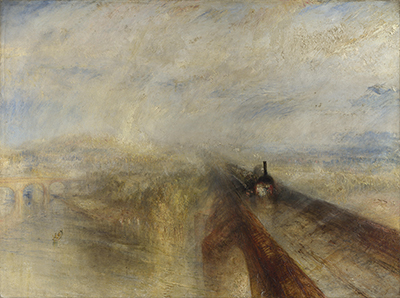
The painting therefore belongs near Turner's interest in modern means of movement, but only in a modest and object-specific way. It should not be forced into the same argument as Rain, Steam, and Speed - The Great Western Railway. This is a slower form of modernity: a navigable cut, a commercial vessel, an attempted inland network, and the evening light that softens all of them.
That restraint is part of the painting's power. The waterway looks still, but it exists because of enterprise, capital and planned movement. Turner makes the viewer hold both facts at once: calm surface and recent infrastructure, pastoral glow and commercial purpose.
The canal also changes the role of distance. A river may wander through a landscape as a natural feature, but a canal suggests planning, straightness and intended passage. Turner softens that planned line through haze and reflection. The result is neither a survey of engineering nor a denial of engineering. It is a view in which a made waterway has been absorbed into the painter's larger concern with light.
That absorption is not an escape from history. The painting's calm is sharper because the history behind the canal was not calm. Investment, hope, commercial failure and local pride all lie behind the view. Turner does not narrate those facts, but the waterway's recent construction keeps the scene from becoming an untouched countryside.
Petworth and Egremont
The Petworth connection is essential. National Trust states that Turner was a frequent guest at Petworth, returning through his friendship with George O'Brien Wyndham, 3rd Earl of Egremont.[6] By the late 1820s, Turner was closely associated with the house, its interiors, its landscape and its owner.[6]
National Trust also explains that Egremont's patronage led to a commission of four final works for the Carved Room at Petworth. These included two scenes of Petworth Park, one Chain Pier subject, and one showing part of the Portsmouth and Arundel canal.[6] That last description places the canal subject within a local and architectural commission rather than only within general landscape painting.
This matters because Chichester Canal has a long format suited to display within a specific interior setting. The canal does not merely happen to be wide; Turner's solution fits the kind of horizontal field demanded by the Petworth group. The painting's shape and patronage context belong together.
Egremont's relation to the canal adds another layer. The National Trust Collections entry for the Petworth version states that the 3rd Earl invested at least 55,000 pounds in the Portsmouth and Arundel Canal, which was finished in 1823 but proved unprofitable, and that he withdrew from the company in 1826 while still commissioning the painting.[5] That history is crucial, but it must be applied carefully. The Tate picture is not the same object as the Petworth version.
Petworth context gives the painting its social frame. A canal in Sussex becomes a subject for Turner because it is local to Egremont's world, tied to improvement, and suitable for a major decorative and pictorial commission. Turner then turns that local scheme into a meditation on light, water and distance.
The Carved Room context also explains the painting's poise. A work made for an interior cannot be understood only as a view taken outdoors. It had to function among carved wood, other paintings and the social life of a great house. Turner's long field of water and sky could answer that setting without surrendering the independence of the image.
Not the Petworth Version
The National Trust Collections work should be treated as a related but separate painting. Its record gives the title Chichester Canal, artist Joseph Mallord William Turner, date 1828-1829, medium oil on canvas, measurements 635 x 1320 mm, collection Petworth House and Park, and inventory number NT 486626.[5]
Those facts differ from Tate N00560. The Tate work's support is 654 x 1346 mm, and its provenance is the Turner Bequest of 1856.[2] The Petworth version has a separate inventory number, different dimensions and a later allocation history connected with Tate and the National Trust.[5]
The distinction is more than administrative. The National Trust description of NT 486626 mentions the water receding to the central distance, the sun sinking in grey, a schooner with bare masts, Chichester Cathedral towers at the right, a rowboat with one figure at the left, a wild duck, elms and cattle.[5] These elements help viewers understand the iconography of the subject, but they should not be used as if they were the catalogue data for Tate N00560.
Keeping the two works separate protects the reading. It allows the Tate painting to remain a specific Turner Bequest canvas while still acknowledging that a related Petworth version gives valuable context for the commission and subject.
The difference also reminds viewers how Turner worked with repetition, variation and commission demands. A subject could be developed across more than one object, and later collection histories could divide those objects between institutions. The safest approach is to name the work, accession and dimensions whenever evidence matters.
This distinction is especially important because the two paintings share title and broad subject. A viewer may see the same canal, similar low banks and comparable atmospheric effects, yet the records are not interchangeable. Tate N00560 belongs to one path through the Turner Bequest. NT 486626 belongs to a Petworth path involving later allocation and long-term loan.[5]
Format and Composition
The painting's horizontal shape is one of its main arguments. Turner places the canal as a long channel of light that begins low in the foreground and narrows toward the central distance. The banks run along each side, but they do not close the space. They guide the eye inward.
The central masted vessel is small but decisive. Its vertical mast rises against the glowing field and gives the composition a point of stillness. The boat does not dominate by size. It dominates by placement. Turner makes a single dark form organize a broad expanse of water and sky.
On the left, a rowboat and figures bring the viewer back to the near bank. On the right, reeds, trees and birds thicken the margin. These details stop the canal from becoming a pure band of light. The scene remains inhabited, used and observed.
The distant towers of Chichester Cathedral are equally important. They are faint, held low on the right side of the horizon. Turner does not make them an architectural portrait. They identify the place quietly and set the canal within a recognizable Sussex setting.
The upper half of the painting is almost daring in its openness. Turner gives a broad expanse of warm air with few hard incidents. The sky is not a backdrop filled with cloud architecture; it is a tonal field. That field presses down toward the horizon and meets the water through reflection.
The painting's design depends on balance rather than drama. Low banks balance open water. A central mast balances distant towers. Dark foreground accents balance the luminous centre. The scene is spare, but it is not empty. Turner has reduced the subject to the few elements needed to carry place, movement and atmosphere.
This is why the work should not be read as simple tranquility. The composition is controlled with great precision. The canal leads the viewer inward, the vessel checks that movement, the banks hold the channel, and the sky expands above the entire scene.
Light, Water and Reflection
The most memorable feature of Chichester Canal is its light. The painting is saturated with yellow, orange and golden-brown tones. Sky and water seem to share the same atmosphere, as if the canal has become a horizontal extension of the sky.
Turner uses reflection to join things that would otherwise remain separate. The vessel rises above the water and descends into it through its reflection. The banks frame the water, but their darkness also intensifies the glow. The sky spreads outward, while the canal pulls that spread toward the viewer.
This is not natural description in a narrow sense. It is a pictorial construction of evening light. Turner makes tone do the work of depth, mood and unity. The viewer sees a canal, but also sees how a canal can become a vessel for atmosphere.
Townsend's account of Turner's materials and methods is useful here because it reminds readers that such effects are made through paint handling, not only through subject choice.[8] In this work, atmosphere depends on oil paint on a long canvas: thin and dense passages, warm colour, dark accents and broad transitions of tone.
The dark marks matter as much as the glow. The rowboat, trees, vessel, birds and banks give the light edges against which to act. Without those dark accents, the golden field would lose scale. Turner uses them sparingly, so each carries more weight than its size suggests.
The reflected light also changes the meaning of the commercial waterway. A canal built for movement of goods becomes a field of suspended vision. Practical water is transformed into luminous water. Turner does not erase the canal's purpose; he absorbs it into a larger study of seeing.
The result is powerful because it is so quiet. There is no violent weather event. The air is not a storm. The painting's force comes from stillness, breadth and colour. Turner asks how much drama can be carried by a low horizon, a central mast and reflected light.
A Modern Subject Without Noise
Turner's later modern subjects can be loud: steam, speed, fire, war, wreckage, waves. Chichester Canal is different. Its modern element is a canal, and the canal is almost silent.
That silence should not be mistaken for absence. A canal is a deliberate intervention in land and water. It changes how goods move, how a city connects to harbour and coast, and how investment imagines future value. The Chichester Ship Canal Trust's history makes clear that the waterway belonged to a large transport ambition.[4]
Turner does not illustrate that history didactically. He does not show labour, locks, ledgers or failure. Instead, he shows the waterway under a light that makes human schemes look fragile and beautiful. A recent construction becomes part of weather, colour and evening.
This is an important distinction. The painting does not reject improvement, but it also does not celebrate it as triumph. The masted craft, the canal and the distant city all belong to a human network. Yet the light is larger than the network. It envelops the scene.
The work therefore sits between landscape and modern subject. It is a Sussex view, a Petworth commission, a canal picture and an atmospheric experiment. Its modesty is what makes it unusual. Turner finds modern life not in speed but in a still waterway that promised connection and revealed uncertainty.
This is why the painting should not be reduced to peaceful scenery. Peace is part of the sensation, but the image also contains ambition that has slowed down. The canal was built to connect places, yet Turner shows it as a luminous corridor where connection becomes contemplative rather than brisk.
Chichester Cathedral and Place
The faint towers on the right horizon help locate the scene. National Trust Collections identifies the Cathedral towers in its description of the Petworth version.[5] In the Tate painting, similar distant forms are part of the work's place identity, though they remain visually subdued.
This restraint matters. Turner does not make the cathedral the subject. He allows it to appear as a far sign of Chichester, almost absorbed by atmosphere. The canal leads toward the city, but the city is not sharply possessed by the viewer.
That distance changes the emotional tone. The viewer is placed on or near the water, looking along the canal toward a glowing horizon. Human settlement is visible, but remote. The canal promises connection; the painting makes that connection feel slow and suspended.
The relation between canal and cathedral also sets old and new forms of presence against each other. The cathedral belongs to a long urban and religious history. The canal belongs to recent transport ambition. Turner lets them occupy the same low horizon without forcing a moral contrast.
This is one reason the painting feels balanced. The older city, the recent canal, the boat and the evening sky are not arranged as rivals. They become elements in one field of light. Turner gives the viewer a Sussex place in which history and improvement are both softened by atmosphere.
How to Look at Chichester Canal
Begin with the format. The painting is long and low, and that shape changes everything. It lets the canal extend across the viewer's field rather than rise as a vertical scene.
Next, follow the water. The canal narrows into the distance, but it also spreads light forward. The eye moves inward along the water and outward across the glow at the same time.
Then look at the central vessel. Its mast supplies the key vertical note. The reflection below it joins sky and canal, turning the boat into a hinge between upper and lower halves of the image.
After that, study the margins. The rowboat on the left, darker vegetation on the right, birds, trees and low banks all keep the luminous centre grounded in a working landscape.
Finally, find the distant city. The cathedral towers are small, but they matter. They give the canal a destination and connect the painted light with Chichester itself.
A second viewing can begin from the colour rather than the subject. Seen this way, the painting becomes a study in how warm tone can hold space together. Place is still present, but it is experienced through atmosphere first.
Why the Painting Matters
Chichester Canal matters because it shows Turner treating a recent transport waterway with the seriousness usually given to more dramatic subjects. The canal is not picturesque filler. It is the means by which the painting brings together Sussex, Petworth patronage, commercial ambition and evening light.
It matters because the object is easily confused with the Petworth version. Tate N00560 and National Trust NT 486626 are related, but they are not interchangeable.[2][5] Keeping them separate gives the painting sharper historical shape.
It matters because the long format is so purposeful. The support's width allows Turner to turn a canal into a field of recession and reflection.[2] The subject and shape reinforce each other.
It also matters within Turner's modern subjects. The painting is quieter than the later railway and storm works, but it is still modern in its concern with transport, improvement and human systems. Turner shows that modern change could appear as still water and fading light, not only as speed or machinery.
Most of all, the painting matters because it makes a practical waterway luminous without denying its practical history. The canal was built for movement, yet Turner makes it a place of suspended vision. The central vessel, distant towers, low banks and golden reflection turn a recent Sussex canal into one of the most contemplative images of Turner's Petworth world.
The work's achievement lies in that restraint. It does not need dramatic incident. It needs a low horizon, a long canvas, a central mast and light held across water. From those elements Turner creates a painting in which modern ambition seems to pause inside atmosphere.
Frequently Asked Questions
Chichester Canal is by Joseph Mallord William Turner, as recorded by Tate.[1]
Tate Images identifies the work as oil paint on canvas.[2]
No. The Petworth House version is National Trust NT 486626, dated 1828-1829 and measured 635 x 1320 mm.[5] It should not be merged with Tate N00560.
Turner was closely connected with Petworth and the 3rd Earl of Egremont. National Trust states that Egremont commissioned four final works for the Carved Room, including one showing part of the Portsmouth and Arundel canal.[6]
Discussion
How does Turner turn a recent commercial canal into a quiet study of light, distance and reflection?
Reader Insights
How does the canal carry sunset light through the long composition?
Where does the working waterway remain visible within the still atmosphere?
Why does separating Tate N00560 from the Petworth version matter?
Join the Conversation
Share a close observation or a source-based question for other readers.
References
- Tate, "Chichester Canal." https://www.tate.org.uk/art/artworks/turner-chichester-canal-n00560
- Tate Images, "Chichester Canal, Joseph Mallord William Turner, c.1828." https://www.tate-images.com/N00560-Chichester-Canal.html
- Art UK, "Chichester Canal." https://artuk.org/discover/artworks/chichester-canal-202367
- Chichester Ship Canal Trust, "Chichester Canal History." https://chichestercanal.org.uk/about-chichester-canal/chichester-canal-history/
- National Trust Collections, "Chichester Canal 486626." https://www.nationaltrustcollections.org.uk/object/486626
- National Trust, "JMW Turner at Petworth House and Park." https://www.nationaltrust.org.uk/visit/sussex/petworth/jwm-turner-at-petworth-house-and-park
- Martin Butlin and Evelyn Joll, *The Paintings of J. M. W. Turner*, revised edition, Yale University Press, 1984.
- Joyce H. Townsend, *How Turner Painted: Materials & Techniques*, Thames & Hudson, 2019.