


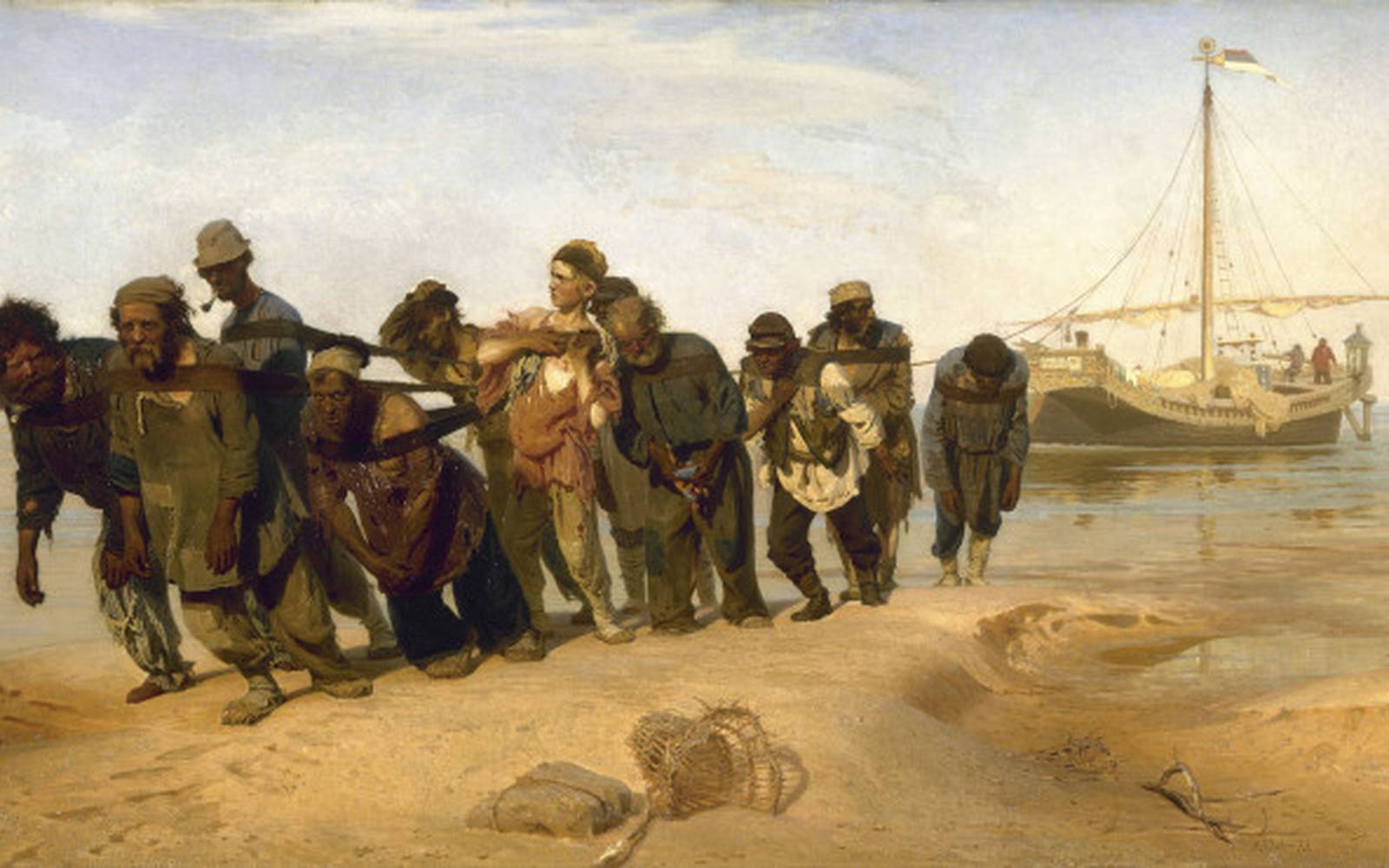
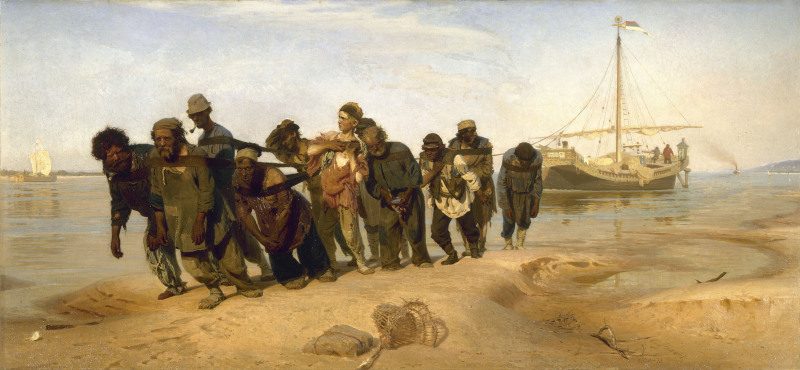
Image reference: Ilya Repin’s Barge Haulers on the Volga.
At a Glance
- Formal nameSociety for Travelling Art Exhibitions
- Common namesPeredvizhniki, Wanderers, Itinerants and Ambulants
- Founded1870 in St Petersburg, through cooperation between artists in St Petersburg and Moscow
- First exhibition1871
- Final exhibitionforty-eighth exhibition, 1923
- Core periodapproximately 1870–1900
- Major centresSt Petersburg and Moscow, with exhibitions travelling through imperial cities
- Key genressocial genre, portrait, landscape, history, biblical painting and sculpture
- Leading figuresIvan Kramskoi, Grigory Myasoedov, Nikolai Ge, Vasily Perov, Ilya Repin, Vasily Surikov, Ivan Shishkin, Alexei Savrasov, Isaac Levitan, Arkhip Kuindzhi and Nikolai Yaroshenko
- Important patronPavel Tretyakov
- Essential distinctionthe Peredvizhniki were an organisation within the larger history of Russian Realism
Contents
- Where it fits
- Partnership and purpose
- The Revolt of the Fourteen
- Four stages
- Artists to know
- Repin and the crowd
- Landscape
- Essential works
- How to look
- Artist directory
Where Russian Realism and the Peredvizhniki fit
Nikolai Ge
Key career periodIvan Shishkin
Key career periodVasily Perov
Key career periodIvan Kramskoi
Key career periodArkhip Kuindzhi
Key career periodIlya Repin
Key career periodVasily Surikov
Key career periodIsaac Levitan
Key career periodThe Peredvizhniki changed Russian art by changing where pictures went, who could see them and how artists organised their working lives. From 1871, their exhibitions opened in St Petersburg or Moscow and then travelled to other cities across the Russian Empire. Viewers encountered recent paintings of peasants, workers, writers, forests, biblical doubt, political return and violent national history without having to enter the Imperial Academy’s annual exhibition.
Their Russian name, Tovarishchestvo peredvizhnykh khudozhestvennykh vystavok, means the Society or Partnership for Travelling Art Exhibitions. “Peredvizhniki” identifies its members; “Wanderers,” “Itinerants” and the French “Ambulants” are common translations. The organisation was founded in 1870, not in 1863, and it was not a single style. Its members shared an exhibition system more reliably than they shared politics or technique.
Russian Realism is broader. It includes art made before the Society existed, painters who showed with it without joining, and realist practices that continued after its dissolution. The movement’s strongest decades were the 1870s and 1880s, but the partnership survived until 1923. Across that long life, moral exposure, commercial success, national pride, religious argument and institutional respectability could occupy the same exhibition.
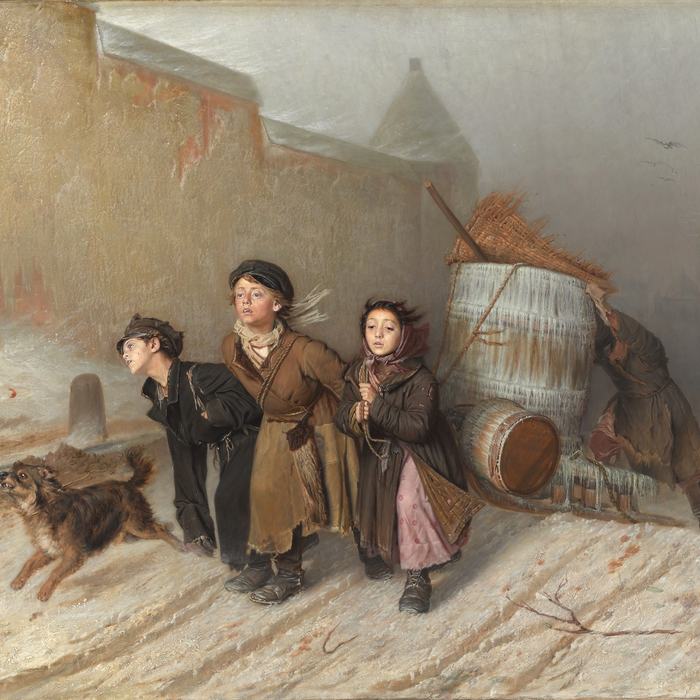
The result was neither a uniformly revolutionary front nor a harmless national school. Perov’s children strain against a frozen barrel; Repin’s crowds refuse one controlling viewpoint; Surikov’s historical actors confront incompatible truths; Levitan’s roads carry memory; Kuindzhi’s theatrical light turns landscape into spectacle. The Peredvizhniki made realism public, but they also made the idea of “Russia” visible across an empire whose many peoples cannot be contained by one modern national label.
A partnership, not a single look
The Society’s importance begins with its structure. The Russian scholarly encyclopedia identifies fifteen founders and describes an organisation that became the country’s most influential artistic body in the final third of the nineteenth century. Its exhibitions accommodated contemporary life, portraiture, history, landscape and, less frequently, religious painting. Membership changed, and the artists named today as “Wanderers” did not all enter at the same moment.[1]
The dates show both achievement and change. The Society was established in 1870, held its first travelling exhibition the next year and continued through the forty-eighth show in 1923. The State Russian Museum confirms that final exhibition and the organisation’s survival across the 1917 revolution.[2] A body founded under Alexander II ended in an entirely different state.
“Travelling” did not mean that paintings wandered informally from village to village. Shows required catalogues, packing, railway transport, rented or borrowed rooms, attendants, publicity, ticket income and negotiations with local institutions. St Petersburg and Moscow remained central, while routes extended at various times to Kyiv, Kharkiv, Odesa, Kazan, Riga, Vilnius, Saratov, Kishinev and other cities. Provincial access expanded, but it was urban, organised and uneven.
The Tretyakov Gallery describes the Society as an unusually large independent educational association whose members wanted contemporary art to reach people beyond the two capitals.[3] That mission gave the exhibitions moral authority. It also created a market. Viewers paid, works were reviewed and collectors could purchase directly. Education and commerce were not opposites; both helped artists reduce dependence on official display.
This is why “critical realism” explains only part of the achievement. David Jackson’s study follows subjects ranging from rural hardship and political activists to portraits, national history, landscape and Slavic revival. It stresses that dissident associations did not make every member an anti-tsarist propagandist.[4] Some canvases accuse. Others mourn, narrate, admire, mystify or build national pride.
Recent institutional history sharpens the point. Andrey Shabanov reconstructs a partnership concerned with rules, profits, professional autonomy, exhibition settings and public self-presentation. The familiar image of a radical realist movement was partly produced by critics after the organisation had already developed more pragmatic aims.[5] The Peredvizhniki did not merely paint a programme; they modernised an art business under authoritarian government.
Before 1870: the Revolt of the Fourteen
The origin story usually begins at the Imperial Academy of Arts in 1863. Fourteen advanced students refused the mythological subject prescribed for the Academy’s gold-medal competition and asked to choose their own themes. When the request failed, they withdrew. Ivan Kramskoi led the secession and helped form the Artists’ Artel, a cooperative that shared commissions, living arrangements and professional support.
That act was a precedent, not the founding of the Society. The Peredvizhniki did not legally exist for another seven years, and several later founders were not among the fourteen. Smarthistory’s account separates the revolt, Artel and 1870 partnership and traces the later irony: some former opponents would eventually join the Academy’s teaching structure.[6]
The dispute concerned more than a Norse subject. Academy hierarchy placed history painting at the summit, disciplined students through competition and made official favour essential to careers. The seceders wanted choice, current relevance and control of their labour. Yet most had learned drawing, composition and large-scale painting within the Academy. Rebellion did not erase training.
This tension distinguishes the Russian case from a simple parallel with Gustave Courbet or the French Impressionists. Like independent exhibitions elsewhere in Europe, the Society challenged control over admission and display. But it developed within an imperial culture where state titles, Academy status and court purchase remained unusually powerful. Its realism was European, Russian and institutional at once.
French-language Musée d’Orsay scholarship places the Ambulants within the search for a national art after the 1861 emancipation of the serfs. It connects their social subjects to a belief that art should serve the people, while also recognising landscape, history, portrait and the Gospel as central fields.[7] Russian “truth” was not confined to contemporary reportage.
Larousse likewise records a change over time. Early denunciations of abuse and inequality gradually shared the exhibitions with anecdote, folklore, landscape and historical narrative.[8] A fifty-year institution cannot be accurately frozen at its most confrontational moment.
The first exhibitions and a new public
The first show opened in St Petersburg in late 1871 before moving to Moscow and other cities. Its remembered works included Alexei Savrasov’s The Rooks Have Returned, Nikolai Ge’s Peter the Great Interrogating Tsarevich Alexei, portraits by Kramskoi and genre scenes by founders. Landscape, history and likeness stood beside social observation from the beginning.
Touring created comparison. A visitor could move from a muddy thaw to a royal interrogation, from a cultural hero’s face to village hardship. The catalogue made these works part of one public event even when their visual languages diverged. Reviews extended the event into newspapers and journals, where critics argued about truth, beauty, technique and national usefulness.
The Dutch Drents Museum later presented the movement as Russian Realism around Repin, a useful measure of international recognition but also of modern compression.[9] Repin became the best-known representative abroad, although he was not a founder and did not join until 1878. Exhibitions make canons, and later exhibitions remake them.
The travelling model also unsettled the Academy’s monopoly without destroying it. A Guggenheim survey notes that academic tradition remained active while the Wanderers rejected its constraints and addressed a broader public. The same account identifies their pictures as foundations of Pavel Tretyakov’s collection.[10] Independent display and museum formation grew together.
The Academy was an adversary—and a resource
The old story sets free Wanderers against a motionless Academy. The evidence is messier. Members sought Academy qualifications, accepted titles, exhibited internationally through official channels and relied on academic skills. By the early 1890s, reform brought Repin, Shishkin, Vladimir Makovsky, Vasily Polenov and other prominent Wanderers into the Academy’s council or teaching studios.[11]
Absorption can be read as compromise, victory or both. The Society had proved that artists outside the annual Academy show could command public interest. The Academy responded by recruiting their prestige. At the same time, official appointments gave painters salaries, studios, pupils and influence. Independence became part of the establishment.
The change did not make their earlier opposition false. It shows that institutions learn from rivals. It also helps explain why younger artists around Mir iskusstva—World of Art—no longer viewed the Peredvizhniki as insurgents. What had once opened artistic life could later seem restrictive.
Follow the Peredvizhniki through four stages
–70
Revolt, Artel and partnership
The Revolt of the Fourteen and the Artists' Artel establish precedents for subject choice, shared labour and professional autonomy before the Society is legally founded in 1870.
–78
Travelling exhibitions create a new public
The first exhibitions join landscape, portrait, history and social genre, while touring, catalogues, reviews and purchases turn independent display into an organised cultural market.
–90
Crowds, history and landscape expand
Repin, Surikov and major landscape painters make the exhibitions nationally authoritative without producing a single politics or style; moral exposure sits beside spectacle and historical ambiguity.
–1923
Authority, challenge and afterlife
Academy reform absorbs former opponents, younger movements dispute the partnership's authority and the Society survives revolution to its forty-eighth exhibition, while Soviet history begins selecting its own precursors.
Peredvizhniki artists to know
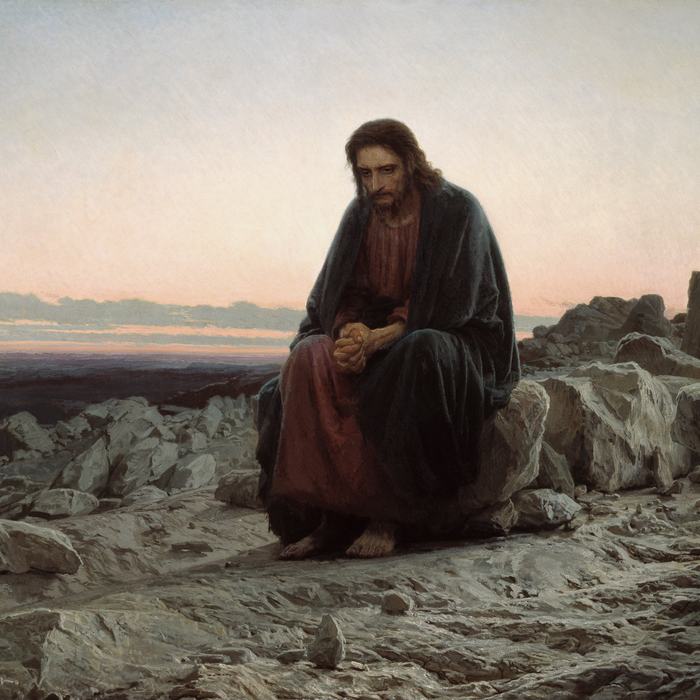
Ivan Kramskoi
Kramskoi led the 1863 secession, organised the Artel and became the partnership's intellectual centre. His portraits and religious paintings make thought and ethical decision visible without sacrificing academic control.
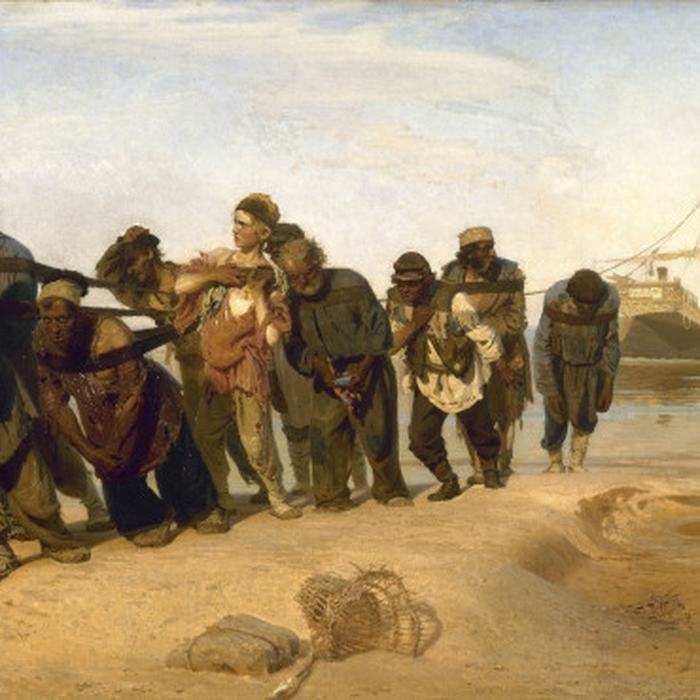
Ilya Repin
Repin joined in 1878 and became the partnership's most famous artist. His crowds resist a single viewpoint, while portraits, political returns, imperial histories and late experiments make his career much larger than protest painting.
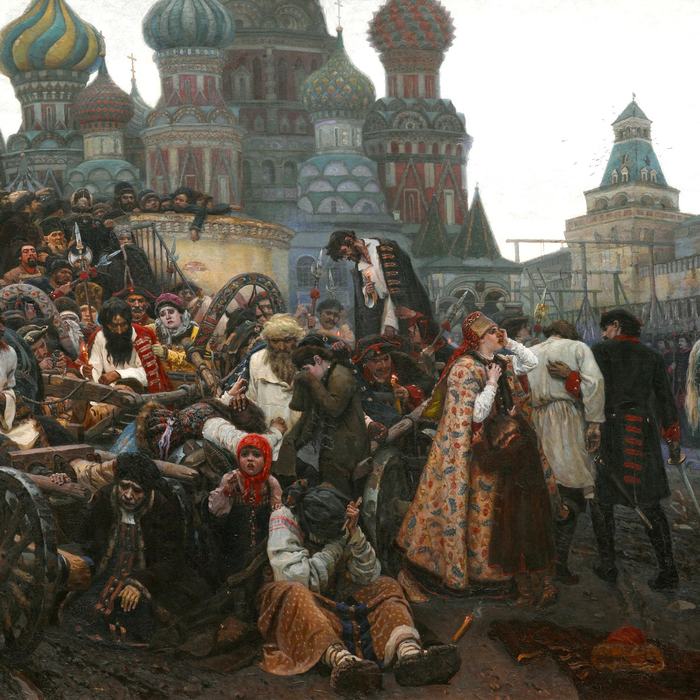
Vasily Surikov
Surikov reconstructed the past through faces, objects and bodily alignments. His large canvases do not settle history; rulers, condemned figures, witnesses and descendants carry rival truths into the same present.
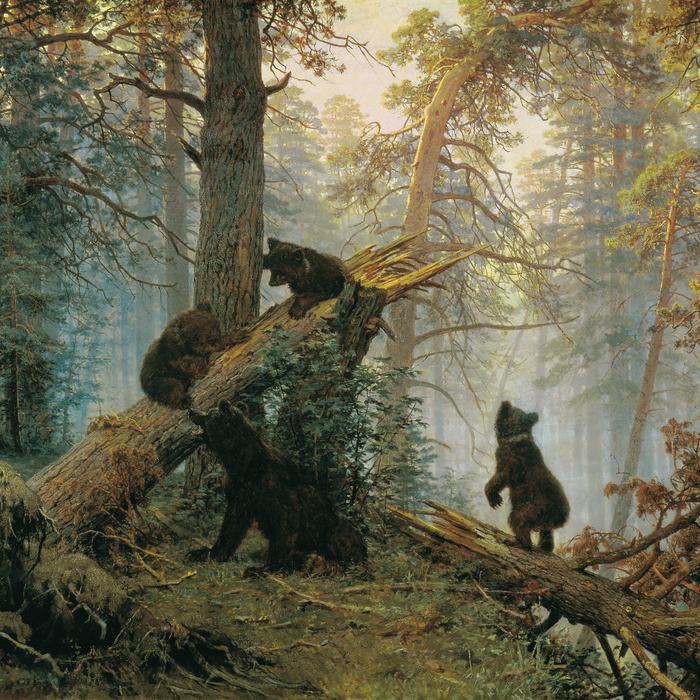
Ivan Shishkin
Shishkin joined sustained field study to meticulous studio construction. His forests made ecological detail monumental while their enormous popularity turned selected territory into a powerful national image.
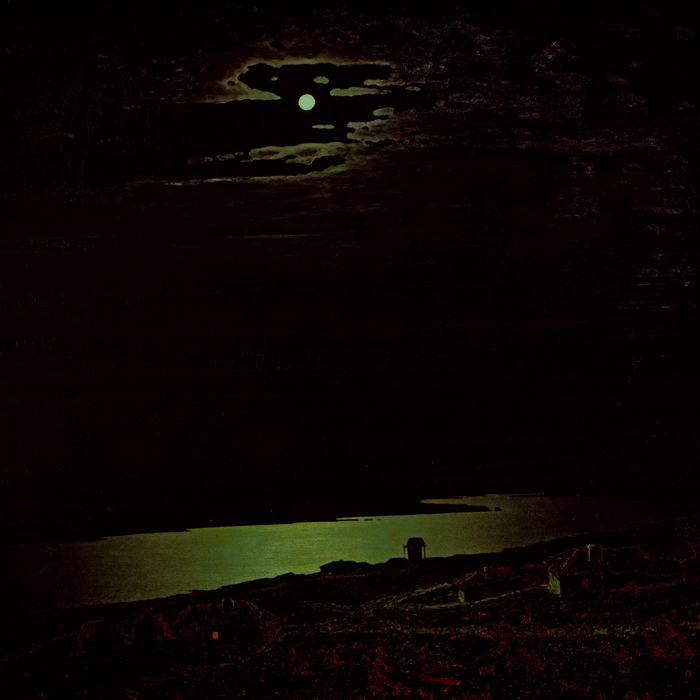
Arkhip Kuindzhi
Kuindzhi treated natural light as a carefully manufactured pictorial event. His independent displays and luminous landscapes show that realism within the Peredvizhniki could include spectacle, simplification and radical tonal effect.
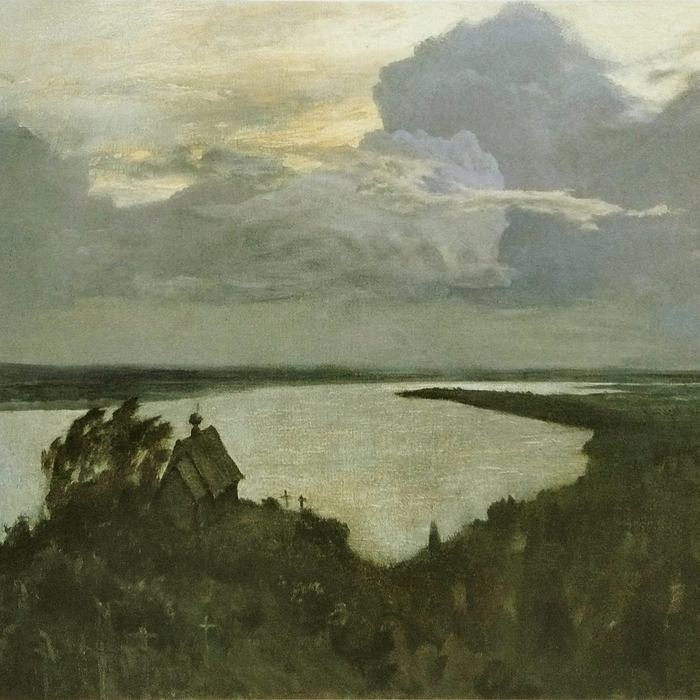
Isaac Levitan
Levitan's landscapes make roads, churches, water and changing weather bear memory. Their emotional force is precise but not programmatic, keeping national belonging and private mortality open to the viewer.
Ivan Kramskoi: conscience, portrait and doubt
Kramskoi supplied the movement with language about moral purpose, but his paintings are stronger than slogans. He had worked as a photographic retoucher before entering the Academy, led the 1863 withdrawal, organised the Artel and became a founder and intellectual centre of the travelling partnership. His letters and criticism argued that art should embody an idea rather than display empty finish.[12]
His portraiture made concentration visible. Neutral backgrounds, restrained colour and direct poses draw attention toward a sitter’s intellectual labour. Writers, painters and thinkers do not require columns or aristocratic costume to appear historically significant. A face, hand, chair and interval of silence can form a civic monument.
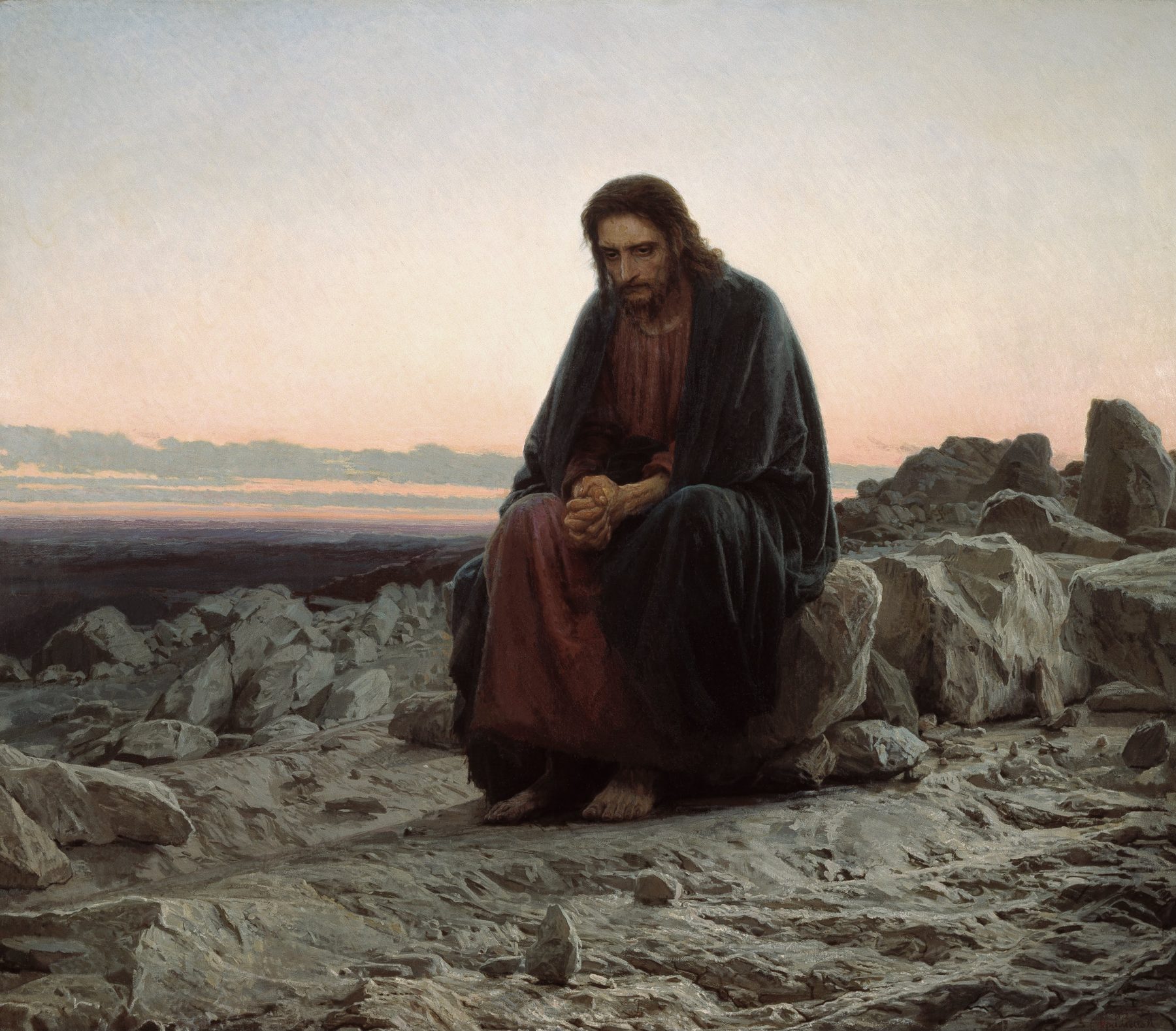
Christ in the Desert
In Christ in the Desert of 1872, dawn has not relieved the cold. Christ sits on a stone, hands locked, shoulders curved, feet exposed and face compressed by thought. No devil appears. Temptation becomes an inner decision about power, sacrifice and action.
Contemporary viewers disagreed sharply over whether the figure was recognisably Christ, a modern sceptic, a revolutionary or an abstract sign of thought. The Tretyakov Gallery treats the work as a philosophical and spiritual self-portrait of its age, noting that Kramskoi considered it the central painting of his life.[13]
The picture demonstrates why “realist” cannot mean merely copying appearances. Rocks are materially convincing, but the desert is an ethical space. Muted violet, grey and brown concentrate attention on a decision that has no visible outcome. Religious art enters modern public debate by withholding miracle.
Pavel Tretyakov and the making of a national collection
Pavel Tretyakov was not a passive buyer waiting at the end of exhibitions. He visited the travelling shows, supported artists materially and morally, bought works from studios before public display and commissioned portraits. His gallery gave the movement permanence even as his choices shaped what later audiences understood as its centre.
From the late 1860s, Tretyakov planned a portrait gallery of people he considered important to national culture. Perov painted Dostoevsky, Ostrovsky and others; Kramskoi painted Tolstoy, Nekrasov, Shishkin and Tretyakov himself. Museum history records how this programme joined personal taste to an ambition for a publicly accessible Russian gallery.[14]
The portrait pantheon broadened honour beyond court rank. Writers and composers could stand for the nation. Yet selection remained power. “Faces dear to the nation” were chosen within a male, educated and largely metropolitan cultural world. A public collection can democratise art while defining the public in selective terms.
Tretyakov’s acquisitions also changed painters’ risks. A large narrative might find a buyer before the exhibition opened. Friendship and disagreement influenced decisions. The collector’s demand for seriousness encouraged ambitious work, but no patron simply dictated the Society’s range.
Women at the exhibitions
The language of artistic democracy concealed a largely male organisation. Women trained in studios and schools, sent works to exhibitions and participated in Moscow artistic networks, but membership remained exceptional.
Emily Shanks, born in Moscow to an English family, studied with artists including Polenov, Vladimir Makovsky and Illarion Pryanishnikov. She began exhibiting with the Society in 1891. In 1894 she became its first woman member. The Tretyakov Gallery’s New Girl at School records a child entering a classroom under the assessing looks of her peers, a subject in which observation and social unease meet.[15]
Emily’s sister Mary also exhibited but did not acquire the same status. Tretyakov Gallery Magazine uses their careers to recover women’s training and professional networks and to distinguish exhibiting from election to membership.[16] One breakthrough did not make the Society equal. It reveals the rule through the exception.
Repin and the unstable crowd
Ilya Repin became the movement’s most internationally familiar painter because he could make a large canvas operate at several emotional scales. A viewer first encounters a procession, labour gang, family room or historical catastrophe. Then individual faces interrupt the total. No crowd remains a single type.
The State Russian Museum’s nineteenth-century collection places Barge Haulers on the Volga among a far wider field that includes Repin, Surikov, Vasnetsov, Shishkin, Serov and later modern art.[17] That museum context is a reminder: one masterpiece did not exhaust either Repin or Russian Realism.
Barge Haulers on the Volga
Eleven men drag a vessel against the river current. Their harness forms a low diagonal across a bright, immense landscape. Clothing, age, posture and attention differ. Kanin, the former priest near the centre, stands more upright; a younger figure adjusts his strap; others bend toward exhaustion. The group is collective without becoming anonymous.
The State Russian Museum dates the finished canvas to 1870–73 and records its monumental width.[18] Scale elevates labour to the domain formerly reserved for history painting. Yet the work does not simply turn suffering into noble sacrifice. The small steam-powered vessel in the distance suggests that this labour persists beside technology capable of replacing it.
Repin studied haulers on the Volga rather than inventing a generic “people.” At the same time, Vladimir Stasov’s criticism helped frame the painting as a model of national art grounded in ordinary lives. Scholarship on this relationship shows how the work’s success depended on composition, publicity and an image of Russian character drawn from an imperial periphery.[19]
The picture was admired by powerful buyers and shown internationally. Social criticism could circulate through elite institutions. Its force lies not in purity from the system but in exposing bodies that the system required.
A career larger than protest
Repin painted biblical subjects, portraits, state ceremonies, revolutionary returns, historical murder, Cossack laughter and the writer Tolstoy at work and rest. The Russian Museum’s major retrospective assembled more than 250 paintings and works on paper, preventing Barge Haulers from standing as a complete biography.[20]
His brushwork also changed. Some passages are tightly descriptive; others break into rapid marks and light. Portraits can feel immediate without abandoning composition. Repin admired European painting and resisted fixed doctrine. Calling him a Realist identifies a commitment to observed and psychologically compelling life, not one finish.
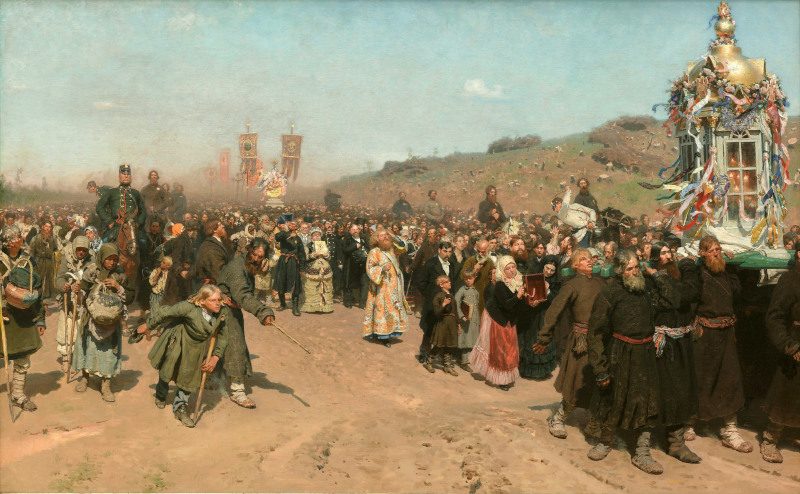
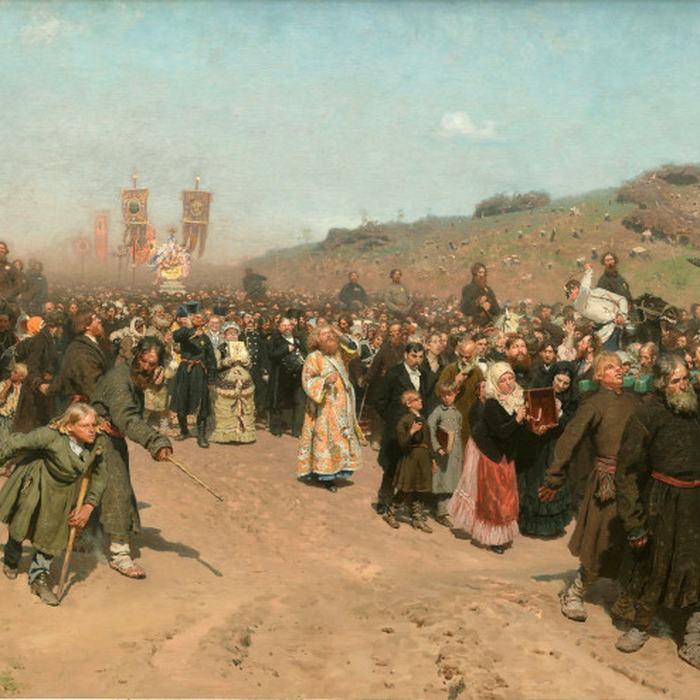
Religious Procession in Kursk Province
In Religious Procession in Kursk Province, a crowd moves diagonally through dust around a revered icon. Clergy, landowners, officials, guards, beggars and peasants occupy unequal positions. Mounted authority presses people aside. A disabled boy on crutches pushes forward while a guard raises a stick.
The procession is one body and many competing bodies. Faith may be sincere, status theatrical, violence routine and endurance stubborn. Dust partly dissolves detail, yet every social layer remains legible. Repin does not give viewers a safe place above the scene; the crowd approaches their space.
The Tretyakov Gallery groups the work with They Did Not Expect Him, Unknown Woman, Christ in the Desert, The Rooks Have Returned and other canonical Wanderer pictures collected through Tretyakov’s support.[21] Canonical proximity encourages us to see a shared age, but each painting constructs public meaning differently.
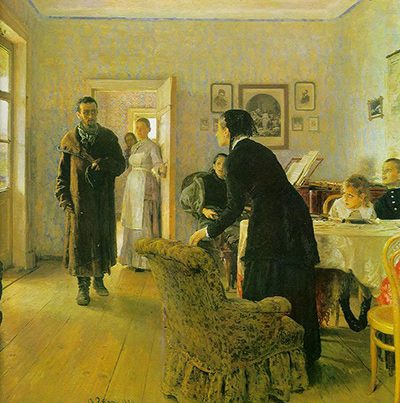
They Did Not Expect Him
A political exile enters a family room. The maid at the door looks uncertain; children react differently; a seated woman rises with a movement that mixes recognition and disbelief. The returning man’s worn body carries punishment into the domestic interior.
Repin revised the entrant’s face and the family relationships. The narrative remains suspended before welcome, accusation or explanation. Objects—portraits, furniture, piano, school materials—place revolutionary politics within educated household culture rather than on a barricade.
The Tretyakov department’s juxtaposition of Repin and Surikov with Vrubel and later art also resists a sealed Realist corridor.[22] Russian visual culture moved through overlap, not a clean relay from one movement to the next.
Cossacks, Ukraine and imperial labels
Reply of the Zaporozhian Cossacks is organised by laughter. Men crowd around a scribe composing an insulting answer to an Ottoman ruler. Open mouths, bent backs, raised moustaches and glittering costume turn defiance into collective performance.
The State Russian Museum explains that the Zaporozhian Host was a military and political community with autonomous territory in what is now Ukraine until Catherine II abolished it in 1775.[23] The anecdotal letter may be legendary, but the picture’s Ukrainian historical subject is not incidental decoration.
Repin was born at Chuhuiv in the Kharkiv region of the Russian Empire and repeatedly studied Ukrainian history, people and landscape. Recent scholarship argues that his Orientalist and Slavic images complicate the simple division between a Russian self and exotic other.[24] Costume can preserve researched specificity and still serve imperial spectacle.
An INHA study of “Painting Ukraine” reads several works as articulations of Ukrainian identity distinct from Imperial Russia.[25] Another scholarly biography traces Repin’s changing national loyalties rather than assigning him one uncomplicated modern category.[26] Responsible interpretation should state the documented place, subject and self-identification, and acknowledge why museum labels now differ.
This caution applies beyond Repin. The Society operated across an empire. Artists connected with Ukraine, Armenia, Latvia, Lithuania, Poland, Georgia and Greek communities participated in its culture. “Russian art” describes a historical institutional field, but it must not silently convert every imperial subject into ethnic Russian property.
History, religion and incompatible truths
The Society enlarged realism by applying it to subjects no witness could directly observe. Historical painters studied documents, architecture, costume and objects, then invented the decisive encounter. Biblical painters placed sacred stories within physical and psychological pressure. In both cases, accuracy of detail served an argument about the present.
Nikolai Ge: the Gospel as confrontation
Nikolai Ge was trained at the Academy and spent long periods in Italy. His Last Supper of 1863 had already treated the Gospel with compressed space, dramatic light and human conflict. As a founder of the Society, he brought academic history painting into a modern moral field.
Ge’s late Passion cycle became more abrasive. In What Is Truth? Christ and Pilate, Pilate’s bright, broad figure turns away from a shadowed, exhausted Christ. Truth is not illustrated as an attribute; it becomes the failure of two people to meet. Russian biographical scholarship traces Ge’s movement from academic and Romantic sources toward biblical pictures whose realism provoked strong public response.[27]
Ge’s association with Tolstoy encouraged an ethical Christianity suspicious of church ritual and coercive power. It would be reductive, however, to make every Gospel scene a political allegory. The paintings work because bodily light, distance and gesture create conflict before a viewer assigns doctrine.
Vasily Surikov: history without a judge
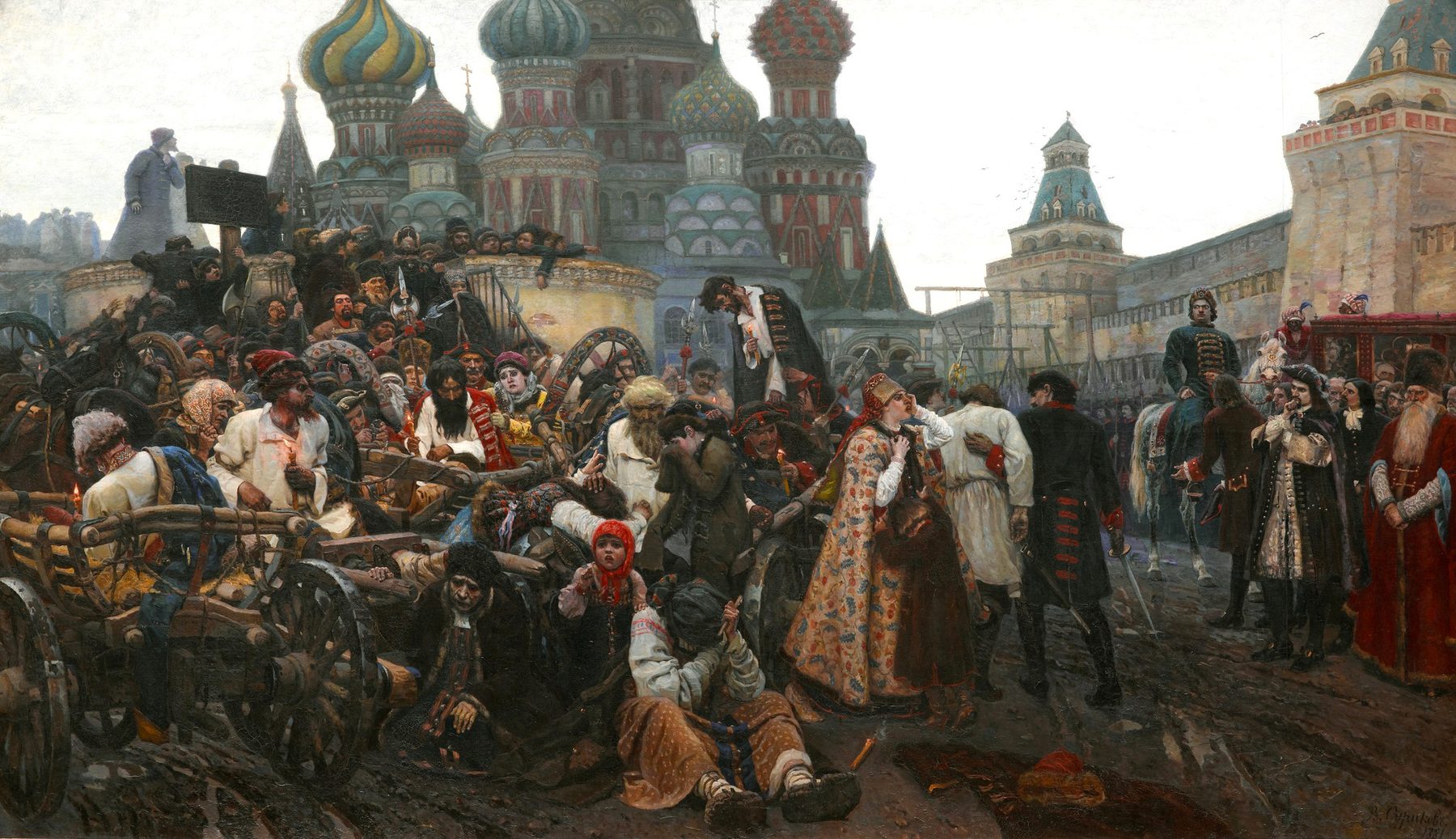
Surikov painted crowds in which historical force becomes personal. Morning of the Streltsy Execution shows condemned musketeers and their families in Red Square while Peter the Great watches from horseback. The executions themselves are not depicted. Candles, carts, white shirts, soldiers and towers construct the waiting before death.
One red-bearded Streltsy soldier directs a furious gaze toward Peter. The ruler is small but immovable at the right edge. Between them lie families, officials and competing versions of historical necessity. A museum study describes the canvas as a conflict between state power and people drawn into changes they may not understand, and refuses a simple verdict about which side owns truth.[28]
Surikov gathered visual evidence from armouries, costume, architecture and historical testimony. The Tretyakov object record notes that the work was acquired from the Society’s ninth exhibition in 1881 and explains how the artist organised documented figures and remembered types into a monumental composition.[29]
The range of realism becomes clearer beside Perov’s Hunters at Rest, whose three listeners turn a hunting anecdote into a study of invention, credulity and amused doubt. The State Russian Museum emphasises both its literary quality and the precision of its psychological observation.[30]
In Boyarina Morozova, an Old Believer noblewoman is transported through a winter crowd, her raised two-finger gesture insisting on the old rite. Mockery, devotion, curiosity, grief and indifference surround her. Snow is not empty ground; tracks and garments make it a field of social contact. The heroine’s conviction is heroic and frightening, while the crowd is too various to become one national voice.
Surikov’s history differs from an official pageant. Peter’s reforms, religious schism and state violence are not settled by progress. The past remains a struggle among incompatible “truths.” His achievement belongs to realism because emotion is distributed across credible bodies, not because the reconstructed scene is a photograph.
Repin’s sovereign violence
In Ivan the Terrible and His Son Ivan, the tsar clutches the son he has fatally struck. Blood marks the carpet and face; the weapon lies near the foreground; the father’s eyes register irreversible recognition. Royal history collapses into an intimate crime.
The work has repeatedly generated political controversy because it makes autocracy visible as damaged flesh. Yet Repin’s broader ideology cannot be reduced to opposition. Research on his aesthetics finds shifting convictions, friendships and responses to public events rather than a stable anti-tsarist platform.[31] Psychological intensity was itself political when it denied rulers the protection of ceremony.
Landscape: territory, memory and theatre
Landscape was not a retreat from the movement’s social purpose. It helped viewers imagine what kind of territory could stand for a nation. A field, forest, road or river might appear unpeopled while carrying histories of cultivation, travel, exile and ownership.
Russian landscape painting did not begin with the Peredvizhniki. Academic travel, Romantic scenery, European study and earlier natural observation supplied essential foundations. Jean-François Millet offered one international model for making labour and land morally weighty, but Russian painters did not simply reproduce French rural Realism.
Savrasov and the unfinished thaw
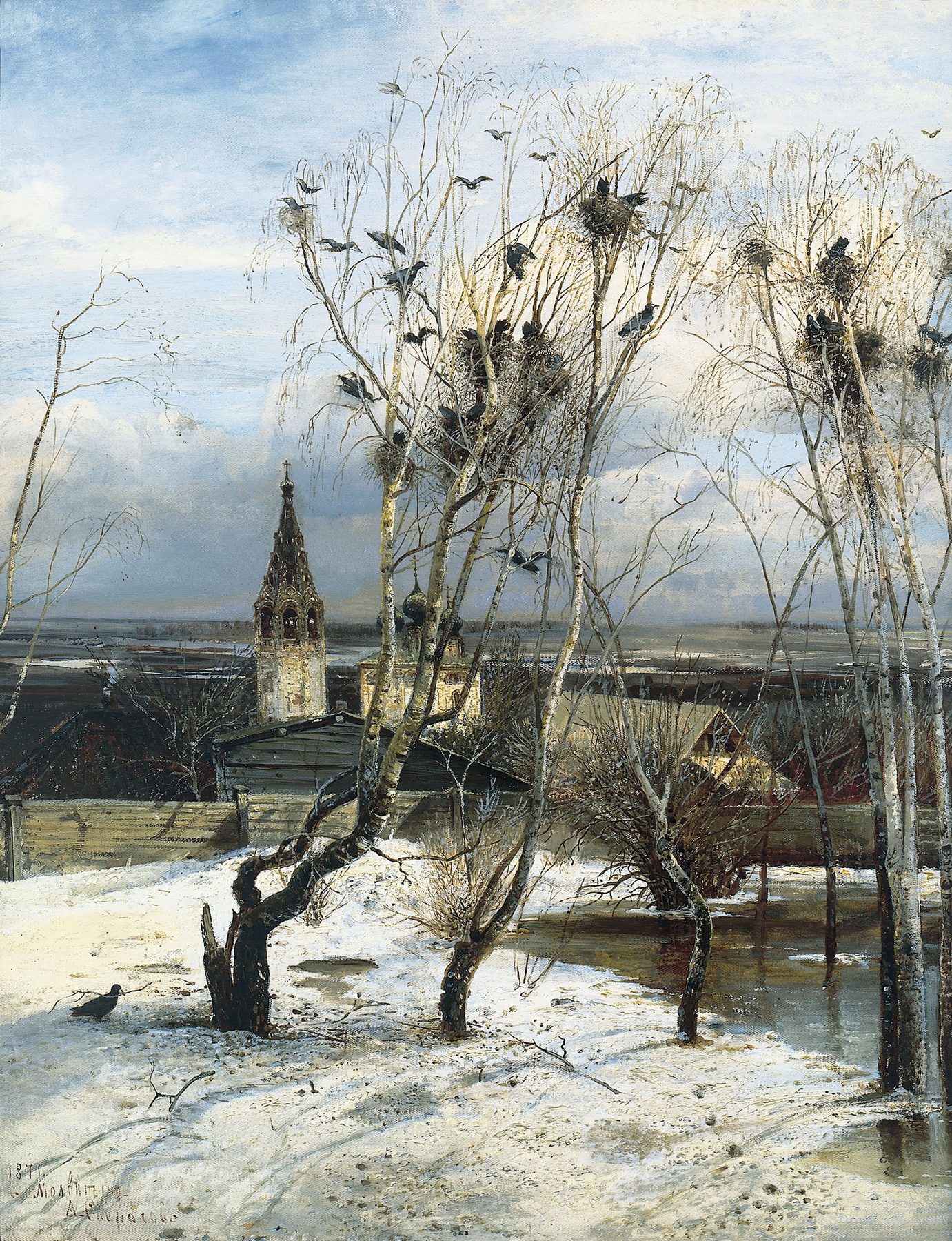
Alexei Savrasov’s The Rooks Have Returned appeared in the first travelling exhibition. Bare birches rise beside a village church; melting snow exposes dark pools; birds return before the season becomes comfortable. Nothing grand occurs, yet small changes in weather become an event.
The Tretyakov Gallery continues to use the painting as an emblem of the first exhibition.[32] Its familiarity can conceal its strangeness. Crooked trunks interrupt the steeple, nests blacken the sky and the foreground is wet rather than picturesque. National feeling emerges through a modest, unstable season.
Shishkin and the forest as monument
Ivan Shishkin’s trees often seem to have been examined species by species. Bark, root, needle and fallen branch build forests through accumulated evidence. In Rye, a road enters a field beneath tall pines and immense sky. The cultivated grain and surviving trees suggest abundance, endurance and vulnerability at once.
Shishkin studied in Prague, Munich, Dresden, Düsseldorf and Zurich. Russian encyclopedia research connects this European training to his later monumental precision and notes that he remained a founding member of the Society while becoming an Academy professor.[33] “National” landscape was made through transnational technique.
Morning in a Pine Forest is remembered for bear cubs among fallen trunks. Konstantin Savitsky painted the bears, although Tretyakov later removed his signature. Collaboration complicates the cult of the solitary national master. The forest’s convincing depth also depends on arrangement: diagonals, mist and a broken tree turn natural study into theatre.
Kuindzhi and manufactured light
Arkhip Kuindzhi was born near Mariupol in a Greek family, joined the Society in 1875 and left in 1879. His biography sits awkwardly inside a homogeneous “Russian school.” Early works such as Forgotten Village shared the Wanderers’ muted social landscape. He then intensified colour, simplified form and painted from memory, producing spaces that approach symbolism.[34]
The State Russian Museum’s Kuindzhi retrospective traces this pursuit from northern and Ukrainian landscapes to the famous nocturnes and late studies.[35] His realism relies on the credibility of an effect—moonlight, sunset, glare—rather than equal description across the whole surface.
For Moonlit Night on the Dnieper, Kuindzhi controlled the viewing conditions. In 1880 the single canvas was displayed in a darkened room with windows covered and a directed light. Crowds queued, suspecting the brilliant green-silver river might be illuminated from behind. Museum history confirms the unprecedented one-picture exhibition and its theatrical staging.[36]
The event made display part of the artwork’s meaning. The Society’s collective travelling show had taught viewers to seek new Russian pictures; Kuindzhi converted that audience into a concentrated spectacle. His departure demonstrates that the Peredvizhniki could generate artistic careers that exceeded its rules.
Levitan: roads, weather and remembered nation
Isaac Levitan entered the Society as a younger landscape painter. His Jewish background and repeated experiences of exclusion complicate later claims that his landscapes transparently express an eternal Russian essence. He made familiar terrain emotionally precise without pretending that belonging was uncomplicated.
In Vladimirka, a road recedes beneath a large sky. A small roadside shrine and solitary walker are nearly swallowed by distance. The route had been associated with prisoners sent east. The picture contains no visible chain gang, so historical suffering appears as memory attached to land.
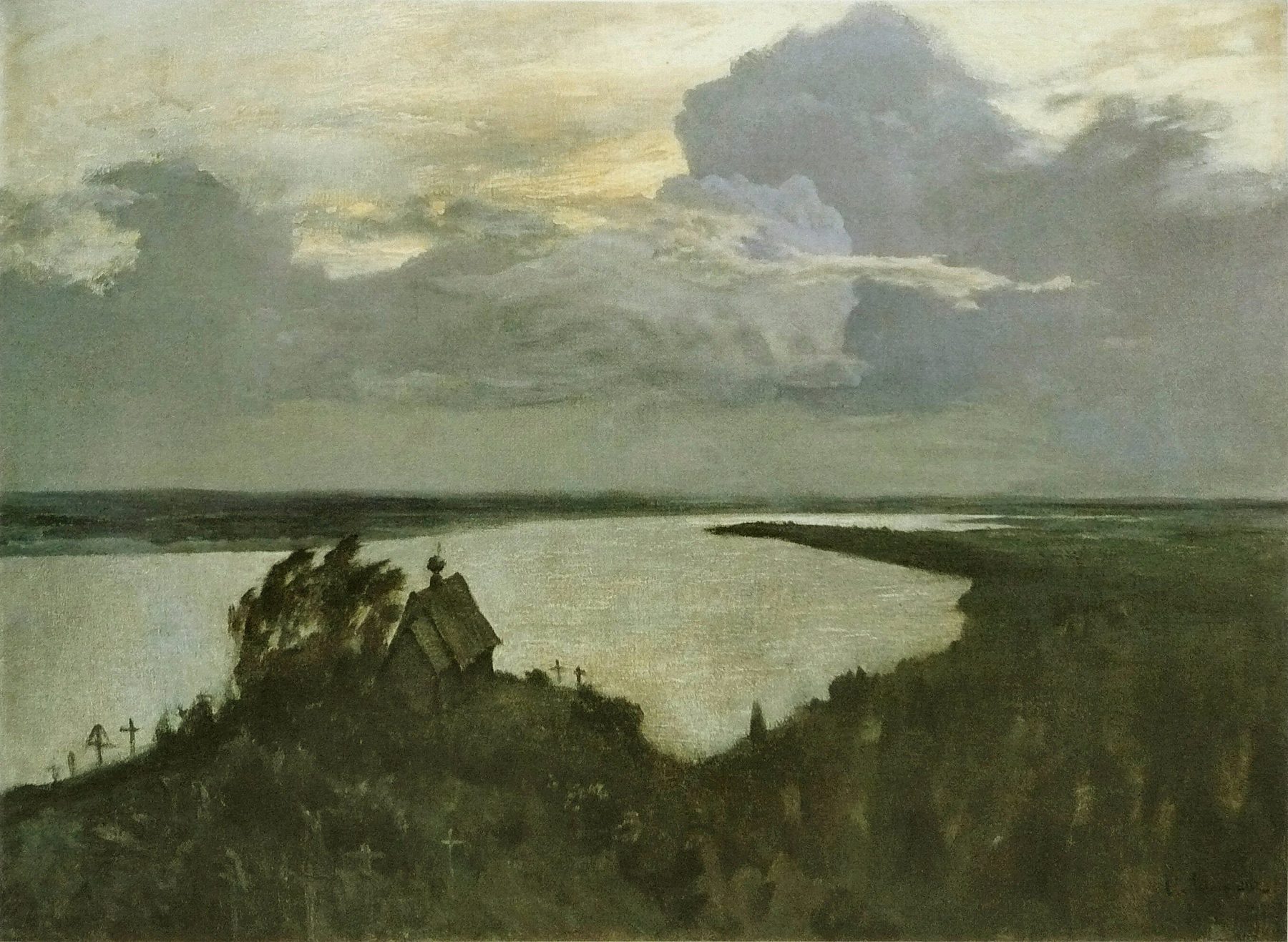
Above Eternal Peace places a small church and cemetery above a dark lake beneath moving cloud. Human habitation is fragile, but the painting is not merely bleak. Water, sky and headland create different measures of time. Scholarship on Levitan’s reception shows how Imperial, Soviet and post-Soviet writers repeatedly recast such landscapes through changing ideas of national identity.[37]
That history warns against treating atmosphere as politically innocent. A landscape can outlive the ideology that first praised it, while each period selects a different “Russia” from the same clouds.
Tretyakov programming groups Savrasov, Shishkin, Levitan and Kuindzhi as masters of the later nineteenth-century landscape.[38] The grouping is useful only if their differences remain visible: thaw, botanical monument, remembered road and engineered radiance are not one formula.
Essential Peredvizhniki works
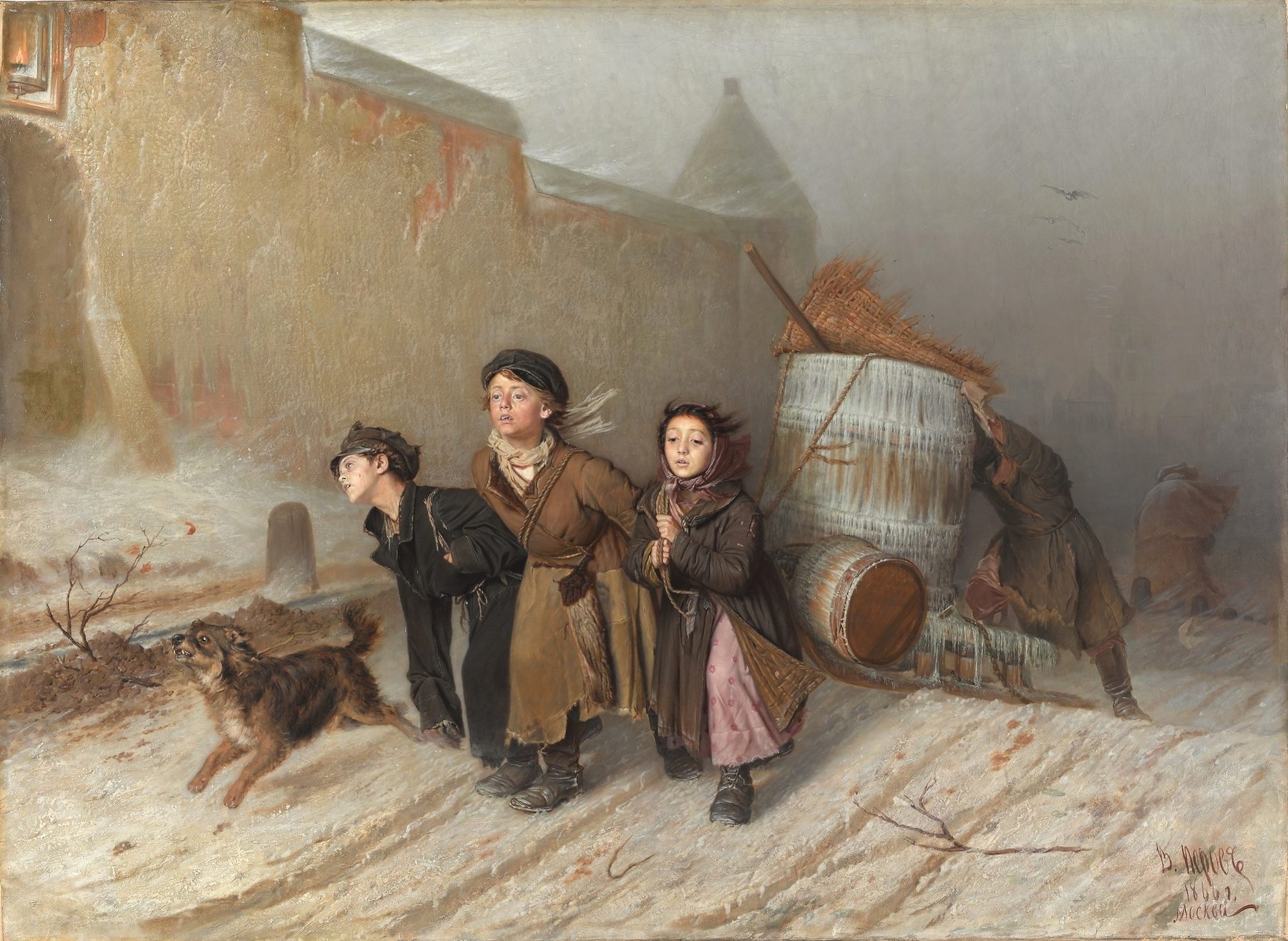
Troika
Vasily Perov · 1866 · Three children drag a frozen water barrel through Moscow, turning everyday labour into a direct test of sympathy and spectatorship.
Christ in the Desert
Ivan Kramskoi · 1872 · Kramskoi removes the visible tempter and makes hesitation itself the drama: cold stone, locked hands and an inward moral decision.
Barge Haulers on the Volga
Ilya Repin · 1870–73 · Repin gives eleven exhausted workers distinct bodies and responses, refusing to reduce the group to either picturesque labour or a single emblem.
Religious Procession in Kursk Province
Ilya Repin · 1880–83 · A dense crowd turns ritual into a contested social system in which rank, force, disability, belief and spectacle occupy the same road.
They Did Not Expect Him
Ilya Repin · 1884–88 · A returned exile enters a domestic interior where every face gives a different verdict, making political history arrive as private uncertainty.
Morning of the Streltsy Execution
Vasily Surikov · 1881 · Surikov makes a historical execution legible through opposed looks and memories rather than one stable judgement about ruler, condemned rebels or crowd.
The Rooks Have Returned
Alexei Savrasov · 1871 · A muddy thaw, bare trees and returning birds transform an unheroic village edge into a seasonal image of territory and renewal.
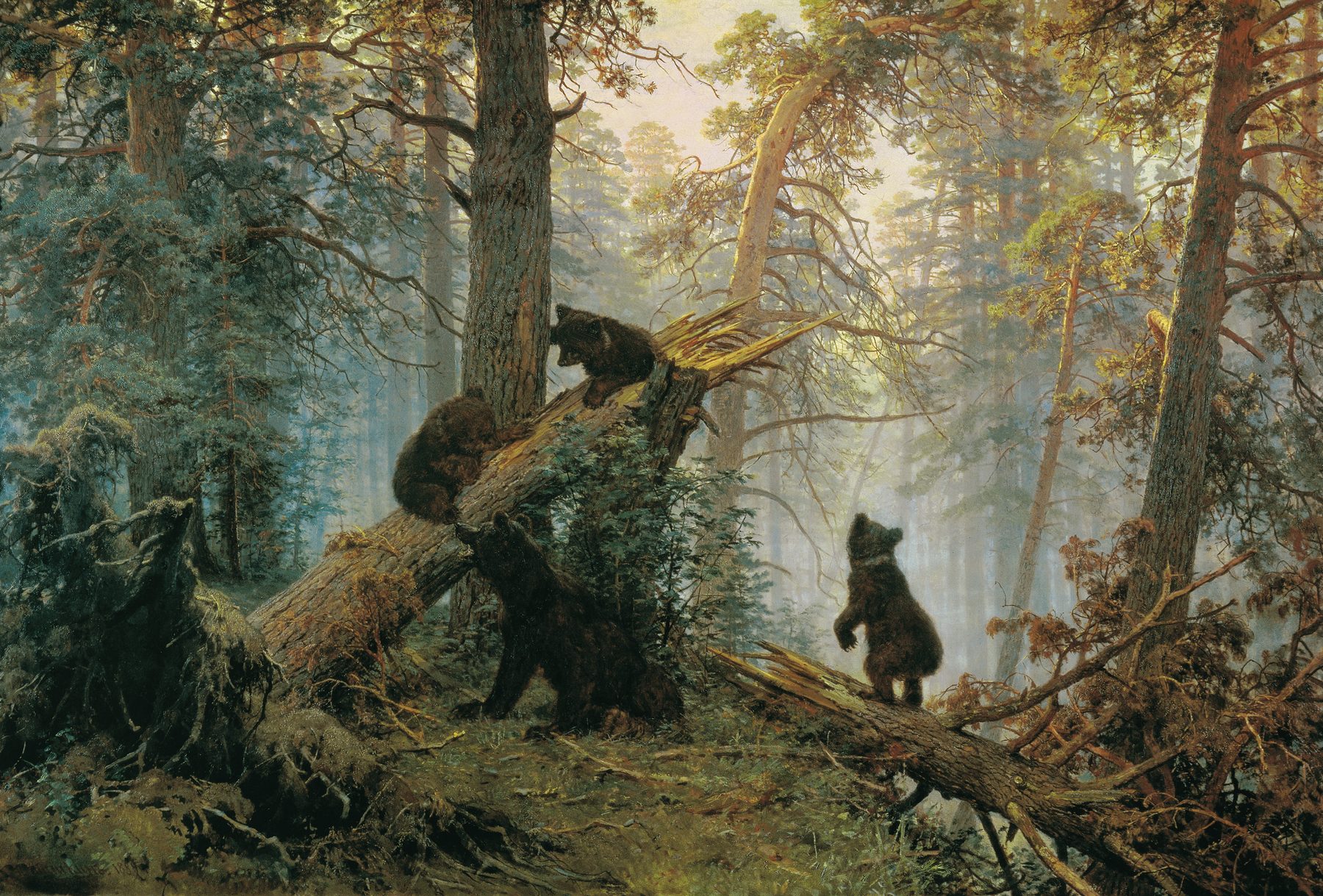
Morning in a Pine Forest
Ivan Shishkin and Konstantin Savitsky · 1889 · Shishkin's monumental forest and Savitsky's bears combine exact natural observation with a scene that became one of Russian art's most reproduced icons.
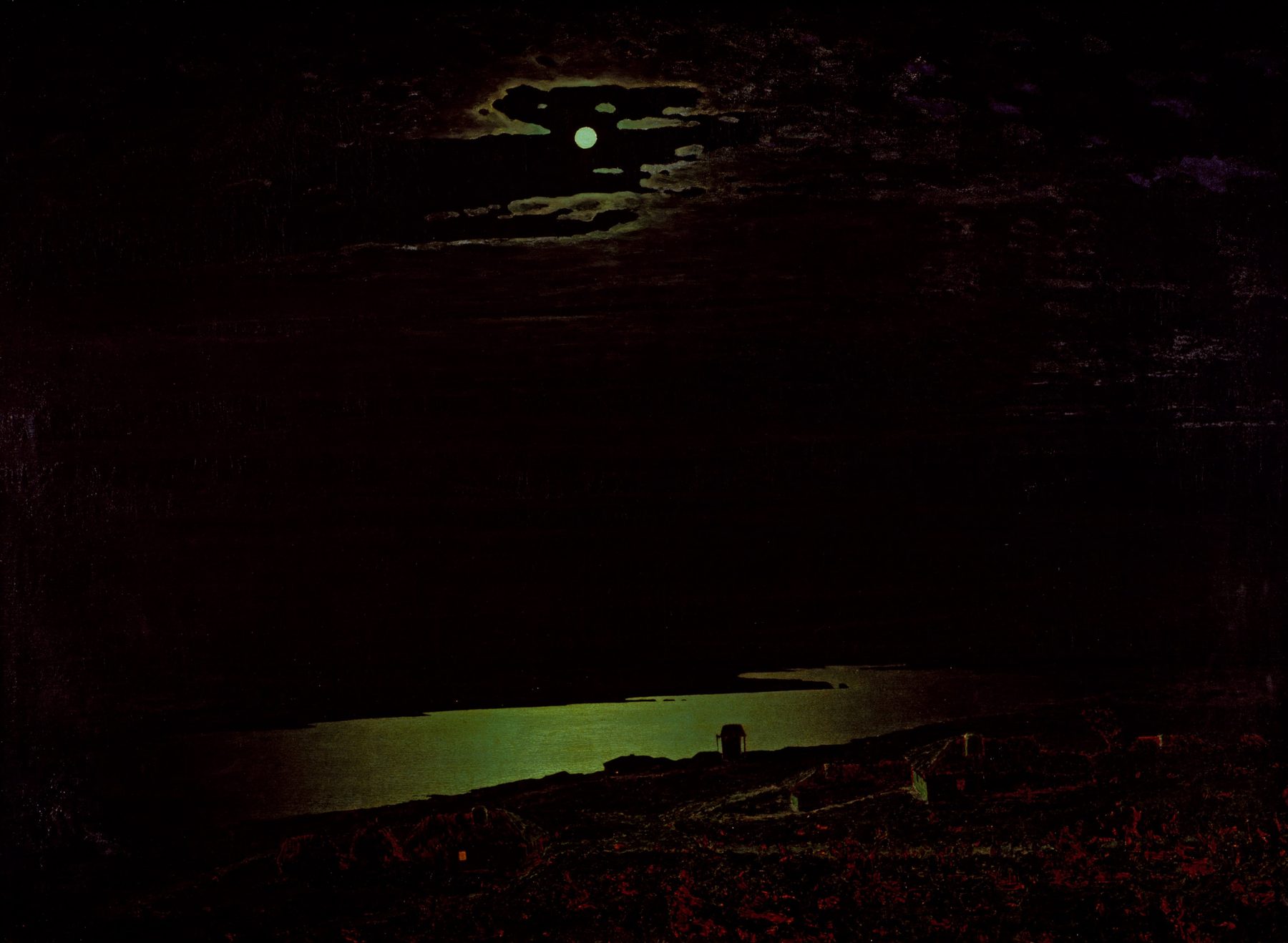
Moonlit Night on the Dnieper
Arkhip Kuindzhi · 1880 · Kuindzhi's concentrated moonlight makes the Dnieper appear almost illuminated from within, joining territorial subject to modern exhibition spectacle.
Above Eternal Peace
Isaac Levitan · 1894 · Levitan's high viewpoint, dark water and small church turn landscape into an argument about memory, mortality and the scale of human presence.
Reading the exhibitions rather than only the masterpieces
Famous images can make the Society look inevitable. In reality, each annual display included strong, minor, conservative, experimental and commercially calculated work. Some artists were members; others were invited exhibitors. Pictures entered, failed to sell, travelled, were altered or disappeared.
The Tretyakov Gallery’s educational project for its major Peredvizhniki exhibition uses archival documents and contemporary criticism to reconstruct the organisation’s disagreements and changing reception.[39] This method is essential. A movement is not only the paintings that museums later selected.
Vladimir Stasov was a powerful participant in that selection. He defended Realism and national art, opposed academic convention and interpreted landscape, genre and history as commentary on current life.[40] His advocacy helped artists, but his emphatic judgments could also narrow their works toward a political or national lesson.
The Nationalmuseum catalogue offers a wider balance: peasant hardship and political activists appear beside portraits, history, myth, landscape and national pride.[41] It is closer to the mixed experience of a travelling exhibition than a room devoted solely to misery.
Empire, nation and the word “Russian”
The Society’s exhibition map was imperial. Kyiv, Odesa, Kharkiv, Riga and Vilnius were not provincial versions of Moscow; they were cities with languages, institutions and artistic communities of their own. Touring could widen access and simultaneously present culture from the capitals as a unifying norm.
Pictures also transformed borderlands into national imagery. Ukrainian villages, Cossacks, the Volga, the Caucasus and Central Asian subjects could be represented with curiosity, solidarity, exoticism or appropriation. The same canvas may contain more than one of those positions.
Rosalind Blakesley’s history of painting in Imperial Russia places the movement within state institutions, patronage, European exchange and the culturally diverse empire that preceded it.[42] That frame prevents two errors: imagining Russian Realism as isolated from Europe, and treating imperial territory as naturally belonging to one ethnic nation.
Modern labels should therefore be informative rather than possessive. “Russian Imperial painter,” “Ukrainian-born artist active in Russian art,” “Armenian member of the Society” or another qualified description may be appropriate depending on evidence. No single rule resolves identity across a changing empire.
Why Repin should not stand for everyone
Repin’s range and fame make him an excellent entrance, but a poor substitute for the entire movement. Russian Museum scholarship on him includes studies of Barge Haulers, his Romantic inheritance, genre formation and reception outside Russia.[43] That breadth belongs to one artist, not to every member.
Kramskoi’s compressed ethical thought, Shishkin’s material forests, Ge’s abrasive Gospel, Surikov’s historical crowds and Kuindzhi’s artificial light make different demands on viewers. A definition broad enough to include them must be institutional and historical as well as stylistic.
The same principle applies to comparison. The social commitments of Käthe Kollwitz or Diego Rivera can illuminate later traditions of accessible public art, but neither is a continuation of the Peredvizhniki. Similar ethical ambitions arise under different media, publics and politics.
Decline: when opposition became authority
By the late 1880s and 1890s, the Society’s position had changed. The imperial family visited and bought from exhibitions. Leading members accepted Academy appointments. Admission rules became cautious. Younger artists looked toward decorative design, Symbolism, Impressionist colour, private patronage and international magazines.
World of Art critics attacked moralising narrative, drab colour and a supposed confusion of literature with painting. Their polemic was self-interested: a new group defines itself by exaggerating the age of its predecessor. Yet it identified a real problem. An organisation founded to expand freedom could become a gatekeeper.
Surikov’s work illustrates why the decline cannot be told as realism simply growing old. Tretyakov scholarship connects his Siberian memories, Moscow experience and historical research to images that remain formally and psychologically strange.[44] Innovation occurred inside the movement even as its institution lost authority.
The public name endured. A Russian cultural dictionary still defines the Peredvizhniki through travelling access and the forty-eight exhibitions from 1871 to 1923.[45] Longevity is not the same as continuous leadership. The final decades matter because they reveal how a radical structure survives after its aesthetic centre disperses.
Soviet inheritance and the danger of a straight line
After the Revolution, the Society continued briefly amid civil war and institutional upheaval. Some older realists joined or influenced the Association of Artists of Revolutionary Russia, known as AHRR. Accessible narrative, contemporary subjects and the claim to serve a broad public offered useful precedents.
Later Soviet art history strengthened the link. Centenary reconstructions and major retrospectives fixed a canon of socially critical masterpieces in the Tretyakov Gallery.[46] Museums preserved essential work, while interpretation often made the nineteenth-century partnership appear more uniformly revolutionary than it had been.
Elizabeth Kridl Valkenier’s Russian Realist Art follows the sequence from the 1863 secession through the Society’s rise and decline to AHRR’s revival of its reputation and the later use of that tradition to legitimise Socialist Realism.[47] “Precursor” was an argument made by institutions, not an inevitable destiny hidden in every canvas.
Socialist Realism developed under a one-party state, centralised unions, censorship and official doctrine. The Peredvizhniki had operated in an autocracy too, but as a voluntary commercial partnership competing with other exhibitions. Shared narrative clarity does not erase that political difference.
International exhibitions continue to alter the afterlife. Nationalmuseum reported strong public interest in its 2011 Peredvizhniki exhibition, despite the movement’s relative unfamiliarity in Western Europe.[48] Translation can open the field, but a title such as “Pioneers of Russian Painting” may also revive a single national story that current scholarship must complicate.
Recent Russian research follows the movement’s reception beyond AHRR into later realism and contemporary conceptual art.[49] Artists may quote Repin, parody textbook reproductions or revisit travelling exhibition as a public model. Influence is not obedience.
AHRR itself belonged to a competitive Soviet field that included avant-garde and other realist organisations. Russian encyclopedia history identifies it as exceptionally large without treating it as the only artistic possibility.[50] The Peredvizhniki’s legacy is therefore branching: museum canon, social narrative, art education, national myth, institutional independence and material for critique.
How to look at a Peredvizhniki painting
- Check the relationship to the Society. Was the painter a founder, later member, occasional exhibitor or realist contemporary? Do not let a broad label replace evidence.
- Reconstruct the first display. An exhibition number, city, neighbouring works and sale can reveal more than a modern isolated reproduction.
- Find the social positions. Who works, watches, owns, commands, prays or travels? Where does the picture place its first buyer?
- Read every response in a crowd. Repin and Surikov distribute meaning across faces. A procession or execution rarely has one emotion.
- Treat landscape as selected territory. Ask why this road, forest, village or river could represent a larger nation—and which territories remain outside the frame.
- Look for international technique. Düsseldorf training, French painting, photography, academic composition and illustration remain present inside national rhetoric.
- Let religious and historical ambiguity survive. A modern Christ or condemned rebel may address contemporary ethics without functioning as a one-to-one political code.
- Compare later uses. Imperial purchase, Soviet textbook reproduction and post-Soviet relabelling can give the same image different public work.
This method also explains a useful comparison with Edvard Munch. Psychological force does not require identical style. A Wanderer may retain descriptive bodies while making anxiety, decision or grief the real subject.
Where to see Russian Realism and the Peredvizhniki
Displays, works on paper, loans and access conditions change. Check current galleries before travelling.
- 01
State Tretyakov Gallery
Moscow, Russia
The essential destination for Kramskoi, Perov, Savrasov, Repin, Surikov, Levitan, Shishkin and the collection formed by Pavel Tretyakov. The historical building in Lavrushinsky Lane lets viewers compare social genre, portrait, landscape, religion and history at sustained depth.
The central Tretyakov collectionVisit collection website - 02
State Russian Museum
St Petersburg, Russia
The principal complement to the Tretyakov. Barge Haulers on the Volga, Repin’s Zaporozhian Cossacks, Kuindzhi’s Moonlit Night on the Dnieper and major works by Ge, Shishkin, Surikov and others reveal a different institutional canon.
Repin, Kuindzhi and a complementary canonVisit collection website - 03
Ilya Repin Museum-Estate Penates
Repino, Russia
Repin’s home and studio north-west of St Petersburg preserves the environment of his later life, working methods and networks. It helps separate the long-lived artist from the narrow image of a 1870s protest painter.
Repin's later home, studio and networksVisit collection website - 04
Vasily Polenov Museum-Reserve
Tula region, Russia
Polenov designed and inhabited this estate on the Oka. Architecture, studio practice, landscape and family archives show how a Wanderer could join painting, education and domestic design.
Polenov's architecture, studio and landscapeVisit collection website - 05
Vasily Surikov Estate Museum
Krasnoyarsk, Russia
The family house places Surikov’s Siberian formation beside the Moscow historical paintings for which he became famous. It is valuable for understanding memory as part of reconstruction.
Surikov's Siberian formation and memoryVisit collection website - 06
Abramtsevo Museum-Reserve
Moscow region, Russia
The artists’ colony around Savva Mamontov brought together Polenov, the Vasnetsovs, Repin, Serov and others. It demonstrates where Peredvizhniki networks overlapped with folklore, craft, theatre and emerging modern design.
The colony's craft, theatre and design networksVisit collection website - 07
Radishchev Art Museum
Saratov, Russia
Founded in 1885 as one of Russia’s first public provincial art museums, it offers the kind of regional collection and audience that the travelling exhibition movement helped make culturally important.
A major provincial public collectionVisit collection website - 08
National Art Museum of Ukraine
Kyiv, Ukraine
Its collections allow Russian Imperial, Ukrainian and local artistic histories to be studied together without assuming that the imperial movement owns every regional identity. Current access and display conditions should be checked before travel.
Ukrainian art within and beyond imperial categoriesVisit collection website
Suggested books
The Wanderers and Critical Realism in Nineteenth-Century Russian Painting by David Jackson
A clear thematic study of the Academy challenge, social genre, activists, portraiture, history, landscape and nationalism. It is particularly useful for resisting the idea that political dissent explains every work.
Art and Commerce in Late Imperial Russia: The Peredvizhniki, a Partnership of Artists by Andrey Shabanov
The strongest corrective to a purely stylistic history. Shabanov reconstructs rules, sales, exhibitions and public identity, showing how professional autonomy and commerce shaped the Society.
Russian Realist Art: The State and Society: The Peredvizhniki and Their Tradition by Elizabeth Kridl Valkenier
A foundational account of relations among state, artists and society. Its treatment of the Soviet appropriation of the movement remains essential to understanding the precursor myth.
The Russian Canvas: Painting in Imperial Russia, 1757–1881 by Rosalind P. Blakesley
A broad institutional and transnational history that places the Wanderers within Academy education, patronage, empire and European exchange rather than beginning Russian painting in 1870.
The Peredvizhniki: Pioneers of Russian Painting, edited by David Jackson and Per Hedström
The substantial Nationalmuseum exhibition catalogue combines thematic essays and a wide visual survey. It is useful for seeing the movement beyond the few paintings most often reproduced.
Major artists associated with Russian Realism and the Peredvizhniki
| Name | Nationality | Key Works |
|---|---|---|
| Ivan Kramskoi | Russian Imperial | Christ in the Desert · Portrait of an Unknown Woman · Portrait of Leo Tolstoy |
| Grigory Myasoedov | Russian Imperial | The Zemstvo is Having Dinner · Harvest Time |
| Nikolai Ge | Russian Imperial | Peter the Great Interrogating Tsarevich Alexei · What Is Truth? |
| Vasily Perov | Russian Imperial | Troika · The Last Tavern at the City Gates · Hunters at Rest |
| Ilya Repin | Ukrainian-born, Russian Imperial | Barge Haulers on the Volga · Religious Procession in Kursk Province · They Did Not Expect Him |
| Vasily Surikov | Russian Imperial | Morning of the Streltsy Execution · Boyarina Morozova · The Conquest of Siberia by Yermak |
| Ivan Shishkin | Russian Imperial | Morning in a Pine Forest · Rye · Mast-Tree Grove |
| Alexei Savrasov | Russian Imperial | The Rooks Have Returned · Country Road |
| Isaac Levitan | Russian Imperial | Above Eternal Peace · Vladimirka · Golden Autumn |
| Arkhip Kuindzhi | Greek-Ukrainian, Russian Imperial | Moonlit Night on the Dnieper · Birch Grove · After the Rain |
| Nikolai Yaroshenko | Ukrainian-born, Russian Imperial | The Stoker · The Student · Everywhere Life |
| Vladimir Makovsky | Russian Imperial | The Condemned · The Bankruptcy |
| Vasily Polenov | Russian Imperial | Moscow Courtyard · Christ and the Woman Taken in Adultery |
| Konstantin Savitsky | Russian Imperial | Repairing the Railway · Morning in a Pine Forest |
| Viktor Vasnetsov | Russian Imperial | After the Battle of Igor Svyatoslavich with the Polovtsy · Bogatyrs |
| Apollinary Vasnetsov | Russian Imperial | Old Moscow reconstructions · Northern landscapes |
| Ivan Pryanishnikov | Russian Imperial | Jokers · Easter Procession in the North |
| Emily Shanks | British-Russian | Newcomer at School · Hiring a Governess |
| Mykola Pymonenko | Ukrainian | Victim of Fanaticism · Wedding in Kyiv Province |
| Abram Arkhipov | Russian Imperial | The Washerwomen · Along the River Oka |
| Valentin Serov | Russian Imperial | Girl with Peaches · Portrait of Nikolai Leskov |
| Nikolai Kasatkin | Russian Imperial | Coal Miners · Poor People Gathering Coal |
Frequently Asked Questions
It is the customary short name for members of the Society for Travelling Art Exhibitions. English translations include Wanderers and Itinerants; French accounts commonly use Ambulants. The name refers to travelling exhibitions, not to artists roaming in search of subjects.
The Society was founded in 1870. In 1863, fourteen Academy students withdrew from a competition and later formed an Artists’ Artel. That earlier revolt was an important institutional precedent, but it was not the same organisation.
No. Russian Realism is a broader category. The Peredvizhniki were a specific partnership whose members and exhibitors worked in varied realist and related modes. Some important realists never joined, and some members’ later work approached Impressionism, Symbolism or decorative modernity.
The standard institutional count is forty-eight, from the first exhibition of 1871 to the last in 1923. Routes and venues varied, and not every exhibition travelled to the same cities.
Not as a unified party or programme. Their organisation challenged Academy control, and many works criticised inequality or represented political dissent. Individual beliefs ranged widely, while members also accepted elite buyers, imperial attention and Academy appointments.
He bought ambitious works, attended exhibitions, supported artists and commissioned portraits of cultural figures. His collection became the Tretyakov Gallery, giving many movement-defining paintings permanent public visibility. His taste also helped shape the later canon.
No. Repin was closely connected to the movement and became its most famous artist, but he joined the Society in 1878. Kramskoi, Myasoedov, Ge, Perov, Savrasov, Shishkin and others were among its founders.
No. Social genre was important, but the exhibitions also featured portraits, landscapes, Russian and Ukrainian history, biblical subjects, myth, folklore, urban scenes and sculpture. Their range widened further across five decades.
Landscape helped define territory, season, memory and national belonging. Savrasov’s thaw, Shishkin’s forests, Levitan’s roads and Kuindzhi’s luminous rivers are formally distinct, showing that national landscape was an argument rather than one style.
Women exhibited, studied with members and worked in related artistic circles, but the Society was overwhelmingly male. Emily Shanks became its first woman member in 1894. Her exceptional election should not be mistaken for general equality.
Use specific evidence. State birthplace, subject, language, self-identification and institutional affiliation where known. The phrase “Russian Imperial art” may describe a historical field, but it should not erase Ukrainian, Armenian, Latvian, Greek or other identities within it.
No. AHRR and Soviet historians adopted parts of its accessible narrative and public mission, then promoted the Wanderers as precursors. Socialist Realism arose under different political institutions and official doctrine. The connection is a selective inheritance, not an inevitable line.
Discussion
Which Peredvizhniki painting changes most when you look beyond its familiar story—to the exhibition where it first appeared, the patron who bought it, the territory it represents or the later political use of its image? Share the detail that altered your reading, and explain whether the work still feels like social evidence, national myth, private drama or something that refuses all four.
Reader Insights
Ask what hung beside a familiar painting, where the show travelled and how catalogue, review and ticket-paying audience changed its public meaning.
A peasant, prisoner, ruler or procession may invite sympathy without supplying one compulsory political reading; compare every face and gesture.
Distinguish imperial institution, birthplace, territory, language and later national label instead of allowing “Russian” to erase regional identities.
Join the Conversation
Which painting changes most when you restore its exhibition, patron, territory or later political use?
References
- Товарищество передвижных художественных выставок, Большая российская энциклопедия (Russian; consulted in Russian), View Source
- Выставки Русского музея в Кемерове, State Russian Museum (Russian; consulted in Russian), View Source
- Конференция Товарищество передвижных художественных выставок к 150-летию, State Tretyakov Gallery (Russian; consulted in Russian), View Source
- The Wanderers and Critical Realism in Nineteenth-Century Russian Painting, David Jackson / Manchester University Press, View Source
- Art and Commerce in Late Imperial Russia: The Peredvizhniki a Partnership of Artists, Andrey Shabanov / Courtauld Institute, View Source
- The Peredvizhniki The Wanderers an Introduction, Kristen M. Harkness / Smarthistory, View Source
- L'Art russe dans la seconde moitié du XIXe siècle en quête d'identité, Musée d'Orsay (French; consulted in French), View Source
- Peredvijniki Ambulants, Larousse (French; consulted in French), View Source
- Peredvizhniki Russisch Realisme rond Repin 1870-1900, Drents Museum (Dutch; consulted in Dutch), View Source
- RUSSIE!, Guggenheim Museum Bilbao (French; consulted in French), View Source
- Российская академия художеств, Большая российская энциклопедия (Russian; consulted in Russian), View Source
- Крамской Иван Николаевич, Большая российская энциклопедия (Russian; consulted in Russian), View Source
- Иван Крамской Христос в пустыне, State Tretyakov Gallery (Russian; consulted in Russian), View Source
- Собирательская деятельность Павла Михайловича Третьякова, State Tretyakov Gallery (Russian; consulted in Russian), View Source
- Новенькая в школе, State Tretyakov Gallery (Russian; consulted in Russian), View Source
- Emily and Mary Shanks Russian-Born Englishwomen Among the Peredvizhniki, Tretyakov Gallery Magazine, View Source
- Painting of the Second Half of the Nineteenth Century to the Beginning of the Twenty-First Century, State Russian Museum (Russian; consulted in Russian), View Source
- Barge Haulers on the Volga, State Russian Museum (Russian; consulted in Russian), View Source
- The Recipe for Success Repin's Painting Barge-Haulers on the Volga and Stasov's Conception of Russian Art, Arts journal / MDPI, View Source
- Ilya Repin to the 175th Anniversary from the Birthday, State Russian Museum (Russian; consulted in Russian), View Source
- В залы постоянной экспозиции возвращаются работы с выставки Передвижники, State Tretyakov Gallery (Russian; consulted in Russian), View Source
- Отдел живописи второй половины XIX начала XX века, State Tretyakov Gallery (Russian; consulted in Russian), View Source
- Zaporozhian Cossacks, State Russian Museum, View Source
- Eastern Encounters Ilia Repin's Orientalist Aesthetics Abroad and at Home, Art History / Oxford Academic, View Source
- Painting Ukraine, Histoire de l'art / INHA, View Source
- A Painter from Ukraine Ilya Repin, Canadian Slavonic Papers, View Source
- Ге Николай Николаевич, Большая российская энциклопедия (Russian; consulted in Russian), View Source
- The Morning of the Streltsy Execution, Virtual Russian Museum / Tretyakov Gallery (Russian; consulted in Russian), View Source
- Утро стрелецкой казни, My Tretyakov (Russian; consulted in Russian), View Source
- Hunters at Rest, State Russian Museum, View Source
- Ilya Repin Ideology and Aesthetics in Russian Art, University of Edinburgh, View Source
- Экскурсия по выставке Передвижники, State Tretyakov Gallery (Russian; consulted in Russian), View Source
- Шишкин Иван Иванович, Большая российская энциклопедия (Russian; consulted in Russian), View Source
- Куинджи Архип Иванович, Большая российская энциклопедия (Russian; consulted in Russian), View Source
- Архип Куинджи Иллюзия света, State Russian Museum (Russian; consulted in Russian), View Source
- Лунный свет Архипа Куинджи, State Russian Museum (Russian; consulted in Russian), View Source
- Isaak Levitan's Enduring Appeal and Russian National Identity 1891-present, The Historian / Taylor & Francis, View Source
- Великие мастера русского пейзажа второй половины XIX начала XX века, State Tretyakov Gallery (Russian; consulted in Russian), View Source
- Московская олимпиада по истории искусств Передвижники, State Tretyakov Gallery (Russian; consulted in Russian), View Source
- Vladimir Vasilievich Stasov, Encyclopedia.com, View Source
- Peredvizjniki Pioneers of Russian Painting, Nationalmuseum Stockholm, View Source
- The Russian Canvas Painting in Imperial Russia 1757-1881, Rijksmuseum Research Library, View Source
- Ilya Efimovich Repin Collection of Articles, State Russian Museum (Russian; consulted in Russian), View Source
- Surikov and Russian History, Tretyakov Gallery Magazine, View Source
- Передвижники, Pushkin State Russian Language Institute (Russian; consulted in Russian), View Source
- Музейная жизнь в послевоенные десятилетия, State Tretyakov Gallery (Russian; consulted in Russian), View Source
- Russian Realist Art the State and Society the Peredvizhniki and Their Tradition, OpenBibArt / Getty Research Institute (French; consulted in French), View Source
- The Peredvizhniki Pioneers of Russian Painting Nationalmuseum report, Nationalmuseum Sweden, View Source
- Передвижники Тернистый путь в XXI век, Russian Academy of Arts (Russian; consulted in Russian), View Source
- 20 век изобразительное искусство, Большая российская энциклопедия (Russian; consulted in Russian), View Source
- Russian Realism and the Peredvizhniki image records, Wikimedia Commons: Troika (Public domain; State Tretyakov Gallery / Wikimedia Commons), Christ in the Desert (Public domain; State Tretyakov Gallery / Google Art Project / Wikimedia Commons), Barge Haulers on the Volga (Public domain; State Russian Museum / Google Art Project / Wikimedia Commons), Religious Procession in Kursk Province (Public domain; State Tretyakov Gallery / Google Art Project / Wikimedia Commons), They Did Not Expect Him (Public domain; State Tretyakov Gallery / Wikimedia Commons), Morning of the Streltsy Execution (Public domain; State Tretyakov Gallery / Wikimedia Commons), The Rooks Have Returned (Public domain; State Tretyakov Gallery / Wikimedia Commons), Morning in a Pine Forest (Public domain; State Tretyakov Gallery / Wikimedia Commons), Moonlit Night on the Dnieper (Public domain; State Russian Museum / Google Art Project / Wikimedia Commons), Above Eternal Peace (Public domain; State Tretyakov Gallery / Wikimedia Commons).

Social genre: sympathy, story and spectatorship
The most recognisable early Wanderer subject is ordinary suffering. Vasily Perov’s Troika shows three children harnessed to a sledge, hauling a heavy barrel through winter slush. Their diagonal effort drives toward the viewer; an adult pushes behind; the title’s comparison with a three-horse team makes exploitation brutally legible.
Grigory Myasoedov’s The Zemstvo Is Dining places peasants outside a district council building while officials’ richer meal is suggested inside. Nikolai Yaroshenko’s The Stoker turns a soot-darkened worker into an exhausted presence rather than picturesque labour. Vladimir Makovsky developed rooms, streets and legal encounters as compact social dramas.
These paintings gave dignity to people marginal in academic history painting, but sympathy did not dissolve distance. Poor subjects became commodities purchased by merchants, officials and nobles. Their torn clothing and fatigue could prompt reformist concern, moral self-recognition or aesthetic pleasure. The viewer is never outside that exchange.
Genre could also be comic and sociable. Perov’s Hunters at Rest depends on three responses to a story: expansive invention, credulous attention and amused disbelief. The painting asks us to listen with our eyes. Russian Realism included tall tales as well as indictments.
Narrative clarity was a strength because viewers could enter quickly. It could become a weakness when a picture seemed to illustrate a pre-decided moral. Later critics objected that literature had replaced painting. The best works resist that charge by making gesture, spacing, colour and uncertainty do more than the anecdote.