


 by Tom Gurney
Tom Gurney BSc (Hons) is an art history expert with over 20 years experience
Published on November 6, 2026 / Updated on November 6, 2026
Email: tomgurney1@gmail.com / Phone: +44 7429 011000
Introduction
The relationship between Fra Angelico and Cosimo de’ Medici produced one of the most important artistic-religious environments of the Early Renaissance: the Dominican convent of San Marco in Florence. Cosimo did not discover an unknown painter and transform his career single-handedly. Angelico was already a major master by the 1430s. He had produced important Fiesole altarpieces. The Linaioli commission had demonstrated his public reputation. Palla Strozzi had employed him for the Santa Trinita Deposition. Cosimo’s importance lies elsewhere.
He gave Angelico a scale of institutional opportunity unprecedented in the painter’s earlier career. At San Marco, patronage was no longer one panel. It was architecture, church, high altar, dormitory, fresco cycles, library and private retreat environment. The convent was rebuilt by Michelozzo at Cosimo’s expense and became one of the defining monuments of Medici Florence. Angelico worked there broadly between 1438 and 1445. The project contained forty-four friars’ cells, differentiated devotional programmes, the monumental Chapter House Crucifixion, the San Marco Altarpiece and the famous Annunciation in the upper dormitory corridor.
Cosimo himself maintained a double cell in the convent and stayed there during spiritual retreats. The library he sponsored was intended not only for friars but for scholars, including lay intellectuals. This makes the relationship more complex than “rich banker hires painter.” Cosimo funded a Dominican institution he personally used. Angelico created art for a community to which he himself belonged. Medici patronage and Dominican spirituality therefore met through two participants whose roles were very different but deeply invested. [1]
At a Glance
- PatronCosimo de’ Medici, 1389–1464 [1]
- ArtistFra Angelico [1]
- Principal shared projectSan Marco, Florence [1]
- ArchitectMichelozzo [1]
- Rebuildingprincipally 1437–43 [1]
- Angelico at San Marcobroadly 1438–45 [1]
- High-altarpiece patronageCosimo and his brother Lorenzo [3]
- Major Medici saintsCosmas and Damian [3]
- Cosimo’s personal usedouble cell for spiritual retreats [2]
- Librarycommissioned by Cosimo, designed by Michelozzo [1]
- Library audiencefriars and outside scholars [1]
- Key themespatronage, reform, family devotion, humanism, retreat and institutional prestige [1]
Contents
- Introduction
- Cosimo the Patron
- Why San Marco?
- Michelozzo
- The Scale of San Marco
- The San Marco Altarpiece
- Cosimo’s Double Cell
- The Library
- Patronage and Control
- Why Cosimo de’ Medici Matters to Fra Angelico
Cosimo the Patron
Cosimo de’ Medici was one of Florence’s most powerful citizens. His banking wealth and political influence enabled extraordinary patronage. Yet patronage in Renaissance Florence was never merely decoration. It could create family memory. Support religious institutions. Enhance civic status. Express piety. Build political networks. San Marco performs all of these functions. [1]
Why San Marco?
The Dominican convent offered Cosimo a prestigious religious project inside Florence. Supporting Observant reform allowed him to associate the Medici with disciplined spirituality. The building also created opportunities for family chapel patronage, intellectual culture and personal retreat. San Marco therefore served several Medici interests without becoming a palace. [1]
Michelozzo
Cosimo entrusted the rebuilding to Michelozzo. The architect created a clear, restrained Dominican complex. This restraint is important. Medici magnificence did not require ornamental excess. The family could display power through patronage of disciplined architecture. This suited the Observant setting. [1]
Angelico was already established. The Prado treats the Linaioli commission as a turning point demonstrating his maturity. Palla Strozzi had also become a major patron. Cosimo therefore selected an artist whose reputation had already been proven. The San Marco commission reflects recognition rather than discovery. [5]
The Prado explicitly notes the importance of both Palla Strozzi and Cosimo de’ Medici as powerful patrons attracted by Angelico’s mature work. This places artistic patronage within Florentine competition. Leading families sought leading artists. Art could therefore function inside rivalry even when its subject was religious. [5]
The Scale of San Marco
San Marco was colossal by comparison with a single altarpiece. Angelico’s involvement included altars, principal rooms and dozens of cells. The Prado stresses that such a project was possible only because of a large, well-organised workshop. Cosimo’s patronage therefore helped turn Angelico’s artistic organisation into an institutional enterprise. [1]
The San Marco Altarpiece
The high-altarpiece was the clearest Medici liturgical statement within the church. Cosimo and his brother Lorenzo obtained patronage of the principal chapel in 1438. Its dedication united Saint Mark, the church’s titular saint, with Cosmas and Damian, the saints most closely associated with Medici devotion. These saint choices made Medici identity visible within sacred form. [3]
Cosmas and Damian were especially associated with Medici devotion. The name Cosmas resonated directly with Cosimo. Their prominence on the high altar gave the family heavenly representatives. The predella narrated their lives in eight scenes. Patronage therefore extended from saint selection to narrative biography. [3]
The Death of Lorenzo
Lorenzo de’ Medici died in 1440 before the San Marco Altarpiece was completed. Cosimo survived to see the work installed. The museum has suggested that differences in the attitudes of Cosmas and Damian may echo this family circumstance. The idea is intriguing but interpretive. The secure point is that the commission changed from two living brothers to one surviving patron during production. [3]
The rebuilt high altar and church were consecrated at Epiphany 1443. Pope Eugene IV and cardinals attended. This ceremony demonstrates the public prestige of the project. Cosimo’s patronage was visible at one of the most important ecclesiastical events in Florence. Angelico’s altarpiece stood at its centre. [3]
Cosimo’s Double Cell
Cosimo maintained a double cell at San Marco. The museum states that he stayed there during spiritual retreats. This is one of the most significant facts about his relationship with the convent. The patron was not only constructing religious reputation from outside. He entered the building as a retreatant. [2]
The double cell gave Cosimo controlled withdrawal from political and domestic life. A man at the centre of Florentine power could enter a space governed by Dominican discipline. This does not erase his wealth or politics. It demonstrates that devotional withdrawal could coexist with them. [2]
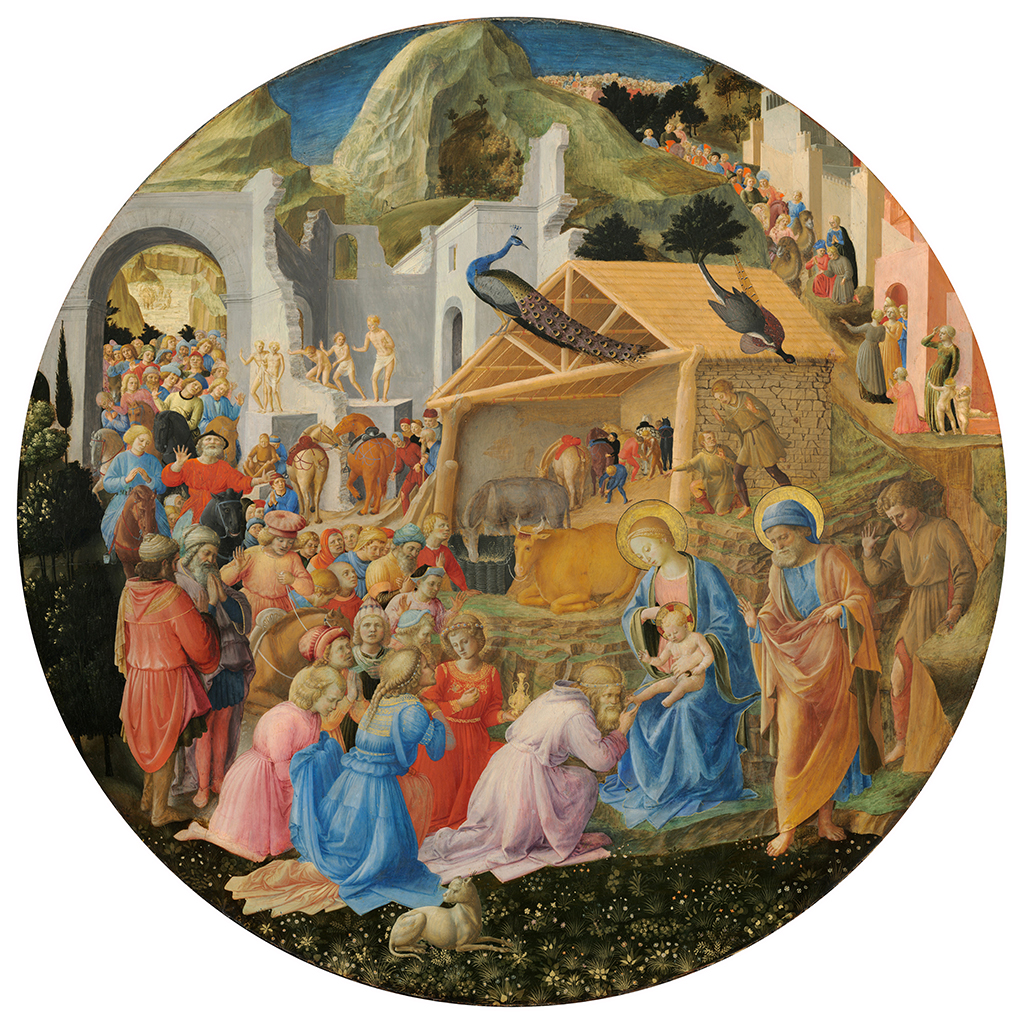
Cosimo’s cell area also contained imagery associated with the Adoration of the Magi. The theme later became famously linked with Medici identity. At San Marco, such imagery connected personal devotion, Christological narrative and family culture. The exact authorship divisions within the cells remain uncertain and vary from fresco to fresco. [2]
Cosimo’s cell creates an unusual relationship. Most patrons stand outside the religious community they fund. Cosimo became a temporary resident inside it. This gave San Marco a porous boundary between lay elite and convent. The arrangement reflects the deeply interconnected nature of Florentine religious and political culture. [2]
The Library
Cosimo also funded Michelozzo’s monumental library. The museum describes it as a public library intended for friars and scholars, including laymen. This was extraordinary. The convent became a place where religious study and urban intellectual culture intersected. [4]
The humanist Niccolò Niccoli’s books became foundational to the library. This connected San Marco directly with Florentine humanism. The same institution containing Angelico’s meditative frescoes also housed one of the city’s great scholarly collections. [4]
This library environment would have had special resonance for Angelico because his career began with manuscript illumination. The mature painter worked in a convent where books were architecturally monumentalised. Painting, study and religious life therefore reinforced one another. [4]
San Marco demonstrates why humanism should not automatically be equated with secular culture. Cosimo could support classical scholarship and Dominican reform simultaneously. The library and cell frescoes existed in the same building. The Renaissance synthesis was institutional, not merely philosophical. [4]
Antonino Pierozzi was a major Dominican leader at San Marco. His role helps keep the institution from being interpreted merely as a Medici creation. The Dominicans had their own leadership and reform programme. Cosimo funded. The friars governed religious life. Angelico belonged to their order. [1]
Patronage and Control
This distinction is crucial. Patronage did not mean total artistic or theological control. Cosimo’s money shaped possibilities. Dominican priorities shaped use. Angelico translated those priorities visually. San Marco therefore emerged through negotiation. [1]
The Chapter House Crucifixion demonstrates this negotiation well. Medici-associated saints appear. So do Dominican, Florentine and other religious figures. The painting acknowledges patrons without turning communal Dominican governance into Medici propaganda. The Cross remains central. [1]
The Medici often used patronal saints rather than intrusive donor portraits. This allowed family identity to become sacredly integrated. Cosmas and Damian could represent ideals associated with the family while remaining legitimate objects of devotion for the wider Church. [1]
Cosmas and Damian were physician saints famous for healing without payment. This creates an especially interesting patronal association for bankers. A purely cynical interpretation would be equally misleading. The saints could represent ideals to which patrons aspired. But the contrast between wealth and charitable healing gives the programme moral depth. [1]
The relationship between Angelico and the Medici continued through Cosimo’s son Piero. Piero commissioned the Armadio degli Argenti for Santissima Annunziata. This demonstrates that Angelico’s Medici relationship extended across generations and institutions. [6]
San Marco versus Santissima Annunziata
Cosimo’s great project centres Dominican reform and scholarship. Piero’s later commission centres Marian devotion and ex-voto culture. Angelico adapts accordingly. The Medici do not receive one house style. They receive art tailored to institution. [6]
San Marco certainly enhanced Medici prestige. A major convent. A papal consecration. A monumental library. Exceptional art. All reflected favourably upon Cosimo. The religious and political meanings should therefore be held together. [1]
At the same time, Cosimo’s double cell is difficult to explain if patronage is reduced entirely to political calculation. The evidence supports real devotional use. A balanced account therefore avoids both hagiography and cynicism. Renaissance patrons could be politically strategic and sincerely religious. [1]
The contrast between palace and convent is revealing. Cosimo supported elite domestic architecture elsewhere. At San Marco, he supported monastic restraint. Different buildings projected different aspects of Medici identity. Patronage was context-sensitive. [1]
Angelico does not flatter the Medici through overt courtliness. His San Marco frescoes remain deeply Dominican. The high-altarpiece acknowledges family saints. The library environment supports humanism. But the cells remain spaces of Passion, humility and prayer. This demonstrates artistic and institutional integrity. [5]
Why Cosimo de’ Medici Matters to Fra Angelico
Cosimo matters because he gave Angelico the opportunity to work at the scale of an entire religious institution. San Marco allowed the painter to design relationships between architecture, altarpiece, communal fresco, private cell and library culture. No earlier commission offered that range. The project also demonstrates why patronage should not be reduced to a payment transaction. Cosimo funded the building. Michelozzo shaped architecture. Dominican reform shaped function. Angelico shaped visual experience.
Books shaped intellectual life. Cosimo himself eventually used the convent for retreat. San Marco therefore became one of the clearest surviving examples of Renaissance culture as a network. The relationship between Cosimo and Angelico matters because both men helped create that network from different positions. The patron supplied resources and political capacity. The friar-painter supplied a visual language capable of making Medici patronage serve Dominican devotion without simply becoming Medici spectacle. [1]
Frequently Asked Questions
Discussion
How does San Marco allow Cosimo de’ Medici’s wealth and Fra Angelico’s Dominican art to cooperate without collapsing patronage into control?
Reader Insights
What changes when patronage funds an entire conventual system rather than one portable artwork?
How does Cosimo’s double cell complicate the boundary between private power and monastic discipline?
Where does the San Marco programme accommodate Medici identity, and where does Dominican purpose remain dominant?
Join the Conversation
Share your reading of Fra Angelico and Cosimo de’ Medici below.
References
- Direzione regionale Musei nazionali Toscana, Museo di San Marco. Direzione regionale Musei nazionali Toscana Museo di San Marco.
- Direzione regionale Musei nazionali Toscana, resources on Cosimo de’ Medici’s double cell and the forty-four-cell dormitory. Direzione regionale Musei nazionali Toscana Cosimo’s double cell and the forty-four-cell dormitory.
- Direzione regionale Musei nazionali Toscana, San Marco Altarpiece restoration and Medici patronage. Direzione regionale Musei nazionali Toscana San Marco Altarpiece restoration and Medici patronage.
- Direzione regionale Musei nazionali Toscana, Michelozzo Library and illuminated manuscripts. Direzione regionale Musei nazionali Toscana Michelozzo Library and illuminated manuscripts.
- Museo Nacional del Prado, Fra Angelico and the Rise of the Florentine Renaissance. Museo Nacional del Prado Fra Angelico and the Rise of the Florentine Renaissance.
- Museo di San Marco, Armadio degli Argenti and Piero de’ Medici. Museo di San Marco research on the Armadio degli Argenti and Piero de’ Medici.
.jpg)


 Fra Angelico.jpg)


