 by Tom Gurney
Tom Gurney BSc (Hons) is an art history expert with over 20 years experience
Published on November 6, 2026 / Updated on November 6, 2026
Email: tomgurney1@gmail.com / Phone: +44 7429 011000
Introduction
Fra Angelico cannot be understood fully without the Dominican order. His religious vocation was not a biographical detail added to an otherwise ordinary artistic career. It shaped where he lived, who commissioned him, which saints appeared repeatedly in his paintings, how images were used, how workshop production operated inside religious institutions and how he understood the relationship between study and devotion. Born Guido di Pietro, he became Fra Giovanni da Fiesole after entering the Observant Dominican convent of San Domenico in Fiesole.
By 1423 he had professed within the order. From that point onward, painting and Dominican identity developed together. He produced major altarpieces for San Domenico. He later became central to the decoration of San Marco in Florence, another Dominican house. He painted Dominican saints repeatedly. He integrated Saint Dominic into scenes from Christ’s life as a devotional witness. He worked in papal Rome as a Dominican friar. Around 1450–52 he served as prior at San Domenico in Fiesole.
The order therefore provided not merely subjects but an institutional framework for his entire mature career. Modern museum research makes the relationship particularly clear at San Marco. The convent contained forty-four cells with differentiated fresco programmes for clerics, novices and lay brothers. The clerics’ corridor received stories from Christ’s life. The novices’ corridor repeatedly presented the Crucifixion with Saint Dominic in prayer. The lay brothers’ corridor received more narrative Gospel imagery. Painting therefore formed part of religious formation. Angelico’s art did not simply illustrate doctrine. It helped train Dominican attention. [1]
At a Glance
- Religious nameFra Giovanni da Fiesole [1]
- OrderOrder of Preachers, commonly called Dominicans [1]
- Professionby 1423 at San Domenico, Fiesole [1]
- Early Dominican centreSan Domenico, Fiesole [1]
- Major mature centreSan Marco, Florence [2]
- Important Dominican saintsDominic, Thomas Aquinas, Peter Martyr, Antoninus and other Blessed of the order [1]
- Key institutional themespreaching, study, prayer, communal discipline and charity [1]
- San Marco cells44, with distinct programmes for different groups [3]
- Later leadershipAngelico served as prior at San Domenico around 1450–52 [1]
- Core significanceDominican identity shaped subject, audience, function and workshop context throughout his career [1]
Contents
- Introduction
- The Order of Preachers
- Observant Reform
- From Guido di Pietro to Fra Giovanni
- San Domenico at Fiesole
- The Fiesole High Altarpiece
- Painting and Preaching
- San Marco
- Forty-Four Cells
- Why the Dominican Order Matters to Fra Angelico
The Order of Preachers
The Dominican order was founded in the early thirteenth century by Dominic of Caleruega. Its formal name, the Order of Preachers, reveals its central mission. Preaching was not merely public speaking. It required theology, scriptural knowledge, disciplined religious life and study. The order therefore developed a strong intellectual culture. This becomes essential to understanding Angelico. A Dominican image could serve prayer and scholarship simultaneously. [1]
Observant Reform
Angelico entered San Domenico at Fiesole within an Observant environment. Observant reform sought stricter adherence to religious discipline. The movement emphasised communal life, prayer and the order’s original ideals. Angelico’s paintings therefore emerged within a community concerned consciously with reform. This helps explain the restrained devotional character of much of his later San Marco work. [1]
From Guido di Pietro to Fra Giovanni
The change of name marks more than a biographical milestone. Guido di Pietro was already a professional painter. Fra Giovanni did not abandon that profession. Instead, the artistic identity was absorbed into Dominican life. This creates one of the distinctive features of his career. He is simultaneously friar and professional master. [1]
San Domenico at Fiesole
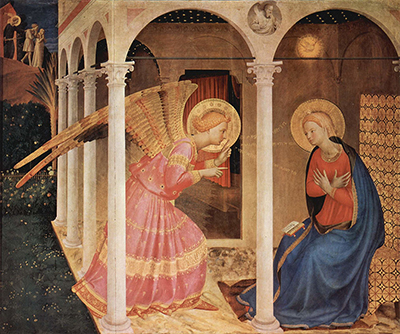
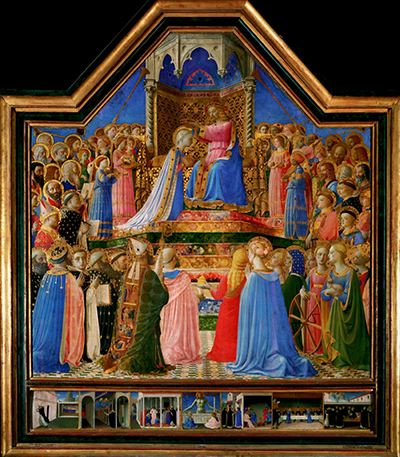
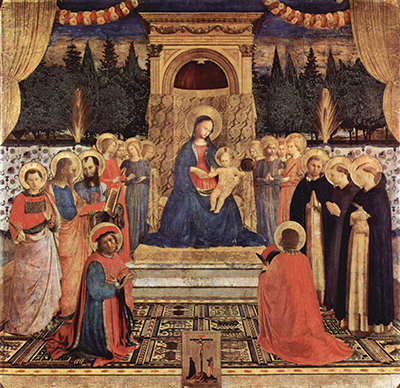
San Domenico became Angelico’s first major Dominican artistic laboratory. He produced the high altarpiece. He painted the Annunciation now in the Prado. He created the Coronation now in the Louvre. These works were not generic commissions for anonymous customers. They belonged to his own religious environment. [5]
The Fiesole High Altarpiece
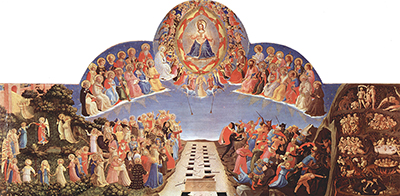
The predella of the Fiesole high altarpiece is especially revealing. Christ appears glorified within a vast heavenly court. Among the surrounding figures are rows of Dominican Blessed. The order therefore places its own holy history within universal Christian heaven. This is institutional self-understanding made visible. [5]
The inclusion of Dominican Blessed matters because they were not all universally famous saints. Their presence was meaningful above all to the order itself. The predella therefore assumes a Dominican audience. Angelico paints not merely for Christianity in the abstract but for one community with a memory of its own holy figures. [5]
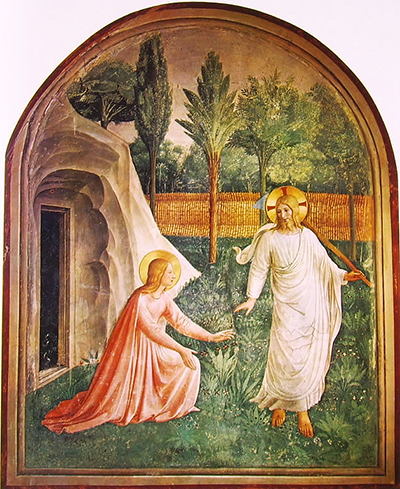
Dominic becomes one of Angelico’s most important recurring figures. At San Marco he appears repeatedly in scenes from Christ’s life. Historically, he could not have witnessed those events. Devotionally, his presence is central. Dominic demonstrates how a friar should respond. [1]
When Dominic kneels before the Crucifixion, the actual friar can imitate him. When he contemplates Christ, he becomes a model of attention. Angelico therefore places a Dominican viewer inside sacred history. The real viewer looks at Dominic looking at Christ. This creates a chain of devotional instruction. [1]
Peter Martyr
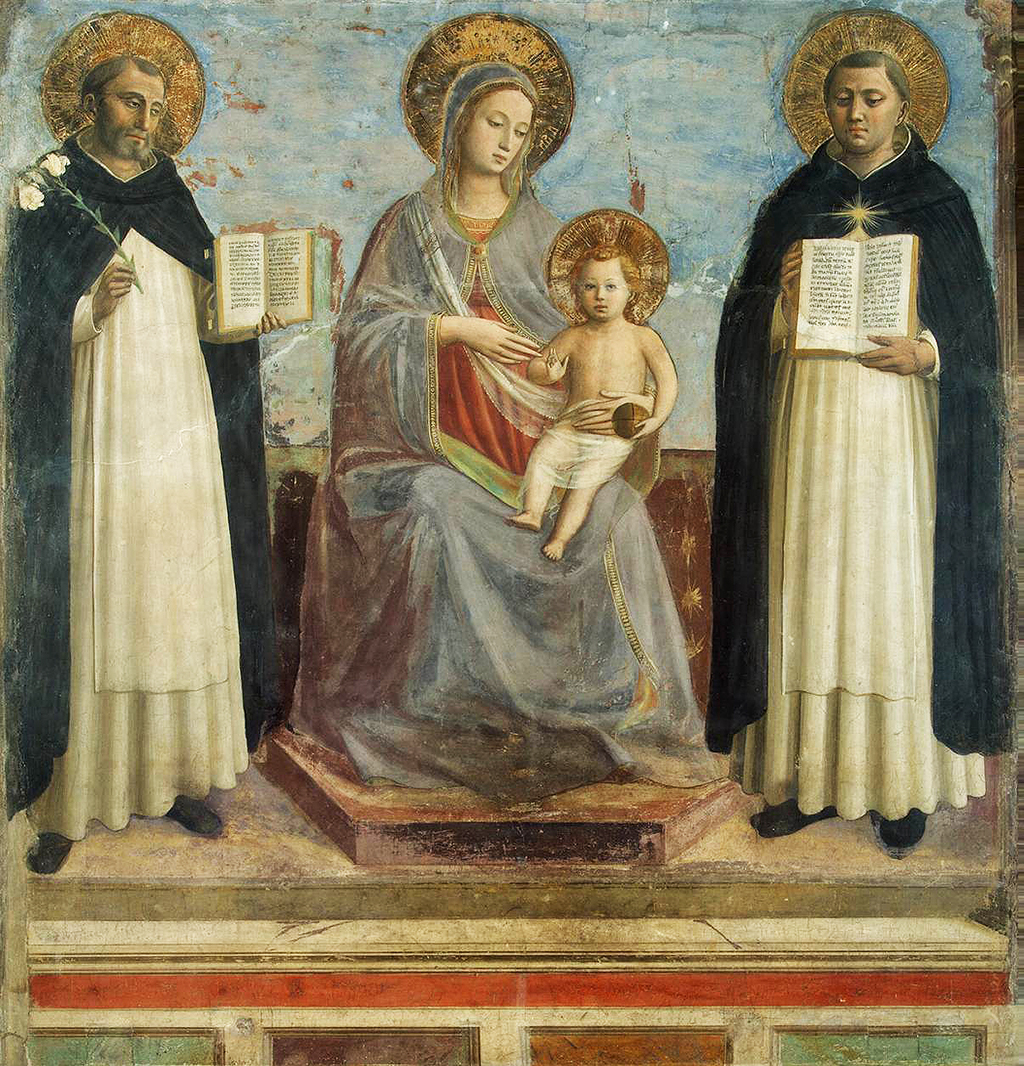
Peter Martyr was another central Dominican saint. His martyrdom and preaching made him an important model for the order. Angelico includes him in altarpieces and devotional contexts. His presence reinforces the identity of the Dominican community as an order of preaching and witness. [1]
Thomas Aquinas represented Dominican theology at its highest intellectual level. His appearance in Angelico’s works connects sacred painting with scholarship. This is especially important for understanding the Armadio degli Argenti, whose theological structure modern San Marco research associates closely with Thomistic thought. [1]
Dominican study was not opposed to prayer. It served preaching. A friar needed knowledge in order to teach. This is why libraries were institutional necessities. San Marco’s famous Michelozzo library belongs directly to this culture. [4]
The monumental library at San Marco was built through Cosimo de’ Medici’s patronage. The museum describes it as a “public library” intended not only for friars but for scholars, including lay intellectuals. Its holdings included illuminated manuscripts. Some were illustrated by Fra Angelico and collaborators. The building therefore joined Dominican study, Medici humanism and Angelico’s own manuscript background. [4]
Angelico’s activity as illuminator fits naturally within Dominican intellectual culture. Books were instruments of liturgy, study and prayer. Illumination made sacred text visually resonant. The early gradual associated with San Domenico, produced around 1424–30, is one of the most important surviving witnesses to this practice. [4]
Painting and Preaching
Angelico’s paintings can be understood as visual forms of preaching. They do not literally replace sermons. But they organise Christian history so viewers can contemplate meaning. Predellas narrate saints’ lives. Cell frescoes train meditation. Altarpieces establish sacred hierarchy. The Niccoline Chapel turns martyr history into public moral argument. [1]
San Marco
San Marco is the clearest surviving Dominican environment in Angelico’s career. The convent combines cloister, church, Chapter House, cells and library. Each space has a different function. Angelico adapts imagery accordingly. The whole building becomes a visual pedagogy. [2]
Forty-Four Cells
The museum identifies forty-four dormitory cells. They were used for prayer and rest. Their frescoes differ according to the communities occupying corridors. This differentiation is one of the strongest pieces of evidence that the programme was designed around religious formation. [3]
The clerics’ corridor contains stories from Christ’s life. These images could sustain a more developed Christological sequence. Clerics were expected to participate deeply in liturgical and intellectual life. The fresco programme reflects that role. [3]
For the novices, repeated Crucifixion images place Saint Dominic in prayer before Christ, turning the founder into a model of contemplative discipline. Repetition is pedagogical. Novices repeatedly see the founder contemplating Christ. The message is direct. Dominican identity begins with imitation of Dominic’s attention to the Cross. [3]
The lay brothers’ corridor contains more narrative Gospel scenes. This distinction demonstrates that the convent did not treat every member identically. Visual material was adapted to different forms of religious participation. [3]
The cells served both prayer and sleep. This is important. Sacred imagery inhabited ordinary rhythms. The fresco was not something encountered only during formal liturgy. It remained present during daily life. The cell itself became devotional environment. [3]
Dominican discipline made silence meaningful. Angelico’s restrained cell frescoes participate visually in that silence. Few figures. Clear gestures. Sparse architecture. The paintings do not overwhelm the room. They reinforce contemplation. [3]
Dominican life was also communal. The Chapter House Crucifixion expresses this opposite scale. There, a large sacred assembly surrounds Christ. The living friars meet beneath saints from many traditions. Private meditation and communal identity therefore receive different visual languages. [2]
Antoninus was one of the leading Dominican figures associated with San Marco. He served as prior and later became Archbishop of Florence. His presence reminds us that San Marco was an active centre of religious leadership, not merely a Medici cultural project. Angelico worked within a serious institutional community. [2]
Cosimo de’ Medici maintained a double cell at San Marco for spiritual retreats. This brought a powerful lay patron into direct contact with Dominican religious life. The arrangement complicates the boundary between convent and city. The Dominicans did not exist in isolation from elite Florentine networks. [2]
San Marco therefore contains an apparent contradiction. A wealthy banking family funds an Observant religious house. Yet such relationships were common in Renaissance patronage. The important question is how wealth is translated into sacred use. Architecture, art, books and liturgy become beneficiaries. Dominican ideals remain institutionally distinct even when patrons support them. [2]
Cosmas and Damian
The Medici saints Cosmas and Damian are not Dominican, but their importance at San Marco demonstrates how patronal identity entered Dominican space. The high altar negotiates between family devotion and convent identity. Angelico’s art performs that negotiation. [1]
Angelico’s Dominican identity did not restrict him to Dominican houses. Pope Nicholas V commissioned him in Rome precisely as a celebrated painter who was also a friar. The Vatican explicitly identifies both identities. In the Niccoline Chapel, Dominican intellectual discipline encounters papal humanism. [6]
The two deacon-martyr cycles are appropriate to Dominican values of service and witness even though the saints predate the order. Preaching. Charity. Public testimony. Martyrdom. These themes resonate strongly with the Order of Preachers. [6]
The late Armadio degli Argenti returns directly to Dominican theological thought. Old and New Testament concordance structures the programme. Text and image work together. The cycle demonstrates that Angelico’s late art remained rooted in learned religious interpretation. [1]
Angelico eventually served as prior at San Domenico in Fiesole. This role matters enormously. It demonstrates that he was not merely an artist living conveniently inside a convent. He exercised institutional leadership. The mature painter also carried administrative and spiritual responsibility. [1]
Leadership and Workshop
The two forms of leadership may have reinforced one another. A prior manages a community. A master painter manages a workshop. Both require organisation, delegation and discipline. It would be speculative to claim a direct causal relationship. But Angelico’s career demonstrates unusual compatibility between religious and artistic administration. [1]
The Prado emphasises that Angelico maintained a large and well-organised workshop despite his religious status. This dismantles another stereotype. Becoming a friar did not prevent professional collaboration. The workshop produced paintings for churches and important patrons in Florence and elsewhere. [1]
Benozzo’s collaboration shows how lay artists could work within Angelico’s orbit. The relationship challenges any simple image of a closed monastic workshop. San Marco and later Roman projects required flexible artistic networks. [1]
The strongest interpretation of Angelico therefore avoids two extremes. He was not merely a professional painter wearing a habit without consequence. He was not merely a mystical friar whose art emerged spontaneously from prayer. He was both religious and professional. His Dominican identity shaped purpose. His artistic skill shaped form. [1]
Vasari’s later biography emphasised Angelico’s piety intensely. Stories of prayer and tears before painting the Crucifixion became central to reception. These accounts should be treated critically. Yet they reflect a genuine historical reputation. The Dominican painter was remembered as unusually devout. [1]
The later beatification of Angelico formalised that devotional reputation. This belongs to reception history rather than fifteenth-century evidence. It nevertheless demonstrates how inseparable painter and friar became in cultural memory. [1]
Why the Dominican Order Matters to Fra Angelico
The Dominican order matters because it provides the institutional logic of Fra Angelico’s career. Fiesole gives him religious identity and early major commissions. San Marco gives him his greatest surviving environment. Dominican saints structure his iconography. Dominican viewers structure his frescoes. Dominican study connects his paintings with libraries and manuscripts. Dominican theology shapes late cycles. Dominican leadership eventually includes Angelico himself as prior.
The order also explains why his art could combine intellectual sophistication with contemplative restraint so naturally. For the Dominicans, study and prayer were not opposites. Preaching required both. Angelico’s paintings inherit this structure. They think carefully in order to help viewers contemplate carefully. That is why Fra Angelico’s Dominican identity should not occupy one paragraph in his biography. It belongs at the centre of how his art works. [1]
Frequently Asked Questions
Discussion
How does Fra Angelico’s Dominican vocation change the way we understand his paintings as professional works, devotional instruments and acts of institutional service?
Reader Insights
How do the different San Marco dormitory programmes adapt imagery to clerics, novices and lay brothers?
In what sense can painting function as a visual counterpart to Dominican preaching and study?
How should we balance the roles of friar, prior, workshop leader and professional master in Angelico’s career?
Join the Conversation
Share your reading of Fra Angelico’s Dominican identity below.
References
- Museo Nacional del Prado, Fra Angelico biography and 2019 exhibition research. Museo Nacional del Prado Fra Angelico exhibition research.
- Direzione regionale Musei nazionali Toscana, Museo di San Marco institutional history. Direzione regionale Musei nazionali Toscana Museo di San Marco institutional history.
- Direzione regionale Musei nazionali Toscana, research on the forty-four cells and differentiated dormitory programmes. Direzione regionale Musei nazionali Toscana account of the forty-four San Marco cells.
- Direzione regionale Musei nazionali Toscana, Michelozzo Library and illuminated manuscripts. Direzione regionale Musei nazionali Toscana Michelozzo Library and illuminated manuscripts.
- National Gallery, London, Fiesole San Domenico altarpiece and Dominican Blessed. National Gallery Fiesole San Domenico Altarpiece and Dominican Blessed.
- Vatican Museums, Niccoline Chapel and Nicholas V. Vatican Museums Niccoline Chapel collection record; Vatican Museums history of Nicholas V and the chapel.
.jpg)
 Fra Angelico.jpg)