 by Tom Gurney
Tom Gurney BSc (Hons) is an art history expert with over 20 years experience
Published on November 6, 2026 / Updated on November 6, 2026
Email: tomgurney1@gmail.com / Phone: +44 7429 011000
Introduction
The relationship between Fra Angelico and Benozzo Gozzoli is one of the most important workshop relationships of the Early Renaissance, but the familiar description of Benozzo simply as “Fra Angelico’s pupil” is too simple. Vasari helped establish the pupil tradition. Modern scholarship is more cautious. The Museo Benozzo Gozzoli explicitly notes that the idea of a conventional master-pupil relationship is not universally accepted and points out the difficulty of imagining a normal lay apprenticeship operating inside a Dominican convent.
What is secure is collaboration. Benozzo participated in the San Marco fresco programme in the late 1430s and early 1440s. He then worked with Lorenzo Ghiberti on the Baptistery doors. By 1447 he is documented in Rome with Fra Angelico. He followed Angelico to Orvieto, where records explicitly identify him as a collaborator and show that he was paid substantially more than ordinary assistants. He also participated in the Roman artistic environment around Angelico.
This sequence tells us far more than the vague label “pupil.” Benozzo was a younger painter who developed inside several elite Florentine workshops and whose relationship with Angelico became increasingly collaborative. Fra Angelico, meanwhile, was not a solitary friar working alone. He directed a large, flexible artistic network capable of producing major fresco cycles, panels and papal commissions. Their relationship therefore gives us one of the clearest routes into understanding how artistic knowledge moved from one Renaissance generation to the next. [1]
At a Glance
- Fra Angelicoc. 1395–1455 [1]
- Benozzo Gozzoli1420–1497 [1]
- Traditional descriptionBenozzo as Fra Angelico’s pupil [1]
- Modern cautionconventional apprenticeship model is debated [1]
- Secure San Marco collaboration1439–40 and 1443–44 [5]
- Benozzo with Ghibertidocumented contract from 1 March 1444 [1]
- RomeBenozzo documented with Angelico from 1447 [2]
- Orvietodocuments call Benozzo Angelico’s “collaborator” [2]
- Relative status at Orvietopaid substantially more than other assistants [2]
- Key significanceworkshop transmission, collaboration and development into an independent master [3]
Contents
- Introduction
- Benozzo’s Early Background
- The Problem with “Pupil”
- Angelico’s Workshop
- San Marco
- Lorenzo Ghiberti
- Rome under Nicholas V
- Orvieto
- Workshop versus Individual Genius
- Why Fra Angelico and Benozzo Gozzoli Matter Together
Benozzo’s Early Background
Benozzo was born in 1420. His father was a tailor. The Museo Benozzo Gozzoli has connected his later sensitivity to textiles with this family background, while carefully distinguishing plausible formation from secure documentation. This is a useful starting point. Benozzo’s eye for fabric, ornament and brilliant surface would later become one of his defining characteristics. [1]
The Problem with “Pupil”
Vasari’s model of artistic biography often depends upon clear master-pupil chains. Such chains are useful. They can also be too neat. The Benozzo museum specifically warns that Fra Angelico’s Dominican status makes a conventional workshop apprenticeship less straightforward than it would be in an ordinary lay studio. The correct conclusion is not that Angelico had no workshop. The Prado makes clear that he did. The conclusion is that Benozzo’s position inside that network may have been collaborative rather than simply apprentice-like. [1]
Angelico’s Workshop
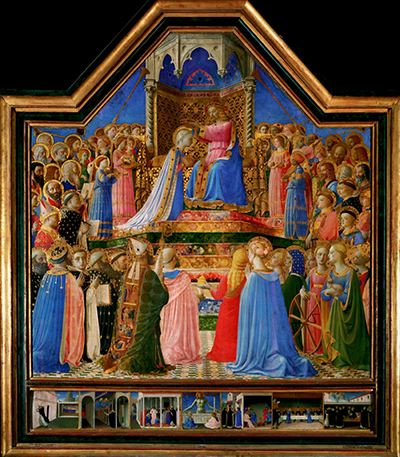
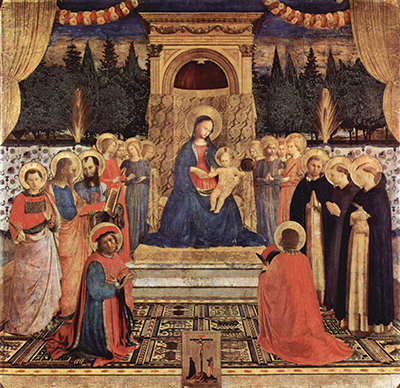
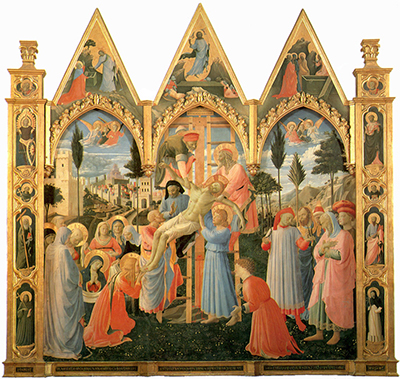
By the early 1430s, Fra Angelico had a large and organised workshop. This was necessary for the scale of his commissions. Altarpieces involved many panels. Predellas required numerous scenes. San Marco eventually involved dozens of frescoed cells. Workshop organisation was therefore central to mature Angelico production. [3]
San Marco
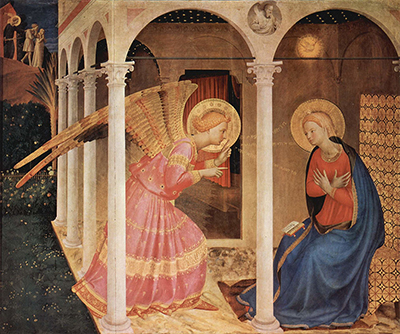
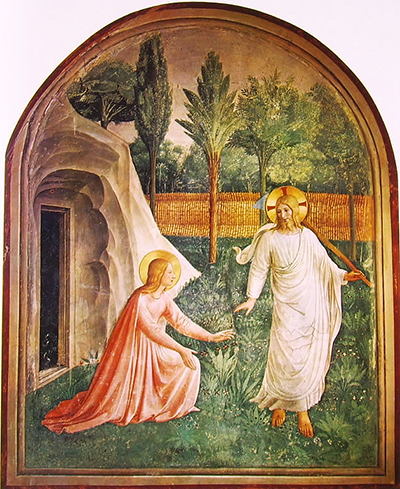
Benozzo’s participation at San Marco is now considered secure. The Museo Benozzo Gozzoli places him within the fresco campaigns of 1439–40 and 1443–44. This is one of the most important phases of his development. San Marco exposed him to Angelico’s mature fresco practice, devotional programming and workshop organisation. [5]
The museum increasingly frames San Marco as collaboration rather than a simple relationship between master and subordinates. This distinction matters. A young but skilled painter can learn while also contributing substantially. The two conditions are not mutually exclusive. Benozzo likely developed through real artistic responsibility. [1]
San Marco would have trained Benozzo in large-scale fresco organisation. Plaster had to be prepared. Designs had to be transferred. Work had to be divided among hands. A project of forty-four cells demanded scheduling and consistency. These practical skills later became essential to Benozzo’s independent mural career. [5]
Angelico’s San Marco language combines clarity, controlled colour and devotional restraint. Benozzo later became more decorative and worldly in many independent works. Yet the underlying clarity of narrative and bright chromatic organisation remained valuable. The relationship is therefore one of transformation rather than imitation. [5]
Lorenzo Ghiberti
After San Marco, Benozzo worked with Lorenzo Ghiberti on the Baptistery’s second bronze doors, the famous “Gates of Paradise.” A contract dated 1 March 1444 documents the relationship. This is important because Benozzo’s formation was not confined to Angelico. He absorbed experience from another of Florence’s greatest masters. [1]
The Benozzo museum specifically connects this Ghiberti period with refinement of perspective skills. This provides an important bridge. Benozzo’s later architecture and crowded processions depend upon strong spatial organisation. His visual language developed from multiple sources. [1]
In 1447 Benozzo is documented in Rome following Fra Angelico again. The renewed association after Ghiberti indicates a durable professional relationship. Benozzo had acquired wider experience and returned to Angelico’s orbit with greater status. [2]
The Benozzo museum connects the artists’ Roman opportunity with Pope Eugene IV’s knowledge of their work at San Marco. The pope had attended the 1443 consecration of the rebuilt church. Angelico’s Florentine achievements therefore helped lead to prestigious papal work. [2]
Benozzo and Angelico worked on important Vatican decoration under Eugene IV that has not survived. Because the frescoes are lost, exact division of labour cannot be reconstructed. This absence is frustrating. It also cautions against overconfident authorship narratives. A major phase of collaboration is known mainly through documents. [2]
Rome under Nicholas V
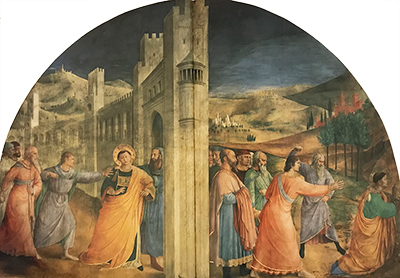
After Eugene IV, Angelico remained active under Nicholas V. The Niccoline Chapel survives as the great monument of his papal career. Benozzo’s precise participation within every section remains debated. What matters securely is that he belonged to Angelico’s Roman working network. [4]
Orvieto
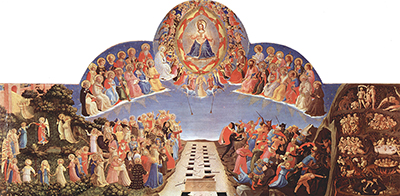
Angelico and Benozzo then worked at Orvieto Cathedral. They decorated parts of the Chapel of San Brizio vault. The surviving work includes the Choir of Prophets and Christ the Judge surrounded by angels. These frescoes provide another direct visual record of collaboration. [2]
Documents for Orvieto are unusually valuable because they call Benozzo a collaborator of Angelico. This word supports the more nuanced modern interpretation. He was not simply another anonymous helper. His position was recognised. [2]
Benozzo was paid considerably more than the other assistants. Payment provides evidence of status. By this stage he had become an artist whose contribution carried independent value. The relationship with Angelico was therefore evolving towards partnership within hierarchy. [2]
Large fresco enterprises often depended upon a principal master setting the intellectual and visual programme. Assistants and collaborators executed portions at different levels of independence. Angelico’s role can therefore remain dominant even where Benozzo contributes substantially. Authorship in Renaissance workshop practice is layered. [1]
Benozzo eventually emerged fully as an independent master. His later career included major fresco cycles across Tuscany and beyond. He became one of the most successful narrative painters of his generation. The Medici Chapel procession in Palazzo Medici Riccardi would make him famous for crowded splendour very different from San Marco’s cells. [1]
From Silence to Procession
This contrast is fascinating. Angelico’s San Marco is often quiet. Benozzo’s later art can be spectacularly populated. Yet both depend upon clear organisation. The pupil-collaborator relationship therefore did not produce stylistic cloning. It provided foundations from which Benozzo developed a distinct voice. [1]
Both artists share a strong sensitivity to brilliant colour. Benozzo often amplifies decorative richness. Textiles, jewels and processions become central. Angelico’s colour is more likely to be modulated according to devotional function. The comparison reveals transmission and divergence. [1]
Angelico’s predellas and Roman frescoes demonstrate exceptional narrative clarity. Benozzo develops that clarity into expansive storytelling. Crowds become larger. Portrait-like figures multiply. Landscape and architecture broaden. The fundamental skill of organising narrative remains. [1]
Benozzo’s extraordinary textile descriptions may owe something to his family background and his experience within visually rich Florentine workshops. Angelico’s own command of drapery and gold also provided a sophisticated model. Their work belongs to a culture in which fabric carried social and sacred meaning. [1]
Workshop versus Individual Genius
The relationship is useful because it challenges modern assumptions about artistic genius. Renaissance masterpieces were often made through groups. Design circulated. Assistants learned by execution. Collaborators carried ideas between workshops. Benozzo moved between Angelico and Ghiberti. Innovation therefore travelled through people. [3]
Modern attribution occasionally tries to assign individual Niccoline passages to Benozzo. Such work can be valuable. It can also become overly precise. The surviving evidence supports collaboration more securely than a complete figure-by-figure division. That distinction is important to any account of the collaboration. [4]
Benozzo has also been discussed in relation to late Angelico workshop projects such as the Armadio degli Argenti. Exact divisions of hand remain uncertain. The broader point is secure: Angelico’s mature production depended upon a network of skilled painters, not one isolated hand. [2]
Zanobi Strozzi
Benozzo was not the only important associate. Zanobi Strozzi is another major name within Angelico’s circle. This prevents Benozzo’s relationship from being treated as an exclusive master-heir succession. Angelico’s workshop contained multiple skilled participants. [1]
Artistic transmission occurs through more than style. Benozzo could learn: fresco logistics; perspective; narrative clarity; workshop management; patronal adaptation; colour organisation; integration of architecture and figure. These practical systems may be as important as individual motifs. [3]
Benozzo becomes one of the clearest ways Angelico’s methods passed into later fifteenth-century painting. His independent work translates lessons into another visual culture. The quieter Dominican master therefore helps shape a painter famous for courtly procession and civic narrative. This is exactly why influence should not be judged solely through superficial resemblance. [3]
Why Fra Angelico and Benozzo Gozzoli Matter Together
Fra Angelico and Benozzo Gozzoli matter together because their relationship reveals how Renaissance workshops actually transmitted artistic knowledge. The old pupil label contains some truth but not enough. Benozzo clearly learned in Angelico’s orbit. He also collaborated. He worked elsewhere. He returned with greater skill. Documents eventually call him collaborator and pay him above ordinary assistants. The relationship evolved. This makes it historically richer than a simple chain from master to disciple.
Angelico’s side matters equally. His Dominican status did not prevent him from directing major collaborative work. San Marco, Rome and Orvieto required complex teams. Benozzo’s career is one of the clearest proofs that Angelico was a sophisticated workshop organiser. The eventual divergence between their styles then demonstrates the success of that transmission. A good master does not necessarily produce copies. He can produce independent artists. [3]
Frequently Asked Questions
Discussion
How does Benozzo Gozzoli’s changing status—from younger associate to documented collaborator—reshape the idea of authorship in Fra Angelico’s workshop?
Reader Insights
What does the scale of San Marco reveal about artistic organisation beyond the name of a single master?
How should documents, wages and stylistic attribution be balanced when reconstructing Benozzo’s contribution?
Which Angelico workshop methods remain visible after Benozzo develops his own more expansive narrative style?
Join the Conversation
Share your reading of Fra Angelico and Benozzo Gozzoli below.
References
- Museo Benozzo Gozzoli, “Artistic Development.” Museo Benozzo Gozzoli Artistic Development.
- Museo Benozzo Gozzoli, “In Rome and Orvieto.” Museo Benozzo Gozzoli In Rome and Orvieto.
- Museo Nacional del Prado, Fra Angelico and the Rise of the Florentine Renaissance. Museo Nacional del Prado Fra Angelico and the Rise of the Florentine Renaissance.
- Vatican Museums, Niccoline Chapel and workshop context. Vatican Museums Niccoline Chapel.
- Museo di San Marco, San Marco fresco programme. Direzione regionale Musei nazionali Toscana Museo di San Marco.
.jpg)
 Fra Angelico.jpg)