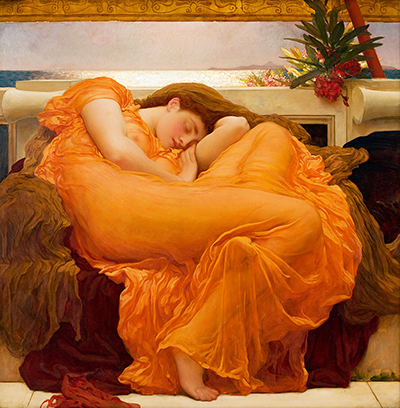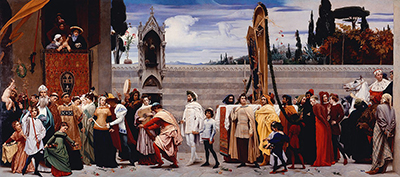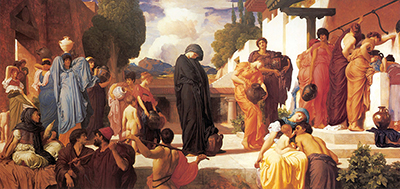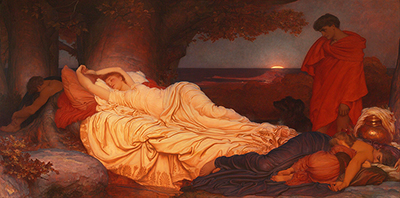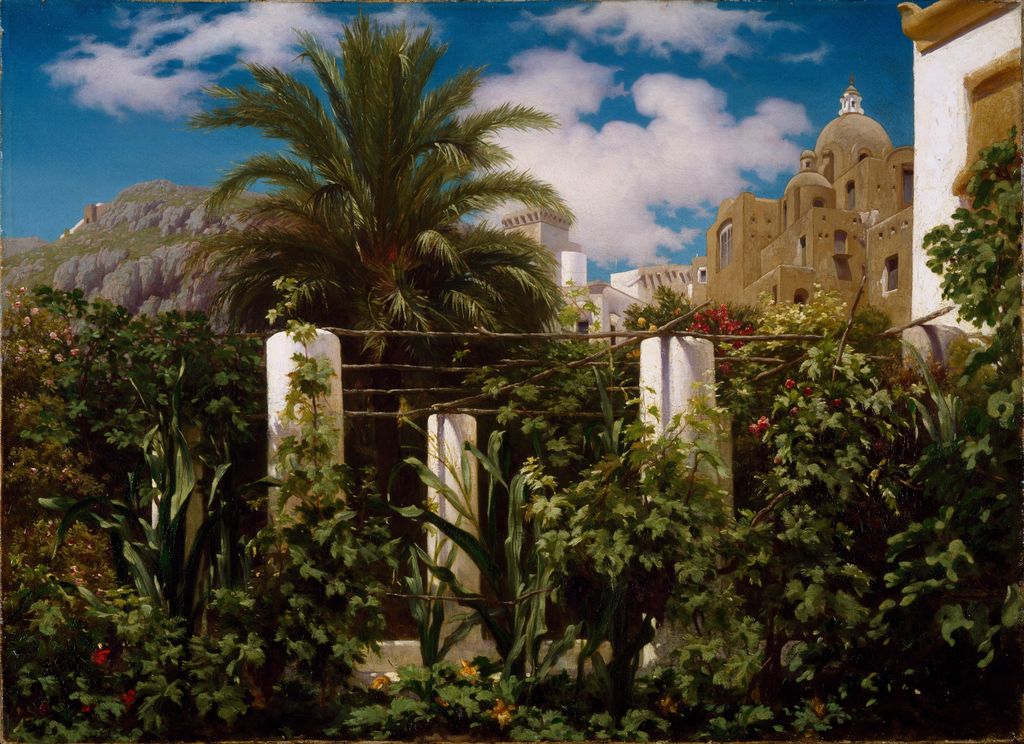
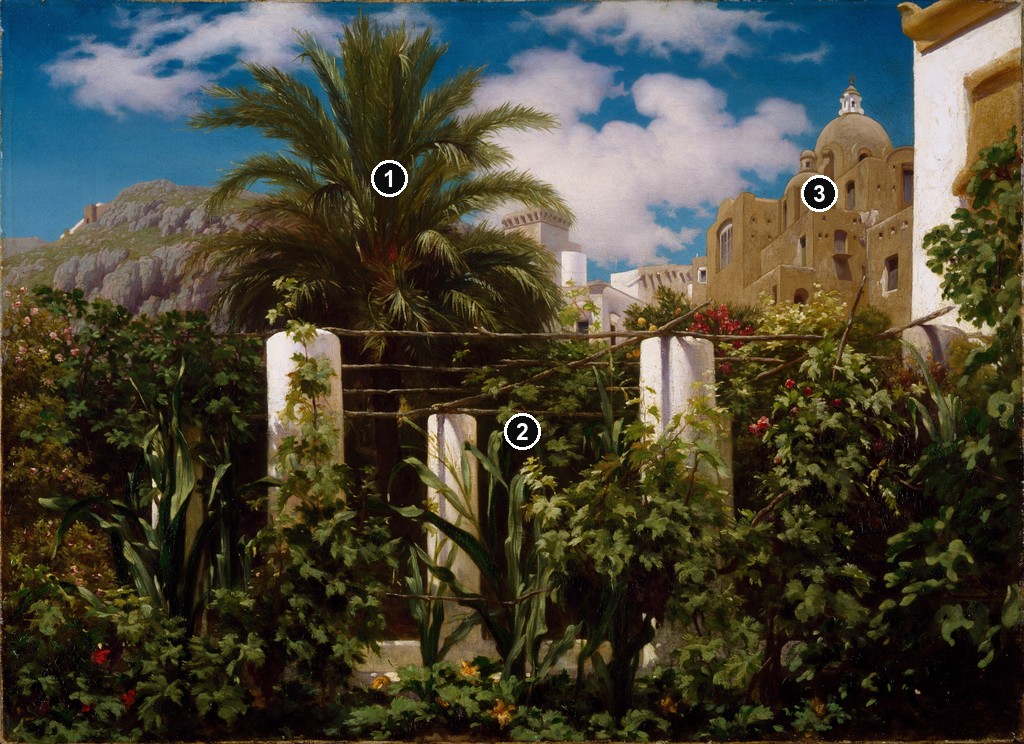
Frederic Leighton, Garden of an Inn, Capri, 1859. Birmingham Museums Trust. Image source. Public domain. Resized without changing the composition.
 by Tom Gurney
Tom Gurney BSc (Hons) is an art history expert with over 20 years experience
Email: tomgurney1@gmail.com / Phone: +44 7429 011000
Frederic Leighton Landscapes: Introduction
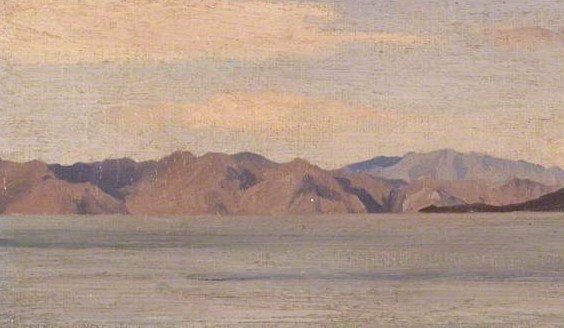
Across a strip of canvas scarcely wider than a sheet of paper, Frederic Leighton painted the coast of Asia Minor as he saw it from Rhodes. The mountains rise and fall in a narrow band between a muted sea and a brighter sky. The shore on which he stood lies outside the frame. In View in Capri he put trees and white houses between himself and the distant ridge, giving the eye one foothold after another. Both are small oils, and both describe a great distance. They give the viewer quite different ways to cross it. [1] [2] [3]
Leighton made such pictures throughout his career. He took oils on his travels, kept many of the results and hung them on his studio walls. Sometimes what he saw outdoors helped him imagine the setting for an exhibition painting. Often the encounter itself was enough to occupy him. A rocky slope, a roof, the fall of moonlight on a building or the colour of a faraway shore could each sustain a painting. [1] [4] [5]
At a Glance
- Works discussedOil sketches and studio paintings
- PlacesCapri, the Roman Campagna, Rhodes, Damascus, Cádiz and the Isle of Wight
- Start withGarden of an Inn, Capri and Coast of Asia Minor seen from Rhodes
Contents
- Looking down over Capri
- Painting with Costa and looking at Corot
- The long view from Rhodes
- Three kinds of light in Damascus
- From a view to a setting
- From the studio walls to the gallery
- Annotated details
Looking down over Capri
Leighton stayed several weeks on his first visit to Capri in the summer of 1859 and painted the island at different hours. The National Gallery in London dates its View in Capri to perhaps 1859. The oil on canvas, from the Gere Collection, measures 21.2 by 29.3 centimetres. The foreground trees and shrubs partly enclose the view. Below them are whitewashed houses, whose rounded roofs and small chimneys catch the eye amid the muted olive greens and browns. The terrain drops, rises to an outcrop and eventually falls away to the sea. The steepness comes through in the succession of these changes in level, even on such a modest canvas. [2]
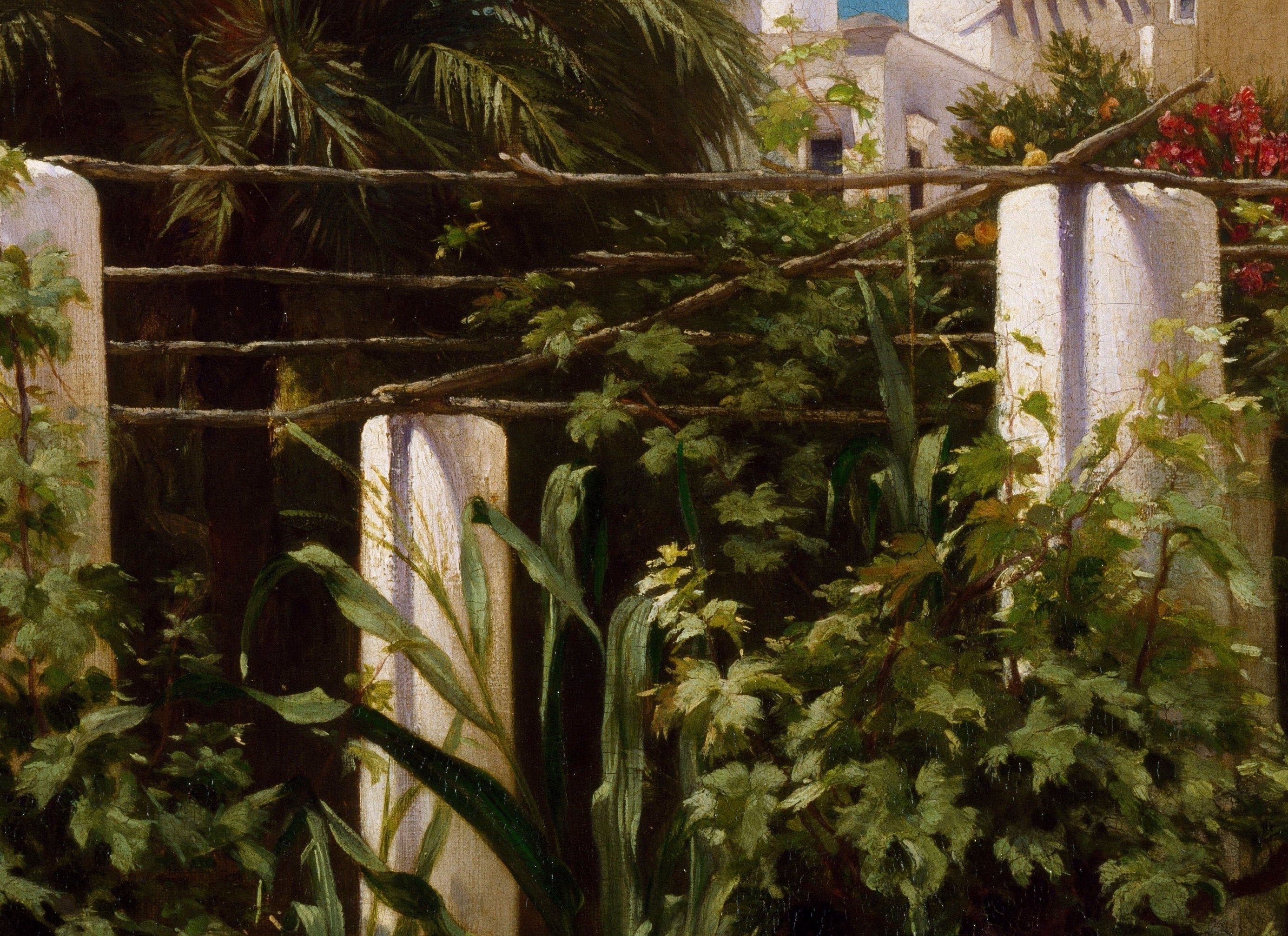
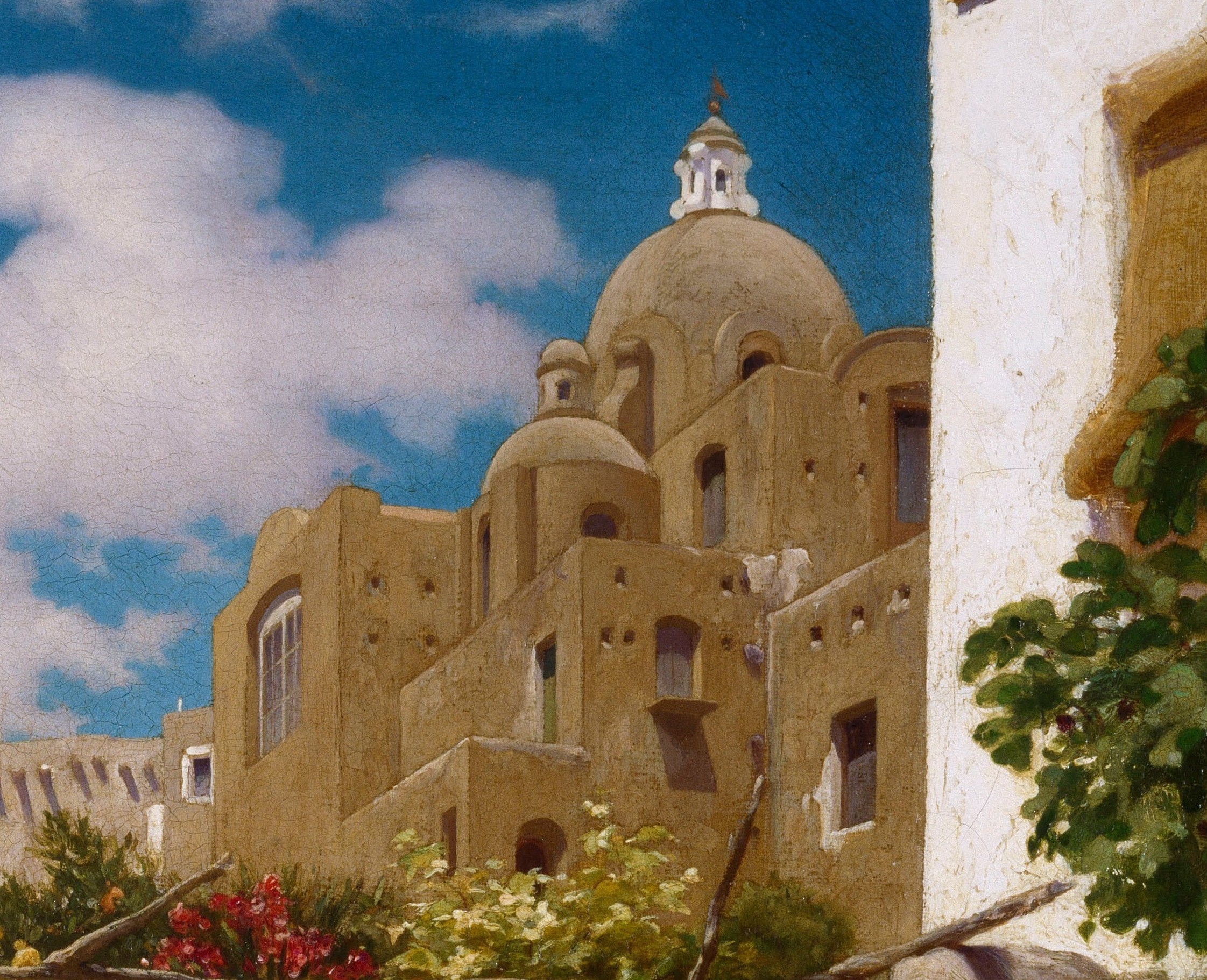
Another work from the same trip, Birmingham Museums Trust’s Garden of an Inn, Capri, measures almost 67 centimetres across. The scene here is enclosed by dense growth and buildings. The palm rises above the other plants and a pergola gives the foliage a visible structure. In a study of Capri’s nineteenth-century artistic community, Ewa Kawamura identifies the palm and pergola as features of the Hotel Pagano. Its palm was painted by other visitors and eventually featured on postcards. In Leighton’s view the close-packed plants and buildings fill much of the canvas, so that the glimpse of blue sky beyond feels bright and far off. [3] [6]
Painting with Costa and looking at Corot
Leighton met the Italian painter Giovanni, or Nino, Costa in 1853. Pola Durajska traces their meeting to an artists’ gathering at Cervara di Roma and describes the sketching company they kept with George Heming Mason. The National Gallery connects Costa’s preference for broad horizontal formats and his feeling for atmosphere to the example of Corot and his followers. The traffic in ideas went both ways. Italy’s national catalogue describes how Costa’s English friendships, including his friendship with Leighton, brought him into contact with Ruskin’s ideas about truth in art. [4] [5] [7]
A painting that passed between the two friends shows how freely Leighton could vary his format. Cervara, recorded as an 1859 work in the Leighton House exhibition loan documentation, is 47 centimetres high and 36 wide, painted on canvas laid on panel. Two small figures descend the slope at lower left. The upright canvas gives the hillside room to climb. Durajska distinguishes it from an earlier, smaller version of the view and points to passages painted over dry paint as evidence for more than one sitting. Leighton told his mother that he intended to finish a Cervara landscape on the spot. The loan record identifies the upright picture as a gift from Leighton to Costa and records an old label for a show in Perugia where Costa lent it. [3] [4] [8] [9]
The National Gallery’s An Outcrop in the Campagna is just over twice as wide as it is tall. A slope almost fills the canvas, leaving a narrow reach of sky. The pale rock at the left catches the light against the softer greens and browns around it. Broad, quick strokes are enough to give the rock faces distinct planes. The Gallery suggests that Leighton may have made the sketch on an 1866 trip with Costa and William Blake Richmond, and leaves both the date and the precise site open. In Cervara, a long rise invites the eye up through the picture. Here it travels across the slope, from one patch of light to another. [4] [10]
Leighton lived and worked in Paris in the 1850s and met Corot around 1861–62. The National Gallery records that Corot advised him on the use of a pigment called weld lake. In 1865 Leighton bought Corot’s The Four Times of Day, four decorative landscapes originally made for the painter Alexandre-Gabriel Decamps. He displayed them in the drawing room at his London house. The panels gave a visitor four changes of light to consider in one room. Leighton’s own oils, grouped in the studio, made possible a different comparison across countries, seasons and hours. [2] [5] [11]
The long view from Rhodes
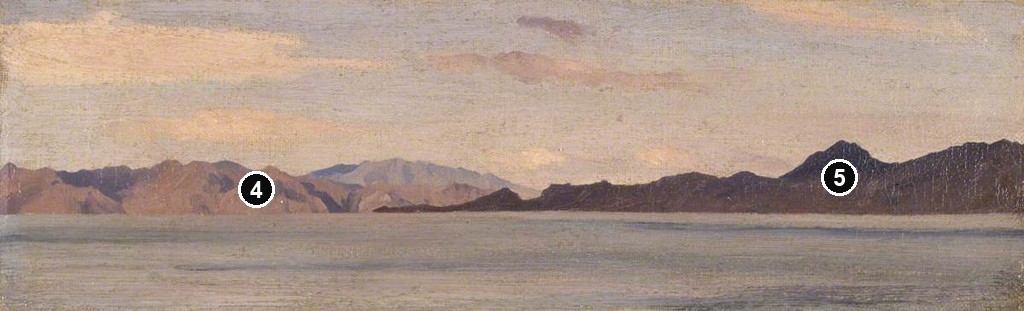
Museum Wales dates Coast of Asia Minor seen from Rhodes to 1867 and lists it as an oil on canvas, 8 by 27 centimetres. The mountains appear as overlapping ridges across the water. A darker stretch at the right gives the coastline an uneven weight, while paler colours farther left let some of the forms recede into haze. Lower down, faint horizontal changes of colour do nearly all the work of describing the sea. The format draws attention to what the mountain profile, the water and the sky do along the whole width of the view. [1] [3] [4]
Other oils made on the same journey show how many choices Leighton had even when he was looking out to sea. In Lindos, Rhodes, now in the Art Gallery of New South Wales, solid white roofs below the viewpoint make the foreground immediately legible. From there the eye can move out over the inlet to the rocky peninsula. Durajska compares the use of roofs to lead the eye into distance with Corot’s 1828 study of Ischia from the slopes of Mount Epomeo, now in the Louvre. Those straight edges are especially distinct among the irregular contours of land and coast. In the Cardiff oil, distance has almost the entire picture to itself. [1] [3] [4] [12]
A coast much nearer to Leighton’s home gave him a different problem of distance. In On the Coast, Isle of Wight, perhaps painted in 1860, trees occupy the foreground and pale cliffs catch the light farther along the shore. A resident recognised the coastline and the roof of the Chalet Hotel in the painting. The turret is a flicker of red among the trees, easy to pass over until you know to look for it. The identification helped the National Gallery connect the canvas to a possible match in Leighton’s 1896 studio sale. [13]
Many of Leighton’s oils were portable enough to carry on long journeys. Durajska found a London colourman’s stencil on two other canvases from the 1867 journey, The Isle of Chios and St Paul’s Bay, Lindos. The variation among Leighton’s supports suggests that he may also have bought some on the road. His interest in materials continued in London, where he corresponded with the Royal Academy’s professor of chemistry about pigments and painting materials. A published account of his landscape palette lists cobalt, pale lemon and vermilion among his colours for skies. Those records give a sense of the practical knowledge behind the seemingly effortless division of sky, sea and coast. [4]
Leighton’s sketching trips on film
Curators at Leighton House discuss the travel and outdoor study behind his landscapes.
Frederic Leighton and his travels | Leighton House
Curators Daniel Robbins and Hannah Lund follow Leighton’s travels and the places he painted.
Watch on YouTube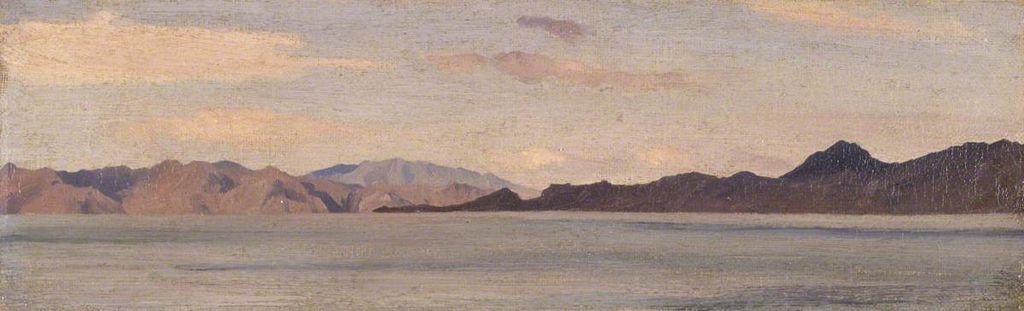
Frederic Leighton, Coast of Asia Minor seen from Rhodes, 1867. Amgueddfa Cymru – Museum Wales. Image source. Public domain. Resized without changing the composition.
Three kinds of light in Damascus
When Leighton went to Damascus in 1873, he stayed with Richard and Isabel Burton. Writing to his father, he described his delight at the first view from outside the city and his mixed response to the streets within it. The old houses won him over. He had several photographs made, but wrote that they could convey little of the quality of the light or the delicate colours in the open courtyards. Those were qualities he could investigate directly in paint. [8] [14]
In View of Maqam al-Arba’in, Mount Qasioun, Damascus, a 35-centimetre-wide oil now at Leighton House, the shrine sits between the dry slopes and the pale sky. Two trees mark its position on the mountain. In the foreground a boy looks towards the slope. The small figures in Cervara help establish the scale of a hillside in a similar way. A photograph taken in 1895 shows this picture among the sketches on Leighton’s studio wall. Leighton House has since acquired it as part of the effort to reassemble his collection. [14] [15]
Set the mountain view alongside two other Damascus studies at Leighton House. In A Street in Damascus, whose canvas is nearly square, daylight picks out the buildings in a close view of the city. Damascus (Moonlight) has a tall, narrow canvas, 31 by 19 centimetres. A minaret rises out of the compact rooftops into a deep blue sky. Barely any light reaches the lower passage, where a small warm glow is still visible. The vertical sweep from dark lane to the top of the tower gives this study its shape. Within three views associated with one journey there is a pale daylight vista, a bright street and a city descending into night. [3] [14]
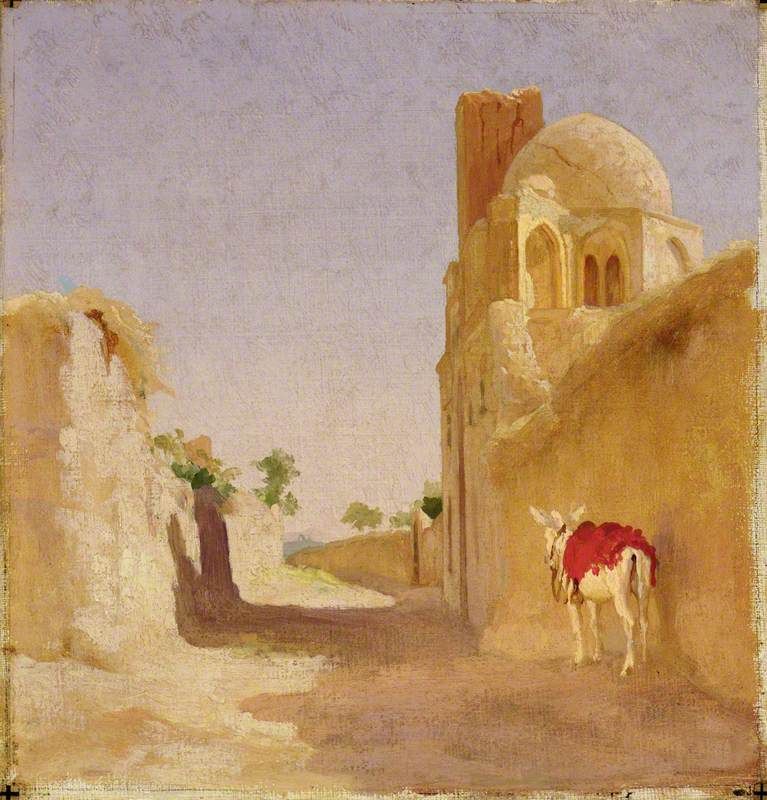
Frederic Leighton, A Street in Damascus, c. 1873. Leighton House. Image source. Public domain. Resized without changing the composition.
From a view to a setting
In a letter from Granada in October 1877, Leighton explained that he had hoped to bring back studies of skies over the sea for the painting that became Winding the Skein. The weather gave him nothing like the sky he wanted. In the finished canvas, the rocky headland recalls Lindos, Rhodes, a resemblance Durajska identifies, while cloud formations stretch above the two women and their thread. The two parts of the setting posed different problems. A headland painted a decade earlier could supply the profile, while the arrangement of clouds was still open. [4] [8]
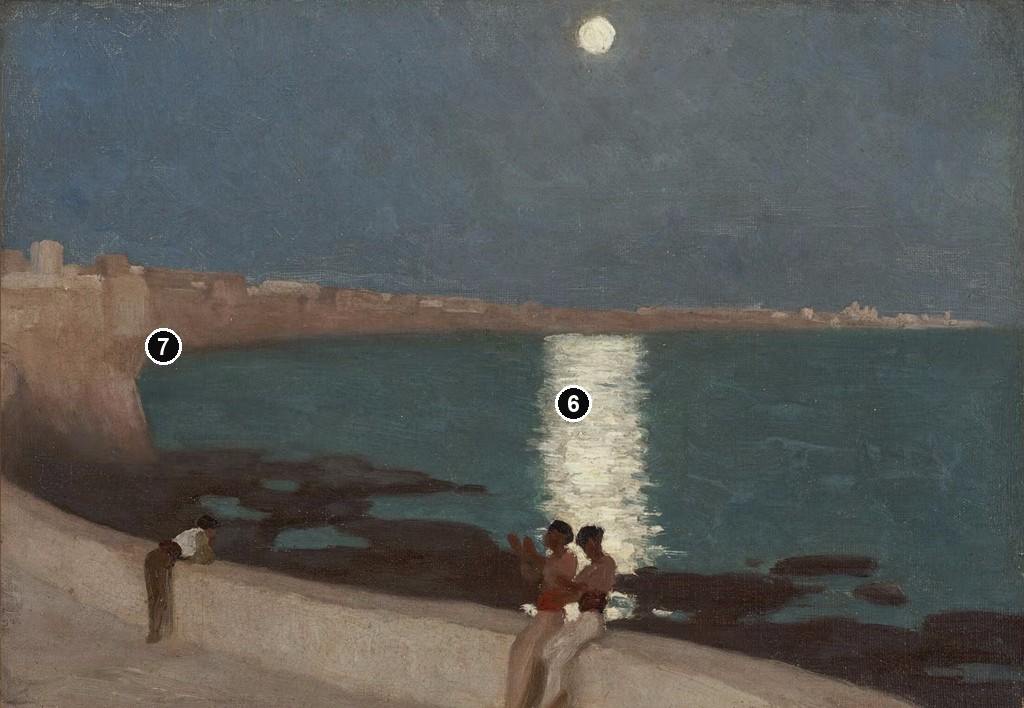
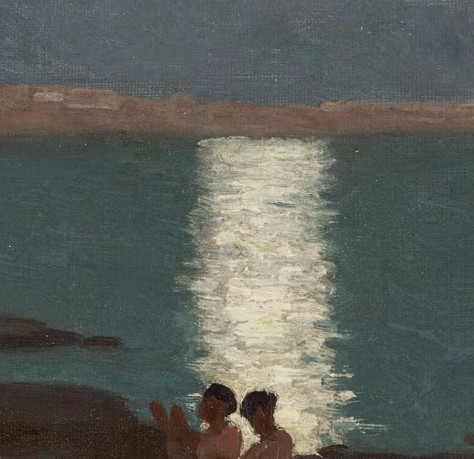
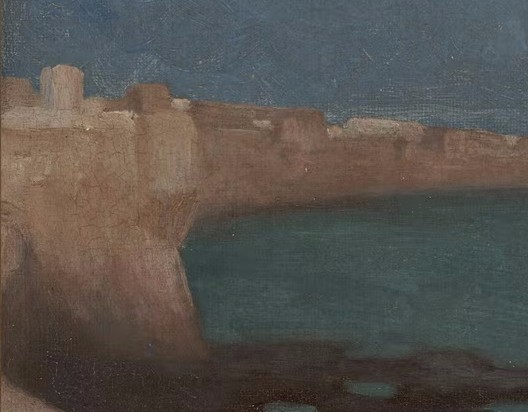
A more direct borrowing can be seen in the coastline in Spanish Dancing Girl: Cadiz in the Old Times, which Leighton exhibited in 1867. It follows the harbour in the little oil now known as The Bay of Cadiz – Moonlight. The nocturne’s shoreline extends from the left while the moonlight comes down in a bright band over the water. Leighton kept the coastal outline for the figure painting and gave the dance the space and attention it needed. The open-air studies could supply the shape of a bay, the profile of a headland or the appearance of a particular light. The studio canvas brought the chosen parts into the world of the figures. [3] [16] [17]
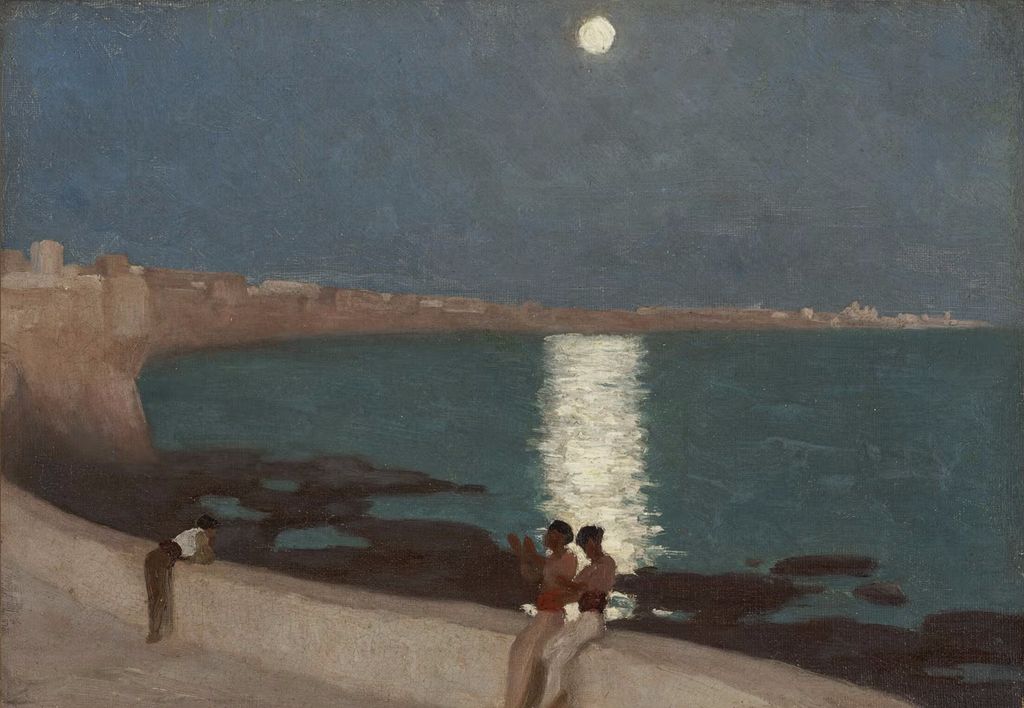
Frederic Leighton, The Bay of Cadiz – Moonlight. Image source. Public domain. Resized without changing the composition.
Annotated Details from Frederic Leighton Landscapes
The numbered points identify visible features discussed in this article. Return from each detail to the numbered overview. Each caption identifies the work shown.
Garden of an Inn, Capri
Frederic Leighton, Garden of an Inn, Capri, 1859. Birmingham Museums Trust. Image source. Public domain. Resized without changing the composition.
Coast of Asia Minor seen from Rhodes
Frederic Leighton, Coast of Asia Minor seen from Rhodes, 1867. Amgueddfa Cymru – Museum Wales. Image source. Public domain. Resized without changing the composition.
The Bay of Cadiz – Moonlight
Frederic Leighton, The Bay of Cadiz – Moonlight. Image source. Public domain. Resized without changing the composition.
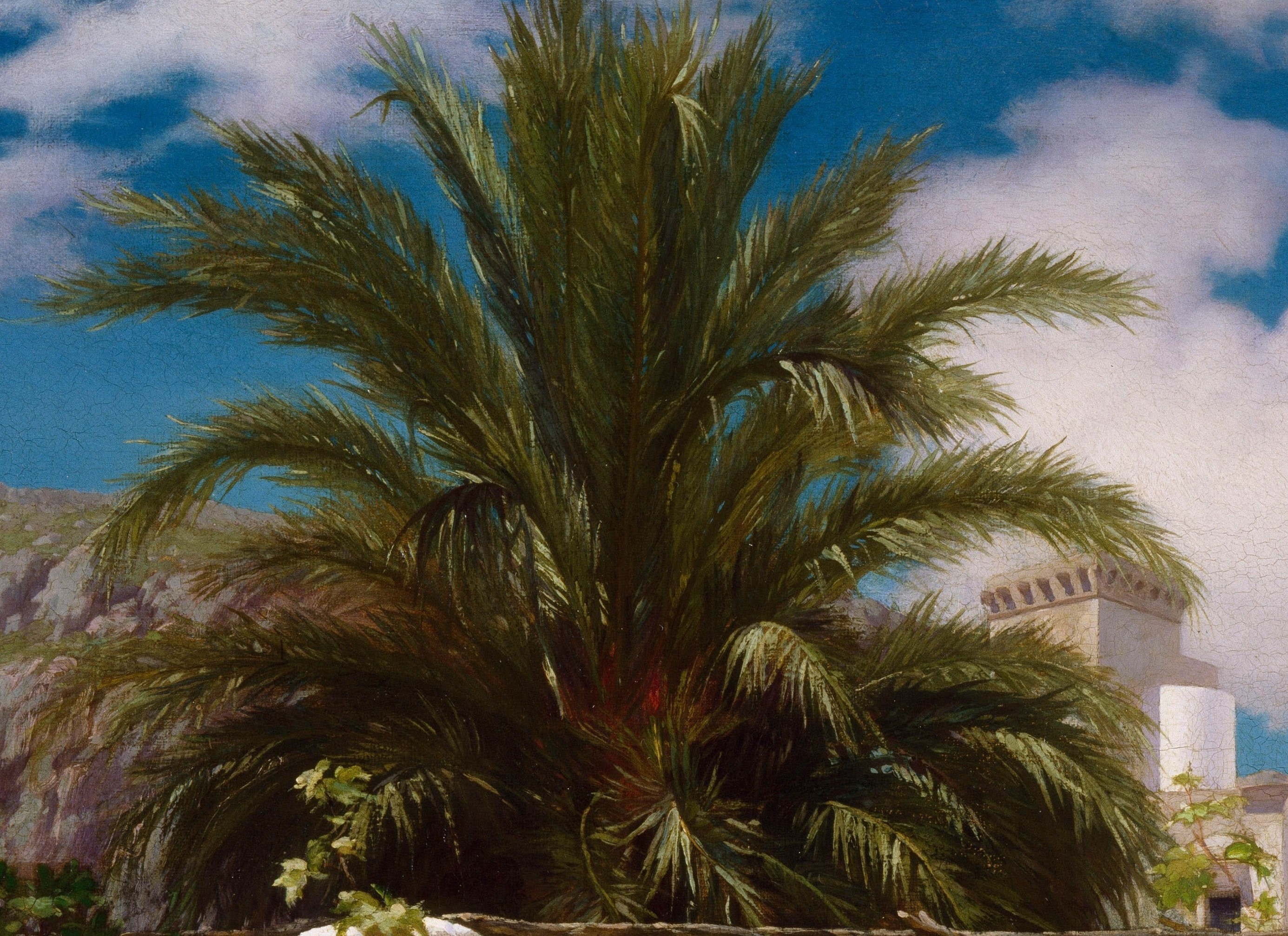
Details from FREDERIC LEIGHTON LANDSCAPES
Compare the cropped details with the source images above. Notice how their colours, shapes and positions contribute to the larger compositions.
Garden of an Inn, Capri
The palm above the garden
The palm’s crown breaks across the sky. Its height gives the eye a measure of the buildings and dense undergrowth around it.
The pergola in deep shade
Light edges the posts, and the crosspieces lift a framework out of the dark leaves. The garden’s growth is held within this small structure.
Capri’s buildings and the sky
The pale buildings catch the sun above the garden. The edge of the slope and the few clear gaps around the architecture make the sky feel distant.
Coast of Asia Minor seen from Rhodes
Pale land at the left
The farther slopes are pale and broken into overlapping shapes. The paint below them stretches horizontally, opening the distance between viewer and coast.
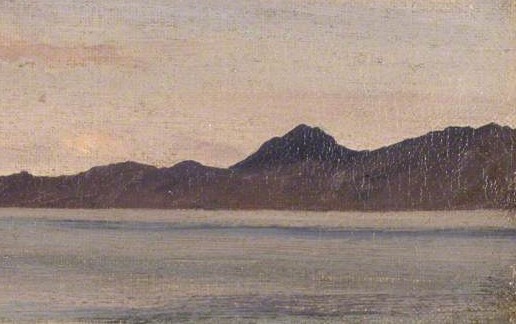
The darker ridge at the right
A darker ridge gives one end of the panorama greater weight. The line where it meets the sea remains low and almost level.
The Bay of Cadiz – Moonlight
Moonlight across the bay
The pale reflection extends in a narrow band across the water. Short strokes interrupt the light as it reaches the dark marks of the shoreline.
The harbour edge
The land projects into the bay from the left. Leighton kept a similar break in the coastline when he used the view in his picture of a dancer.
From the studio walls to the gallery
The sketches were rarely exhibited in Leighton’s lifetime, although he showed some at the Royal Society of British Artists in 1894 and 1895. View in Capri is visible among the other small pictures in a photograph taken after his death in 1896. Many were dispersed at the studio sale that July. Since then, reuniting them has helped scholars and curators compare objects that spent decades apart. The Museo de Arte de Ponce presented small oils alongside figure paintings and the drawings for Flaming June. Leighton House’s 2024–25 survey brought landscapes together by subjects including architecture, weather and technique. [2] [4] [18] [19]
At the same size on a screen, the pictures can look deceptively similar in scale. Compare the broad, low band of sea seen from Rhodes with the strip of sky above the Damascus minaret. One canvas lets the eye travel almost uninterrupted from side to side, while the other follows the rise of a single building. The care with which Leighton chose the shape of each small painting is as revealing as the places he chose to paint. [1] [3]
Browse Frederic Leighton’s artworks
Explore paintings, drawings, sculptures and prints, with separate rows for identified preparatory works, reproductions and casts.
| Name | Date | Medium |
|---|---|---|
| A Girl Feeding Peacocks | Exhibited 1863 | Painting Catalogue. |
| A Recognition from ‘Romola’, engraved by Swain (Tate N04054) | published 1862 | Print Catalogue. |
| A Roman Lady | 1859 | Painting Catalogue. |
| Abram and the Angel (Tate A00733) | published 1881 | Print Catalogue. |
| Acme and Septimius | Exhibited 1868 | Painting Catalogue. |
| An Athlete Wrestling with a Python (Tate exhibition bronze) | 1877 | Sculpture Catalogue. |
| And the Sea Gave Up the Dead Which Were in It (Tate N01511) | 1891–92 | Painting Catalogue. |
| Andromache in Captivity (photogravure after Leighton) | 1889 | Print Catalogue. |
| Athlete Wrestling with a Python (Anglesey Abbey cast) | model 1877; cast 1905 | Sculpture Catalogue. |
| Athlete Wrestling with a Python (Hood reduced cast) | 1877 (inscribed model date) | Sculpture Catalogue. |
| Athlete Wrestling with a Python (Saint Louis reduced cast) | 1877 (museum date) | Sculpture Catalogue. |
| Cain and Abel (Tate A00731) | published 1881 | Print Catalogue. |
| Captive Andromache | 1888 | Painting Catalogue. |
| Cimabue's Celebrated Madonna | 1853–55 | Painting Catalogue. |
| Cimon and Iphigenia, with Many Smaller Subjects (Tate T09061) | date not known | Drawing Catalogue. |
| Crenaia, the Nymph of the Dargle | Exhibited 1880 | Painting Catalogue. |
| Cymon and Iphigenia | 1884 | Painting Catalogue. |
| Daedalus and Icarus | 1869 | Painting Catalogue. |
| Dante in Exile | 1864 | Painting Catalogue. |
| Death of the First Born (Tate A00737) | published 1881 | Print Catalogue. |
| Electra at the Tomb of Agamemnon | c. 1869 | Painting Catalogue. |
| Eliezer and Rebekah (Tate A00735) | published 1881 | Print Catalogue. |
| Elijah in the Wilderness | 1877–78 | Painting Catalogue. |
| Fanny Kemble: A Study for ‘Jezebel and Ahab’ (Tate T08208) | c.1862 | Drawing Catalogue. |
| Figure Studies | Date not recorded | Drawing Catalogue. |
| Flaming June | 1895 | Painting Catalogue. |
| Gulnihal | Exhibited 1886 | Painting Catalogue. |
| Helios and Rhodes (Tate N03015) | date not known | Painting Catalogue. |
| Hercules Wrestling with Death for the Body of Alcestis | c. 1869–71 | Painting Catalogue. |
| Jonathan's Token to David | c. 1868 | Painting Catalogue. |
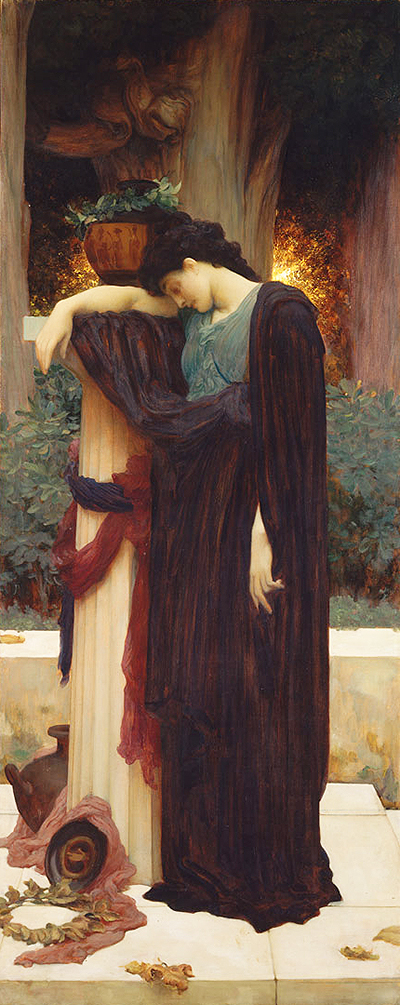
| Lachrymae | 1894–95 | Painting Catalogue. |
| Lieder ohne Worte | Exhibited 1861 | Painting Catalogue. |
| Light of the Harem | Exhibited 1880 | Painting Catalogue. |
| Moses Views the Promised Land (Tate A00736) | published 1881 | Print Catalogue. |
| Mrs James Guthrie | 1865 | Painting Catalogue. |
| Mrs John Hanson Walker (Tate N04731) | 1867 | Painting Catalogue. |
| Music Lesson | 1877 | Painting Catalogue. |
| Needless Alarms (Met cast) | modelled 1886; cast nineteenth century | Sculpture Catalogue. |
| Needless Alarms (Tate N05120) | 1886 | Sculpture Catalogue. |
| Pavonia | c. 1859 | Painting Catalogue. |
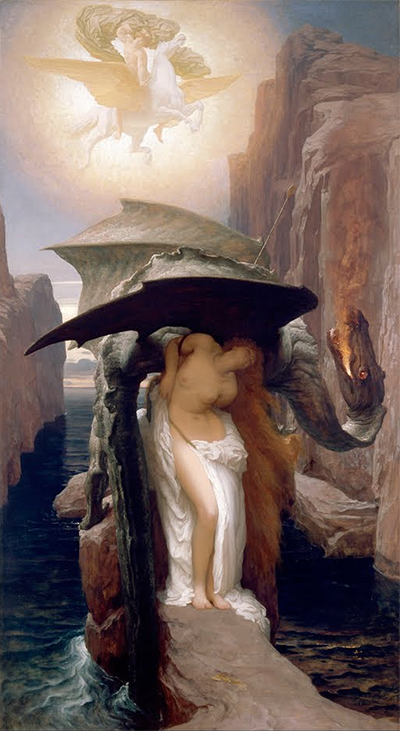
| Perseus and Andromeda | 1891 | Painting Catalogue. |
| Portrait of May Sartoris | c. 1860 | Painting Catalogue. |
| Preparing for a Festa, Florence (Tate T09062) | date not known | Drawing Catalogue. |
| Puerta de los Vientos, near Ronda, Spain (Tate N04006) | c.1886–9 | Painting Catalogue. |
| Samson and the Lions (Tate A00732) | published 1881 | Print Catalogue. |
| Samson at the Mill (Tate A00734) | published 1881 | Print Catalogue. |
| Samson Carrying the Gate (Tate A00738) | published 1881 | Print Catalogue. |
| Sketch for ‘An Athlete Wrestling with a Python’ (Tate N01761) | c.1877 | Sculpture Catalogue. |
| Sketches for Cimon and Iphigenia (Tate T09060) | date not known | Drawing Catalogue. |
| Study for The Return of Persephone (Demeter) | c. 1890–91 | Drawing Catalogue. |
| Study for The Return of Persephone (Persephone) | c. 1890–91 | Drawing Catalogue. |
| Study for ‘Needless Alarms’ (Tate N02945) | 1886 | Sculpture Catalogue. |
| Study for ‘The Discovery of Juliet Apparently Lifeless’ (Tate N01806) | c.1858 | Painting Catalogue. |
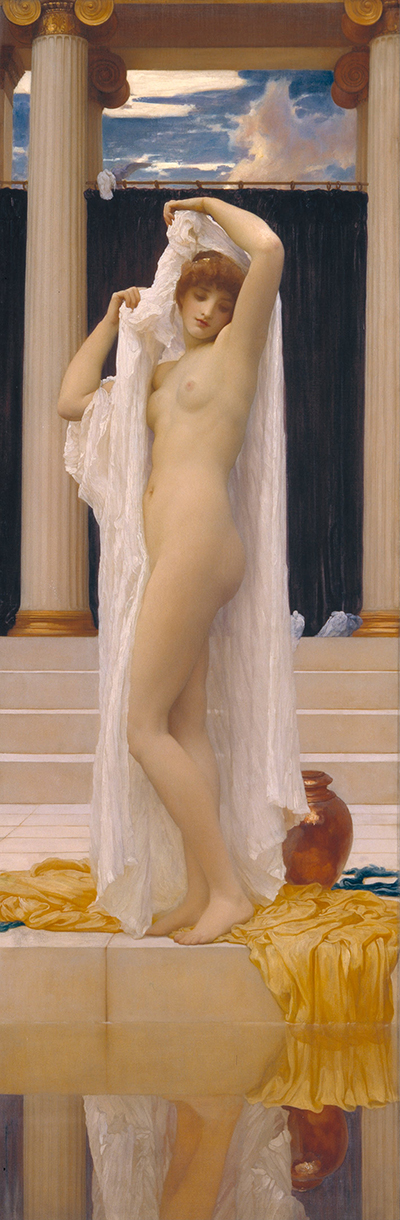
| The Bath of Psyche | Exhibited 1890 | Painting Catalogue. |
| The Daphnephoria | 1874–76 | Painting Catalogue. |
| The Death of Brunelleschi | 1852 | Painting Catalogue. |
| The Fisherman and the Siren | Exhibited 1858 | Painting Catalogue. |
| The Painter's Honeymoon | c. 1864 | Painting Catalogue. |
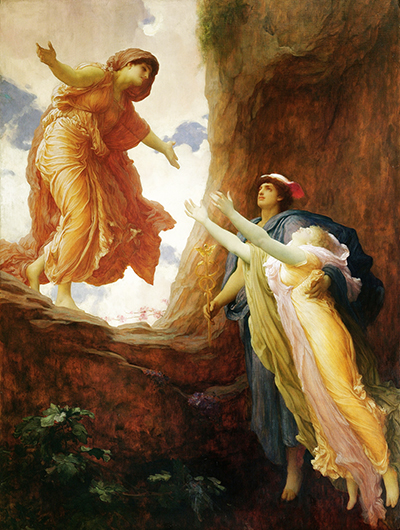
| The Return of Persephone | 1891 | Painting Leeds painting identified in the Met study record. |
| The Return of Persephone (preparatory oil) | c. 1890–91 | Painting Catalogue. |
| The Sluggard (Anglesey Abbey cast) | probably 1890–about 1906 | Sculpture Catalogue. |
| The Sluggard (Met cast) | modelled 1886; cast possibly before 1896 | Sculpture Catalogue. |
| The Sluggard (Museum Wales) | 1882–85 (museum date) | Sculpture Catalogue. |
| The Sluggard (Tate N01752) | 1885 | Sculpture Catalogue. |
| The Spies Escape (Tate A00730) | published 1881 | Print Catalogue. |
| Various Subjects (Tate T09063) | date not known | Drawing Catalogue. |
| View in Capri | Possibly 1859 | Painting Catalogue. |
| Wedded | 1882 | Painting Catalogue. |
| Winding the Skein | c. 1878 | Painting Catalogue. |
Discussion
Look again at the images and ideas explored in Frederic Leighton Landscapes. These editorial prompts invite your observations.
Reader Insights
What difference does the shape of a small canvas make to the way you see the Rhodes coast?
Which parts of a place did Leighton keep when he used an outdoor study in a studio painting?
Join the Conversation
Share a detail, comparison or question about Frederic Leighton Landscapes below.
References
- Amgueddfa Cymru – Museum Wales, Coast of Asia Minor seen from Rhodes, object NMW A 28347. View source.
- National Gallery, London, View in Capri, Gere Collection, inventory L847. View source.
- Pola Durajska, Nature, Science, and Myth in the Landscape Art of Frederic Leighton, University of York doctoral thesis, 2021, vol. II, figs. 17, 45, 49 and 103 and catalogue entries 4, 36, 50–52, 60 and 93–94. View source.
- Pola Durajska, Nature, Science, and Myth in the Landscape Art of Frederic Leighton, University of York doctoral thesis, 2021, vol. I, pp. 34–38, 43, 55–61, 72–73, 78–81 and 87. View source.
- National Gallery, London, Artistic Exchanges: Corot, Costa, Leighton, exhibition text, 2014. View source.
- Ewa Kawamura, “19世紀の風景画家の聖地としてのカプリ島”, University of Tokyo repository, pp. 25–27 and fig. 6. View source.
- Catalogo generale dei Beni Culturali, To Be or Not to Be, Who Loves Not Is Not, Nino Costa, national record 1200827508, historical and critical notes. View source.
- Frederic Leighton, letters reproduced in Emilie Barrington, The Life, Letters and Work of Frederic Leighton, vol. II, George Allen, 1906, pp. 48, 207–08 and 210–12. View source.
- Royal Borough of Kensington and Chelsea, Leighton and Landscape: Impressions from Nature, loan documentation, entry LLPL24. View source.
- National Gallery, London, An Outcrop in the Campagna, Gere Collection, inventory L852. View source.
- Sarah Herring, “The Four Times of Day”, National Gallery Catalogues: The Nineteenth Century French Paintings, Volume 1: The Barbizon School, 2019, “The Panels and Frederic, Lord Leighton”. View source.
- Musée du Louvre, Ischia, vue prise des pentes du Mont Epomeo, Jean-Baptiste-Camille Corot, RF 2231. View source.
- National Gallery, London, On the Coast, Isle of Wight, Gere Collection, inventory L849. View source.
- Leighton House, “Collections Highlight: A Damascus Landscape”, with notes on the three Damascus oils. View source.
- Arts Council England and the Victoria and Albert Museum, Purchase Grant Fund awards 2021–22, Leighton House entry for View of Maqam al-Arba’in, Mount Qasioun, Damascus. View source.
- Christie’s, The Bay of Cadiz – Moonlight, lot 6486787, object record and catalogue essay. View source.
- Christie’s, “Leighton and Landscape at Leighton House”, illustrated comparison and interview with Leighton House senior curator Daniel Robbins. View source.
- Museo de Arte de Ponce, Frederick Leighton y el mediterráneo eterno, exhibition text. View source.
- Leighton House, Leighton and Landscape, exhibition account, 2024–25. View source.