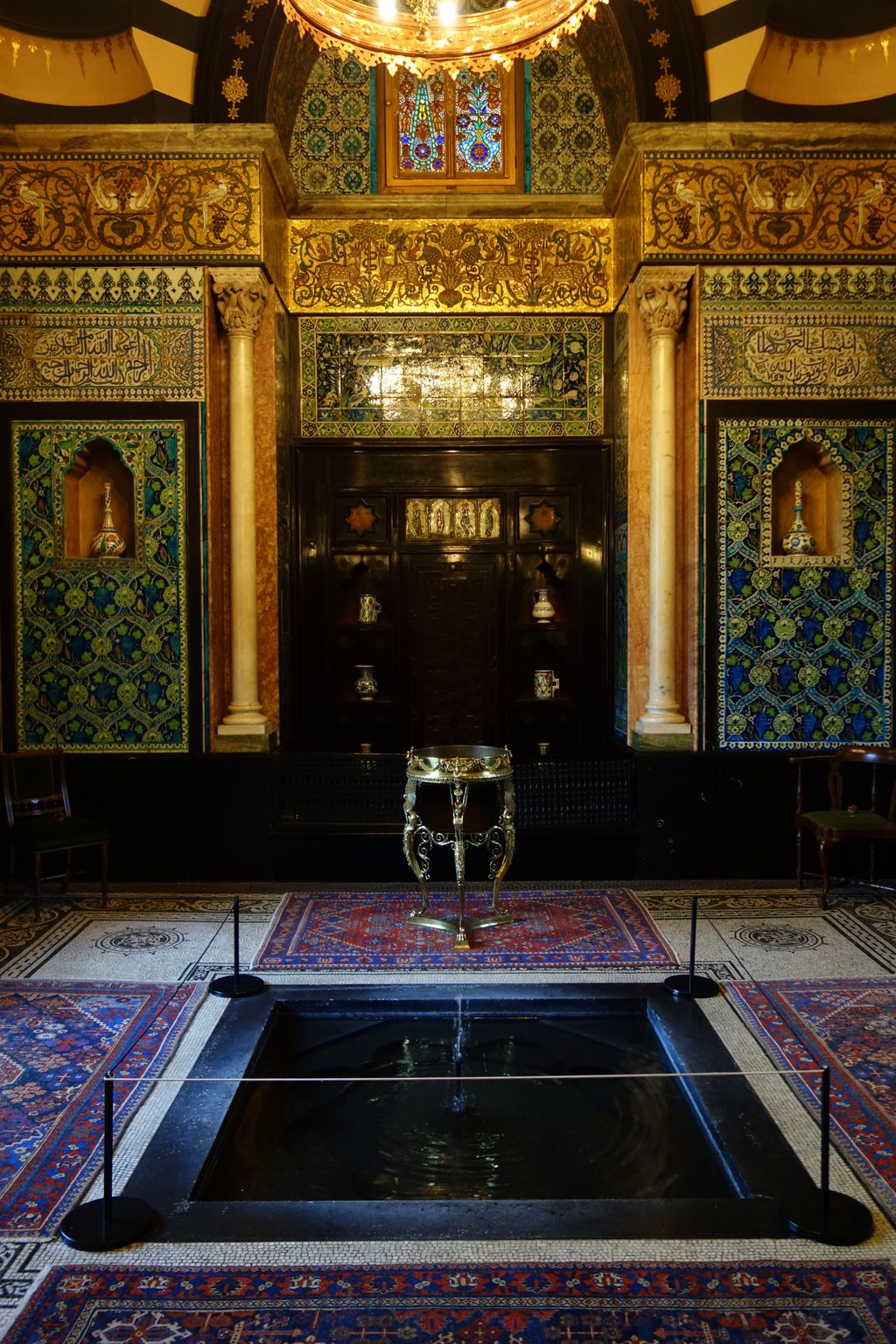
The Arab Hall viewed across its central pool. Daderot. Image source. CC0 / Public domain. Resized JPEG; photograph otherwise unaltered.
 by Tom Gurney
Tom Gurney BSc (Hons) is an art history expert with over 20 years experience
Email: tomgurney1@gmail.com / Phone: +44 7429 011000
Leighton House and the Arab Hall: Introduction
The largest window at Frederic Leighton’s house in Holland Park faces the garden. It lights the painter’s upstairs studio, the reason he commissioned the building in the first place. A very different kind of light fills the Arab Hall, the domed room he added to the west more than a decade later. There, light passes through coloured glass and wooden screens and catches on glazed tiles and gold mosaic. Both rooms depended on Leighton’s long partnership with architect George Aitchison. [1] [2]
At a Glance
- PlaceHolland Park Road, London
- ArchitectGeorge Aitchison
- Studio-houseLeighton moved in in 1866
- Arab HallBegun in 1877 and completed in 1881
Contents
- A house built around a painting studio
- From collecting tiles to building a room
- From Palermo to Holland Park Road
- Where the tiles meet
- The house after Leighton
A house built around a painting studio
Leighton bought the plot on Holland Park Road in 1864 and turned to Aitchison, whom he had known since meeting him in Rome in the early 1850s. The architect came from a practice experienced in docks, warehouses and railways. This was his first house. Building began in 1865 and Leighton moved in the following year. Aitchison gave the red-brick entrance front the restrained appearance of an Italian palazzo. The garden elevation advertised the purpose of the building more plainly. Its great north-facing window belonged to a workroom that, with Leighton’s unassuming bedroom, took up the upper floor. [1] [3]
The studio was put to work almost at once. An unusually large opening in its west wall allowed canvases to be moved outside, an important provision for a painter whose exhibition pictures could run to several metres across. In 1869–70 Aitchison extended the studio eastwards by roughly five metres. The new arrangements included canvas storage reached through a trapdoor and altered access for models using the service stairs. Aitchison also incorporated two coloured-glass windows into the east wall of the extension. A signed watercolour of February 1870 records their position. Both show a vase of flowers beneath an Arabic inscription. Gibson suggests that Leighton may have bought them in Cairo in 1868. They already formed part of the house several years before the Arab Hall took shape. [1] [4] [5]
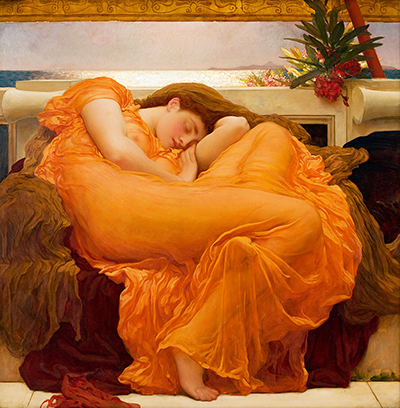
The workroom could become a picture gallery for a day. A photograph from Show Sunday, 7 April 1895, records the studio when Leighton first showed Flaming June as one of six pictures he was sending to the Royal Academy that year. The spring exhibition schedule also posed a practical problem. Leighton needed to finish pictures through London’s winter fog and smog, when reliable daylight was scarce. The winter studio, added in 1889–90 at the east end, had a glass roof and two glazed sides supported by cast-iron columns. That extension brought daylight into the workroom from above as well as from the sides. [1] [6] [7]
From collecting tiles to building a room
Some of the tiles Leighton bought in Cairo went into an arrangement at the foot of the stairs. Gibson identifies tiles there made in Ottoman Turkey, among them panels formed from several patterns in blue, turquoise and white. A vase flanked by cypresses is one of the most recognisable motifs. The difference between where a tile was purchased and where it was made matters throughout the house. Dealers traded objects across the region, and Leighton could buy Turkish ceramics in Cairo or Rhodes. [2] [5]
On his journey to Damascus in 1873 Leighton was already intent on finding tiles. William Wright, a missionary resident in the city, helped him find ceramics and textiles and continued buying tiles for him after his departure. The diplomat Richard Burton also sourced tiles for Leighton. Caspar Purdon Clarke, who later directed what is now the Victoria and Albert Museum, bought a pair of matching panels in Damascus in 1877. Their grape motifs make it easy to pick them out on the west wall of the Arab Hall. Much of the hall’s wall tiling came from Damascus and dates from around the end of the sixteenth and beginning of the seventeenth centuries. The woodwork of the west wall holds tiles from much farther east. Gibson identifies its two star-shaped tiles as late thirteenth-century work from Kashan and the two larger ones between them as early seventeenth-century work from Isfahan. [1] [2] [4] [5]
The correspondence also gives a glimpse of the cost to the interiors from which the panels came. In 1871 Burton wrote to Leighton about the possibility of having a house pulled down to obtain tiles. He remarked on how well dealers understood their value and on the dwindling availability of fine older examples. The letter records an offer and the pressures of the market. The route taken by each tile is harder to establish, particularly once fragments from different sources had been assembled in London. [4]
From Palermo to Holland Park Road
Work on the Arab Hall began in 1877. The principal construction took place in the late 1870s and the interior was fully completed in 1881. The addition was visible from the street and blocked the opening that had once allowed large paintings to leave the studio. Inside, the leap from the relatively low, turquoise-lined Narcissus Hall to the height of the gold dome is part of the effect. The basin and the floor around it draw the eye to the middle of the room before the arches and windows lead it up again. [1] [2] [4] [5]
Aitchison identified La Zisa, a twelfth-century palace of the Norman kings in Palermo, as a model. At the Sicilian palace a fountain and wall mosaic share a richly decorated chamber. Walter Crane recalled receiving a photograph of La Zisa’s mosaic as a guide for his design. In London the resulting gold frieze runs around the room above the tiles. Salviati & Co. made the mosaic in Venice, from where it was sent to London in sections. Look higher and a different reference comes into view. The gilded wooden panels set in the corners adapt ornament from an alcove off the Court of the Myrtles at the Alhambra in Granada. Gibson traces the design to a plate published by Jules Goury and Owen Jones, who called the court the Patio de la Alberca after its rectangular pool. [1] [2] [5] [8] [9]
Other parts of the room took shape in London workshops. The sculptor Joseph Edgar Boehm made capitals in the hall. Leighton’s executor Samuel Pepys Cockerell describes a separate pair of gilded capitals modelled by Randolph Caldecott on the red marble columns at the entrance. Aitchison designed the patterned mosaic floors in the three connecting halls, which were made by Burke & Co. The shallow fountain takes its form from a type encountered in Cairo houses. It was made in London, first in white marble and then in black marble after the first basin leaked. The London firm Forrest and Son made the chandelier. It originally burned gas and was converted to electricity in the 1890s. Behind these new commissions were elements with histories of their own. The pierced wooden screens, or mashrabiyya, filter daylight. Aitchison remembered the latticework as coming from Damascus, while Leighton’s executor Samuel Pepys Cockerell associated the screens with Cairo. The surviving accounts leave their exact sourcing open. [2] [4] [5] [10] [11]
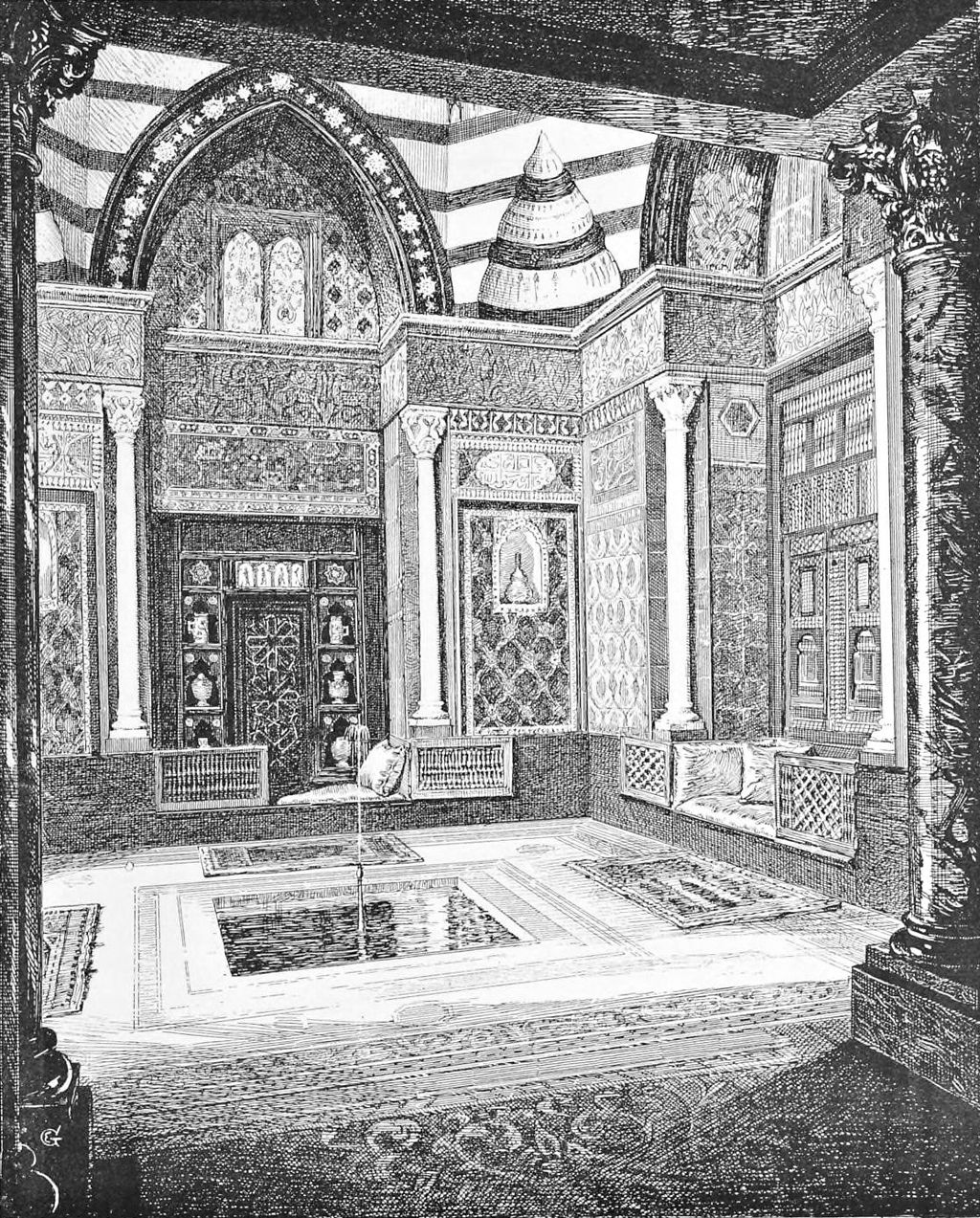
The Arab Hall in an illustration published in 1882. Unknown maker, published in Illustrated Biographies of Modern Artists (1882). Image source. Public domain. Resized JPEG; photograph otherwise unaltered.
A film about the Arab Hall
Hear visitors describe the room and the craft traditions that inspired it.
An artist’s studio-home: The Arab Hall | Leighton House
Visitors reflect on the Arab Hall and its references to Damascus, Palermo and Granada.
Watch on YouTubeWhere the tiles meet
Aitchison’s drawings show different versions of the tiled walls. The Japanese historian Noriko Yoshimura points to an 1880 elevation as evidence that the collection itself shaped the design. On site, the collaborators worked with uneven groups of tiles and had to bridge the gaps where individual pieces were broken or missing. The ceramicist William De Morgan repaired damaged tiles and made replacements. He also supplied the deep turquoise tiles of the Narcissus Hall and staircase, where the broad stretches of colour set off the Arab Hall’s much denser patterns. One group travelled only a few steps in this last stage of its journey. The six tiles inscribed with the bismillah, the invocation that introduces most chapters of the Qur’an, appear under the stairs in an engraving published in 1876. They were moved into one of the Arab Hall’s panels. [2] [4] [5] [12] [13]
On the south wall, De Morgan’s two new blue tiles near the centre of a Damascus panel blend into the curved composition. On the east wall, a pair of large İznik tiles shows how difficult the same task could be. An upper corner of the left-hand tile is a Victorian insert. From across the room the foliage seems to carry on over the joint. Up close there is a noticeable line of grout and areas where the replacement blue is stronger or less sharply edged. Mary Roberts follows those differences back to the ceramicist’s task of judging how much clay would shrink in the kiln and how cobalt would behave during firing. The joint lets one compare the skills of makers working centuries apart. [4]
Inscriptions give the joins a further significance. In one pair of facing panels, some tiles are missing and others were set in the wrong sequence. In a museum project to read the inscriptions, Souad Mohamad identified a piece on one side that belonged on the other, and suggested that the two groups would read more coherently if they changed places. Elsewhere, a group of tiles preserves the opening verses of the Qur’an’s fifty-fifth chapter in their proper sequence. Reading across both examples makes it possible to see what the pressure to fit a wall can do to a text as well as to a pattern. [12]
The hall became a subject for Leighton himself in Sun Gleams, shown at the Royal Academy in 1884. Roberts draws attention to the thick paint with which he represented one of its tile panels. On canvas the broken-up pattern is drawn together by colour and texture. The painting was one more place where Leighton could decide how much of the seams and irregularities of the ceramics the viewer would see. [2] [4] [11]
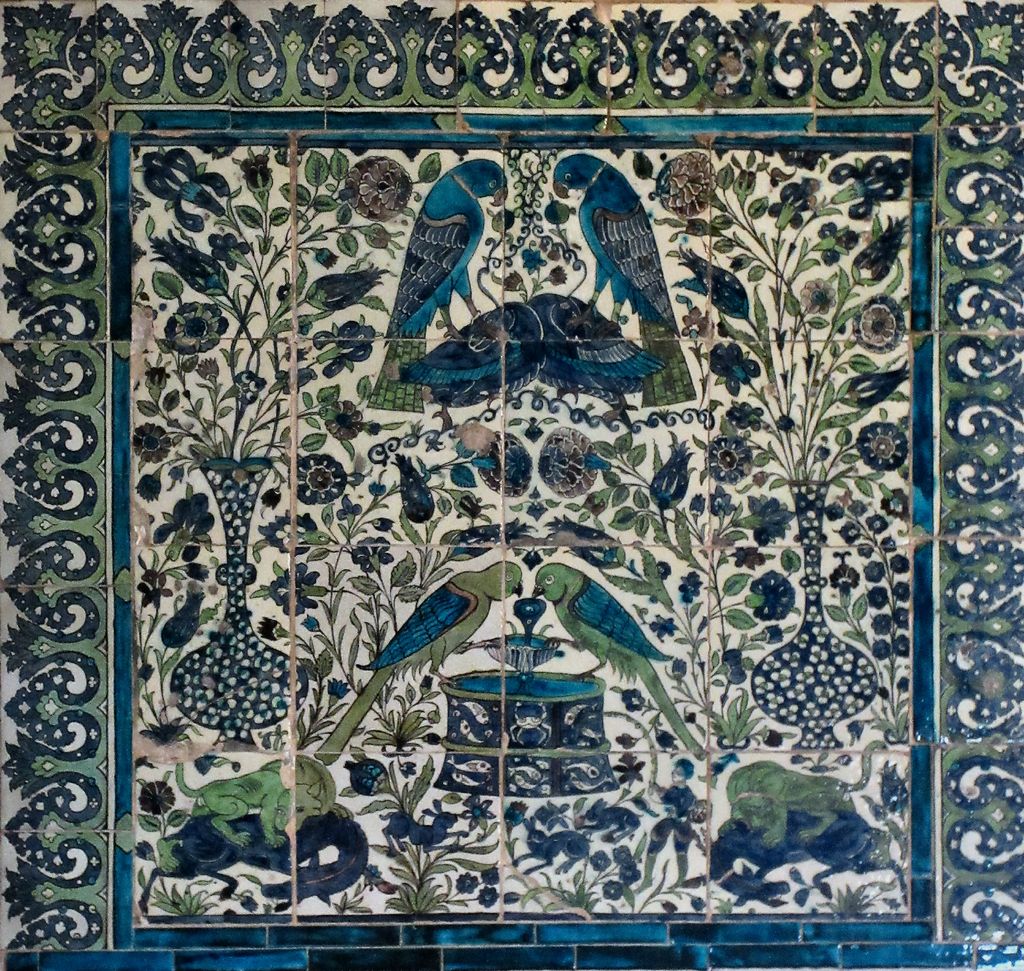
A tiled panel in the Arab Hall at Leighton House. AndyScott. Image source. CC0 / Public domain. Resized JPEG; photograph otherwise unaltered.
The house after Leighton
Leighton’s final addition, the Silk Room, was built over a former roof terrace in 1894–95. Its green silk walls served as a backdrop to pictures by contemporaries including John Everett Millais, Albert Moore and Lawrence Alma-Tadema. It gave the collection a room of its own. Within months of Leighton’s death in 1896, the sale at Christie’s dispersed much of what had filled the house. When the museum opened to the public in 1900 under a committee led by Emilie Barrington, the rooms were sparsely furnished. Leighton’s drawings, many secured with help from his sisters, formed the heart of the early collection. The borough opened its public museum in 1926, and the house and its contents transferred to borough ownership in 1926–27. [1] [7] [14] [15] [16]
The modern house brings together things that survived in place, objects that have come home and furnishings remade from surviving evidence. Alma-Tadema’s In My Studio, a gift exchanged between the painters in 1893, has returned to its documented place in the Silk Room. In Leighton’s studio the pair of bookcases Aitchison had designed was sold and has since been lost. Modern makers used period photographs to reconstruct the cabinets, including the inlaid detailing visible beside the artist in one of the photographs. Restorers have also renewed the gilding of the Arab Hall dome and used photographs and descriptions to recover finishes elsewhere. The work of reconstructing the collection can also stop short of recovering the object itself. An elaborate Italian tabernacle appeared in early photographs of the studio, but its identity emerged only after museum researchers traced Leighton’s 1889 purchase from the Florentine dealer Stefano Bardini and connected its carved details to the sculptor Domenico Di Paris. For the exhibition Ghost Objects, the artist Annemarieke Kloosterhof recreated the tabernacle in paper. The paper shrine and the remade bookcases return a little of the density to the rooms that Cockerell remembered, where even a painting studio had space for objects several centuries apart. [1] [7] [11] [14] [17] [18]
Browse Frederic Leighton’s artworks
Explore paintings, drawings, sculptures and prints, with separate rows for identified preparatory works, reproductions and casts.
| Name | Date | Medium |
|---|---|---|
| A Girl Feeding Peacocks | Exhibited 1863 | Painting Catalogue. |
| A Recognition from ‘Romola’, engraved by Swain (Tate N04054) | published 1862 | Print Catalogue. |
| A Roman Lady | 1859 | Painting Catalogue. |
| Abram and the Angel (Tate A00733) | published 1881 | Print Catalogue. |
| Acme and Septimius | Exhibited 1868 | Painting Catalogue. |
| An Athlete Wrestling with a Python (Tate exhibition bronze) | 1877 | Sculpture Catalogue. |
| And the Sea Gave Up the Dead Which Were in It (Tate N01511) | 1891–92 | Painting Catalogue. |
| Andromache in Captivity (photogravure after Leighton) | 1889 | Print Catalogue. |
| Athlete Wrestling with a Python (Anglesey Abbey cast) | model 1877; cast 1905 | Sculpture Catalogue. |
| Athlete Wrestling with a Python (Hood reduced cast) | 1877 (inscribed model date) | Sculpture Catalogue. |
| Athlete Wrestling with a Python (Saint Louis reduced cast) | 1877 (museum date) | Sculpture Catalogue. |
| Cain and Abel (Tate A00731) | published 1881 | Print Catalogue. |
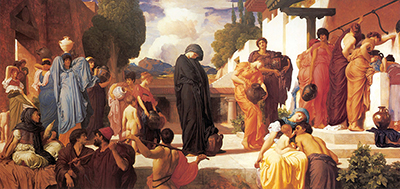
| Captive Andromache | 1888 | Painting Catalogue. |
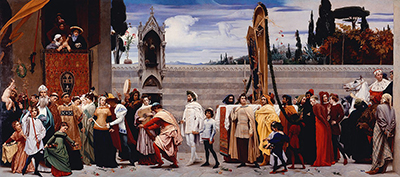
| Cimabue's Celebrated Madonna | 1853–55 | Painting Catalogue. |
| Cimon and Iphigenia, with Many Smaller Subjects (Tate T09061) | date not known | Drawing Catalogue. |
| Crenaia, the Nymph of the Dargle | Exhibited 1880 | Painting Catalogue. |
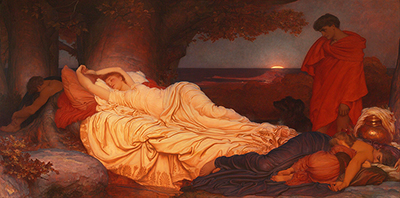
| Cymon and Iphigenia | 1884 | Painting Catalogue. |
| Daedalus and Icarus | 1869 | Painting Catalogue. |
| Dante in Exile | 1864 | Painting Catalogue. |
| Death of the First Born (Tate A00737) | published 1881 | Print Catalogue. |
| Electra at the Tomb of Agamemnon | c. 1869 | Painting Catalogue. |
| Eliezer and Rebekah (Tate A00735) | published 1881 | Print Catalogue. |
| Elijah in the Wilderness | 1877–78 | Painting Catalogue. |
| Fanny Kemble: A Study for ‘Jezebel and Ahab’ (Tate T08208) | c.1862 | Drawing Catalogue. |
| Figure Studies | Date not recorded | Drawing Catalogue. |
| Flaming June | 1895 | Painting Catalogue. |
| Gulnihal | Exhibited 1886 | Painting Catalogue. |
| Helios and Rhodes (Tate N03015) | date not known | Painting Catalogue. |
| Hercules Wrestling with Death for the Body of Alcestis | c. 1869–71 | Painting Catalogue. |
| Jonathan's Token to David | c. 1868 | Painting Catalogue. |
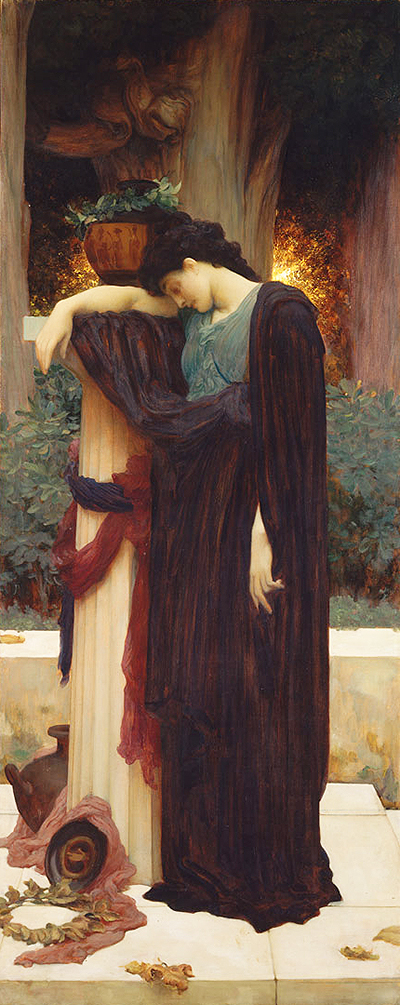
| Lachrymae | 1894–95 | Painting Catalogue. |
| Lieder ohne Worte | Exhibited 1861 | Painting Catalogue. |
| Light of the Harem | Exhibited 1880 | Painting Catalogue. |
| Moses Views the Promised Land (Tate A00736) | published 1881 | Print Catalogue. |
| Mrs James Guthrie | 1865 | Painting Catalogue. |
| Mrs John Hanson Walker (Tate N04731) | 1867 | Painting Catalogue. |
| Music Lesson | 1877 | Painting Catalogue. |
| Needless Alarms (Met cast) | modelled 1886; cast nineteenth century | Sculpture Catalogue. |
| Needless Alarms (Tate N05120) | 1886 | Sculpture Catalogue. |
| Pavonia | c. 1859 | Painting Catalogue. |
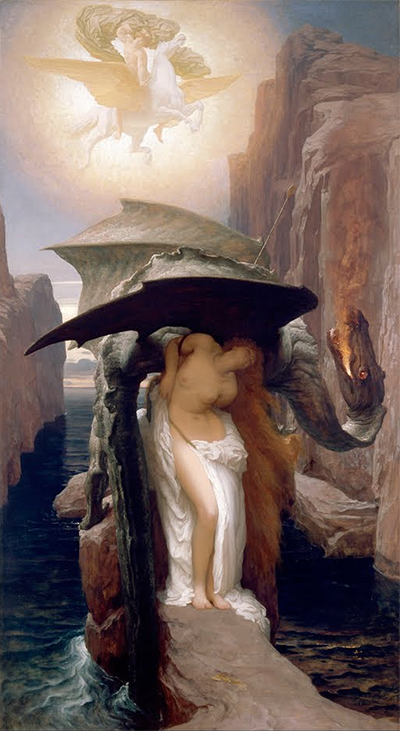
| Perseus and Andromeda | 1891 | Painting Catalogue. |
| Portrait of May Sartoris | c. 1860 | Painting Catalogue. |
| Preparing for a Festa, Florence (Tate T09062) | date not known | Drawing Catalogue. |
| Puerta de los Vientos, near Ronda, Spain (Tate N04006) | c.1886–9 | Painting Catalogue. |
| Samson and the Lions (Tate A00732) | published 1881 | Print Catalogue. |
| Samson at the Mill (Tate A00734) | published 1881 | Print Catalogue. |
| Samson Carrying the Gate (Tate A00738) | published 1881 | Print Catalogue. |
| Sketch for ‘An Athlete Wrestling with a Python’ (Tate N01761) | c.1877 | Sculpture Catalogue. |
| Sketches for Cimon and Iphigenia (Tate T09060) | date not known | Drawing Catalogue. |
| Study for The Return of Persephone (Demeter) | c. 1890–91 | Drawing Catalogue. |
| Study for The Return of Persephone (Persephone) | c. 1890–91 | Drawing Catalogue. |
| Study for ‘Needless Alarms’ (Tate N02945) | 1886 | Sculpture Catalogue. |
| Study for ‘The Discovery of Juliet Apparently Lifeless’ (Tate N01806) | c.1858 | Painting Catalogue. |
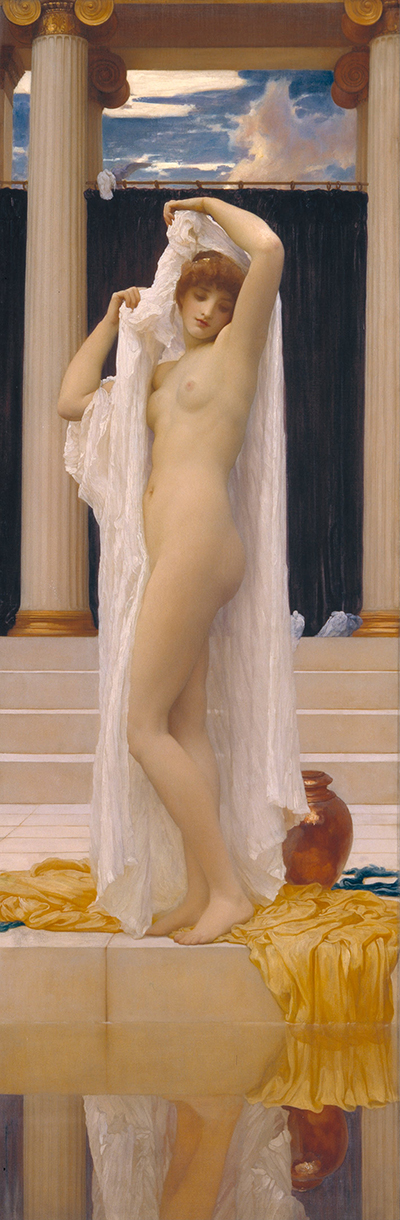
| The Bath of Psyche | Exhibited 1890 | Painting Catalogue. |
| The Daphnephoria | 1874–76 | Painting Catalogue. |
| The Death of Brunelleschi | 1852 | Painting Catalogue. |
| The Fisherman and the Siren | Exhibited 1858 | Painting Catalogue. |
| The Painter's Honeymoon | c. 1864 | Painting Catalogue. |
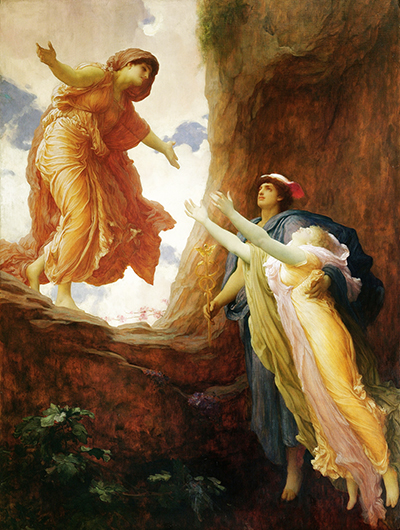
| The Return of Persephone | 1891 | Painting Leeds painting identified in the Met study record. |
| The Return of Persephone (preparatory oil) | c. 1890–91 | Painting Catalogue. |
| The Sluggard (Anglesey Abbey cast) | probably 1890–about 1906 | Sculpture Catalogue. |
| The Sluggard (Met cast) | modelled 1886; cast possibly before 1896 | Sculpture Catalogue. |
| The Sluggard (Museum Wales) | 1882–85 (museum date) | Sculpture Catalogue. |
| The Sluggard (Tate N01752) | 1885 | Sculpture Catalogue. |
| The Spies Escape (Tate A00730) | published 1881 | Print Catalogue. |
| Various Subjects (Tate T09063) | date not known | Drawing Catalogue. |
| View in Capri | Possibly 1859 | Painting Catalogue. |
| Wedded | 1882 | Painting Catalogue. |
| Winding the Skein | c. 1878 | Painting Catalogue. |
Discussion
Look again at the images and ideas explored in Leighton House and the Arab Hall. These editorial prompts invite your observations.
Reader Insights
What do the repairs to the tiles let you see about the work of William De Morgan and the earlier ceramicists?
How does the shift from the studio’s daylight to the Arab Hall’s filtered light change what you notice?
Join the Conversation
Share a detail, comparison or question about Leighton House and the Arab Hall below.
References
- Leighton House, “History of Leighton House”. View source.
- Leighton House, “Q&A: The Arab Hall at Leighton House,” with Melanie Gibson. View source.
- Historic England, “Leighton House,” National Heritage List for England, Grade II*, entry 1191541. View source.
- Mary Roberts, “The Resistant Materiality of Frederic Leighton’s Arab Hall,” British Art Studies, no. 9 (2018). View source.
- Melanie Gibson, “‘An Oriental Kiosk’: The Building of the ‘Arab Hall’ at Leighton House in London,” Orientations 51, no. 2 (2020), pp. 2–15. View source.
- Leighton House, “Frederic Leighton’s Flaming June: The Making of an Icon”. View source.
- Martina Droth, “Leighton’s House: Art In and Beyond the Studio,” Journal of Design History 24, no. 4 (2011), pp. 339–358. View source.
- Regione Siciliana, “Palermo, al via i lavori di restauro del Castello della Zisa,” 27 March 2023. View source.
- Patronato de la Alhambra y Generalife, “Patio de los Arrayanes”. View source.
- Leighton House, “Conservation of the mosaic floors at Leighton House”. View source.
- Ernest Rhys, Frederic Lord Leighton: An Illustrated Record of His Life and Work, chapter V, chronological list of works, and Samuel Pepys Cockerell’s chapter X, ‘Lord Leighton’s House in 1900’. View source.
- Leighton House, “The Arab Hall inscriptions retold”. View source.
- Noriko Yoshimura, 「家(テイスト)」とは何か―イギリス19世紀後半の「アーティスト・ハウス」―, 英文学会誌 (English Department Journal), no. 44, pp. 13–34, especially pp. 24–25 and fig. 6. View source.
- Leighton House, “Summoning Leighton’s Lost Collection”. View source.
- Leighton House, “100 Years of Leighton House”. View source.
- Royal Borough of Kensington and Chelsea, Leighton House Museum Collections Review, Appendix C, §2, “History of the collections” (2018). View source.
- Leighton House, “Bringing home Alma-Tadema’s In My Studio”. View source.
- Leighton House, “Recreating Aitchison’s studio bookcases”. View source.