 by Tom Gurney
Tom Gurney BSc (Hons) is an art history expert with over 20 years experience
Published on June 19, 2020 / Updated on October 30, 2026
Email: tomgurney1@gmail.com / Phone: +44 7429 011000
Cathedral: Introduction
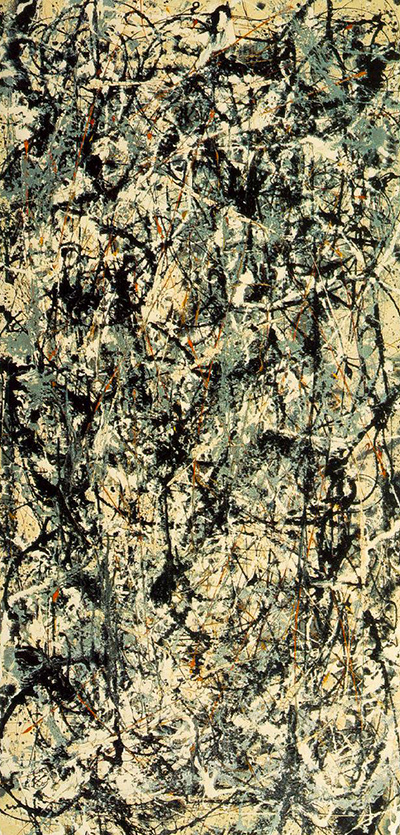
Jackson Pollock’s Cathedral is an upright painting from 1947, made with enamel and aluminum paint on canvas and belonging to the Dallas Museum of Art. The 1998 Museum of Modern Art catalogue records its dimensions as 181.6 × 89 centimetres: a surface a little more than twice as high as it is wide. Those proportions matter when approaching a painting whose lines distribute attention across the surface. Cathedral has a definite, narrow physical boundary, even when its activity seems capable of continuing beyond it. Its scale is bodily; its format gives that potentially spreading activity a particular shape. [1]
The question of how such a painting holds together has accompanied Cathedral throughout its public life. In a 1998 interview, curator Kirk Varnedoe singled it out alongside Lucifer as a work in which pouring appeared to determine the whole picture. He resisted choosing one solitary breakthrough canvas. His distinction was between works whose poured lines covered an earlier composition and those in which the process generated the composition from beginning to end. This is a critical account of the painting’s organisation, rather than a material analysis proving how every passage was applied. Varnedoe also stressed the variety of marks available through liquid paint and the adjustments possible as layers accumulated. Following his account, the useful question becomes how one mark answers another: a thicker passage can change the force of a finer line, while a new layer can adjust what came before. The apparent freedom of the network invites attention to decisions made across a developing surface. [2]
At a Glance
This work across Jackson Pollock’s career
The Flame
c.1934–38The She-Wolf
1943Mural
1943Alchemy
1947Number 1A, 1948
1948Blue Poles
1952The Deep
1953White Light
1954Contents
A surface with room inside it
An all-over painting distributes its incidents without asking every line to serve a dominant central figure. Yet a distributed surface can still suggest depth. Bernice Rose’s study of Pollock’s drawing and painting offers a useful explanation of this distinction. She describes the linear screen, the intervals within it and the tonal ground as producing space through their interaction. In her account, the eye can sense an opening behind the network without finding the usual perspective devices that locate objects in a room. She also considers reflective paint and the optical activity of lines as contributors to spatial sensation. Applied as a framework for approaching Cathedral, this directs attention to relationships between surface and apparent depth, rather than to a search for a building hidden behind the title. Rose’s discussion concerns a family of works; it supplies a way to ask questions, without establishing a particular architectural subject for this canvas. [3]
Comparison makes the choices within this kind of painting easier to recognise. The Peggy Guggenheim Collection describes Enchanted Forest through its broad white intervals and its restricted gold, black, red and white palette, contrasting its openness with the denser layered colour of Alchemy. Its account emphasises lines that become forms in their own right, carrying the eye onward without a single commanding focus. These are useful companion questions for Cathedral: how much breathing room does a network allow, and how do colour and spacing affect its movement? A common method leaves considerable room for different pictorial character. [4]
Full Fathom Five offers a more material comparison. MoMA describes a surface built with brush and palette knife, embedded objects and poured upper layers. Its documented nails, cigarettes, buttons and other fragments contribute to its encrusted character. That history gives concrete substance to the distinction Varnedoe made between a layered transitional work and Cathedral’s more thoroughly process-generated organisation. It also encourages care with the convenient phrase “drip painting.” Paint travelling through the air can be one part of a much more varied construction. Each work needs its own material account; the familiar label alone cannot explain its texture or the relationship between successive layers. [5]
Watch: Jackson Pollock
Choose a film about Pollock’s paintings and ways of working.
The argument over structure
Cathedral appeared among seventeen paintings at Betty Parsons Gallery, New York, from 5 to 23 January 1948. In his 17 January review, Robert M. Coates found it disorganised and meaningless, while finding poetic suggestion in Enchanted Forest. The disagreement continued in the Life modern-art round table published on 11 October. As transcribed in Francis V. O’Connor’s 1967 catalogue, Clement Greenberg championed Cathedral, and James Johnson Sweeney recognised linear organisation and textured surface. Sir Leigh Ashton admired its colour but compared it to printed silk and doubted its structural design. Aldous Huxley wondered why its potentially endless pattern stopped at all. These responses make the difficulty precise: could an image that seemed extendable still possess the organisation of a complete painting? Even admiration for its colour did not necessarily produce agreement about its structure. The early reception was divided within a conversation about particular qualities. [6]
That debate can sound surprising to readers accustomed to the image of Pollock as a painter of violent disorder. Pepe Karmel’s introduction to Jackson Pollock: Interviews, Articles, and Reviews distinguishes the early anxiety about decoration from the later emphasis on chaos. As mass publicity widened Pollock’s audience, Karmel explains, critics increasingly treated the pictures as disorderly; defenders could then turn that supposed disorder into evidence of meaningful action. The change affected what viewers were encouraged to notice. For Cathedral, recovering the earlier debate brings colour, pattern and the problem of a self-contained picture back into view. It also explains why the work could seem too decorative to one observer while seeming insufficiently organised to another. Both judgements concerned how its elements belonged together, but they approached that question with different expectations about what painting should provide. [7]
Greenberg’s defence had its own historical commitments. Robert Storr notes that the critic compared Cathedral to Picasso and Braque’s Cubist masterpieces of 1912–15. Such a comparison placed Pollock within an established modernist lineage and made the emphatic surface an important part of his achievement. Storr questions the exclusiveness of that genealogy: he argues that Greenberg’s account increasingly privileged Cubism while reducing the significance of other affinities, including Mexican painting. The two positions offer a productive disagreement. Greenberg’s comparison asks readers to consider how an apparently radical surface relates to earlier pictorial problems. Storr asks what disappears when that relationship becomes the governing explanation. The Cubist connection therefore belongs to Cathedral’s interpretive history as a consequential critical proposal. It should be weighed alongside other accounts of Pollock’s development, with attention to the choices each critic makes. [8]
A painting for a future audience
The painting’s move to Dallas gave these questions a civic setting. Leigh Arnold’s museum history records its 1950 gift by Mr. and Mrs. Bernard J. Reis, who had bought it from Betty Parsons Gallery. Bernard Reis’s friendship with Stanley Marcus helped bring the work to the museum, then the Dallas Museum of Fine Arts; its object number is 1950.87. Arnold cautions that their recollections vary. In Marcus’s remembered account, he invited a gift because the museum lacked purchasing money. Separately, in the letter Arnold cites, Reis sought to place Pollock’s work in a part of the country where it was absent. Marcus also recalled worrying about the audience’s understanding, to which Reis answered that its children would understand. Preserved as recollection, the exchange conveys the ambition of the acquisition: collecting could give an unfamiliar art time to find its public. [9]
One later response came through music. Paul Davies composed Cathedral 1947 for two pianos in 1998–99; the programme for UC San Diego’s Sonic Diasporas festival lists duo runedako, Ruth Neville and Daniel Koppelman, performing it on 20 January 2011. Davies explains that he sought a musical context for impressions prompted by Pollock’s luminous skeins, colour and handling of depth. He also used numbers associated with his subject to organise rhythm and form. His description brings together sensory impression and deliberate construction, two concerns that had animated the painting’s reception from the outset. Davies’s account of nature and radiance belongs to his own response to Pollock. The programme demonstrates something more specific than a general claim of influence: a composer found in this painting a starting point for decisions in another medium, carrying its questions of continuity and organisation into musical time. [10]
Pollock artworks directory
Explore the distinct works discussed in these guides. This selection is not a complete catalogue. Green Silver and Untitled, 1949 are two guides to the same painting.
Discussion
Look again at the images and ideas explored in Cathedral. These editorial prompts invite your observations.
Reader Insights
Which detail in “A surface with room inside it” changes how you understand this work?
What comparison comes to mind after “The argument over structure”?
What would you like to discuss about “A painting for a future audience”?
Join the Conversation
Share a detail, comparison or question about Cathedral below.
References
- Kirk Varnedoe, with Pepe Karmel, Jackson Pollock. New York: The Museum of Modern Art, 1998, pp. 47–48 and plate 120, PDF p. 232. Catalogue. View source.
- Kirk Varnedoe, interview with Terry Gross, “The Revolutionary Work of Painter Jackson Pollock,” Fresh Air, WHYY, 16 November 1998, transcript, process discussion and Cathedral passage. Interview. View source.
- Bernice Rose, Jackson Pollock: Drawing into Painting. New York: The Museum of Modern Art, 1980, pp. 17–19, especially p. 18. Catalogue. View source.
- Peggy Guggenheim Collection, “Enchanted Forest,” 1947, object essay and collection record. Museum record. View source.
- The Museum of Modern Art, “Jackson Pollock. Full Fathom Five. 1947,” object record, 2010–11 gallery label and 2017 course text. Museum record. View source.
- Francis V. O’Connor, Jackson Pollock. New York: The Museum of Modern Art, 1967, pp. 42–44: exhibition entry, Robert M. Coates’s 17 January 1948 review, and “A Life Round Table on Modern Art,” Life, 11 October 1948, transcribed excerpts. Catalogue. View source.
- Pepe Karmel, “Introduction,” in Jackson Pollock: Interviews, Articles, and Reviews, edited by Karmel. New York: The Museum of Modern Art, 1999, pp. 9–11; notes, p. 13. Anthology. View source.
- Robert Storr, “A Piece of the Action,” in Kirk Varnedoe and Pepe Karmel, eds., Jackson Pollock: New Approaches. New York: The Museum of Modern Art, 1999, p. 36. Catalogue. View source.
- Leigh Arnold, “Contemporary Art at the Dallas Museum of Art: How Stanley Marcus, Al Meadows, and James and Lillian Clark Shaped a Collection,” 2013, section on Stanley Marcus, Cathedral gift paragraphs and note 12. Museum essay. View source.
- Paul Davies, “Cathedral 1947 for two pianos (1998/99),” programme note, Sonic Diasporas, UC San Diego Department of Music Alumni Festival, 20–22 January 2011, PDF pp. 7–8. Programme. View source.