 by Tom Gurney
Tom Gurney BSc (Hons) is an art history expert with over 20 years experience
Published on June 19, 2020 / Updated on October 30, 2026
Email: tomgurney1@gmail.com / Phone: +44 7429 011000
Mural by Jackson Pollock: Introduction
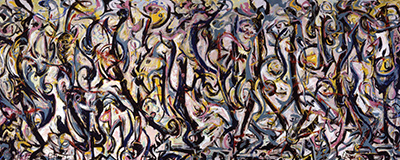
Jackson Pollock’s Mural is a painting on the scale of a wall: more than six metres wide, with curved black verticals moving through yellow, pink, teal and pale greenish blue. The University of Iowa Stanley Museum of Art records it as Mural, 1943, oil and casein on canvas, Gift of Peggy Guggenheim, accession 1959.6. Its current recorded dimensions are 242.25 × 603.89 × 6.35 centimetres. [1]
In July 1943 Peggy Guggenheim contracted to pay Pollock $150 a month as an advance against sales, enabling him to paint full-time. She scheduled his first solo exhibition at Art of This Century that November and commissioned the large painting for her East 61st Street entrance hall. These arrangements offered him both a livelihood and a public platform. [2]
At a Glance
- Date1943
- MaterialsOil and casein on canvas
- CollectionUniversity of Iowa Stanley Museum of Art
- Accession1959.6
This work across Jackson Pollock’s career
The Flame
c.1934–38The She-Wolf
1943Alchemy
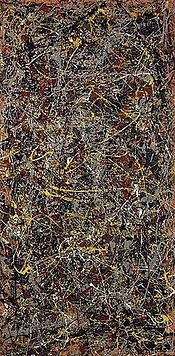
1947Number 1A, 1948
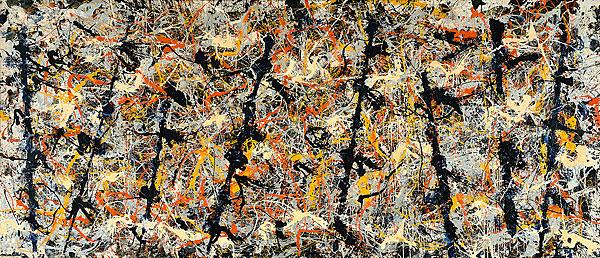
1948Blue Poles
1952The Deep
1953White Light
1954Contents
- A canvas inside an apartment
- Rhythm and changing marks
- The night that became a legend
- Working upright, opening spaces
- Conserving the surface and its boundaries
- The journey to Iowa
- Between an easel picture and a mural
A canvas inside an apartment
Guggenheim allowed Pollock to choose the subject. Marcel Duchamp suggested canvas so she could take the painting with her when she moved. Iowa’s history gives the intended commission format as 8 feet 1¼ inches by 19 feet 10 inches, distinct from the present museum measurements. [3]
The challenge of making it appears vividly in Pollock’s correspondence. Writing to his brother Charles on 29 July 1943, he described the commission and his freedom over how and what to paint. He intended to use oil on canvas, and had already stretched the support. To accommodate it, he reported tearing out the partition between the front and middle rooms of his apartment. His letter combines excitement with a very concrete alteration of his working space. Before the painting could develop, there had to be somewhere to put it. [4]
Rhythm and changing marks
The Peggy Guggenheim Collection connects Mural with the energy Pollock had previously concentrated in individual figures, such as the upright presence in The Moon Woman of 1942. Its account emphasises the larger painting’s variety: long arcs and swirls coexist with flicked and speckled pigment. These are useful differences to follow across the surface. A sustained curve carries the eye differently from a scattered touch; the painting gathers several kinds of movement into one field. The museum locates in this range of marks possibilities that would expand in Pollock’s later poured paintings. [5]
Iowa’s description calls attention to a dance-like quality in the curved black verticals. Their upright emphasis works within the exceptionally broad format: the eye can move across the painting while registering these recurring forms. Rhythm provides a way into the picture without requiring every mark to resolve into a named figure or a fixed symbolic message. [1]
The night that became a legend
The overnight story entered influential art-historical accounts. Francis V. O’Connor’s 1967 MoMA catalogue described Pollock facing the untouched canvas after his November show, then completing it in one session in December or early January. Hesitation followed by sudden release gave the painting a memorable origin. [6]
Elizabeth Levine and Anna Indych’s 1998 chronology repeated that winter dating but recorded a contradictory postcard: Pollock told his brother Frank and sister-in-law Marie he had made the painting during the summer. These incompatible accounts leave the detailed timetable unresolved. [2] [7]
Getty’s examination found four diluted early colours—lemon yellow, teal, red and umber—applied wet into wet. Tom Learner allowed that this initial composition might have been made in one night. Most layers, however, followed after earlier paint had dried, implying intervals of days or weeks. [8]
Working upright, opening spaces
Getty found strong documentary support for a stretched canvas leaning against a wall in Pollock’s cramped New York apartment. Most paint appears to have been applied upright. String-like pink passages raised the possibility of floor working, but experiments produced comparable effects by adjusting oil paint’s consistency and flicking it at an upright test canvas. Getty therefore judged horizontal application unlikely. This reconstruction establishes a plausible method, rather than every gesture Pollock made. [9]
Most of Mural consists of high-quality artist’s oils on Belgian linen. Getty identified later white housepaint used to recover open areas within the developed composition. Those spaces were actively painted: adding material could restore a sense of air between the marks. [8]
Conserving the surface and its boundaries
Portability brought physical demands. Getty estimates that early moves involved at least five rollings and unrollings, between the studio, Guggenheim’s hall, Vogue’s photographic studios, MoMA, Yale and Iowa. [8]
A 1973 wax-resin lining stabilised flaking paint but fixed a sag into the canvas. Its varnish later dulled colour and gloss differences, while the stretcher inadequately supported the lined work. Getty’s 2012–14 treatment removed grime and aged varnish. A new, slightly curved stretcher followed the surviving painted boundaries, returning exposed unpainted margins to the sides and supporting the canvas’s weight. Respect for those boundaries shaped the solution: the painting’s material history affected how its image could be presented. [9]
The treated painting was exhibited at the Getty from 11 March to 1 June 2014, alongside the project’s findings. [8]
The journey to Iowa
On 3 October 1948 Guggenheim reminded Lester Longman, head of Iowa’s School of Art and Art History, of her offer to give Mural if the university paid freight from Yale. Negotiations followed; it arrived in October 1951. [3]
The offer, arrival and accession belong to different stages of its history. The current collection record carries the gift credit and accession 1959.6. [1] Getty’s 2014 account calls 1951 the donation year. [8]
After conservation, the painting travelled widely. Beginning in 2015, David Anfam’s Jackson Pollock’s “Mural”: Energy Made Visible, organised by Iowa’s museum, travelled to Venice, Berlin and Málaga. Mural returned to Iowa City on 14 July 2022 before the Stanley Museum’s August reopening. [3]
Between an easel picture and a mural
Pollock’s own later words give the work a useful place in his thinking. In a 1947 Guggenheim Fellowship application, he proposed “large movable pictures” operating “between the easel and mural.” He named the commission for Guggenheim as a precedent, recalling its installation in her house, its subsequent exhibition at MoMA and its loan to Yale. The journeys that might appear incidental to a painting’s meaning were already part of his account of this new kind of picture. [10]
He imagined an intermediate state: a work related to the mural through its scale and effect on a room, yet able to move as an easel picture could. His application treated that position as an artistic possibility still to be developed. Mural gave the proposal an existing example: a picture whose scale could shape an architectural setting while its canvas support allowed further journeys. [10]
Comparison with The Key clarifies another development. The Art Institute of Chicago records that the 1946 oil on linen was painted on the floor of an upstairs bedroom, with Pollock working from all sides. Just over two metres wide, it was considerably smaller than Mural. The comparison separates scale from working position: greater access around the support could change the act of painting without requiring a larger canvas. Chicago describes its gestural abstraction as anticipating the allover compositions that followed. [11]
Full Fathom Five makes the changing relationship to the support still more tangible. MoMA describes the 1947 work as begun on an easel with brush and palette knife, then completed on the floor with black and silver enamels. It measures 129.2 × 76.5 centimetres and contains small objects embedded in its paint. Here the support changed position during the making of one work, allowing successive forms of handling to accumulate within it. [12]
Together these works give a more particular view of Pollock’s paintings: the vast commission, the smaller canvas approached from all sides, and the easel painting developed on the floor each posed a different physical problem. The Key and Full Fathom Five extend the story through changes in access and application, showing why the development cannot be measured by dimensions alone. [11] [12]
Pollock artworks directory
Explore the distinct works discussed in these guides. This selection is not a complete catalogue. Green Silver and Untitled, 1949 are two guides to the same painting.
Discussion
Look again at the images and ideas explored in Mural by Jackson Pollock. These editorial prompts invite your observations.
Reader Insights
Which detail in “A canvas inside an apartment” changes how you understand this work?
What comparison comes to mind after “Rhythm and changing marks”?
What would you like to discuss about “The night that became a legend”?
Join the Conversation
Share a detail, comparison or question about Mural by Jackson Pollock below.
References
- University of Iowa Stanley Museum of Art, “Jackson Pollock, Mural”, current object record 1959.6, metadata and descriptive text, consulted 25 October 2026. View source.
- Elizabeth Levine and Anna Indych, “Chronology,” in Kirk Varnedoe, with Pepe Karmel, Jackson Pollock (New York: The Museum of Modern Art; distributed by Harry N. Abrams, 1998), p. 320, PDF p. 343. View source.
- University of Iowa Stanley Museum of Art, “Pollock’s ‘Mural’ Returns Home to Iowa City After World Tour”, news release, 4 August 2022, pp. 1–2, particularly “About ‘Mural’,” p. 2. View source.
- Jackson Pollock, letter to Charles Pollock, 29 July 1943, transcribed in Francis V. O’Connor, Jackson Pollock (New York: The Museum of Modern Art, 1967), p. 28, PDF p. 33. View source.
- Peggy Guggenheim Collection, “Pollock’s Mural”, concluding discussion of movement, The Moon Woman and types of mark, consulted 25 October 2026. View source.
- Francis V. O’Connor, Jackson Pollock (New York: The Museum of Modern Art, 1967), p. 29, PDF p. 34, historical account of the single-session making of Mural. View source.
- Elizabeth Levine and Anna Indych, “Chronology,” note 17, in Varnedoe with Karmel, Jackson Pollock (1998), p. 329, PDF p. 352, discussing conflicting accounts and quoting Pollock’s postcard to Frank and Marie Pollock. The postcard is consulted through this published transcription. View source.
- J. Paul Getty Trust, “Getty Completes Conservation of Milestone Painting by Jackson Pollock”, 21 January 2014, account of research and treatment, including statements by Tom Learner and Yvonne Szafran. View source.
- Getty, “Jackson Pollock’s Mural”, conservation project, 2012–2014; “Outcomes,” “Prior Conservation,” “Researching Technique,” “Recreating Conditions” and “Conservation Challenges,” consulted 25 October 2026. View source.
- Jackson Pollock, “Application for Guggenheim Fellowship” (1947), reprinted in Pepe Karmel, ed., Jackson Pollock: Interviews, Articles, and Reviews (New York: The Museum of Modern Art; distributed by Harry N. Abrams, 1999), p. 17, PDF p. 21. View source.
- Art Institute of Chicago, The Key, 1946, accession 1987.261, current institutional object metadata and description, consulted 25 October 2026. View source.
- The Museum of Modern Art, Full Fathom Five, 1947, object 186.1952, current object metadata; In the Studio: Postwar Abstract Painting course text (2017); and gallery label for Abstract Expressionist New York, 3 October 2010–25 April 2011, consulted 25 October 2026. View source.