 by Tom Gurney
Tom Gurney BSc (Hons) is an art history expert with over 20 years experience
Published on June 19, 2020 / Updated on October 30, 2026
Email: tomgurney1@gmail.com / Phone: +44 7429 011000
The She-Wolf: Introduction
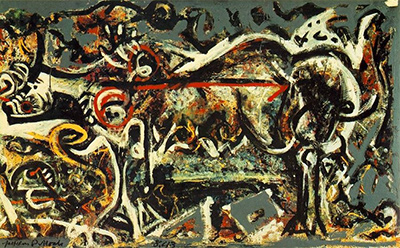
Jackson Pollock’s The She-Wolf sets a recognisable animal within a restless surface of marks. Painted in 1943, it belongs to the Museum of Modern Art, New York, which records its medium as oil, gouache and plaster on canvas, its dimensions as 106.4 × 170.2 cm, and its accession number as 82.1944. The museum describes the wolf advancing leftward, drawn with strong black and white lines beneath abstract patches and dense, unreadable calligraphy. [1]
The animal gives the painting an immediate point of entry, while the surrounding activity makes following its form a more involved experience. Carolyn Lanchner, in the opening of her discussion of The She-Wolf, places it alongside Guardians of the Secret as a declaration of Pollock’s ambition. She identifies a tension between symbolic figures and the impact of the entire painted field. This is a useful way into the picture: attend to the creature, then consider how its presence changes as attention moves across the surface. Recognition supplies a beginning; the painting’s larger organisation keeps that recognition unsettled. [2]
At a Glance
This work across Jackson Pollock’s career
The Flame
c.1934–38Mural
1943Alchemy
1947Number 1A, 1948
1948Blue Poles
1952The Deep
1953White Light
1954Contents
- A form made through layers
- Paint that defines and conceals
- What does the wolf mean?
- Other ways to organise a mystery
- Recognition with reservations
A form made through layers
Kirk Varnedoe’s account draws attention to the relationship between smooth overpainting and the more turbulent passages underneath. He describes an initial spread of diluted colour, washes and spatters, followed by paint that covers and defines. A long run of grey enters the animal’s neck. Such a passage joins the figure to the behaviour of the paint: a downward flow remains active within an image that also depends on deliberate contours. Background paint can establish a body’s boundary as effectively as a line drawn around it. [3]
Varnedoe compares these densely revised paintings with the more open structure of Stenographic Figure. His discussion resists arranging Pollock’s early work into a tidy sequence of improvements. Different densities and manners existed alongside one another. That variety matters here. The wolf’s heavily worked surface represents one solution to organising a painting, while the thinner planes and freer calligraphy of Stenographic Figure offer another. Their differences make the choices within each more legible. [3]
Paint that defines and conceals
Conservator Carol C. Mancusi-Ungaro reconstructs a changing working position. Initial thin splashes on white priming suggest a horizontal canvas; brushmarks then indicate upright work on the animal. She notes granular filler, probably sand, and shinier, fluid paint used to mask areas around forms, whose appearance suggests an industrial paint type. These are qualified observations: they neither chemically identify a binder nor settle the relationship between her proposed sand and MoMA’s present plaster designation. The account makes overpainting central to the image’s construction, with covering and revealing both helping to establish its forms. [4]
What does the wolf mean?
MoMA proposes a possible connection with the wolf that nursed Romulus and Remus, Rome’s legendary founders. Pollock declined to supply a fixed identification: “She-Wolf came into existence because I had to paint it.” The title and possible myth provide associations without requiring every mark to stand for a named character. The museum’s Highlights text also relates the sombre palette and mythic atmosphere to a world shadowed by war. This remains a historical interpretation, rather than a statement by Pollock explaining his subject. [1]
Pollock’s own account of his interests offers a broader context for this openness. In a questionnaire published in Arts and Architecture in February 1944, he welcomed the presence of European modern artists in America and emphasised their idea that art could originate in the unconscious. He distinguished that interest from allegiance to particular émigré painters, naming Picasso and Miró, who remained abroad, as the artists he most admired. His answers describe an active engagement with modern painting’s possibilities. They do not give a glossary for The She-Wolf. Reading them beside the picture helps preserve a distinction between the ideas available to an artist and an exact explanation of an individual image. The unconscious could be a source from which painting developed without making the finished work a document that viewers could translate back into a single private experience. [5]
Watch: Jackson Pollock
Choose a film about Pollock’s paintings and ways of working.
Other ways to organise a mystery
Guardians of the Secret, also dated 1943, gives a useful comparison. SFMOMA’s description places tall figures at either side of a broad central field, with a dog-like creature stretched beneath it. The centre resembles an inscribed object, variously suggesting a scroll, tapestry or shroud. Those alternatives belong to the museum’s description, and remain alternatives. This arrangement gives the reader a different route through a densely marked picture: from the flanking figures towards something apparently guarded. The She-Wolf instead offers an animal as the principal point of recognition. Comparing the two need not establish that they share a secret message. It brings out the different roles a creature and an inscribed field can occupy within a composition. SFMOMA also notes that Pollock never explained the secret named by its painting’s title. [6]
The Musée national Picasso-Paris’s account of the early work places this variety within a practical setting. Peggy Guggenheim’s Art of This Century brought European avant-garde work and younger American artists into contact. Her support gave Pollock a monthly income and an individual exhibition. The museum’s dossier treats that exhibition as an opportunity to see both symbolic imagery and experiments with colour and material. It also connects the period with the larger ambition of Mural, commissioned for Guggenheim’s home. In this setting, The She-Wolf belongs to a group of sustained investigations into scale, line and painted matter. The dossier’s comparison with the smoother, airier Stenographic Figure reinforces how wide that investigation already was: gaining support did not mean settling on a uniform appearance. The paintings could address related problems through markedly different surfaces. [7]
Recognition with reservations
Interest preceded Pollock’s first solo show, held at Art of This Century from 9 to 27 November 1943. Francis V. O’Connor reproduces Howard Putzel’s letter of 2 October reporting James Thrall Soby’s enthusiasm and suggestion that MoMA should buy The She-Wolf. The exhibition’s reception nevertheless involved distinctions and reservations. James Johnson Sweeney’s catalogue introduction praised Pollock’s vitality while acknowledging a need for discipline. Reviewing the show on 20 November, Robert M. Coates admired Pollock’s force and colour but singled out The She-Wolf and Stenographic Figure as examples of ideas pushed too far. Clement Greenberg’s 27 November review supported Pollock’s promise while finding the smaller works more resolved than the larger ones. His broader verdict should not be mistaken for a specific assessment of this canvas. These responses show how admiration for an emerging painter could coexist with doubts about particular pictures. [8]
Soby placed The She-Wolf on reserve for MoMA’s consideration. Varnedoe and Pepe Karmel describe debate over the purchase. Recognition emerged through advocacy and discussion, with the painting itself still capable of dividing opinion. [4]
In 1944, MoMA purchased The She-Wolf, becoming the first museum to acquire a painting by Pollock. [2]
Pollock artworks directory
Explore the distinct works discussed in these guides. This selection is not a complete catalogue. Green Silver and Untitled, 1949 are two guides to the same painting.
Discussion
Look again at the images and ideas explored in The She-Wolf. These editorial prompts invite your observations.
Reader Insights
Which detail in “A form made through layers” changes how you understand this work?
What comparison comes to mind after “Paint that defines and conceals”?
What would you like to discuss about “What does the wolf mean?”?
Join the Conversation
Share a detail, comparison or question about The She-Wolf below.
References
- The Museum of Modern Art, The She-Wolf, object record 82.1944; 2025 gallery label; MoMA Highlights, 1999, revised 2004. View source.
- Carolyn Lanchner, Jackson Pollock (MoMA, 2009), pp. 3, 13: preface and opening of The She-Wolf entry. View source.
- Kirk Varnedoe, with Pepe Karmel, Jackson Pollock (MoMA, 1998), pp. 35–36. View source.
- Carol C. Mancusi-Ungaro, “Jackson Pollock: Response as Dialogue,” p. 119; Kirk Varnedoe and Pepe Karmel, introduction, p. 10, in Jackson Pollock: New Approaches (MoMA, 1999). View source.
- Jackson Pollock, “A Questionnaire,” Arts and Architecture 61, no. 2 (February 1944), p. 14; reprinted in Pepe Karmel, ed., Jackson Pollock: Interviews, Articles, and Reviews (MoMA, 1999), pp. 15–16. View source.
- San Francisco Museum of Modern Art, Guardians of the Secret, object record and audio-description transcript; introductory narrative to interview transcript. View source.
- Musée national Picasso-Paris, Jackson Pollock: Les premières années (1934–1947), Dossier documentaire (2024), pp. 30–31. View source.
- Francis V. O’Connor, Jackson Pollock (MoMA, 1967), pp. 28–31, including Putzel’s letter and excerpts from Sweeney, Coates and Greenberg. View source.