 by Tom Gurney
Tom Gurney BSc (Hons) is an art history expert with over 20 years experience
Published on June 19, 2020 / Updated on October 30, 2026
Email: tomgurney1@gmail.com / Phone: +44 7429 011000
Shimmering Substance: Introduction
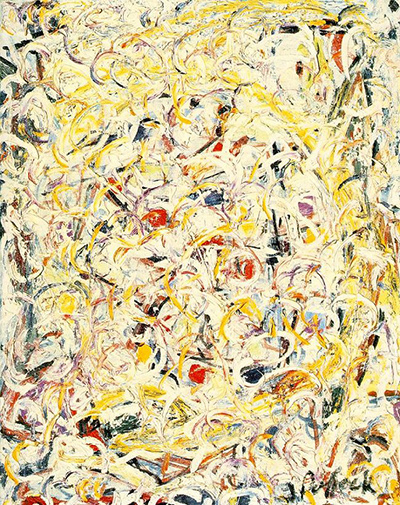
Shimmering Substance makes light seem inseparable from the weight of paint. Jackson Pollock squeezed colour from tubes and worked it into open curls that carry activity to the canvas edges. MoMA describes its encrusted surface as one of his first wholly nonrepresentational paintings. Made in 1946, this oil on canvas measures 76.3 × 61.6 cm. Its place in Pollock’s work becomes clearer when we follow the contact between tool and paint. [1]
At a Glance
This work across Jackson Pollock’s career
The Flame
c.1934–38The She-Wolf
1943Mural
1943Alchemy
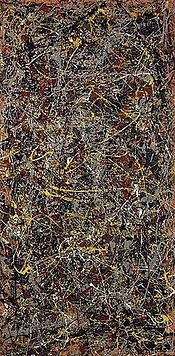
1947Number 1A, 1948
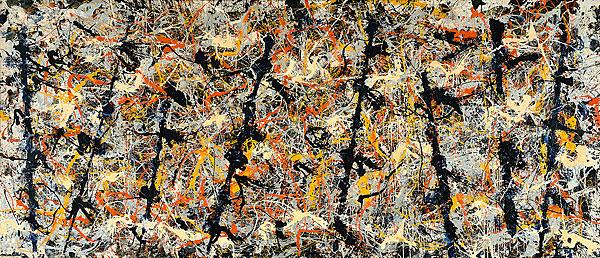
1948Blue Poles
1952The Deep
1953White Light
1954Contents
- A new place to work
- Colour in contact
- Thinking through the paint
- Light without a fixed subject
- The painting’s public life
A new place to work
Pollock and Lee Krasner moved to Springs, near East Hampton, in November 1945. The following year he initially painted in an upstairs bedroom, then began using the barn after having it moved within the property during the summer. Krasner took the bedroom as her own studio. Elizabeth Levine and Anna Indych’s chronology distinguishes the two groups shown at Art of This Century from 14 January to 1 February 1947: the Accabonac Creek paintings were made upstairs; the Sounds in the Grass paintings were finished in the barn. That wording gives a useful history of the group without specifying where every passage of Shimmering Substance was painted. Kirk Varnedoe places its trowelled paint within the varied experiments of 1946, and stresses the substantial difference between these worked surfaces and the dominantly poured paintings that followed. [2]
MoMA includes Shimmering Substance among the seven Sounds in the Grass canvases, whose palette it describes as lighter than Pollock’s previous work. Its label suggests a possible response to the rural surroundings. Summer light is an analogy for its effect, without identifying a particular outdoor view. The same label describes paint manipulated with a palette knife, or perhaps a finger. Keeping that small uncertainty matters: the tangible surface is documented more securely than the identity of every tool. [1]
Colour in contact
Eyes in the Heat helps explain what this kind of surface could do. The Peggy Guggenheim Collection describes that painting’s tube paint pushed and smeared with blunt tools into a thick crust. Its account follows colour moving across the canvas and identifies scattered watchful eyes within it. The viewer’s attention travels, but is repeatedly caught by suggestions of creatures. This gives a useful comparison with MoMA’s account of Shimmering Substance: a shared way of working can sustain very different relationships to recognisable imagery. [3]
The comparison also makes the word “allover” more precise. It describes activity spread across the picture, while leaving open the question of how that activity was made. In Eyes in the Heat, according to its museum, the hand’s pressure, pushing and smearing help colour take its course. The marks retain the consequences of contact. Calling such a painting allover therefore tells us about the distribution of attention, not a single paint-delivery system shared by every Pollock canvas. [3]
Varnedoe explicitly distinguishes the curls of Shimmering Substance, the rope-like knots of Eyes in the Heat and the finer scratched work of Croaking Movement. Their group title accommodates differences in density, structure and handling. Carol C. Mancusi-Ungaro adds a complementary observation: Shimmering Substance is among the paintings where gaps preserve earlier paint or ground within the finished composition. Her concern is the continuing role of earlier stages in the work. These openings provide compositional reference points; they are not evidence of a concealed figurative image. [4]
Watch: Jackson Pollock
Choose a film about Pollock’s paintings and ways of working.
Thinking through the paint
Pollock’s own accounts make room for both discovery and revision. In a 1944 questionnaire he called craftsmanship essential. In “My Painting,” published in the winter of 1947–48, he described working close to the surface and using unconventional tools, then coming to recognise what he had done. He also allowed for changing or destroying an image. A first response could be followed by reassessment: the painter did not have to know the finished result before beginning. [5]
Pepe Karmel points out that the illustrations accompanying “My Painting” showed works of 1944–46, rather than the new poured paintings. Its discussion of a resistant support and heavy impasto belongs partly to that earlier experience. Reading the statement alongside Shimmering Substance restores the practical importance of pushing material against a surface. It also guards against treating the text as a diary of one later method. [4]
Asked in 1967 about accounts of Pollock painting in an almost unthinking emotional transport, Krasner firmly defended the artist’s awareness and intelligence. Her answer is a useful companion to his own account of recognising and changing a painting as it developed. Together they suggest a way to think about these contact marks: experience and judgement can operate during an exploratory process, without a predetermined image governing each movement. More of this exchange belongs to Krasner and Pollock’s artistic relationship. [5]
Light without a fixed subject
Bernice Rose treats shimmer as a recurring concern in Pollock’s art. In Drawing into Painting, she connects this painting’s title with White Light, Scent and the flicker of his late black drawing strokes. Her account asks how marks activate the space of a work and how colour addresses sensation. It gives the title a formal significance extending beyond a suggestion of pleasant weather. [6]
Rose’s comparison allows a useful distinction between light as a depicted subject and light as a changing visual experience. A painting can evoke shimmer through relations among its marks without illustrating a light source. Her discussion ranges across different works and materials, however; it does not establish metallic pigment in Shimmering Substance. Nor does a shared concern with light make those paintings successive solutions to one fixed problem. The value of the connection lies in noticing a recurring question: how can a painted surface keep perception active? [6]
Omri Moses offers a less settled reading. Discussing Shimmering Substance alongside Eyes in the Heat, he considers landscape associations, a luminous eye-like form and the tension between the canvas’s small physical dimensions and the immense, indeterminate scale it can suggest. In this account, light can make perception unstable as well as pleasurable. His interpretation helps explain why the work need not yield a single, comfortably grasped image. [7]
Moses also reports Serge Guilbaut’s connection between the painting and accounts of atomic testing at Bikini. Crucially, he questions the attempt to make one specific historical event the determining basis of the painting. The nuclear association is therefore an attributed critical reading, not a demonstrated subject or a record of Pollock’s intention. Moses’s discussion leaves room for the painting’s uncertain scale and illumination to exceed that explanation. Readers can consider the historical association while retaining the ambiguity on which the interpretation itself depends. [7]
The painting’s public life
Writing for MoMA in 1956, Sam Hunter paired the substantial paint of Shimmering Substance with the thinner linear work of The Blue Unconscious. He related its material richness to later paintings including Lavender Mist and Ocean Greyness. This is a historical critic’s comparison across different surfaces, rather than a claim that the 1946 canvas already employed their methods. His contrast is valuable because it gives weight and substance a central place in Pollock’s achievement alongside flowing line. [8]
The same exhibition catalogue listed Shimmering Substance as number 8, from the collection of Mrs Emily Walker of Ridgefield, Connecticut. That records its collection context for the 1956 exhibition; it is one point in its history, rather than a complete chain of ownership. [8]
MoMA’s present record identifies accession 6.1968 and credits the Mr. and Mrs. Albert Lewin and Mrs. Sam A. Lewisohn Funds. [1]
Pollock artworks directory
Explore the distinct works discussed in these guides. This selection is not a complete catalogue. Green Silver and Untitled, 1949 are two guides to the same painting.
Discussion
Look again at the images and ideas explored in Shimmering Substance. These editorial prompts invite your observations.
Reader Insights
Which detail in “A new place to work” changes how you understand this work?
What comparison comes to mind after “Colour in contact”?
What would you like to discuss about “Thinking through the paint”?
Join the Conversation
Share a detail, comparison or question about Shimmering Substance below.
References
- The Museum of Modern Art, “Jackson Pollock. Shimmering Substance. 1946”, object 6.1968; collection data and 2015 gallery label. View source.
- Kirk Varnedoe, with Pepe Karmel, Jackson Pollock (MoMA, 1998), pp.47–49; Elizabeth Levine and Anna Indych, chronology, pp.321–322. View source.
- Peggy Guggenheim Collection, “Eyes in the Heat”, object 76.2553 PG 149, collection commentary. View source.
- Pepe Karmel, “A Sum of Destructions,” pp.86–87; Carol C. Mancusi-Ungaro, “Jackson Pollock: Response as Dialogue,” p.151; Kirk Varnedoe, discussion, p.240, in Jackson Pollock: New Approaches, ed. Varnedoe and Karmel (MoMA, 1999). View source.
- Jackson Pollock, “A Questionnaire” (1944), pp.15–16, and “My Painting” (1947–48), pp.17–18; Lee Krasner, interview with Bruce Glaser (1967), p.28, in Jackson Pollock: Interviews, Articles, and Reviews, ed. Pepe Karmel (MoMA, 1999). View source.
- Bernice Rose, Jackson Pollock: Drawing into Painting (MoMA, 1980), p.18 (physical PDF p.21). View source.
- Omri Moses, “Jackson Pollock’s Address to the Nonhuman”, Oxford Art Journal 27, no.1 (2004), pp.13–15; DOI 10.1093/oaj/27.1.1. View source.
- Sam Hunter, Jackson Pollock, MoMA Bulletin 24, no.2 (1956–57), p.11 and catalogue p.34, no.8. View source.