 by Tom Gurney
Tom Gurney BSc (Hons) is an art history expert with over 20 years experience
Published on June 19, 2020 / Updated on October 30, 2026
Email: tomgurney1@gmail.com / Phone: +44 7429 011000
Greyed Rainbow: Introduction
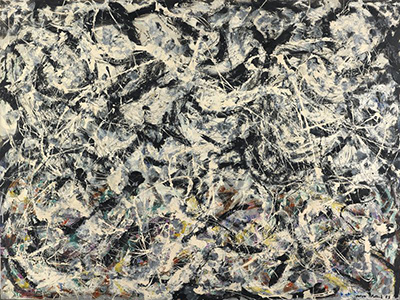
Jackson Pollock’s Greyed Rainbow brings heavy paint and wandering lines together on an expansive surface. Painted in 1953, it is oil on linen, 182.9 × 244.2 cm, in the Art Institute of Chicago. The museum describes black, white, grey and silver dominating a composition whose lower third contains thinly concealed orange, yellow, green, blue and violet. Paint applications range from thick tube-squeezed chunks to fine poured or squirted lines. Its title presumably refers to the partly hidden colours: the museum offers that explanation as a possibility, leaving the name suggestive. [1]
At a Glance
This work across Jackson Pollock’s career
The Flame
c.1934–38The She-Wolf
1943Mural
1943Alchemy
1947Number 1A, 1948
1948Blue Poles
1952The Deep
1953White Light
1954Contents
- Line with weight and movement
- Colour, light and the painted surface
- How much order is there?
- Different possibilities in 1953
- From the gallery to Chicago
Line with weight and movement
The Art Institute’s education guide describes a space animated by black and white coils, with lines winding into one another, contracting and opening out. It singles out broad black arabesques whose ends spread into fishtail shapes. These descriptions give the apparent tangle a vocabulary: a line can change direction, broaden at its termination, join the surrounding activity or pull away from it. Movement depends on differences within the network, as well as on the accumulation of marks. [2]
The guide compares the delicate colours emerging below to a rainbow showing through storm clouds. This is an evocative museum analogy, giving weatherlike language to the passage between obscurity and brightness. Its usefulness lies in the relationship it describes: colour comes into awareness through the surrounding black and white. The guide’s questions about focus and the movement of the eye also recognise how difficult it is to isolate one dominant incident. Attention has several possible routes through the painting. [2]
Colour, light and the painted surface
Bernice Rose’s account of Pollock’s colour offers a way to understand such divided impressions. In Jackson Pollock: Drawing into Painting, she describes colour working simultaneously as hue and tone. A colour can retain its distinct identity while participating in a broader sensation of brightness or darkness. She also connects Pollock’s spatial effects with reflected light, contrasts between colours and the intervals within a linear network. For Rose, the experience of space arises from relationships across the painting, including the viewer’s shifting perception. [3]
Applied as a general framework to Greyed Rainbow, this distinction helps explain how a predominantly grey impression can accommodate several hues. The palette’s identity and its overall effect operate at different levels. Rose further distinguishes visual space from space created by physical means: the thickness of a painted surface and the expansion or recession it suggests are related experiences. Her argument directs attention to the exchange between material paint and light, allowing the painting’s density and its atmospheric associations to be considered together. [3]
How much order is there?
Greyed Rainbow became a test case in a dispute about accident and organisation. William Rubin’s revised essay recounts Rudolf Arnheim’s argument that the many incidents resolve principally into an even texture, with their individual relationships losing significance. In Rubin’s account, Arnheim allowed the painter supervision over that result; his position was more considered than the familiar charge of indiscriminate paint throwing. Rubin nevertheless answered that the whole painting possesses a comprehensive order, integrating its apparent confusion into a structured experience. The disagreement concerns what becomes perceptible when individual marks are considered together. Pollock’s own discussion with William Wright adds the practical dimension: he explained that experience permitted substantial control over flowing paint, while describing only a general notion of the eventual result. Control, in this testimony, could develop through action. It did not require a fully pictured outcome before work began. [4]
Watch: Jackson Pollock
Choose a film about Pollock’s paintings and ways of working.
Different possibilities in 1953
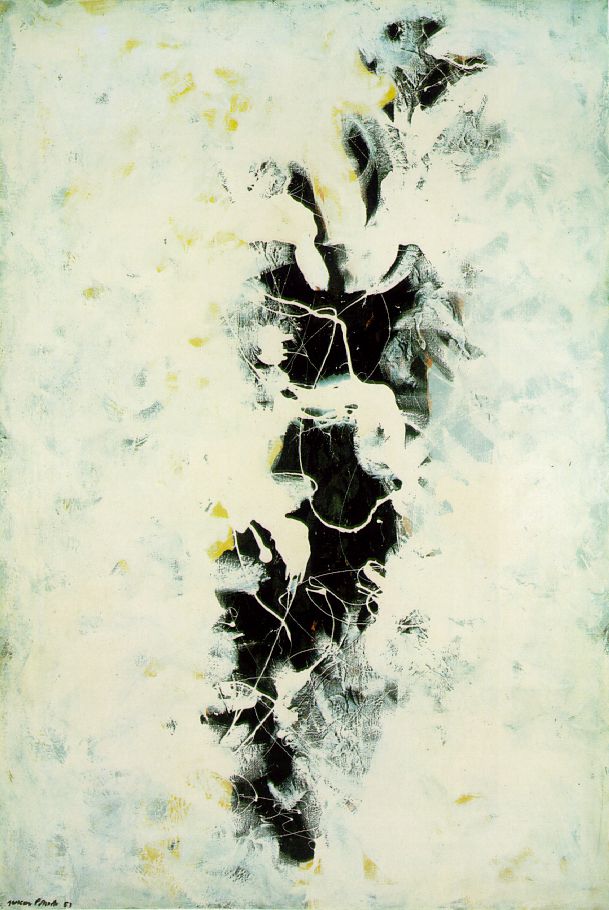
Kirk Varnedoe’s 1998 account places the paintings of 1953 amid strikingly different choices. He contrasts the brushwork of Ritual and Easter and the Totem with the combination of upright brush painting and pouring in Portrait and a Dream. His discussion of The Deep identifies another possibility, a dark opening framed by a congested foreground. These neighbouring works make the conjunction of weight and fluid line in Greyed Rainbow particularly meaningful. Pollock had several approaches available, and the works gathered under one year could explore different relationships between gesture, shape and space. [5]
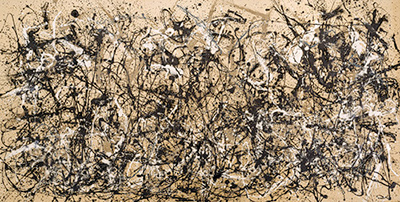
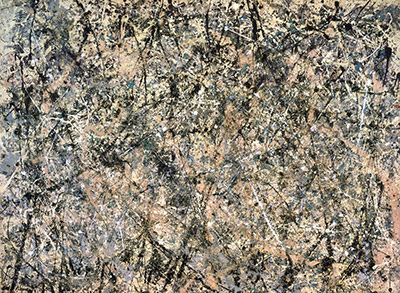
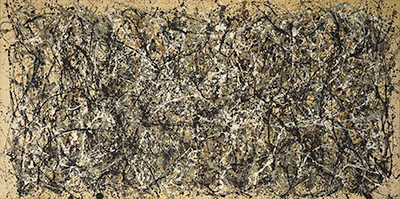
The comparison reaches back to the large paintings of 1950. Varnedoe describes the black-and-white armatures and earth colours of One and Autumn Rhythm, while later works again combine pouring and brushwork. Greyed Rainbow’s muted field and material variety place it within that continuing negotiation between colour, line and the physical action of paint. Each new painting could reconsider how these elements organise a surface. [5]
In his later essay “Open-Ended Conclusions about Jackson Pollock,” Varnedoe challenges the habit of making stylistic change follow the artist’s biography in a fixed sequence. He points to artistic and personal developments occurring out of step, and to strong differences between paintings made close together. This approach makes the calendar a starting point for comparison, while allowing each work its own pace and character. [6]
Varnedoe makes his case through a recurring contrast. He relates Birth and Stenographic Figure to Picasso and Matisse respectively, then finds that pairing again in Ritual and Easter and the Totem a decade later. Earlier artistic concerns could reappear in changed circumstances. For Greyed Rainbow, this opens a productive context for its mingling of dense paint and fluid line: the resources of different phases remained available for recombination. Its relationship to neighbouring paintings therefore involves the longer career, alongside the particular experiments brought together in 1953. [6]
From the gallery to Chicago
Francis V. O’Connor records Greyed Rainbow among ten paintings, all dated 1953, in Pollock’s Sidney Janis Gallery exhibition of 1–27 February 1954. The company included The Deep, Easter and the Totem and Ocean Greyness. The exhibition brought these divergent approaches before viewers together, making variety an immediate part of their public reception. [7]
O’Connor’s reprinted reviews preserve an unsettled response. Emily Genauer continued to reject the poured pictures but praised The Deep and Easter and the Totem. Robert Coates balanced reservations about repetition, chance and elaboration against admiration for Pollock’s authority and interest in his new directions. James Fitzsimmons welcomed the expanded range, especially Ocean Greyness and Sleeping Effort. Their selections differ, and Genauer’s praise of two paintings cannot be transferred to Greyed Rainbow. Together the reviews show critics negotiating a varied exhibition, measuring fresh possibilities against expectations already formed around Pollock’s earlier achievement. [7]
Chicago’s connection developed soon afterwards. The museum records Greyed Rainbow in its 61st American Exhibition, 21 October–5 December 1954, and its Society for Contemporary American Art exhibition, 27 April–30 May 1955. Sidney Janis Gallery sold it to the Art Institute in 1955; its credit names the Society’s gift. [1]
Pollock artworks directory
Explore the distinct works discussed in these guides. This selection is not a complete catalogue. Green Silver and Untitled, 1949 are two guides to the same painting.
Discussion
Look again at the images and ideas explored in Greyed Rainbow. These editorial prompts invite your observations.
Reader Insights
Which detail in “Line with weight and movement” changes how you understand this work?
What comparison comes to mind after “Colour, light and the painted surface”?
What would you like to discuss about “How much order is there?”?
Join the Conversation
Share a detail, comparison or question about Greyed Rainbow below.
References
- Art Institute of Chicago, “Greyed Rainbow,” 1953, accession 1955.494, object record: metadata, description, provenance and exhibition history. View source.
- Art Institute of Chicago, “Three Modern Artists,” Science, Art and Technology, updated 10 November 2004, Pollock section. View source.
- Bernice Rose, Jackson Pollock: Drawing into Painting (New York: Museum of Modern Art, 1980), pp. 17–19. View source.
- William Rubin, “Jackson Pollock and the Modern Tradition”, Artforum, February–May 1967, revised 1999, p. 137; Jackson Pollock, interview with William Wright, p. 22; both in Pepe Karmel, ed., Jackson Pollock: Interviews, Articles, and Reviews (New York: Museum of Modern Art, 1999). View source.
- Kirk Varnedoe, with Pepe Karmel, Jackson Pollock (New York: Museum of Modern Art, 1998), pp. 52, 65–67. View source.
- Kirk Varnedoe, “Open-Ended Conclusions about Jackson Pollock”, in Varnedoe and Pepe Karmel, eds., Jackson Pollock: New Approaches (New York: Museum of Modern Art, 1999), p. 237. View source.
- Francis V. O’Connor, Jackson Pollock (New York: Museum of Modern Art, 1967), pp. 69–70, including contemporary review extracts. View source.