 by Tom Gurney
Tom Gurney BSc (Hons) is an art history expert with over 20 years experience
Published on June 19, 2020 / Updated on October 30, 2026
Email: tomgurney1@gmail.com / Phone: +44 7429 011000
Guardians of the Secret: Introduction
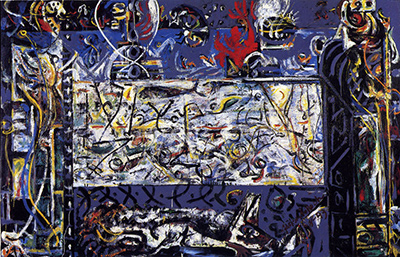
Jackson Pollock’s Guardians of the Secret (1943) belongs to SFMOMA: oil on canvas, 122.9 × 191.5 cm, acquired in 1945 for the Albert M. Bender Collection through the Albert M. Bender Bequest Fund. [1]
SFMOMA’s description suggests two tall guardians: a skull and bones at left, a masked or helmeted, robed figure at right. A doglike animal stretches beneath a white and yellow central field carrying dark marks. That field might resemble a scroll, tapestry or shroud. Above it, a shieldlike shape, possible scarab and possible rooster accompany further streaks. These tentative identifications give the scene inhabitants without supplying a fixed story. The arrangement offers something like a stage: figures flank an enigmatic centre, with an animal beneath. [1]
At a Glance
This work across Jackson Pollock’s career
The Flame
c.1934–38The She-Wolf
1943Mural
1943Alchemy
1947Number 1A, 1948
1948Blue Poles
1952The Deep
1953White Light
1954Contents
- A public arrival
- Building and revising the scene
- An ambitious painting, disputed
- Reading without a key
A public arrival
The painting emerged within a New York art world where European modernism and new American painting met in galleries and artists’ circles. The Musée national Picasso-Paris’s account of this period places Peggy Guggenheim’s Art of This Century at that intersection. Opened in autumn 1942, the gallery brought abstraction and Surrealism into adjoining spaces; Pollock exhibited there in spring 1943 before receiving a contract providing monthly income and a solo show later that year. The practical support matters alongside the exchange of ideas. It gave his experiments a public setting and more secure conditions for work. The museum’s account stresses the range of that first exhibition: symbolic figures appeared together with explorations of colour, paint and rhythmic line. Guardians belongs within this variety, at a moment when a recognisable figure and an experimental surface could occupy the same painting. [2]
Carolyn Lanchner brings Guardians together with The She-Wolf when discussing the ambition of the November 1943 exhibition. Her useful distinction is between the wish to make symbolic figures and the wish to create a compelling effect across the entire painted surface. Each puts demands on the other. A figure asks to be recognised; the marks also participate in the organisation of the canvas around it. This makes a productive starting point for Guardians: recognition is one experience among several, alongside the relationships of lines and areas of paint. The tension between deciphering the figures and experiencing the canvas as a whole gives these early works their particular difficulty and interest. [3]
Building and revising the scene
The surface records decisions as well as fluent movement. Conservator Carol C. Mancusi-Ungaro identifies brushmarked tube oil paint throughout Guardians. The direction of drips in its lower right indicates that Pollock worked with the canvas upright. She also describes a shinier, more fluid paint used to mask areas around forms, with a smooth finish suggesting an industrial material such as floor paint. This is a deduction from handling and appearance, not a reported chemical identification of every paint. The contrast of substances is integral to the process she describes: covering an area could help define the shape beside it. Her comparison with The She-Wolf shows masking as a shared concern, while allowing their initial applications to differ. In Guardians, a drip and a brushed boundary therefore offer different kinds of evidence about making. Both belong in an account of Pollock’s painting technique. [4]
Pepe Karmel’s comparison of a published 1943 studio photograph with the finished painting identifies substantial revisions. Heads in the upper zone were replaced; the left figure retained its linear structure but acquired stronger colours; a dark vertical bar separated it from the central field. He also reports Donald E. Gordon’s reading of stick figures in the central marks when the work is turned upside down. That proposal concerns how figures might be perceived, rather than disclosing a secret. Kirk Varnedoe, in the same catalogue, judged the painting weighed down by symbols and accumulated revisions. He described the dog’s shape as defined through overpainting the surrounding ground, contrasting the work’s density with Stenographic Figure. His adverse judgement is one critical response. Together these accounts direct attention to alteration, orientation and the power of surrounding paint to make a figure legible. [5]
Pollock’s own words help place improvisation within a larger artistic activity. In his February 1944 questionnaire for Arts and Architecture, he expressed particular interest in the unconscious as a source of art. In the same statement he considered craftsmanship essential. Those positions can coexist: an image may arise through an exploratory process and still require discrimination in its development. Lee Krasner made that point forcefully in her 1967 interview with Bruce Glaser. Asked about descriptions of Pollock working in an emotional outpouring with little awareness, she insisted on the painter’s intellect and accumulated experience. Her response invites us to take the revisions in Guardians seriously as painting decisions. The unconscious supplied a way of thinking about creativity; it did not relieve the artist of choices about the resulting work. [6]
Watch: Jackson Pollock
Choose a film about Pollock’s paintings and ways of working.
An ambitious painting, disputed
Francis V. O’Connor records Guardians in Pollock’s first solo exhibition, held at Art of This Century from 9 to 27 November 1943. The responses he reproduces reveal several measures of promise. James Johnson Sweeney’s catalogue introduction welcomed Pollock’s vitality and independence while calling for discipline. Clement Greenberg’s Nation review of 27 November treated the larger paintings as especially original and ambitious, yet found Guardians unresolved: its spatial tensions had not become a convincing whole. He preferred the greater concentration of the small Conflict and Wounded Animal. Robert Motherwell, writing in winter 1944, praised Pollock’s colour and surface, while locating the search for a subject within painting itself. Early support thus included reservations and competing expectations. The painting attracted attention because its ambition was conspicuous; what that ambition had achieved remained open to argument. These reviews make its first public life more interesting than a simple story of immediate acclaim. [7]
Reading without a key
The neighbouring example of The She-Wolf offers a useful limit to symbolic explanation. MoMA proposes a possible connection with the wolf who nursed Rome’s legendary founders, while preserving Pollock’s refusal to identify the creature specifically. In the statement reproduced by the museum, he warned that explaining that painting might damage what it accomplished. This concerns The She-Wolf, and cannot be transferred into a declaration about the intended subject of Guardians. It nevertheless helps distinguish an association available to a viewer from a definitive account supplied by the artist. A mythic reading can sharpen attention to an image while leaving room for the image to act in other ways. The two paintings invite this freedom differently: each has its own arrangement, marks and material history to sustain the encounter. [8]
On SFMOMA’s page, Jungian psychologist Kate Donohue responds to grounded guardians, layers and improvisation, comparing the experience to jazz. This is a modern interpretation. The narrator states that Pollock never explained the secret; Donohue’s response supplies no artist’s diagnosis or definitive decoding. [1]
SFMOMA’s educational activity offers a practical way into that openness. It asks viewers to consider shape, colour and line, and to weigh planning against chance through the evidence of the painting. Its questions about guardians and secrets ask for reasons: which element suggests protection, and what in the image supports that impression? Try following one line before deciding what it depicts. Consider the movement your hand would need to make, then return to the way the mark sits among its neighbours. Or begin with the arrangement of shapes and ask which seem deliberately placed. Such questions allow a first response to become more precise. The title can remain a prompt while attention moves between an imagined scene and the decisions embodied in paint. Looking becomes an exchange between what a form suggests and what its position, colour and line actually contribute. [9]
Pollock artworks directory
Explore the distinct works discussed in these guides. This selection is not a complete catalogue. Green Silver and Untitled, 1949 are two guides to the same painting.
Discussion
Look again at the images and ideas explored in Guardians of the Secret. These editorial prompts invite your observations.
Reader Insights
Which detail in “A public arrival” changes how you understand this work?
What comparison comes to mind after “Building and revising the scene”?
What would you like to discuss about “An ambitious painting, disputed”?
Join the Conversation
Share a detail, comparison or question about Guardians of the Secret below.
References
- SFMOMA. Guardians of the Secret, 1943, accession 45.1308. Object record and English transcripts: Kate Donohue interview and audio description. View source.
- Musée national Picasso-Paris. Jackson Pollock: Les premières années (1934–1947), Dossier documentaire, 2024, pp. 29–31, especially p. 31. View source.
- Carolyn Lanchner. Jackson Pollock. New York: The Museum of Modern Art, 2009. Published excerpt, opening of The She-Wolf, p. 13. View source.
- Carol C. Mancusi-Ungaro. “Jackson Pollock: Response as Dialogue,” in Jackson Pollock: New Approaches, edited by Kirk Varnedoe and Pepe Karmel. New York: The Museum of Modern Art, 1999, p. 119. View source.
- Kirk Varnedoe, with Pepe Karmel. Jackson Pollock. New York: The Museum of Modern Art, 1998. Varnedoe’s essay, p. 36; Karmel’s essay, pp. 127–129. View source.
- Jackson Pollock, “Jackson Pollock: A Questionnaire,” Arts and Architecture 61, no. 2 (February 1944), p. 14; Bruce Glaser, “Jackson Pollock: An Interview with Lee Krasner,” Arts Magazine 41, no. 6 (April 1967), pp. 36–39. Reprinted in Jackson Pollock: Interviews, Articles, and Reviews, edited by Pepe Karmel. New York: The Museum of Modern Art, 1999, pp. 15–16, 28. View source.
- Francis V. O’Connor. Jackson Pollock. New York: The Museum of Modern Art, 1967, pp. 29–31. Exhibition record and extracts from Sweeney, Greenberg and Motherwell. View source.
- The Museum of Modern Art. The She-Wolf, 1943, accession 82.1944. Gallery label, 2025, and MoMA Highlights excerpt, 1999, revised 2004. View source.
- SFMOMA. “Guardians of Your Secret”, May 2020. Introduction, looking questions and discussion. View source.