 by Tom Gurney
Tom Gurney BSc (Hons) is an art history expert with over 20 years experience
Published on June 19, 2020 / Updated on October 30, 2026
Email: tomgurney1@gmail.com / Phone: +44 7429 011000
Enchanted Forest: Introduction
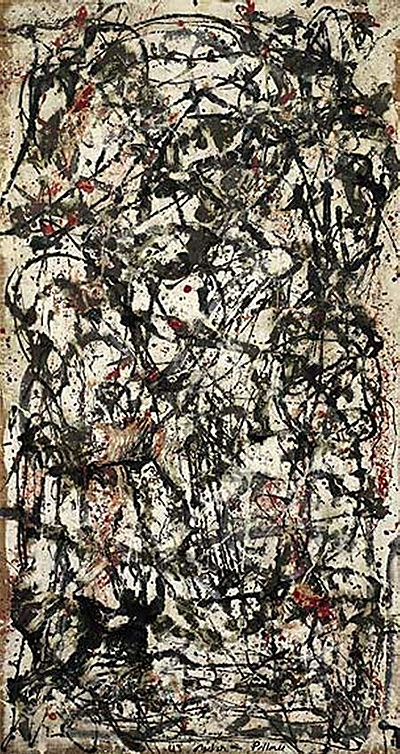
Jackson Pollock's Enchanted Forest of 1947 gives its moving lines room to breathe. The tall canvas belongs to the Peggy Guggenheim Collection in Venice, which records its medium as oil and alkyd enamel paint on canvas and its dimensions as 221.3 × 114.6 cm. [1]
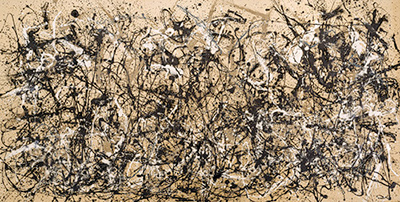
The museum draws a revealing comparison with Alchemy: here, larger white intervals open up the densely layered construction of that painting. Gold, black, red and white form a restrained palette. The lines gather momentum, ease back and resume, producing an uneven, intermittent rhythm. Following this account, looking becomes a movement between strands and intervals, without one commanding centre. A line no longer needs to outline a separate object; it can itself supply the painting's form. [1]
At a Glance
This work across Jackson Pollock’s career
The Flame
c.1934–38The She-Wolf
1943Mural
1943Alchemy
1947Number 1A, 1948
1948Blue Poles
1952The Deep
1953White Light
1954Contents
- Drawing becomes painting
- Painting through the fabric
- What the paint can tell us
- A painting that divided expectations
- Choice within the moving line
Drawing becomes painting
The importance of line reaches beyond the familiar distinction between a drawing on paper and a painting on canvas. In Jackson Pollock: Drawing into Painting, Bernice Rose argues that Pollock repeatedly brought the two practices together. Earlier works combined thickly worked colour with lines that organised figures and spaces; she describes areas around figures being painted in ways that could exchange the roles of figure and background. Her account makes the poured line a solution to a concrete pictorial problem: it could remain a recognisable linear mark while also producing a painted surface. [2]
That distinction rewards a slower approach to Enchanted Forest. In Rose's terms, drawing is doing the work of painting: the line carries movement and participates in the whole field. Her argument concerns Pollock's development across works, rather than a hidden design she claims to have discovered beneath this particular canvas. It offers a vocabulary for its openness without requiring the viewer to identify a figure behind every curve. [2]
Painting through the fabric
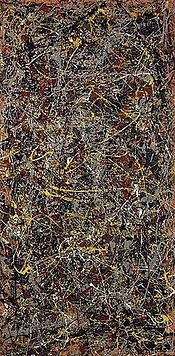
Conservator Carol C. Mancusi-Ungaro contrasts paint absorbed by Enchanted Forest's unprimed fabric with colour resting on Number 5's hard fibreboard. Tacking edges suggest that painting began on today's reverse. A conservator later added an unattached lining; a shadow of the original paint remains discernible through it. Evidently Pollock painted one side, turned the canvas, then responded to the bleed-through. Robert Storr attributes stains and bleeds to turpentine- or benzine-diluted washes. Mancusi-Ungaro relates the experiment to 1951 inks penetrating stacked thin Japanese papers before further modification—a later example of responding to transferred marks, not proof of a universal method. [3]
Pollock's own description of working helps explain why a transferred image could become an invitation to continue. In “My Painting,” published in Possibilities in winter 1947–48, he describes unstretched canvas tacked to a wall or laid on the floor, and the resistance supplied by a hard surface. Working below him let him approach from four sides and feel involved in the painting. He also describes an interval of becoming acquainted with what he had done, followed by a willingness to alter or destroy an image. Activity and reconsideration belong together in this account. It is a general statement of practice, not a diary of Enchanted Forest. Lee Krasner later recalled The Key occupying an upstairs bedroom floor before the barn became his studio, a reminder that floor working had a history before the celebrated studio photographs. Her recollection supplies that sequence without securely dating every move. [4]
Watch: Jackson Pollock
Choose a film about Pollock’s paintings and ways of working.
What the paint can tell us
The Peggy Guggenheim Collection's research programme of 2013–15 examined eleven paintings dated between 1942 and 1947. It identified both glossy and matt black alkyd paints in Enchanted Forest and Alchemy. Alkyd refers to the paint's binding material; a shiny surface by itself cannot establish that identity, especially when the identified paints include matt examples. The distinction matters when comparing a historical caption with a modern technical account. [5]
The same research identified alkyd in orange paint in Eyes in the Heat (1946), moving documented use earlier than the previously proposed 1947 threshold. The finding concerns a named colour and work. It deepens the history of experimentation around Enchanted Forest without turning every paint used by Pollock into a single commercial formula. [5]
The published study is more cautious about Untitled (1946), describing alkyd in its black and yellow paints as possible. For Enchanted Forest and Alchemy, strong absorption by black pigment left little reflected near-infrared light; identification required the mid-infrared range. Different paints could demand different analytical approaches within one investigation. [6]
The authors also suggest that cracking in Alchemy's thick surface might have encouraged Pollock to try a flatter painting. If so, Enchanted Forest would follow it; the proposed order and motivation remain hypotheses. Their conclusions also carry a sampling limit: tiny samples and individual measurement points cannot fully represent a whole painting. They propose hyperspectral imaging, which maps materials across larger areas, to improve that representation. [6]
A painting that divided expectations
Enchanted Forest appeared in Pollock's exhibition at the Betty Parsons Gallery, New York, from 5 to 23 January 1948. Francis V. O'Connor's catalogue records it among seventeen paintings, alongside Alchemy, Cathedral and Reflection of the Big Dipper. Reviewing the show on 17 January, Robert M. Coates found poetic suggestion in Enchanted Forest, although he considered Cathedral and Reflection of the Big Dipper unsuccessful eruptions of energy. His response distinguished between paintings made through related methods: abstraction did not produce one verdict even within a single review. [7]
O'Connor also lists Enchanted Forest in Tendances actuelles at the Kunsthalle Bern, 29 January–6 March 1955, with Alchemy, Eyes in the Heat, Croaking Movement and The Moon-Woman. That exhibition placed it within a longer span of Pollock's work. The varied company helps restore a history of individual paintings being selected, compared and judged, rather than a seamless passage from technical innovation to general approval. [7]
Choice within the moving line
Looking back in a 1998 interview with Terry Gross, curator Kirk Varnedoe resisted choosing a single breakthrough painting. He described a succession of experiments, including poured paint applied over existing compositions, before discussing the more fully poured works of 1947. He also emphasised Pollock's control: one mark prompted another, and subsequent layers could adjust, cover or correct what came before. His interpretation gives spontaneity a history inside the making of a picture. It does not require every accidental occurrence to be preserved. [8]
Varnedoe further stressed that pouring had to be reinvented at different scales, with a wrist movement and a sweeping arm movement calling for different decisions. For a viewer, this suggests attending to the character of individual lines instead of treating “dripping” as a complete explanation. The word identifies a family of actions; Varnedoe's account asks what Pollock achieved through their variations. In Enchanted Forest, that question remains open to the particular rhythm of this painting. [8]
In comparing Enchanted Forest with Lucifer, Kirk Varnedoe emphasised its broad looping rhythms, soaking washes and milky fullness. He contrasted this with Lucifer's more leisurely, directionless drift, emphasising how works of the same year could diverge. [3]
Pollock artworks directory
Explore the distinct works discussed in these guides. This selection is not a complete catalogue. Green Silver and Untitled, 1949 are two guides to the same painting.
Discussion
Look again at the images and ideas explored in Enchanted Forest. These editorial prompts invite your observations.
Reader Insights
Which detail in “Drawing becomes painting” changes how you understand this work?
What comparison comes to mind after “Painting through the fabric”?
What would you like to discuss about “What the paint can tell us”?
Join the Conversation
Share a detail, comparison or question about Enchanted Forest below.
References
- Peggy Guggenheim Collection, “Enchanted Forest, 1947”, collection record and accompanying essay. View source.
- Bernice Rose, Jackson Pollock: Drawing into Painting (New York: The Museum of Modern Art, 1980), pp. 8–9. View source.
- Carol C. Mancusi-Ungaro, “Jackson Pollock: Response as Dialogue,” p. 147; Robert Storr, “A Piece of the Action,” p. 59; Kirk Varnedoe, “Open-Ended Conclusions about Jackson Pollock,” p. 241, in Jackson Pollock: New Approaches, ed. Kirk Varnedoe and Pepe Karmel (MoMA, 1999). View source.
- Jackson Pollock, “My Painting,” Possibilities 1 (winter 1947–48), pp. 78–83; Lee Krasner, interview with Barbara Rose (1980), reprinted in Jackson Pollock: Interviews, Articles, and Reviews, ed. Pepe Karmel (MoMA, 1999), pp. 17–18, 40. View source.
- Peggy Guggenheim Collection, “New Paints for a New Way of Painting”, technical research account and interview with Costanza Miliani. View source.
- Francesca Rosi, Costanza Miliani, John Delaney, Kathryn Dooley, Lena Stringari, Grazina Subelyte and Luciano Pensabene Buemi, “Jackson Pollock's Drip Paintings: Tracing the Introduction of Alkyds Through Non-invasive Analysis of Mid-1940s Paintings”, in Science and Art: The Contemporary Painted Surface, ed. Antonio Sgamellotti, Brunetto Giovanni Brunetti and Costanza Miliani (Royal Society of Chemistry, 2020), pp. 7, 9, 13–16. View source.
- Francis V. O'Connor, Jackson Pollock (New York: The Museum of Modern Art, 1967), pp. 42–43, 71; includes Robert M. Coates's review, The New Yorker, 17 January 1948. View source.
- Kirk Varnedoe, interviewed by Terry Gross, “The Revolutionary Work of Painter Jackson Pollock”, Fresh Air, WHYY, 16 November 1998, transcript, discussions of process and breakthrough paintings. View source.