 by Tom Gurney
Tom Gurney BSc (Hons) is an art history expert with over 20 years experience
Published on June 19, 2020 / Updated on October 30, 2026
Email: tomgurney1@gmail.com / Phone: +44 7429 011000
Going West: Introduction
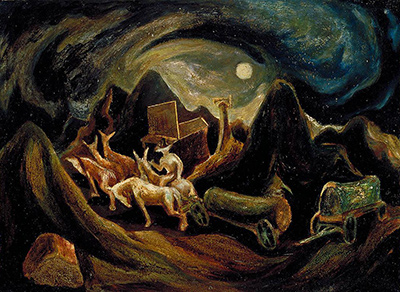
Jackson Pollock’s Going West is a small painting with a far-reaching title. The Smithsonian American Art Museum dates it to about 1934–1935 and identifies its medium as oil on fiberboard. At 38.3 × 52.7 centimetres, it invites an encounter quite different from that of a wall-sized canvas. Its presence in the museum also preserves a personal connection: Thomas Hart Benton, Pollock’s teacher, gave the work in 1973. The accession number is 1973.149.1. [1]
At a Glance
This work across Jackson Pollock’s career
The Flame
c.1934–38Going West (current article)
c.1934–35The She-Wolf
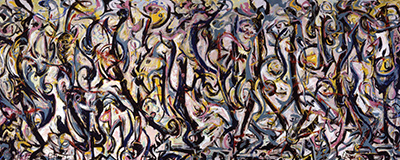
1943Mural
1943Alchemy
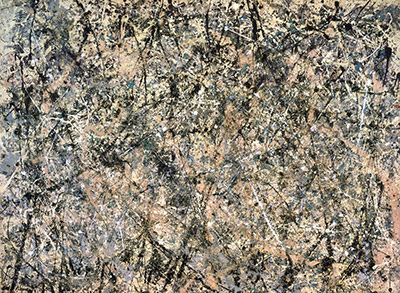
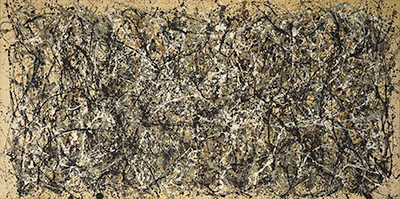
1947Number 1A, 1948
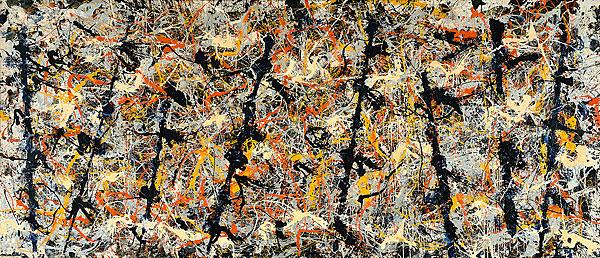
1948Blue Poles
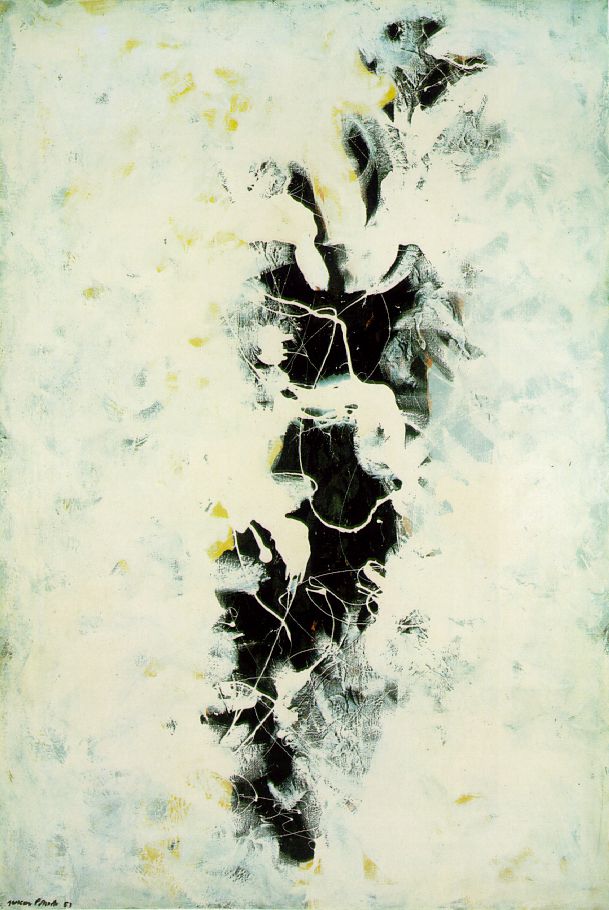
1952The Deep
1953White Light
1954Contents
- A journey after dark
- Travel and the lessons of Benton
- Light, atmosphere and later viewers
- From a teacher’s collection to museum display
A journey after dark
Columbia University’s teaching resource describes mules pulling two wagons along a road past an unsteady-looking general store. A full moon presides over the nocturnal landscape. In its account, the terrain owes something to Benton, while the atmosphere recalls Albert Pinkham Ryder. These two connections help distinguish the picture’s storytelling from its mood: recognisable travellers occupy a landscape organised through swirling movement. The resource also reads a human profile in the bright sky, looking towards the muleteer. The profile gives the sky a potential human presence; the resource offers a reading, without identifying a supernatural personage. [2]
The same account links the wagon motif to a family photograph of Cody. This is a reported connection, not proof that the painting records a particular place or that Pollock personally witnessed its journey. A remembered image and an invented setting can coexist. The reported photograph connection leaves the extent of autobiography open. [2]
Travel and the lessons of Benton
Travel nevertheless belonged to Pollock’s experience. Francis V. O’Connor’s chronology records his registration in Benton’s Art Students League class on 29 September 1930. The following summer he travelled towards California with fellow student Manuel Tolegian, intending to sketch along the way. His letter to his brother Charles describes hitchhiking, freight trains, hunger and encounters with people seeking work. He admitted that little drawing resulted. This is useful context for a young artist interested in travel and American subjects; the letter supplies no secure identification of the journey in Going West. [3]
Benton’s contribution was also practical. Kirk Varnedoe explains that his teaching reduced complex historical compositions to organising arcs, bars and figures. Students could study the distribution of movement and pauses before becoming absorbed in the story depicted. Varnedoe also connects Benton’s lessons in rhythm with movement and countermovement in bodies and natural forms. For a reader approaching Going West, that distinction makes influence more interesting than a resemblance between two artists’ landscapes. A teacher can shape how a painter arranges a picture as well as what he chooses to paint. [4]
Varnedoe also discusses Pollock’s later sketchbook studies after older masters, observing how he intensified particular forms within the material he copied. Those drawings belong to the later 1930s and cannot serve as preparatory studies for this earlier painting. They do, however, extend the account of an active education. The broader subject of Pollock’s drawings helps explain why his training deserves attention in its own right, without making every exercise a prediction of his famous paintings. [4]
Pollock gave a more combative retrospective account in his 1944 questionnaire for Arts and Architecture. He said that working with Benton had provided a strong position against which to react, while acknowledging his introduction to Renaissance art. Elsewhere in the same questionnaire, he singled out Ryder among American painters and rejected the idea that modern painting’s fundamental problems belonged exclusively to one country. These remarks record the thinking of the artist in 1944. They give no direct account of making Going West a decade earlier. [5]
Read alongside the picture, the questionnaire allows attachment and independence to remain part of the same relationship. Pollock could value what he had learned while defining a different direction. It would be misleading to make the western subject a permanent declaration of artistic nationalism when his later statement expressly questioned that position. His biography follows those changing commitments more fully. [5]
Watch: Jackson Pollock
Choose a film about Pollock’s paintings and ways of working.
Light, atmosphere and later viewers
The connection with Ryder also opens a question about light. Writing in 1980, Bernice Rose placed the atmospheric effects of Pollock’s mature painting within an American tradition that included Ryder and Winslow Homer. Her discussion concerned the spatial effects of colour and tonality, including paintings whose space could feel natural without describing an identifiable landscape. It was a formal interpretation of the later work, rather than a specific analysis of Going West. [6]
A later museum response shows how strongly expectations can affect the encounter. In his 2008 Smithsonian essay, Howard Kaplan described rediscovering Pollock through the museum’s early works. He recognised Benton’s influence in Going West and wondered how this painting related to the poured pictures through which he already knew the artist. His response is valuable as an account of looking back from familiarity towards surprise. It belongs to the painting’s modern reception, rather than to Pollock’s intentions. [7]
From a teacher’s collection to museum display
O’Connor’s 1967 catalogue already listed Going West in Benton’s collection in Kansas City. Its caption and exhibition entry provide a dated record of ownership before the Smithsonian gift. The catalogue’s description specifies a gesso ground on composition board. [3]
The museum’s current record gives oil on fiberboard: a simpler description than the one published in 1967. [1] [3]
The painting subsequently travelled as a museum loan. The checklist for Tokyo’s Jackson Pollock: A Centennial Retrospective, held from 10 February to 6 May 2012, lists it as exhibition number 6, with the Smithsonian as lender. It gives the approximate 1934–1935 date and the same metric dimensions. Its placement in the opening chapter, devoted to the artist finding his way between 1930 and 1941, made the early work part of the retrospective’s account from the outset. The checklist number identifies its place in that exhibition; it is distinct from the Smithsonian accession number. [8]
The Smithsonian later paired Benton and Pollock in Artist to Artist, organised by Melissa Ho and held from 1 October 2021 to 26 July 2026. The exhibition explored relationships through which artists supported and influenced one another. Its online gallery brought Going West together with Benton’s Wheat, dated 1967. The dates are essential to understanding the comparison: the much later Benton painting could not have been a model for Pollock’s early work. The pairing was a curatorial invitation to consider their relationship across time. [9]
The Smithsonian classifies the picture under subjects including night, mountains, mules and westward expansion. These terms offer a useful starting point for identifying its historical imagery. They do not settle its politics or make the travellers emblems of an unquestioned heroic destiny. The title invites a story about movement west; the museum’s subject categories leave its particular emotional and historical meaning open to discussion. [1]
Pollock artworks directory
Explore the distinct works discussed in these guides. This selection is not a complete catalogue. Green Silver and Untitled, 1949 are two guides to the same painting.
Discussion
Look again at the images and ideas explored in Going West. These editorial prompts invite your observations.
Reader Insights
Which detail in “A journey after dark” changes how you understand this work?
What comparison comes to mind after “Travel and the lessons of Benton”?
What would you like to discuss about “Light, atmosphere and later viewers”?
Join the Conversation
Share a detail, comparison or question about Going West below.
References
- Smithsonian American Art Museum, Going West, object 1973.149.1, current collection record, accessed 25 October 2026. View source.
- Columbia University, Department of Art History and Archaeology, Jackson Pollock, A Monograph: History and Context, paragraphs on Going West; bibliography credits Grove Dictionary of Art. View source.
- Francis V. O’Connor, Jackson Pollock (New York: The Museum of Modern Art, 1967), pp. 16, 82, 132, catalogue no. 4; PDF pp. 21, 87, 139. View source.
- Kirk Varnedoe, with Pepe Karmel, Jackson Pollock (New York: The Museum of Modern Art; distributed by Harry N. Abrams, 1998), pp. 23–25; PDF pp. 28–30. View source.
- Jackson Pollock, anonymous questionnaire, Arts and Architecture 61, no. 2 (February 1944), p. 14; reprinted in Pepe Karmel, ed., Jackson Pollock: Interviews, Articles, and Reviews (New York: The Museum of Modern Art; distributed by Harry N. Abrams, 1999), pp. 15–16; PDF pp. 19, 18. View source.
- Bernice Rose, Jackson Pollock: Drawing into Painting (New York: The Museum of Modern Art, 1980), p. 17; PDF p. 20. View source.
- Howard Kaplan, “Jackson and Me”, Smithsonian American Art Museum, 30 May 2008, concluding paragraphs on Going West. View source.
- National Museum of Modern Art, Tokyo, Jackson Pollock: A Centennial Retrospective, exhibition checklist, 10 February–6 May 2012, p. 1, no. 6. View source.
- Smithsonian American Art Museum, Artist to Artist, 1 October 2021–26 July 2026, introduction, description and online gallery entries for Wheat and Going West; organised by Melissa Ho. View source.