 by Tom Gurney
Tom Gurney BSc (Hons) is an art history expert with over 20 years experience
Published on June 19, 2020 / Updated on October 30, 2026
Email: tomgurney1@gmail.com / Phone: +44 7429 011000
Echo: Number 25, 1951: Introduction
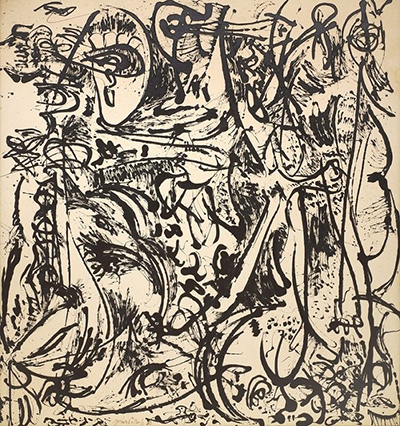
Jackson Pollock’s Echo: Number 25, 1951 makes black line carry an extraordinary amount of pictorial life. MoMA describes a measured, economical painting in which suggestions of figures reappear within abstraction. Its course text points to an eye in the upper-left corner: a useful place to begin, provided that a hint remains a hint. Recognition can be part of the experience without supplying a complete cast of characters. The museum contrasts the work’s delicacy and controlled pace with the multidirectional energy of One: Number 31, 1950. Echo is enamel paint on canvas, 233.4 × 218.4 cm, in the Museum of Modern Art, New York, accession 241.1969. It was acquired through the Lillie P. Bliss Bequest, by exchange, and the Mr. and Mrs. David Rockefeller Fund. The nearly square format gives this economical language a substantial physical presence. [1]
At a Glance
This work across Jackson Pollock’s career
The Flame
c.1934–38The She-Wolf
1943Mural
1943Alchemy
1947Number 1A, 1948
1948Blue Poles
1952The Deep
1953White Light
1954Contents
Figures in the line
Pollock knew that his new paintings would complicate expectations. Writing to Alfonso Ossorio and Ted Dragon on 7 June 1951, he described working in black on canvas while earlier images emerged again, and anticipated trouble for committed abstractionists and people who thought his work easy to imitate. Kirk Varnedoe reproduces the passage in his 1998 catalogue; the letter provides unusually direct evidence that Pollock recognized the change himself. Varnedoe also hears earlier rhythms in Echo, connecting it with Gothic and ink drawings of about 1946–47. Those comparisons make the change more interesting than a simple return to Picasso or an abandoned earlier style. The black paintings could bring older resources into a newly developed way of working. A familiar image vocabulary and an altered painted line could operate together, without making the result a repetition of an earlier painting. [2]
Bernice Rose offers another way to understand that combination. She compares Echo with Out of the Web, treating both as attempts to balance an encompassing field with recognizable figuration. In her account, the figure can appear and disappear within the same arrangement. The interest lies in that unstable relationship: making the figure more emphatic, or pushing further into abstraction, could dissolve the balance. This is a critical interpretation, rather than the discovery of one concealed subject. It gives the viewer a productive task. Follow a possible figure, then return to the whole field and consider what happened to it. A line that briefly seems descriptive can continue as part of a larger movement. Rose’s comparison allows recognition and uncertainty to remain active together; neither experience has to cancel the other. Her argument also places the painting’s figurative possibilities within Pollock’s ongoing problem of joining drawing to painting. [3]
Drawing with paint
Lee Krasner’s recollection helps explain the deliberateness behind this change. In her 1969 interview with B. H. Friedman, she rejected a shortage of coloured paint as its cause and described Pollock’s choice as conscious. Her account includes basting syringes, controlled flow and decisions about cutting and orienting canvas. She sometimes participated in the discussion, while the final decisions remained his. This is testimony about the group and its working practice, rather than a complete reconstruction of every mark in Echo. [4]
The painting has a particularly instructive material history. Conservator James Coddington reports some brushwork in Echo, with most paint poured or, more probably, applied with a baster capable of extended lines and larger discharges. He explicitly found no Rivit glue coating. [5]
Varnedoe’s 1998 catalogue had described a Rivit preparation, anticipating the forthcoming technical publication. That prepublication statement requires correction. [2]
Coddington’s published 1999 account suggests a possible mixture of oil paint and alkyd enamel to control spreading into the cloth. He also records occasional red swirls, interpreted as a possible mixture producing a warmer black. The mixture remains a suggestion. Unprimed means lacking a painted ground; unsized means lacking the separate preparation that can alter absorption. Krasner’s general account of sizing cannot establish a Rivit preparation for this particular object. [5]
Watch: Jackson Pollock
Choose a film about Pollock’s paintings and ways of working.
Exhibitions and changing responses
Echo belonged to a change that viewers encountered publicly at Betty Parsons Gallery. Francis V. O’Connor’s exhibition chronology places it in Pollock’s show of 26 November–15 December 1951, alongside paintings and works on paper from that year. The reviews he reprints register the impact of recognizable heads and bodies, and a different relation between drawing and painting. Howard Devree welcomed a greater suggestion of conscious organization; Fairfield Porter considered how black forms and surrounding spaces could exchange roles. These responses concern the exhibition, so they should not be treated as descriptions of Echo alone. They nevertheless show that the new direction was already being discussed through specific pictorial questions. Colour, figuration, breadth of line and the activity of the unpainted areas all became matters for argument. O’Connor also records Echo in the Sidney Janis Gallery survey of 28 November–31 December 1955, placing it within a longer account of Pollock’s development. [6]
The Parsons exhibition also reached readers through printmaking. MoMA’s six-screenprint portfolio of 1951 was based on paintings in that show, with minor changes and a reduction to about one-quarter scale. Tony Smith suggested the project, which Pollock carried out with his brother Sanford McCoy, a professional screenprinter. MoMA records an edition of twenty-five. This gives the black paintings a further context: their forms could be translated into a repeatable printed medium as well as encountered on canvas. It does not establish that Echo supplied one of the six images. The portfolio belongs to the history of the exhibition and Pollock’s prints, with its own scale, materials and publication history. [7]
At the 1955 Janis exhibition, Leo Steinberg singled out Echo as especially compelling. His review describes black tendrils appearing to draw the ground with them into a changing, moulded space. He contrasted that experience with the obstructed density he found in White Light. His praise coexisted with broader reservations about Pollock. [4]
MoMA purchased Echo in 1969 as its collection developed a fuller representation of Pollock’s career. The painting gave the museum a major example of the 1951 black pourings. [5]
The surrounding career continued to change. Tate’s account points to the bright colours reintroduced in Yellow Islands and Number 8, 1952, while the tension between abstraction and representation persisted. The black paintings consequently occupy a specific place within a varied later practice. Looking outward from Echo to those works makes its restriction of colour easier to understand as an available artistic decision. It also keeps the painting’s concentrated language distinct: one response to the possibilities of line, among further experiments that could reopen the palette and change the relationship again. [8]
Pollock artworks directory
Explore the distinct works discussed in these guides. This selection is not a complete catalogue. Green Silver and Untitled, 1949 are two guides to the same painting.
Discussion
Look again at the images and ideas explored in Echo: Number 25, 1951. These editorial prompts invite your observations.
Reader Insights
Which detail in “Figures in the line” changes how you understand this work?
What comparison comes to mind after “Drawing with paint”?
What would you like to discuss about “Exhibitions and changing responses”?
Join the Conversation
Share a detail, comparison or question about Echo: Number 25, 1951 below.
References
- The Museum of Modern Art. Echo: Number 25, 1951, 241.1969. Object record, gallery labels and 2017 course text. View source.
- Kirk Varnedoe, with Pepe Karmel. Jackson Pollock. MoMA, 1998, pp. 63–64; notes 177 and 181, p. 84. Letter quoted through this catalogue. View source.
- Bernice Rose. Jackson Pollock: Drawing into Painting. MoMA, 1980, p. 10. View source.
- B. H. Friedman, “An Interview with Lee Krasner Pollock,” Jackson Pollock: Black and White (Marlborough-Gerson Gallery, 1969), pp. 7–10, reprinted pp. 35–38; Leo Steinberg, “Month in Review: Fifteen Years of Jackson Pollock,” Arts 30, no. 3 (December 1955), pp. 43–44, 46, reprinted pp. 81–83. In Pepe Karmel, ed., Jackson Pollock: Interviews, Articles, and Reviews. MoMA, 1999. View source.
- James Coddington, “No Chaos Damn It,” pp. 110–111; Kirk Varnedoe and Pepe Karmel, introduction, p. 12. In Varnedoe and Karmel, eds., Jackson Pollock: New Approaches. MoMA, 1999. View source.
- Francis V. O’Connor. Jackson Pollock. MoMA, 1967, pp. 61–62, 72, exhibition chronology and reprinted reviews. View source.
- The Museum of Modern Art. Untitled, 1951, portfolio 1188.1969.1–6. Object record and 2015–16 gallery label. View source.
- Tate. Jackson Pollock Black Paintings (portfolio). Curatorial description, paragraphs on the 1951–52 paintings. View source.