 by Tom Gurney
Tom Gurney BSc (Hons) is an art history expert with over 20 years experience
Published on June 19, 2020 / Updated on October 30, 2026
Email: tomgurney1@gmail.com / Phone: +44 7429 011000
The Tea Cup by Jackson Pollock: Introduction
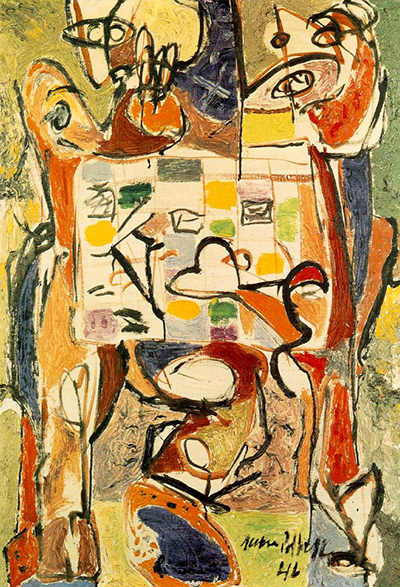
The Tea Cup belongs to Jackson Pollock’s Accabonac Creek series of 1946. Painted in oil on canvas, it measures 101.6 × 71.1 cm, or 40 × 28 inches: an upright picture a little over a metre high. The Museum of Modern Art’s 1998 catalogue identifies it as OT 150 and records the Frieder Burda collection. That caption also establishes the work’s title, The Tea Cup, with the series name supplied in parentheses. The collection credit is a separate part of the painting’s history. [1]
At a Glance
This work across Jackson Pollock’s career
The Flame
c.1934–38The She-Wolf
1943Mural
1943Alchemy
1947Number 1A, 1948
1948Blue Poles
1952The Deep
1953White Light
1954Contents
- Figures around an uncertain centre
- Two series in one exhibition
- Painting before and alongside the pours
- A later view from Basel
Figures around an uncertain centre
The title offers a familiar object, but the composition has prompted more than one account of what its figures are doing. Pepe Karmel places The Tea Cup within a recurring theatrical arrangement in Pollock’s paintings: figures flank an opening, like flats framing a stage. He connects it with Guardians of the Secret, Pasiphaë and The Key. Elsewhere he describes its two figures as positioned around a game board, comparing them with a chess scene by the painter Hans Moller. That gives the central encounter a different emphasis from the one suggested by the cup in the title. [2]
A useful way into this uncertainty comes from Bernice Rose’s account of Pollock’s drawing and painting. She describes a tension in his work of the 1940s between lines that define figures and paint that insists on its own surface. The areas around a figure can become as active as the figure itself, exchanging the usual roles of object and background. Her argument helps explain why identifying a person or a table need not settle the experience of a picture. A contour can describe something while also joining a rhythm that travels beyond it. Applied as a general framework to The Tea Cup, this directs attention to relationships: between the two sides, between a surrounding area and a bounded shape, between a recognisable encounter and the painted marks that sustain it. Rose’s discussion concerns the changing organisation of Pollock’s art; it supplies no fixed dictionary of meanings for the objects in this particular painting. [3]
Markus Klammer and Stefan Neuner offer another possibility in their essay for the 2016 Basel catalogue Der figurative Pollock. They suggest that a viewer might see a garden tea party in The Tea Cup. Their phrasing leaves the identification open. It appears within a comparison between the Accabonac Creek paintings and the other group Pollock exhibited alongside them, Sounds in the Grass. In their reading, the latter group evokes a nature that confronts the viewer, rather than providing a pastoral setting for people gathered together. The possible tea party is therefore a counterpoint in a larger argument about the relation of figures to their surroundings. It is an invitation to consider how the series differ, with no claim to recover a documented afternoon in Pollock’s household. Holding that possibility open allows the painting’s ordinary title and its elusive subject to remain in conversation. [4]
Two series in one exhibition
The distinction between those groups was part of the painting’s early public life. Francis V. O’Connor’s exhibition record places The Tea Cup in Pollock’s fourth solo show at Peggy Guggenheim’s Art of This Century, New York, from 14 January to 1 February 1947. Sixteen paintings were shown. Eight belonged to Accabonac Creek, including The Water Bull, Yellow Triangle and The Key; seven belonged to Sounds in the Grass, including Eyes in the Heat and Shimmering Substance. Guggenheim’s Mural completed the exhibition. The catalogue note by W. N. M. Davis praised Pollock’s continuing strength and encouraged repeated viewing. Davis also detected a brighter mood across the show. His response belongs to the exhibition as a whole: it helps recover the hopeful reception surrounding these pictures without assigning every one of them an identical mood or subject. [5]
The series name also carries a local connection. Pollock and Lee Krasner moved to the Springs farmhouse on Long Island in November 1945, and its backyard looked towards Accabonac Creek. The 1998 chronology places the Accabonac group in the upstairs working period before Pollock began using the barn studio. The landscape name thus locates a period of work as well as a place. [1]
Watch: Jackson Pollock
Choose a film about Pollock’s paintings and ways of working.
Painting before and alongside the pours
How the canvas was positioned deserves care. Fondation Beyeler’s 2008 Action Painting text calls The Tea Cup a still figurative work painted on an easel, identifying it with Pollock’s first series after the move to Long Island. This is the institution’s historical account, rather than a published technical examination of the canvas. It provides a useful caution against imagining every Pollock as paint poured onto a floor. An exhibition devoted to action painting could make room for this earlier picture because changes in his practice involved several kinds of painting. Beyeler’s account also points to partial pouring experiments before 1946 and to the survival of figuration within later abstraction. Its presentation makes The Tea Cup part of a wider field of experiments. Its place in this exhibition brings the surviving figures into the history of his changing methods. [6]
Pollock’s own statement “My Painting,” published in Possibilities in winter 1947–48, describes a similarly broad range of activity. He writes of attaching unstretched canvas to a wall or floor and needing the resistance of a hard surface. His tools include sticks, knives and trowels, while his materials range from fluid paint to heavy impasto. He also allows for a period of recognising what has happened in a painting and for making changes afterwards. These details matter because they give his method both physical variety and time for reconsideration. They offer a language for understanding the experiments surrounding The Tea Cup, while leaving its particular working procedure open. The statement can accompany an encounter with the painting without turning the canvas into an illustration of every method Pollock lists. [7]
Karmel notes that The Tea Cup was among the earlier paintings reproduced with that statement, although Pollock’s poured work was already underway. Its appearance in Possibilities kept these figurative experiments in circulation alongside the newer paintings. Readers encountered an overlapping practice, with earlier work helping to represent the artist’s present concerns. [2]
A later view from Basel
That overlap remained productive decades later. Alice Henkes’s review of Der figurative Pollock at the Kunstmuseum Basel, published by SRF on 3 October 2016, introduces the less familiar figurative painter through the exhibition’s expressive forms and connections with Klee, Miró and Picasso. Nina Zimmer’s exhibition brought together about a hundred works from collections across several continents and ran from 2 October 2016 to 22 January 2017. Henkes finds the figurative pictures closer in character to the famous poured paintings than their different methods might initially suggest. Her account treats their shared force as a reason to look across the usual division in Pollock’s career. The review’s caption identifies The Tea Cup, 1946, with Museum Frieder Burda, Baden-Baden, adding a later historical collection record to the 1998 catalogue credit. For this painting, the Basel perspective gives the unresolved encounter around its centre a place within Pollock’s continuing exploration of figures and paint. [8]
Pollock artworks directory
Explore the distinct works discussed in these guides. This selection is not a complete catalogue. Green Silver and Untitled, 1949 are two guides to the same painting.
Discussion
Look again at the images and ideas explored in The Tea Cup by Jackson Pollock. These editorial prompts invite your observations.
Reader Insights
Which detail in “Figures around an uncertain centre” changes how you understand this work?
What comparison comes to mind after “Two series in one exhibition”?
What would you like to discuss about “Painting before and alongside the pours”?
Join the Conversation
Share a detail, comparison or question about The Tea Cup by Jackson Pollock below.
References
- Kirk Varnedoe with Pepe Karmel, Jackson Pollock. New York: The Museum of Modern Art, 1998, plate 107, p. 211; Elizabeth Levine and Anna Indych, “Chronology,” pp. 321–322. View source.
- Pepe Karmel, “A Sum of Destructions,” in Jackson Pollock: New Approaches, edited by Kirk Varnedoe and Pepe Karmel. New York: The Museum of Modern Art, 1999, pp. 80, 86–87 and 98, note 56. View source.
- Bernice Rose, Jackson Pollock: Drawing into Painting. New York: The Museum of Modern Art, 1980, p. 8. View source.
- Markus Klammer and Stefan Neuner, “Bildfeld und Blickfeld: Figurationen der Abstraktion bei Jackson Pollock”, in Der figurative Pollock, edited by Nina Zimmer. Kunstmuseum Basel; Munich: Prestel, 2016, pp. 48–49, author repository excerpt. View source.
- Francis V. O’Connor, Jackson Pollock. New York: The Museum of Modern Art, 1967, pp. 40–41, exhibition roster and Davis catalogue note. View source.
- Fondation Beyeler, Action Painting: Saaltexte, “Jackson Pollock”, 2008, PDF p. 2, rooms 17–18; also published as the exhibition website’s Pollock section. View source.
- Jackson Pollock, “My Painting,” Possibilities 1 (winter 1947–48), pp. 78–83; reprinted in Jackson Pollock: Interviews, Articles, and Reviews, edited by Pepe Karmel. New York: The Museum of Modern Art, 1999, pp. 17–18. View source.
- Alice Henkes, “Basel im Zeichen der US-amerikanischen Kunst”, SRF, 3 October 2016, Pollock review and The Tea Cup caption. View source.