 by Tom Gurney
Tom Gurney BSc (Hons) is an art history expert with over 20 years experience
Published on June 19, 2020 / Updated on October 30, 2026
Email: tomgurney1@gmail.com / Phone: +44 7429 011000
White Light: Introduction
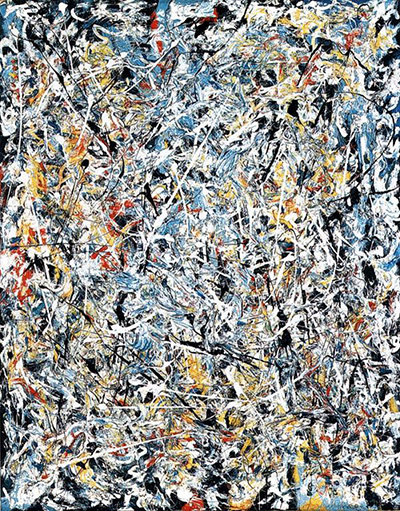
Jackson Pollock's White Light brings the physical thickness of paint into unusually close conversation with the brightness promised by its title. Made in 1954, it belongs to the Museum of Modern Art in New York, where it is catalogued as oil, enamel and aluminum paint on canvas, measuring 122.4 × 96.9 centimetres. MoMA describes it as one of his last paintings and the only one he completed that year. That careful distinction matters: an exceptional late work need not be turned into a final artistic testament. [1]
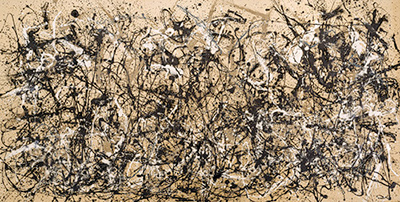
The exhibition record supplies a useful corrective. Francis V. O'Connor's chronology lists both White Light and Search in the Sidney Janis Gallery retrospective held from 28 November to 31 December 1955. The show brought together sixteen paintings under the title 15 Years of Jackson Pollock. Its selection also included The Key, Eyes in the Heat, Autumn Rhythm and Echo. Encountering White Light within that range would have meant seeing it among several different ways Pollock had organised paint, space and imagery. The roster helps restore that varied public setting to a picture too easily isolated as an ending. A retrospective could make the differences between these surfaces as revealing as any apparent continuity. [2]
At a Glance
This work across Jackson Pollock’s career
The Flame
c.1934–38The She-Wolf
1943Mural
1943Alchemy
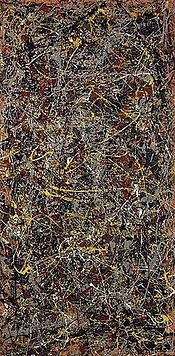
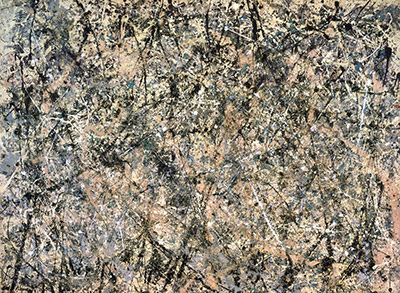
1947Number 1A, 1948
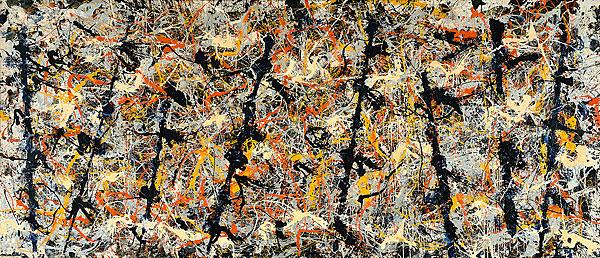
1948Blue Poles
1952The Deep
1953Contents
- Paint that stands up
- Earlier surfaces, different problems
- Weight and reflected light
- A demanding late painting
Paint that stands up
MoMA's account identifies two complementary kinds of work. Pollock squeezed paint through tube nozzles and through holes punctured in the tube sides, building raised black and white strands in the upper layers. He also brushed sections while the paint remained wet, pulling and smearing it into marbled passages. The surface therefore records both extrusion and subsequent manipulation. Its sculptural strands and mingled wet colours invite attention to the difference between depositing paint and changing paint already deposited. [1]
Conservator James Coddington makes a further distinction between the familiarity of a gesture and the particular behaviour of its material. In White Light, glossy white tube squeezes resemble applications in earlier paintings, yet their smoothness differs from stiffer brushed oil elsewhere. Analysis identified this glossy white as oil paint which appears to contain added damar varnish. Its manufacture remains unresolved: an unusual commercial formula, Pollock's own mixture or a preparation made for him. This finding does not establish an acrylic medium. He also groups White Light with Ocean Greyness and Scent as examples of overt premixing for heavy impasto passages. Familiar tools could produce materially different results. [3]
Earlier surfaces, different problems
A useful earlier companion is Shimmering Substance, painted in 1946. MoMA describes paint squeezed directly onto that canvas and then worked into open loops with a palette knife, or possibly a finger. The uncertainty about the second tool belongs in the account: the museum offers alternatives rather than a witnessed sequence. It places the painting among the seven Sounds in the Grass canvases and stresses their lighter palette. This gives tube application a history within Pollock's practice before the paintings for which pouring became his signature. It also suggests a practical way to compare the two works: follow what happens after the paint leaves its container. A tube can supply a line, a lump or material for further spreading; the tool alone does not determine the finished effect. [4]
Full Fathom Five offers another specific comparison. MoMA describes its brushed and palette-knifed underlayer, embedded objects and poured upper skeins. Its account traces a move from easel to floor during the making of this 1947 canvas. The density of the surface thus combines several kinds of material activity, including the incorporation of everyday debris. For a reader of White Light, this is a useful reminder that Pollock's layered surfaces can have quite different physical constructions. In Full Fathom Five, nails, cigarette ends, coins and a key contribute a layer of ordinary objects as well as paint. Its lower worked surface and upper poured lines also preserve distinct kinds of touch and movement. The comparison directs attention towards how density is built: an apparently continuous surface can bring together materials that retain quite different histories. [5]
In his 1998 Pollock essay, Kirk Varnedoe compared White Light with Full Fathom Five, connecting their congestion and some of their compositional devices. Alongside them, he described Scent, dated approximately 1953–55, as returning to the territory of Eyes in the Heat. These are different connections to earlier work, not a single backward movement shared by every late canvas. Read as a critical comparison, his account makes the late paintings more individual: each can reopen a different problem in Pollock's earlier practice. It also places White Light within a chronology that extends beyond 1954. The catalogue also dates Search to 1955. Together, these dates are a further reason to resist the familiar assertion that White Light was Pollock's last painting, or that everything he attempted afterwards remained unfinished. [6]
Watch: Jackson Pollock
Choose a film about Pollock’s paintings and ways of working.
Weight and reflected light
Bernice Rose approached these connections through the problem of light. In Jackson Pollock: Drawing into Painting, she linked Shimmering Substance, White Light and Scent within a continuing interest in shimmer and optical pulsation. Her account considers reflective materials, the interaction of lines with their grounds and the activation of the space around a painting. This is a critical framework for thinking about perception, rather than a chemical description of every work she names. It encourages us to keep two experiences in view: paint has physical weight and thickness, while colour, reflection and closely interacting marks can make a surface seem mobile. The title White Light becomes useful within that discussion without having to supply a fixed symbolic message. Rose's reading offers a question to bring to the work—how a tangible paint surface generates an unstable sensation of light—rather than a code that assigns each colour a particular emotion. [7]
A demanding late painting
The thick surface also provoked resistance. Reviewing the 1955 Janis exhibition, Leo Steinberg found White Light laboured and obstructed, describing dense pigment as if it were frustrating the emergence of an image beneath. His response is valuable as an encounter with the painting at the time, including the difficulty he experienced before it. It remains his critical judgment, rather than proof that the artist's powers had simply failed. In the same review Steinberg singled out Echo as the exhibition's most hypnotic picture, revealing how differently he responded to individual works. His designation of White Light as the last painting is outdated. The review preserves an argument about the surface; its chronological claim should not govern the painting's history. [8]
White Light entered MoMA with Free Form in Sidney and Harriet Janis's 1967 gift. Varnedoe and Pepe Karmel place that gift within the development of a fuller career collection, distinguishing it from the museum's purchase of One the following year. [3]
Pollock artworks directory
Explore the distinct works discussed in these guides. This selection is not a complete catalogue. Green Silver and Untitled, 1949 are two guides to the same painting.
Discussion
Look again at the images and ideas explored in White Light. These editorial prompts invite your observations.
Reader Insights
Which detail in “Paint that stands up” changes how you understand this work?
What comparison comes to mind after “Earlier surfaces, different problems”?
What would you like to discuss about “Weight and reflected light”?
Join the Conversation
Share a detail, comparison or question about White Light below.
References
- The Museum of Modern Art, White Light, 1954, object 337.1967; collection record, 2015–16 gallery label and 2017 course text. View source.
- Francis V. O'Connor, Jackson Pollock (New York: The Museum of Modern Art, 1967), p. 72, 1955 exhibition chronology. View source.
- James Coddington, “No Chaos Damn It,” pp. 111–12; Kirk Varnedoe and Pepe Karmel, introduction, p. 12, in Jackson Pollock: New Approaches (New York: The Museum of Modern Art, 1999). View source.
- The Museum of Modern Art, Shimmering Substance, 1946, collection record and 2015–16 gallery label. View source.
- The Museum of Modern Art, Full Fathom Five, 1947, collection record, 2010–11 gallery label and 2017 course text. View source.
- Kirk Varnedoe, Jackson Pollock, with Pepe Karmel (New York: The Museum of Modern Art, 1998), p. 66 and plate 225 (PDF p. 336). View source.
- Bernice Rose, Jackson Pollock: Drawing into Painting (New York: The Museum of Modern Art, 1980), p. 18. View source.
- Leo Steinberg, “Month in Review: Fifteen Years of Jackson Pollock,” Arts 30, no. 3 (December 1955), pp. 43–44, 46; reprinted in Pepe Karmel, ed., Jackson Pollock: Interviews, Articles, and Reviews (New York: The Museum of Modern Art, 1999), pp. 81–83. View source.