 by Tom Gurney
Tom Gurney BSc (Hons) is an art history expert with over 20 years experience
Published on June 19, 2020 / Page Updated on November 6, 2026
Email: tomgurney1@gmail.com / Phone: +44 7429 011000
Introduction
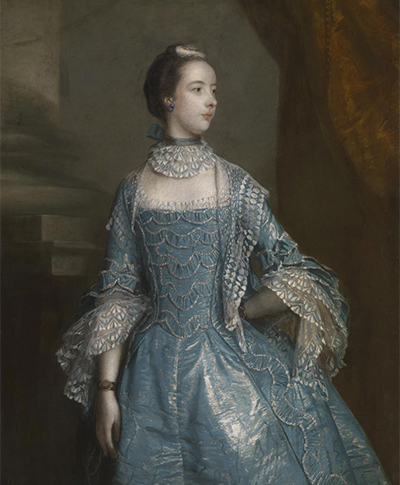
Sir Joshua Reynolds’s Suzanna Beckford is a portrait of glittering control. Painted in 1756, when Reynolds was still consolidating his London reputation, it presents Susannah Love, newly Mrs Francis Beckford, as a woman whose rank is carried through fabric, posture and composure as much as through likeness. The painting is recorded in Tate/National Gallery history as N05799 / NG5799, with the sitter identified as Susannah Love and the work dated 1756.[1] A second structured portrait listing confirms the same core identity: Reynolds, Suzanna Beckford, 1756, linked to Tate and to the Art UK record for the work.[2]
The first impression is not intimacy but magnificence. Susannah stands in blue, silver and lace, the colour and surface of her dress flooding the picture. Her face is alert but relatively restrained; the great labour of the image lies in the gown, the ruffles, the shining silk, the straightened arm and the turn of the body. Reynolds is not merely recording a fashionable sitter. He is testing how a newly married woman, an heiress and a member of the Beckford world could be made to inhabit a grand pictorial language usually associated with aristocratic male command.
At a Glance
- Route titleSuzanna Beckford
- Controlled sitterSusannah Love, Mrs Francis Beckford [1]
- ArtistJoshua Reynolds
- Date1756 [1]
- MediumOil on canvas [1]
- CollectionTate / National Gallery historic relationship [1]
- AccessionN05799 / NG5799 [1]
- MarriageFrancis Beckford, February 1755 [4]
- DressBlue-and-silver moiré with silk lace [3]
- Pose sourceVan Dyck’s Lord Russell via Mannings [5]
Contents
- Introduction
- The portrait and its sitter
- Dress as display
- Marriage, inheritance and the Beckford world
- Van Dyck and the hand-on-hip pose
- Studio labour and the making of splendour
- Fashion, gender and command
- Why Suzanna Beckford matters
The portrait and its sitter
The sitter was born Susannah Love, daughter of Richard Love of Basing Park, and became Mrs Francis Beckford after her marriage in 1755. Tate-label-derived material preserved in a later museum-visit record states that Reynolds began work in December 1755 and that the painting is signed and dated 1756.[4] That timing matters. The portrait belongs to the immediate aftermath of the marriage, when Susannah’s public identity was being remade through name, fortune and alliance. The painting can therefore be read as a marriage portrait, probably conceived with a companion image of Francis Beckford, though the pairing should be treated as probable rather than absolutely documented.[4]
The name in the title, Suzanna Beckford, is a familiar public form rather than a precise birth-name formula. The controlled identity is Susannah Love, Mrs Francis Beckford. That distinction is useful because the portrait depends on transition: from Love to Beckford, from inheritance to marital status, from private person to visible participant in a powerful family network. Reynolds places her in that transition without turning her into a passive emblem. Her body is upright, the left arm set sharply at the waist, the gaze direct but cool. Even before the dress is read in detail, the figure claims space.
The painting is also early Reynolds at a decisive moment. He had returned from Italy a few years earlier and was building the kind of portrait practice that would soon dominate British elite image-making. In Suzanna Beckford, the ambition is already apparent. The likeness is not isolated from art history; it is lifted by quotation, costume and pose. Reynolds is making a modern marriage portrait behave like a grand old-master image, which is why this work feels more forceful than a simple record of fashionable appearance.
That early date gives the picture additional value within Reynolds’s career. It precedes the formal authority of the Royal Academy presidency and the later theoretical confidence of the Discourses, yet it already shows the habits that would define him: a willingness to borrow from admired predecessors, a belief that portraiture could be raised by historical association, and a sharp understanding of what patrons wanted from pictorial grandeur. Susannah’s portrait is not a tentative experiment. It is a young London painter’s declaration that social portraiture could carry old-master memory, fashionable immediacy and dynastic ambition in one polished image.
Dress as display
The costume is the portrait’s most conspicuous language. The fashion-history record identifies Susannah’s dress as a blue-and-silver moiré gown and petticoat, enriched with blue-and-blonde silk bobbin lace, a ruff, a triangular shawl or handkerchief, and triple-layered “weeping ruffles,” probably French.[3] The description helps explain why the image seems to shimmer even in reproduction: Reynolds built the sitter’s social presence out of light-catching surfaces. The gown does not merely clothe her. It becomes a theatre of wealth, taste and disciplined posture.
Mid-eighteenth-century elite women’s dress required structure. Foundation garments shaped the torso; fashionable gowns controlled the body’s width and movement; lace and ribbons signalled refinement through minute workmanship. In Susannah’s portrait, those pressures are made visible as splendour. The blue and silver operate almost architecturally, holding the figure forward against the darker background. The sleeve and ruffle at the extended arm become a kind of ornamental hinge, where bodily gesture and fabric display meet.
A Tate-label-derived account describes an open à la française dress with turquoise-blue colour, silver silk trimming and fine lace at collar, mantle, shoulders and sleeves.[4] It also notes the unpowdered dark hair decorated with ribbon and feather, the clip-on earrings and two black silk bracelets holding miniature portraits whose identities are not known.[4] These details matter because they show the portrait balancing public display with smaller tokens of attachment. The bracelets draw attention to relationship and possession, but the figures within them remain unidentified. Reynolds lets them enrich the sitter’s social aura without turning them into a simple explanatory key.
The face is comparatively quiet because the clothing is doing so much work. That does not mean Susannah is swallowed by costume. On the contrary, the dress amplifies the body’s command. The hand on the hip, the angled elbow, the full fall of the skirt and the glittering sleeve all collaborate to make her appear composed rather than merely adorned. Reynolds understood that fashion could be a vehicle of authority. In this portrait, female display becomes a form of standing power.
Marriage, inheritance and the Beckford world
The portrait’s splendour cannot be separated from money. Susannah was an heiress, and the Tate-label-derived account identifies her as daughter of Richard Love of Basing Park, with contemporary press estimating the fortune attached to her marriage at £20,000.[4] Landed-family research traces Basing Park’s descent from Richard Love to his daughter Susannah, widow of Francis Beckford, and then into the next generation of the Love Beckford line.[8] The painting therefore belongs to a network of inheritance, property and dynastic calculation as much as to fashion.
Francis Beckford brought a different kind of wealth and family history. He was a son of Peter Beckford, a former governor of Jamaica, and the Beckford fortune was bound to Caribbean plantation wealth. The City of London’s investigation of the Beckfords places the family’s Jamaican power in the longer story that began with Colonel Peter Beckford’s arrival after the English seizure of Jamaica, followed by land grants and the family’s growth through plantation ownership and enslaved labour.[9] A National Gallery biographical record for the later collector William Thomas Beckford likewise identifies the wider family fortune as coming from Jamaican plantations worked by enslaved people.[10]
This history should neither be pasted onto the painting as a hidden symbol nor pushed out of sight. Nothing in Susannah’s ruffles or jewellery can responsibly be decoded as a direct emblem of slavery. Yet the conditions that made such display possible included the Beckford family’s Caribbean wealth, and Reynolds’s portrait participates in a British visual culture in which elegance, inheritance and empire often occupied the same room. The careful reading is therefore double: the image is a portrait of a woman in a marriage alliance, and it is also an object produced within a world whose fortunes were entangled with colonial violence.
That double reading makes the picture stronger, not simpler. Susannah Beckford’s dress is genuinely beautiful; the handling of silk and lace is part of the portrait’s artistic achievement. But its beauty sits inside a social order that converted distant labour, land and coerced bodies into metropolitan refinement. Reynolds does not expose that mechanism; his job, for his patrons, was to transform wealth into grace. The modern viewer can admire the transformation while also naming what the transformation helps to conceal.
The portrait also shows how marriage could make several forms of capital visible at once. Susannah’s inherited fortune, Francis Beckford’s family connections, Basing Park property and Jamaican plantation wealth are not painted as separate facts. They gather into a single social image: a woman presented with enough refinement to appear naturalised within rank. That is one of portraiture’s great eighteenth-century powers. It could make recent alliance look settled, turn money into manners and transform a newly assumed name into an appearance of inherited ease.
Van Dyck and the hand-on-hip pose
David Mannings’s work on Reynolds and Van Dyck is crucial for this portrait because it identifies the old-master model behind Susannah’s pose. The Burlington Magazine summary of Mannings’s 1984 article states that Reynolds’s portrait of Susannah Love, Mrs Francis Beckford in Tate is closely based on Van Dyck’s portrait of Lord Russell in the double portrait with Lord Digby at Althorp.[5] It further notes the upright triangular pose, shallow pictorial plane, distribution of light and shade, neckline and lace ruffles as points of comparison.[5]
The connection is vivid once noticed. The National Portrait Gallery’s iconography record for William Russell, later 1st Duke of Bedford, describes Van Dyck’s c.1635 double portrait with George, 2nd Earl of Bristol, in which Russell appears whole-length with his right hand on his hip.[6] The British Museum’s record for a later print after the same Althorp painting confirms the double-portrait composition and the hand-on-hip action in the Van Dyck tradition.[7] Reynolds did not casually borrow a gesture. He imported a language of aristocratic confidence from a seventeenth-century male portrait and adapted it to an eighteenth-century female sitter.
That adaptation is the painting’s intellectual spark. The hand-on-hip pose carries implications of command, ease and social superiority. In Van Dyck, it belongs to a noble male body. In Reynolds, it is transferred to Susannah’s fashionable body and complicated by dress. The wide skirt, ruffles and shining lace feminise the pose without weakening it. The result is not imitation but conversion: a male aristocratic formula becomes a female portrait of marriage, inheritance and display.
Reynolds repeatedly looked to Van Dyck because Van Dyck offered a British-ready model of elegance and rank. Van Dyck’s seventeenth-century portraits had become a visual grammar for later British aristocratic self-presentation. By 1756, Reynolds could use that grammar to elevate a modern sitter beyond mere likeness. In Suzanna Beckford, the old-master quotation acts almost like a social engine. It turns fashionable portraiture into pictorial ancestry.
There is a subtle irony here. The borrowed pose brings old nobility into the picture, but the portrait’s urgency belongs to the eighteenth century: marriage markets, colonial fortunes, textile luxury and the expanding London portrait trade. Reynolds’s method allows those newer realities to dress themselves in older authority. Susannah stands in the present, but the painting asks us to see her through a remembered aristocratic language. That is the Grand Manner before it becomes a slogan: the present raised by strategic memory.
Studio labour and the making of splendour
The portrait also opens a view into Reynolds’s working practice. The Tate-label-derived account suggests that sittings were probably used for the face and pose, while the elaborate dress was likely painted with the aid of a mannequin and perhaps by a professional drapery painter, possibly Giuseppe Marchi.[4] The phrasing needs caution: Marchi should not be treated as certain. But the broader point is important. Such an image was not made by facial observation alone. It required studio systems capable of converting a sitter, a gown and a social ambition into a convincing full-length performance.
Eighteenth-century portrait studios often divided labour between likeness, pose, costume and finish. Reynolds’s reputation rested on invention and authority, yet large works also depended on assistants, repetitions, drapery specialists and practical substitutions when a sitter could not remain present for every passage of silk. The likely use of a mannequin is therefore not a trivial technical aside. It explains why the dress can seem so dominant: the fabric may have been studied as an independent object, granted a density and precision almost equal to the face.
This studio reality does not reduce Reynolds’s authorship. It clarifies what authorship meant in a busy London practice. The final effect is orchestral. Face, pose, borrowed old-master structure, luxury textile and possibly specialist drapery handling are brought into one pictorial voice. Reynolds’s achievement lies in making those different kinds of work appear socially inevitable, as if Susannah Beckford simply arrived in the world already shaped by Van Dyck, silk and fortune.
Fashion, gender and command
The portrait’s most original move is the way it gives a young married woman a pose of active authority without making her unfeminine by eighteenth-century standards. Susannah is not shown reading, playing music, embracing a child or acting as a gentle domestic presence. She is not absorbed into sentimental softness. She stands, turns and displays. Her femininity is expressed through dress, lace, hair ornament and jewellery, but the body underneath those signs is assertive.
This is why the Van Dyck borrowing matters beyond connoisseurship. It changes the gendered pitch of the portrait. The pose brings with it a memory of male aristocratic command, but Reynolds wraps that command in the codes of elite womanhood. The painting neither rejects those codes nor submits entirely to them. It makes them work harder. The ruffles become emphatic; the gown becomes structural; the hand on the hip becomes a sign not of casual vanity but of practiced public ease.
The result is a portrait of display as discipline. Susannah’s body is corseted, ornamented and socially legible, yet she is not made weak by that legibility. Reynolds asks the viewer to admire the fabric, then to recognise that the fabric is part of the sitter’s force. Her power is not modern autonomy in any simple sense. It is the power available within marriage, property, family connection and elite performance. That limitation is precisely what gives the image its historical tension.
Why Suzanna Beckford matters
Suzanna Beckford matters because it catches Reynolds early, already thinking at full scale about how portraiture could transform modern sitters into grand images. It is a portrait of fashion, but not only of fashion. It is a marriage portrait, but not only of marriage. It is a Beckford image, and so it belongs to a family history inseparable from Jamaican plantation wealth and enslaved labour, yet the painting itself speaks that history through silence, splendour and omission rather than through overt symbols.
It also matters because Mannings’s Van Dyck connection makes the portrait sharper. Reynolds did not simply flatter Susannah Love after her marriage to Francis Beckford. He used an aristocratic pose from Van Dyck to lend her image a lineage of authority. In doing so, he made a young woman’s fashionable body carry a form of command more commonly attached to male rank. The blue and silver dress, the lace, the bracelets and the hand on the hip all become parts of the same argument: status is something performed, inherited, bought, painted and remembered.
The portrait’s beauty is therefore not innocent, but it is still beauty. Reynolds’s art lies in the way he lets splendour do complicated work. Susannah Beckford appears before us as a woman, an heiress, a wife, a fashionable body, a Van Dyckian echo and a figure within the imperial economy of eighteenth-century Britain. The painting holds those identities in one polished surface. That surface dazzles; it also asks to be read.
Frequently Asked Questions
Discussion
How does Reynolds turn dress, inherited pose and controlled stillness into a public language of rank?
Reader Insights
What changes when the familiar Suzanna title is read alongside the sitter's controlled identity as Susannah Love?
Does the blue-and-silver gown ornament the sitter, discipline her body, or become the main architecture of her authority?
How does the Van Dyckian pose make an eighteenth-century marriage and colonial fortune appear established?
Join the Conversation
Share your reading below.
References
- Wikidata, “WikiProject sum of all paintings / Creator / Joshua Reynolds,” structured entry for Suzanna Beckford. https://www.wikidata.org/wiki/Wikidata:WikiProject_sum_of_all_paintings/Creator/Joshua_Reynolds
- Wikidata, “WikiProject Women / Portraits of Women 1750-1759,” structured entry for Suzanna Beckford. https://www.wikidata.org/wiki/Wikidata:WikiProject_Women/Portraits_of_Women_1750-1759
- Fashion History Timeline, “1750-1759.” https://fashionhistory.fitnyc.edu/1750-1759/
- Brundarte, “Tate Britain – Londra (GB),” reproducing/translating Tate gallery label material for Suzanna Beckford. https://brundarte.wordpress.com/2016/04/13/tate-britain-londra-gb/
- The Burlington Magazine, back issue, November 1984, David Mannings, “Reynolds, Hogarth and Van Dyck.” https://www.burlington.org.uk/archive/back-issues/198411
- National Portrait Gallery, William Russell, 1st Duke of Bedford, iconography record. https://www.npg.org.uk/collections/search/personExtended/mp00335/william-russell-1st-duke-of-bedford?tab=iconography
- British Museum, Frédéric Laguillermie after Van Dyck, The Earls of Bristol and Bedford, 1903,0420.9. https://www.britishmuseum.org/collection/object/P_1903-0420-9
- Landed Families of Britain and Ireland, “Beckford of Fonthill, Basing Park and Stepleton House - part 2.” https://landedfamilies.blogspot.com/2022/09/524-beckford-of-fonthill-basing-park_30.html
- City of London, “Beckford - an investigation.” https://www.cityoflondon.gov.uk/things-to-do/attractions-museums-entertainment/guildhall-art-gallery/revealing-the-citys-past-project/beckford-an-investigation
- National Gallery, William Thomas Beckford person record. https://www.nationalgallery.org.uk/people/william-thomas-beckford