 by Tom Gurney
Tom Gurney BSc (Hons) is an art history expert with over 20 years experience
Published on June 19, 2020 / Updated on July 28, 2026
Email: tomgurney1@gmail.com / Phone: +44 7429 011000
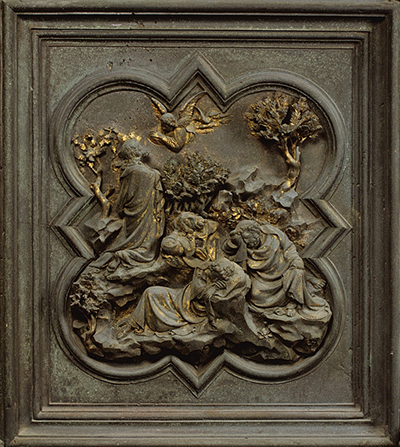
Lorenzo Ghiberti separates prayer from sleep in the Agony in the Garden without breaking the landscape apart. Christ kneels at the upper left, an angel descends above him, and three disciples sleep across the rocky foreground. Trees, bushes and a rising path connect the figures physically while emphasizing their different states of awareness.
Contents
- Position and chronology
- Christ apart
- The descending angel
- The sleeping disciples
- Distance as meaning
Position and chronology
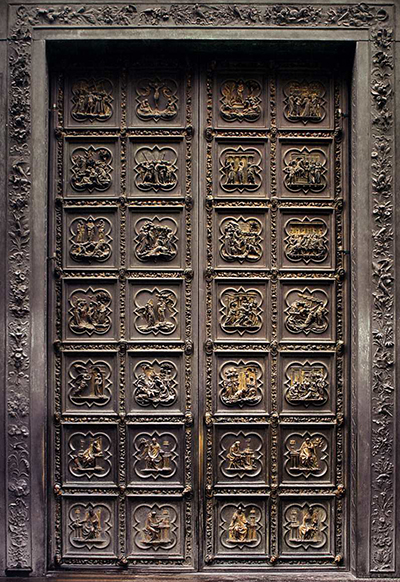
The relief is on the left leaf of the North Door, paired with Christ is Arrested. It follows the Last Supper in the Passion narrative. The physical pairing is especially pointed: solitude and sleeping bodies are answered by weapons, betrayal and crowd pressure.
Ghiberti worked on the North Door between 1403 and 1424. The original is now in the Museo dell'Opera del Duomo, while a copy occupies the Baptistery's exterior. Opera del Duomo places the Agony within a proposed early phase around 1403–1407 in Krautheimer's stylistic reconstruction. That phase is not an individually documented execution date.[1][2]
Christ apart
Christ kneels on higher ground at the left, turned away from the disciples. Elevation does not make him triumphant. It makes his isolation visible. The slope and vegetation open a gap between prayer and the sleeping group.
Matthew 26:36–46, Mark 14:32–42 and Luke 22:39–46 identify the event and the disciples' failure to remain awake. Ghiberti translates that contrast into posture: Christ is upright enough to address the angel, while the others fold into the ground.[3]
The descending angel
An angel appears above Christ, creating a compact vertical encounter. The heavenly figure occupies the upper lobe and directs attention toward the kneeling body. This line of communication is private, unlike the public divine manifestation in the Baptism.
The angel's position also prevents the upper landscape from becoming empty. Heaven enters the same terrain but does not awaken the disciples below.
The sleeping disciples
Three disciples occupy the foreground in distinct collapsed poses. Their cloaks and bodies merge with the rocks, making sleep appear heavy and earthbound. Repetition is avoided: each figure bends differently, so the group becomes a study in unconscious weight.
The surrounding trees divide the space gently rather than functioning as walls. One tree rises at the right and another cluster marks the left, enclosing the event within a garden while leaving the path between Christ and his followers visible.
Distance as meaning
Begin with the sleeping bodies and follow the terrain upward toward Christ. Then trace the shorter vertical between Christ and the angel. Compare the open spiritual exchange above with the closed poses below.
The panel's strength lies in its quiet distances. No architecture or crowd is needed. Height, wakefulness and posture distinguish prayer from human exhaustion. When read beside the Arrest, that quiet becomes temporary: the garden's connected landscape will soon be overwhelmed by a group whose bodies and weapons leave almost no open space.
Discussion
Ghiberti rewards slow looking: relief, gilding, narrative structure, workshop practice and conservation evidence can all change how a work is read.
Join the Conversation
Have an observation about Agony in the Garden, a source to add, or a comparison that sharpens the reading? Share it below.
References
- Opera del Duomo scientific catalogue, North Door
- Opera del Duomo, North Door
- Matthew 26:36–46; Mark 14:32–42; Luke 22:39–46.