 by Tom Gurney
Tom Gurney BSc (Hons) is an art history expert with over 20 years experience
Published on June 19, 2020 / Updated on July 28, 2026
Email: tomgurney1@gmail.com / Phone: +44 7429 011000
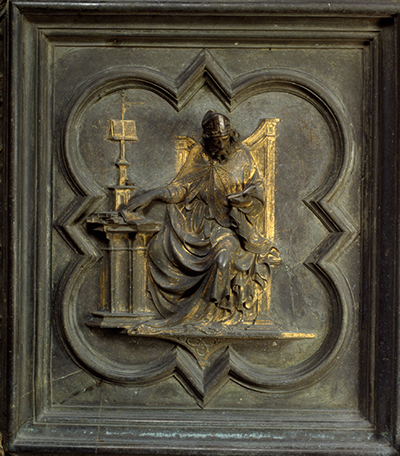
Lorenzo Ghiberti presents Augustine in an active turn between study and address. The mitred bishop sits diagonally on an architectural throne, extending one arm toward a stand at the left while the other gathers a book or the folds near his torso. Cascading drapery pushes the seated body toward the lower edge.
Contents
Position and chronology
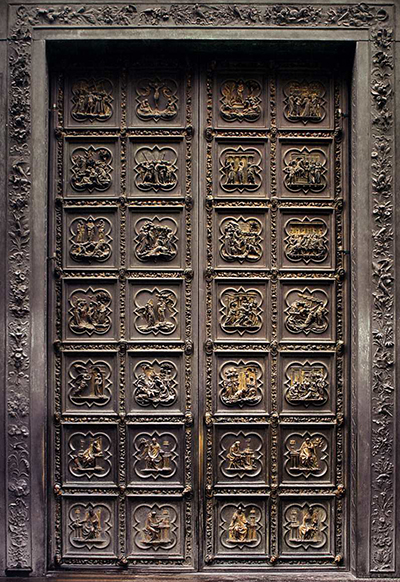
Augustine is in the North Door's lowest register on the left leaf, directly beneath John. Jerome sits beside him; Gregory and Ambrose occupy the corresponding level on the right.
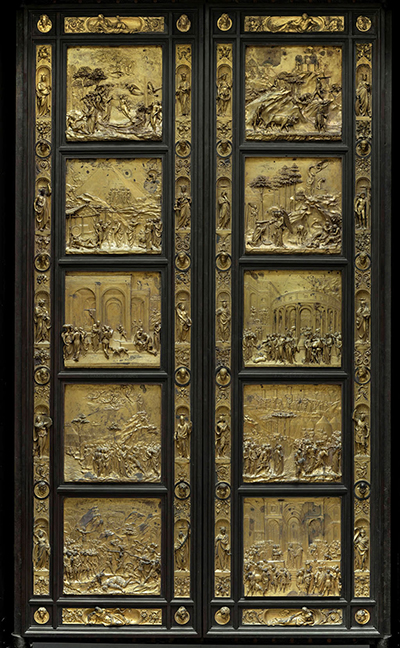
The North Door dates from 1403–1424 and is now displayed in the Museo dell'Opera del Duomo. A copy stands outside on the Baptistery. Opera del Duomo reports the Doctors within a proposed Krautheimer phase around 1407–1413/15. This is a stylistic reconstruction, not an exact recorded date for Augustine.[1][2]
A diagonal seated figure
Augustine's body does not settle into strict frontality. Head, torso and extended arm turn across the seat toward the stand. The pose joins the equipment of study with the space beyond the throne.
Mitre and chair establish episcopal authority, while the book anchors it in learning. The extended arm makes that learning active rather than self-contained.
Drapery and outward movement
Heavy folds descend over the knees and chair, giving the lower half weight. Against that mass, the reaching arm becomes more pronounced. Furniture and clothing therefore create stability while the gesture opens the composition.
Augustine's vertical pairing with John is revealing. John above bends inward in contemplation; Augustine turns outward from a similarly compact intellectual setting. Comparison with Ambrose also shows two episcopal types: Ambrose concentrates on the book before him, while Augustine creates a diagonal relation between body, stand and implied audience.
Begin with the mitred head, follow the turn through the shoulder and arm, then return through the falling drapery. The relief makes doctrinal authority visible as movement between reading and communication.
Discussion
Ghiberti rewards slow looking: relief, gilding, narrative structure, workshop practice and conservation evidence can all change how a work is read.
Join the Conversation
Have an observation about Augustine, a source to add, or a comparison that sharpens the reading? Share it below.