 by Tom Gurney
Tom Gurney BSc (Hons) is an art history expert with over 20 years experience
Published on June 19, 2020 / Updated on July 28, 2026
Email: tomgurney1@gmail.com / Phone: +44 7429 011000
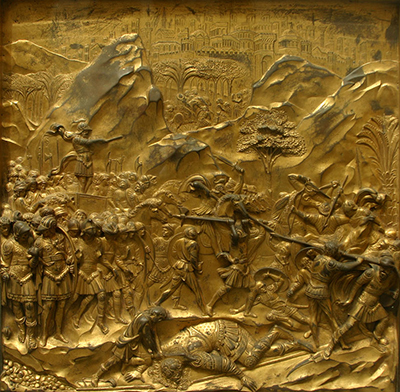
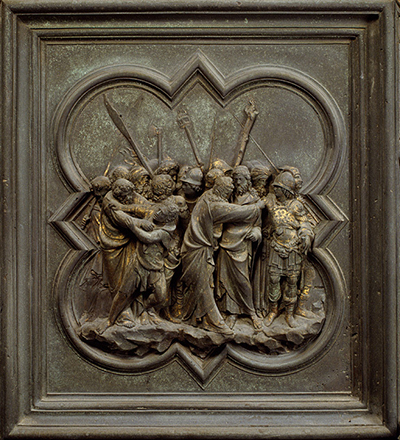
In Lorenzo Ghiberti's Christ is Arrested, betrayal becomes a physical collision. Judas reaches Christ at the crowded centre, soldiers press inward with raised weapons, Peter attacks the high priest's servant at the left, and an armoured figure anchors the right edge. Bodies and spear shafts compete for the limited space of the quatrefoil.
Contents
- Position on the North Door
- Betrayal at the centre
- Peter and the servant
- Weapons and compression
- Reading a collision
Position on the North Door
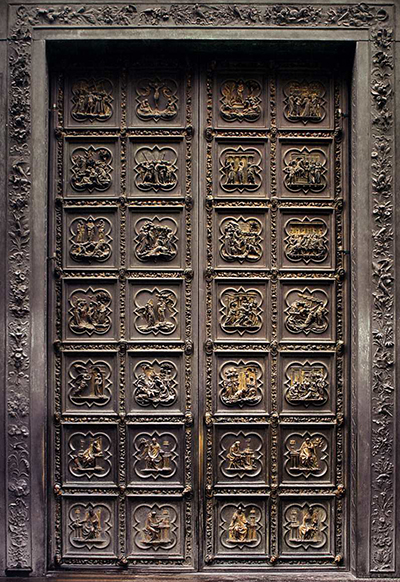
The panel is on the left leaf of the North Door, paired with the Agony in the Garden. The sequence moves from Christ's isolated prayer and the disciples' sleep to sudden collective violence. The contrast is created not only by subject but by density.
The North Door dates from 1403–1424. The original bronze is displayed in the Museo dell'Opera del Duomo; the exterior Baptistery door is a copy. Opera del Duomo reports the Arrest within a proposed phase around 1420–1424, following Krautheimer's stylistic reconstruction. This should not be converted into a documented exact execution date.[1][2]
Betrayal at the centre
Judas and Christ meet near the centre. The betrayal is represented through proximity and touch rather than through an empty space reserved for two principal figures. Their encounter is difficult to detach from the soldiers surrounding it, which makes the act feel inseparable from its consequence.
Matthew 26:47–56, Mark 14:43–52, Luke 22:47–53 and John 18:1–12 provide the narrative routes. Ghiberti combines the kiss or act of identification, seizure and resistance in one concentrated scene.[3]
Peter and the servant
At the left, Peter's attack on the servant adds a second knot of violence. The bodies bend and overlap below the raised weapons of the arresting party. This subsidiary action prevents the crowd from moving in only one direction: force erupts both toward Christ and within the surrounding group.
The episode also distinguishes discipleship from passive witnessing. Yet the relief does not make Peter the hero. His action is absorbed into the larger disorder.
Weapons and compression
Spears, swords or staffs rise through the upper lobes. Their diagonals extend the crowd's pressure beyond the level of heads and shoulders. Because the shafts are narrow, they can cross open bronze without requiring additional full figures, making the entire field feel occupied.
An armoured figure at the right gives the group a hard vertical boundary. Metal armour represented in bronze creates a visual concentration of authority and force, while the quatrefoil edge blocks further outward movement.
Reading a collision
Begin at the central meeting of Judas and Christ. Move left to Peter's attack, then trace the weapons upward and across to the armoured figure at the right. Notice how few areas of undisturbed ground remain.
The relief gains meaning through comparison with the adjacent Agony. There, landscape separates wakeful prayer from sleep. Here, bodies erase distance. Ghiberti uses crowd compression, touch and weapon diagonals to transform a narrative of identification into the sensation of capture.
Discussion
Ghiberti rewards slow looking: relief, gilding, narrative structure, workshop practice and conservation evidence can all change how a work is read.
Join the Conversation
Have an observation about Christ is Arrested, a source to add, or a comparison that sharpens the reading? Share it below.
References
- Opera del Duomo scientific catalogue, North Door
- Opera del Duomo, North Door
- Matthew 26:47–56; Mark 14:43–52; Luke 22:47–53; John 18:1–12.