 by Tom Gurney
Tom Gurney BSc (Hons) is an art history expert with over 20 years experience
Published on June 19, 2020 / Updated on July 28, 2026
Email: tomgurney1@gmail.com / Phone: +44 7429 011000
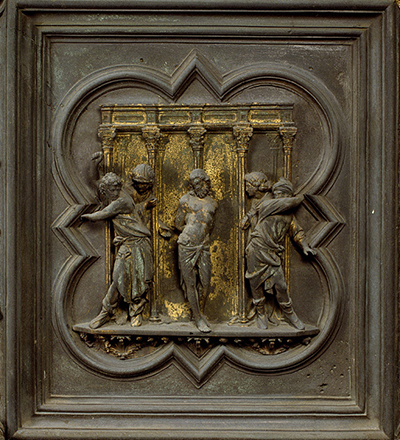
Lorenzo Ghiberti organizes the Flagellation with striking symmetry. Christ stands frontally at a central column while two pairs of executioners balance one another across the relief. A classical colonnade encloses the figures, turning physical punishment into a rigidly staged event.
Contents
Position and chronology
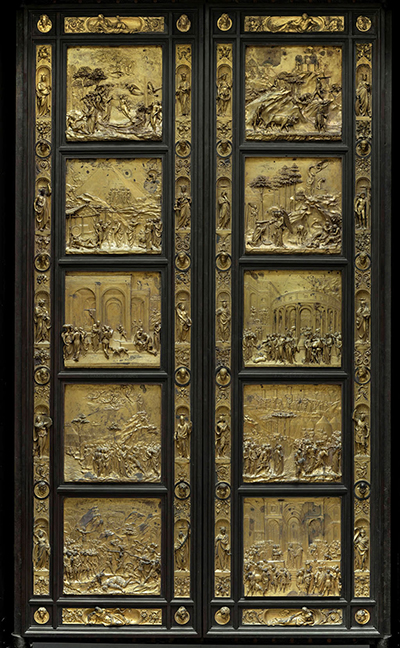
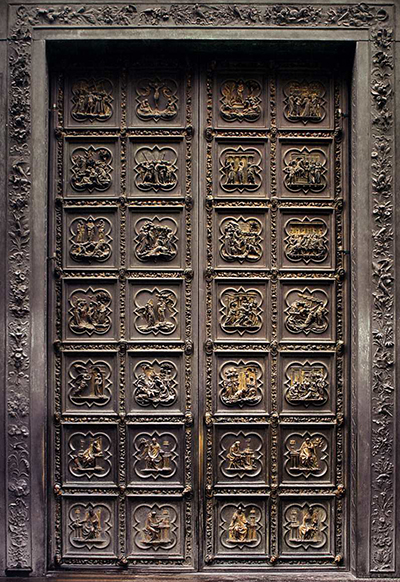
The panel is on the right leaf of the North Door, paired with Christ before Pilate. It is the second scene from the top in the left column of that leaf. The original door, made between 1403 and 1424, is now in the Museo dell'Opera del Duomo; the Baptistery's exterior door is a copy.[1][2]
Opera del Duomo reports the panel within a proposed Krautheimer phase around 1420–1424. This is a stylistic reconstruction, not a documented individual execution date.
Christ at the column
Christ occupies the exact visual centre. The column reinforces his vertical body, while the surrounding architecture repeats its upright line. His relative stillness contrasts with the active limbs of the flagellators.
Matthew 27:26, Mark 15:15 and John 19:1 identify the punishment. Ghiberti concentrates on the act itself rather than expanding the surrounding trial narrative, which belongs to the adjacent Pilate panel.[3]
Balanced violence
The executioners are arranged in opposing pairs. Their torsos turn and arms extend toward Christ, producing lateral force on both sides. Symmetry does not soften the violence; it makes the central body's exposure more deliberate.
This controlled arrangement differs from the crowd collision of the Arrest. There, weapons and bodies congest the quatrefoil. Here, the action is spaced, frontal and almost ceremonial.
Classical enclosure
Columns and entablature create a shallow architectural screen. The regular structure holds each figure in a defined position and prevents the scene from dissolving into movement. Selective gilding catches the background and bodies, sharpening the contrast between gleaming order and punishment.
Begin with Christ and the column, then compare the paired executioners' poses. Finally, follow the architectural verticals and horizontals. The relief's distinctive tension lies between bodily exertion and formal control: violence unfolds, but every movement is bound to a symmetrical stage.
Discussion
Ghiberti rewards slow looking: relief, gilding, narrative structure, workshop practice and conservation evidence can all change how a work is read.
Join the Conversation
Have an observation about Flagellation, a source to add, or a comparison that sharpens the reading? Share it below.
References
- Opera del Duomo scientific catalogue, Flagellation
- Opera del Duomo scientific catalogue, North Door
- Matthew 27:26; Mark 15:15; John 19:1.