 by Tom Gurney
Tom Gurney BSc (Hons) is an art history expert with over 20 years experience
Published on June 19, 2020 / Updated on July 28, 2026
Email: tomgurney1@gmail.com / Phone: +44 7429 011000
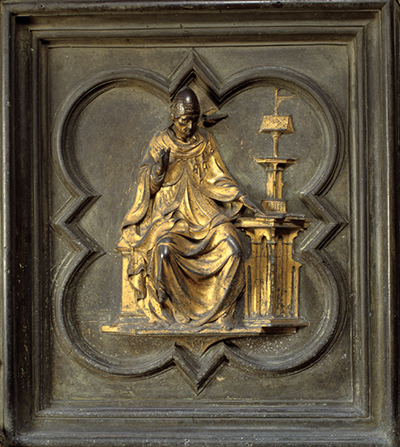
Lorenzo Ghiberti gives Gregory the Great a frontal, public authority. The papal figure sits in layered vestments, raising one hand in exposition while the other opens outward. A tall stand at the right supplies a vertical counterweight, and the broad drapery reinforces the central seated mass.
Contents
Position on the North Door
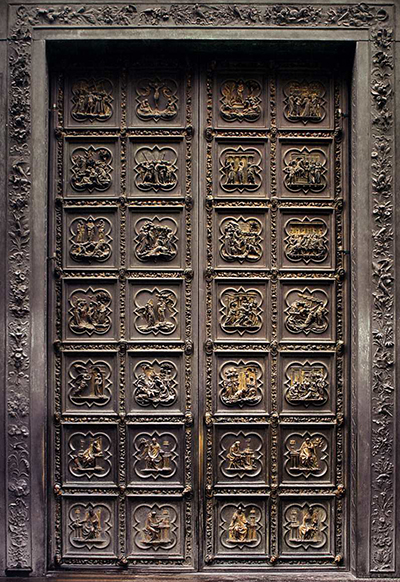
Gregory is in the lowest register of the right leaf, directly beneath Luke. Ambrose sits beside him; Augustine and Jerome occupy the corresponding level on the left.
The North Door was produced between 1403 and 1424. Its original reliefs are now in the Museo dell'Opera del Duomo, while the exterior Baptistery door is a copy. Opera del Duomo reports the Doctors within a proposed Krautheimer phase around 1407–1413/15. This stylistic reconstruction is not a documented individual execution date.[1][2]
Gesture and office
Gregory's raised hand projects beyond private study. It suggests exposition, blessing or authoritative speech without requiring a precise spoken text. The second hand expands the address and makes the body unusually open.
Papal vestments identify institutional office. Their layered folds broaden the figure and help make his frontal pose the visual centre of the quatrefoil.
From learning to proclamation
The stand at the right introduces the apparatus of reading or writing, but Gregory is not bent over it. Knowledge is presented as something communicated outward. This distinguishes him from Jerome's concentrated study and Luke's active engagement with a page directly above.
Read the panel from the central face and torso outward through the two hands, then compare that expansion with the stand's narrow vertical. Ghiberti turns a seated figure into a public presence through symmetry and open gesture. Gregory's authority is not shown through narrative action but through the controlled performance of office.
Discussion
Ghiberti rewards slow looking: relief, gilding, narrative structure, workshop practice and conservation evidence can all change how a work is read.
Join the Conversation
Have an observation about Gregory the Great, a source to add, or a comparison that sharpens the reading? Share it below.