 by Tom Gurney
Tom Gurney BSc (Hons) is an art history expert with over 20 years experience
Published on June 19, 2020 / Updated on July 28, 2026
Email: tomgurney1@gmail.com / Phone: +44 7429 011000
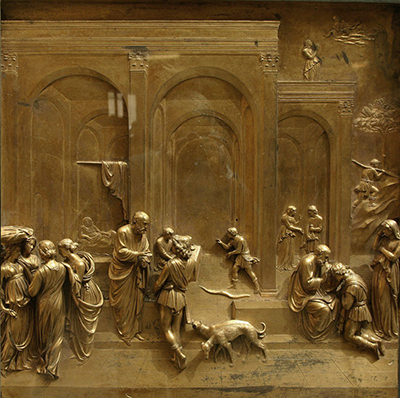
In the fifth panel of the Gates of Paradise, Lorenzo Ghiberti turns the intertwined story of Isaac, Rebecca, Esau and Jacob into an architectural drama. Birth, prophecy, hunger, hunting, deception and blessing occupy a single square field. A sequence of arches draws the eye into depth while the principal family encounters remain legible in the foreground and along the sides.
Contents
- A family story in seven moments
- Rebecca and the birth of the twins
- Birthright and hunger
- Esau sent to hunt
- Rebecca and Jacob's deception
- Architecture and perspective
- Following the sequence
A family story in seven moments
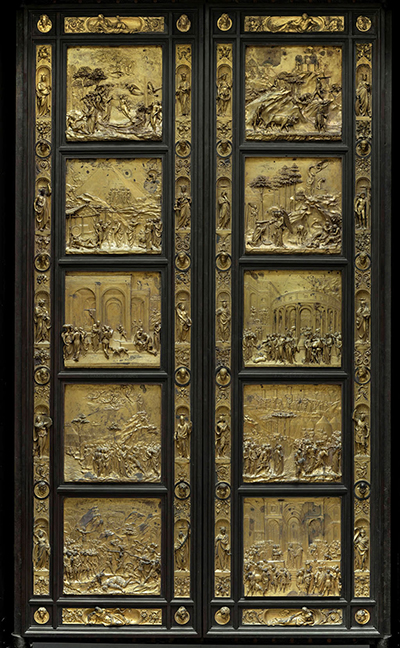
The panel belongs to the Gates of Paradise, made between 1425 and 1452 and now displayed in the Museo dell'Opera del Duomo. The official sequence places it after the stories of Abraham and before those of Joseph. It continues the history of the patriarchs but changes the visual setting from rocky landscape to an elaborate classical building.[1][2]
The Met's account identifies seven moments within the panel. Rebecca receives a divine explanation for the conflict she feels during pregnancy; the twins are born; Esau trades his birthright to Jacob for food; Isaac sends Esau hunting; Rebecca prepares the deception; Jacob receives the blessing intended for his brother; and Esau returns. These events do not form a simple strip. They are distributed through different depths and architectural zones.[3][4]
Rebecca and the birth of the twins
The narrative begins in the upper-right area, where Rebecca seeks an explanation for the turmoil in her womb. The small scale and distant placement suit an event that precedes the principal foreground actions. Nearby, attendants surround the birth of Esau and Jacob.
Ghiberti relies on changes in scale and relief to make these episodes recede without making them irrelevant. The viewer must look into the architecture to discover the origins of the later conflict. The panel's depth is therefore also chronological: earlier events tend to occupy more distant zones.
Birthright and hunger
Jacob's acquisition of Esau's birthright begins with an ordinary bodily need. Esau returns hungry and accepts food in exchange for the privilege of the elder son. The episode gives the brothers' rivalry a material form before the later deception over Isaac's blessing.
Within the panel, small exchanges of gesture distinguish conversations from more public actions. Ghiberti does not require monumental scale for every turning point. A hand extended towards a bowl or a pair of bodies turned towards one another can carry an event within the wider architectural order.
Esau sent to hunt
The blind or ageing Isaac directs Esau to hunt and prepare food before receiving his blessing. Esau's movement towards the edge of the panel separates him from the domestic conspiracy taking shape elsewhere. Hunting becomes both a subject and a device that temporarily removes the elder son from the household.
This outward movement contrasts with the architecture's strong pull inward. The arches draw the eye towards a central depth, while Esau's departure takes the story laterally towards the margin. Ghiberti makes spatial direction part of the plot.
Rebecca and Jacob's deception
Rebecca arranges for Jacob to approach Isaac in his brother's place. The story depends on touch, disguise and mistaken identity: Jacob's hands and neck are covered so that the blind Isaac will believe he feels Esau's hair.
The blessing occupies the lower-right foreground and receives greater projection. Isaac, Jacob and Rebecca form a concentrated group near the viewer. Their bodies overlap, and the deception becomes physically compressed into the contact between father and son. Rebecca's presence connects the action to the planning episodes elsewhere in the panel.
Architecture and perspective
The panel is celebrated for its series of round arches, pilasters and tiled planes. Orthogonal lines and diminishing architectural elements create a measured recession. Yet the building is not a neutral demonstration of perspective. It divides the story into rooms, thresholds and public spaces while keeping them within one continuous structure.
The Met describes the arches as leading the eye compellingly through space. Ghiberti's own account of the Gates emphasizes measure, the imitation of nature and shallow relief that makes distant figures appear smaller. Here those principles join a classical architectural vocabulary: relief and linear construction reinforce one another.[5]
Following the sequence
The panel cannot be read adequately by moving only from left to right. A better method begins in the distance with Rebecca and the birth, returns to the brothers' exchange, follows Esau out to hunt, and then moves to the foreground blessing. The eye repeatedly travels between background and foreground, just as the story moves between prior knowledge and present deception.
Isaac's blessing is the visual climax, but it is not meaningful alone. Architecture preserves the actions that made it possible. Ghiberti's achievement lies in allowing one decisive foreground encounter to remain connected with a network of earlier choices.
Discussion
Ghiberti rewards slow looking: relief, gilding, narrative structure, workshop practice and conservation evidence can all change how a work is read.
Join the Conversation
Have an observation about Isaac with Esau and Jacob, a source to add, or a comparison that sharpens the reading? Share it below.
References
- Opera del Duomo, Gates of Paradise
- Opera del Duomo, Stories of Jacob and Esau (in Italian)
- Metropolitan Museum of Art, The Gates of Paradise
- Smarthistory, Gates of Paradise
- Lorenzo Ghiberti, I Commentarii, ed. Julius von Schlosser (Berlin, 1912), printed pp. 48–50.