 by Tom Gurney
Tom Gurney BSc (Hons) is an art history expert with over 20 years experience
Published on June 19, 2020 / Updated on July 28, 2026
Email: tomgurney1@gmail.com / Phone: +44 7429 011000
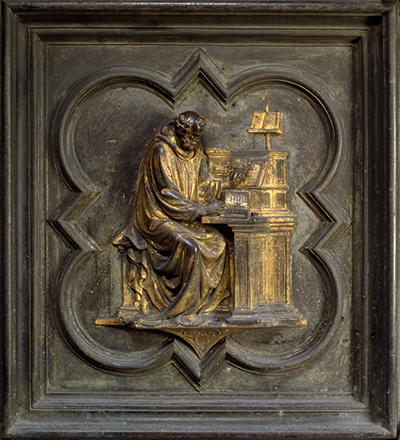
Lorenzo Ghiberti represents Jerome as a scholar absorbed in reading. The seated saint bends toward an open volume on a substantial desk. His profile is compact and his body wrapped in heavy folds, concentrating attention on the small zone where face, hands, book and furniture meet.
Contents
Position and chronology
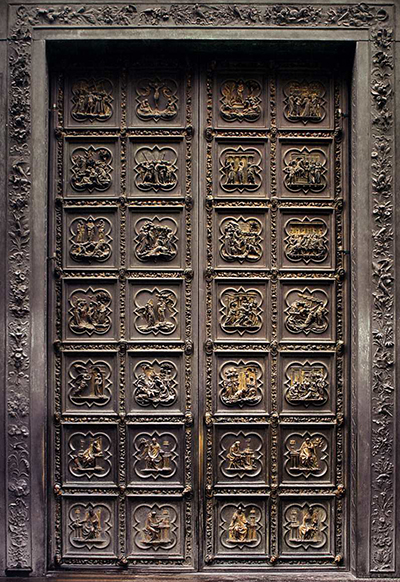
Jerome occupies the lowest register of the North Door's left leaf, directly beneath Matthew. Augustine sits beside him; Gregory and Ambrose occupy the corresponding level on the right leaf.
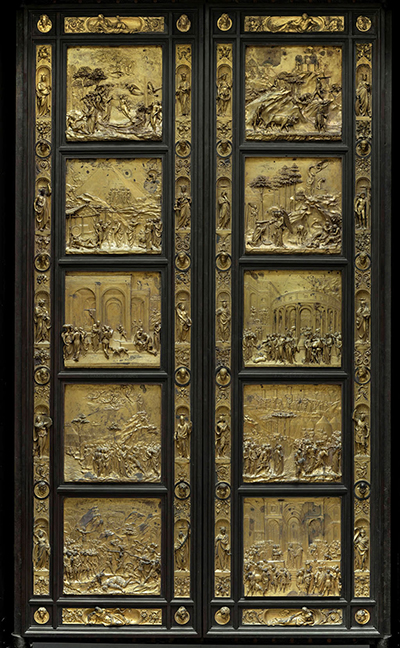
The original North Door, made between 1403 and 1424, is displayed in the Museo dell'Opera del Duomo. The Baptistery's exterior door is a copy. Opera del Duomo reports the Doctors within a proposed Krautheimer phase around 1407–1413/15. This remains a scholarly reconstruction rather than an exact panel date.[1][2]
Scholarship as bodily labour
Jerome's bent back and lowered head make reading visibly physical. He does not address an audience or turn toward a symbolic companion. The pose contracts around the text.
The large desk reinforces that concentration. Its layered surfaces and vertical supports create a stable block against which the softer drapery gathers. Book and furniture take up nearly as much compositional importance as the saint's body.
An inward model of authority
The relatively bare field around the figure intensifies the working zone. Ghiberti does not need a library or narrative episode to communicate scholarship; posture, text and desk are sufficient.
Jerome forms a useful contrast with Gregory the Great, whose frontal pose and open gesture suggest proclamation. He also links vertically to Matthew above: both involve book and inspiration, but Matthew turns into dialogue while Jerome closes himself around sustained study.
Begin with Jerome's bowed head, follow his gaze to the book, and then examine how the desk supports the action. The relief treats learned authority as patient absorption rather than public display.
Discussion
Ghiberti rewards slow looking: relief, gilding, narrative structure, workshop practice and conservation evidence can all change how a work is read.
Join the Conversation
Have an observation about Jerome, a source to add, or a comparison that sharpens the reading? Share it below.