 by Tom Gurney
Tom Gurney BSc (Hons) is an art history expert with over 20 years experience
Published on June 19, 2020 / Updated on July 28, 2026
Email: tomgurney1@gmail.com / Phone: +44 7429 011000
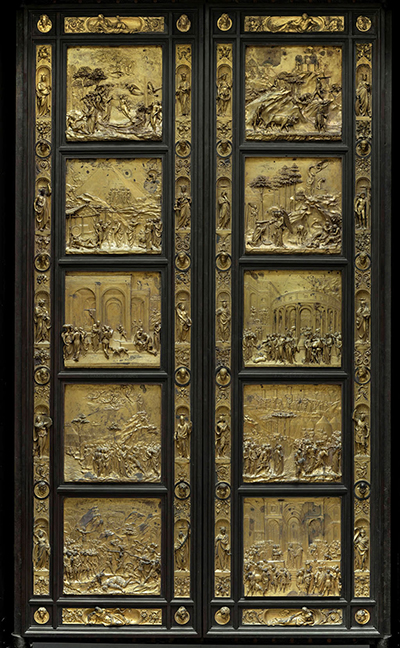
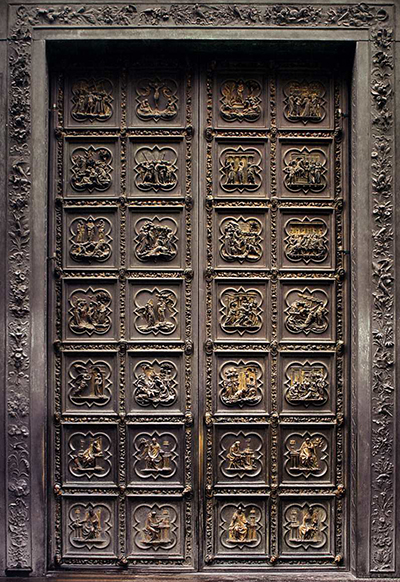
Lorenzo Ghiberti's North Doors for the Florence Baptistery contain twenty-eight bronze reliefs within elaborate quatrefoil frames. Made between 1403 and 1424, they were the defining project of the first half of his career and the foundation for the later Gates of Paradise. The original doors are displayed in the Museo dell'Opera del Duomo, while a replica occupies the Baptistery. [1]
Contents
- From competition relief to monumental commission
- The twenty-eight-panel programme
- Bronze, dark ground and recovered gold
- Signature, portrait and authorship
- Original position and later movement
- North Doors and Gates of Paradise compared
From competition relief to monumental commission
The project followed the Arte di Calimala's competition of 1401. Ghiberti and Filippo Brunelleschi produced surviving trial reliefs of the Sacrifice of Isaac, while the other entries are lost. Later narratives disagree about the judging, so the result should not be presented as an uncontested unanimous victory. The secure fact is that Ghiberti received the commission, formalized in 1403.
The original competition concerned an Old Testament programme, but the executed doors were devoted principally to the life of Christ. Ghiberti worked within a format related to Andrea Pisano's earlier Baptistery doors, retaining the repeated quatrefoil as the basic narrative unit.
The twenty-eight-panel programme
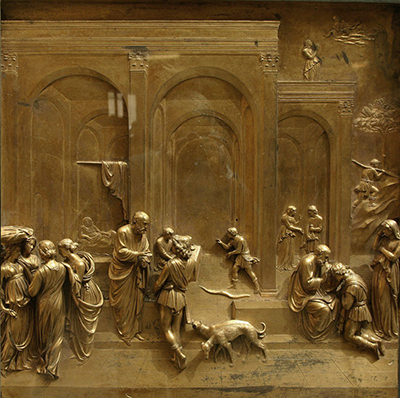
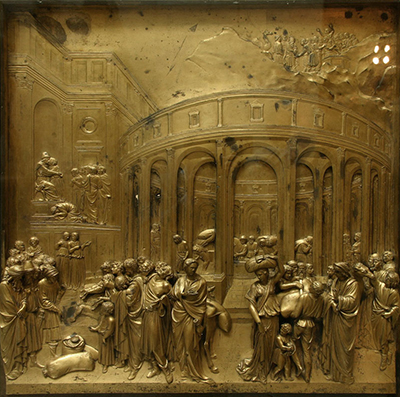
The twenty upper reliefs tell episodes from the New Testament, beginning with the Annunciation and Nativity and continuing through Christ's ministry, Passion, Resurrection and Pentecost. The eight lower panels depict the four Evangelists and four Doctors of the Church.
The sequence rewards reading across the whole object. Individual panel pages can examine subjects such as the Baptism of Christ, Entry into Jerusalem or Last Supper, but the door's larger meaning depends on their relationship. The Evangelists and Doctors below establish textual and theological authority for the narrative above.
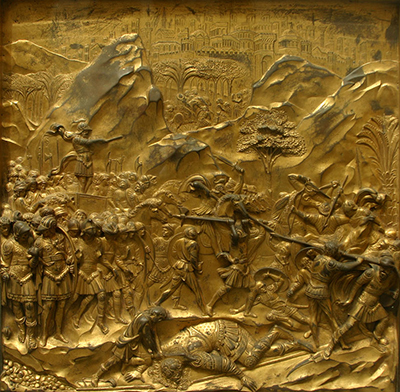
Each scene must also negotiate the quatrefoil. Its projecting lobes and narrow corners could restrict composition, yet Ghiberti used them to frame movement. Figures lean into curves, architecture stabilizes crowded scenes, and empty bronze ground can clarify a gesture or encounter. The format is inherited, but the solutions vary from panel to panel.
Bronze, dark ground and recovered gold
For centuries, the North Doors were often experienced as dark bronze. Restoration begun in 2013 established that Ghiberti had selectively gilded the relief figures and ornamental elements using mercury amalgam while leaving surrounding bronze darker. The contrast allowed bodies, drapery and foliage to catch light against the ground.
The Opificio delle Pietre Dure carried out the treatment for the Opera di Santa Maria del Fiore. Conservators used chemical and mechanical methods as well as selective laser cleaning on gilded areas. The recovery of gold was not merely cosmetic: it changed understanding of the original visual design by restoring a deliberate relationship between luminous relief and darker field. [2]
The treatment should not be assumed to match the Gates of Paradise in every detail. The two doors had different surface schemes, histories and conservation problems. Modern methods were selected in response to each object's material condition.
Signature, portrait and authorship
The door includes Ghiberti's signature and a self-portrait head. These details make authorship visible within a project that necessarily depended on a workshop. Over two decades, assistants participated in modelling, casting, chasing, gilding and assembly. Surviving references to workshop members are important, but they do not justify assigning individual panels to famous young artists without specific evidence.
The door is best understood as a work designed and directed by Ghiberti and realized through changing teams of skilled labor. That structure became even more important during the longer and more complex Gates of Paradise commission.
Original position and later movement
The doors were first installed in 1424 at the Baptistery's eastern entrance facing the cathedral. When the Gates of Paradise were completed in 1452, the earlier Ghiberti doors were moved to the north portal. Their present name therefore describes their later and familiar position, not their original installation.
This movement matters when comparing Florence's three Baptistery door campaigns. Andrea Pisano's doors, Ghiberti's first doors and the Gates of Paradise have occupied different portals over time. Today, the original doors are preserved together in the Museo dell'Opera del Duomo and replicas maintain the exterior arrangement. [3]
North Doors and Gates of Paradise compared
The North Doors divide narrative into twenty scenes enclosed by Gothic quatrefoils. The Gates of Paradise use ten large rectangles in which multiple episodes share continuous spaces. The difference is dramatic, but the later doors grew from the earlier workshop's accumulated knowledge of bronze casting, narrative clarity, surface finishing and large-scale assembly.
The first doors also show that gold, complex spatial settings and self-conscious authorship were already central to Ghiberti. The Gates did not replace an immature work with a Renaissance one; they expanded possibilities developed across the twenty-one-year North Door project.
Discussion
Ghiberti rewards slow looking: relief, gilding, narrative structure, workshop practice and conservation evidence can all change how a work is read.
Join the Conversation
Have an observation about North Doors, a source to add, or a comparison that sharpens the reading? Share it below.
References
- Opera di Santa Maria del Fiore, North Door.
- Opera di Santa Maria del Fiore, North Door restoration report (in Italian).
- Opera di Santa Maria del Fiore, Baptistery.