 by Tom Gurney
Tom Gurney BSc (Hons) is an art history expert with over 20 years experience
Published on June 19, 2020 / Updated on July 28, 2026
Email: tomgurney1@gmail.com / Phone: +44 7429 011000
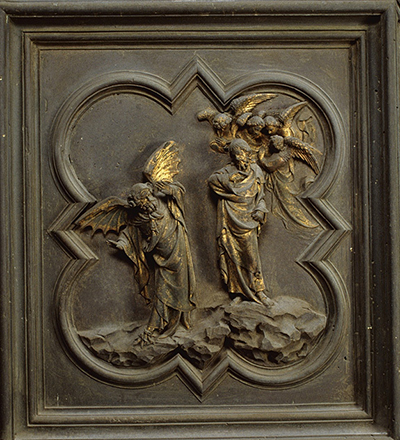
In Lorenzo Ghiberti's Temptation in the Wilderness, confrontation is expressed through opposed bodies. A winged tempter bends toward Christ from the left, while Christ stands upright at the right with a gesture of refusal or command. Angels gather above him, and the rocky ground strips the encounter of distracting narrative detail.
Contents
- Position and chronology
- The tempter's approach
- Christ's stability
- Angels and wilderness
- A close-looking route
Position and chronology
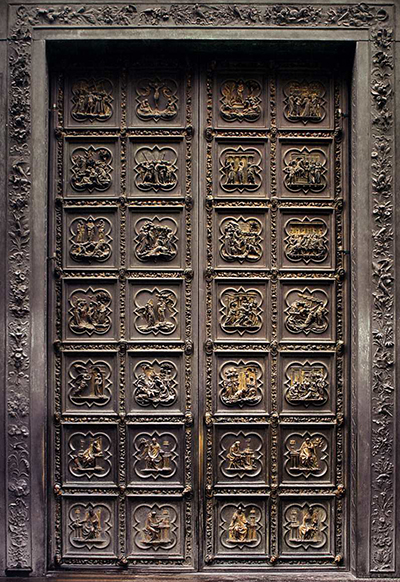
The panel is on the left leaf of the North Door, paired with Christ is Baptised by John. Baptism and temptation form a deliberate transition from divine recognition to testing at the beginning of Christ's public ministry.
Ghiberti's North Door dates from 1403–1424 and is now displayed in the Museo dell'Opera del Duomo; the exterior Baptistery door is a copy. Opera del Duomo reports the Temptation within a proposed stylistic phase around 1407–1413/15. The phase is Krautheimer's scholarly reconstruction rather than an individual documented date.[1][2]
The tempter's approach
The tempter enters from the left with wings and a forward-bending pose. This diagonal compresses the distance between the figures and makes speech feel like physical pressure. The creature is neither a neutral conversational partner nor a distant symbol; its body actively tests the space around Christ.
Matthew 4:1–11 and Luke 4:1–13 describe a sequence of temptations. Ghiberti condenses the subject into one legible confrontation rather than illustrating every exchange separately.[3]
Christ's stability
Christ remains upright at the right. His raised hand can be read as refusal, blessing or authoritative dismissal, but its exact verbal content need not be reconstructed. Visually, the gesture stops the tempter's diagonal advance.
The contrast with the Baptism is instructive. In the adjacent scene, Christ's stillness anchors a ritual between John, angels and water. Here the same quality becomes resistance. Stability is no longer receptive; it is active refusal.
Angels and wilderness
Angels cluster above or behind Christ, anticipating the conclusion of the biblical episode. Their presence reinforces the right side without dissolving the direct opposition between the two principal figures.
Rocky, relatively bare ground emphasizes the encounter. There is no architectural enclosure and no crowd. The wilderness is conveyed through sparseness and irregular terrain, giving the figures' gestures unusual clarity within the quatrefoil.
A close-looking route
First compare the angle of the two torsos. Follow the tempter's bent body and then Christ's upright line. Next examine the space between their hands, where the verbal contest becomes a visual interval. Finally, locate the angels and consider how they weight Christ's side of the composition.
The panel's economy is its strength. Rather than narrating three temptations through repeated protagonists, Ghiberti concentrates the theme into posture, gesture and opposed direction. The result is a compact image of pressure met by immovable authority.
Discussion
Ghiberti rewards slow looking: relief, gilding, narrative structure, workshop practice and conservation evidence can all change how a work is read.
Join the Conversation
Have an observation about Temptation in the Wilderness, a source to add, or a comparison that sharpens the reading? Share it below.
References
- Opera del Duomo scientific catalogue, North Door
- Opera del Duomo, North Door
- Matthew 4:1–11; Luke 4:1–13.