 by Tom Gurney
Tom Gurney BSc (Hons) is an art history expert with over 20 years experience
Published on June 19, 2020 / Updated on July 28, 2026
Email: tomgurney1@gmail.com / Phone: +44 7429 011000
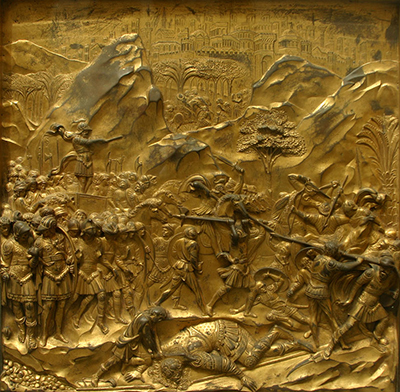
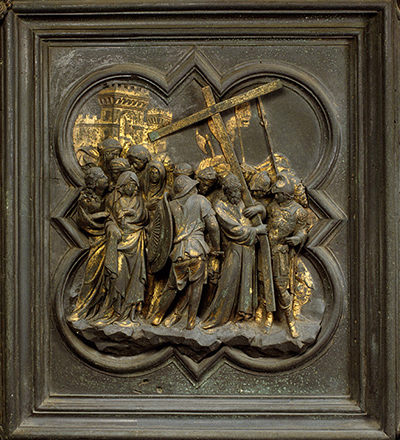
Lorenzo Ghiberti makes Christ's burden visible by nearly losing him within the procession. The cross cuts diagonally across the upper field, while soldiers, mourners and helpers crowd around its bearer. Spears and standards repeat the forward thrust, and a city structure recedes at the upper left.
Contents
Position and sequence
The panel occupies the uppermost narrative level of the North Door's left leaf, paired with the Crucifixion. Procession and execution thus stand together at the culmination of the Passion.
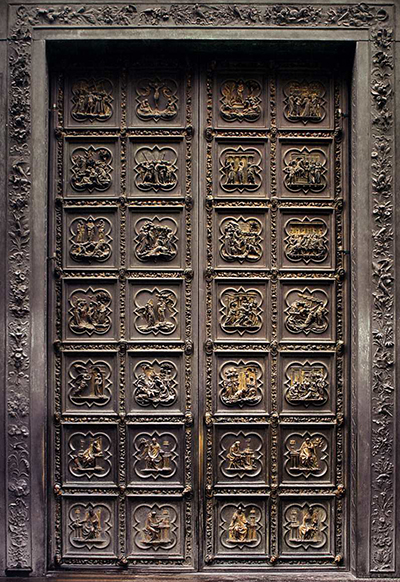
The original North Door was made between 1403 and 1424 and is now in the Museo dell'Opera del Duomo; the exterior Baptistery door is a copy. Opera del Duomo reports the Way to Calvary within a proposed Krautheimer phase around 1420–1424. The grouping is a scholarly reconstruction rather than a recorded panel date.[1][2]
Christ within the crowd
Christ is not isolated against open ground. Bodies overlap him, and the cross competes with other diagonals. This obstruction is meaningful: the viewer must find the protagonist within the machinery of forced movement.
Matthew 27:31–32, Mark 15:20–21, Luke 23:26–32 and John 19:16–17 identify the route to execution and differ over details of carrying the cross. The relief focuses on the collective procession rather than resolving every textual variation.[3]
The cross as direction
The cross reaches across the upper lobes of the quatrefoil. Its long beams give the compact panel a dominant direction and make burden legible at a scale larger than Christ's body.
Spears and standards echo or interrupt that line. Their repetition makes the crowd feel driven forward, while vertical shafts prevent the procession from becoming a simple horizontal band.
From city to Calvary
Architecture at the upper left marks the place being left behind. The crowded foreground and rocky base direct attention outward, toward the paired Crucifixion.
Begin by tracing the cross before locating Christ beneath it. Then separate helpers, soldiers and mourners through their gestures and equipment. The relief's force comes from visual obstruction: burden, coercion and movement are carried not by an isolated hero but by a crowd whose competing bodies almost consume him.
Discussion
Ghiberti rewards slow looking: relief, gilding, narrative structure, workshop practice and conservation evidence can all change how a work is read.
Join the Conversation
Have an observation about Way to Calvary, a source to add, or a comparison that sharpens the reading? Share it below.
References
- Opera del Duomo scientific catalogue, North Door
- Opera del Duomo, North Door
- Matthew 27:31–32; Mark 15:20–21; Luke 23:26–32; John 19:16–17.