 by Tom Gurney
Tom Gurney BSc (Hons) is an art history expert with over 20 years experience
Published on June 19, 2020 / Updated on October 14, 2023
Email: tomgurney1@gmail.com / Phone: +44 7429 011000
Introduction
Masaccio’s influence on Renaissance painting is extraordinary precisely because his career was so short. He died in his twenties after only a handful of securely documented years, yet the visual language developed in the Brancacci Chapel, Pisa Polyptych and Holy Trinity became part of the foundation on which later Florentine painters built. His influence did not operate mainly through exact copies. Later artists absorbed principles: bodies should possess weight, light should unify figures, perspective should organise real space, gesture should carry emotion and sacred narrative should feel physically credible. The Brancacci Chapel was crucial because those principles remained visible on the wall.
Artists could visit, draw and compare Masaccio’s figures directly, turning the chapel into an informal school long before formal academies existed. Fra Angelico, Fra Filippo Lippi, Filippino Lippi, Leonardo and Michelangelo all belong to this larger story in different ways. Some worked close to Masaccio’s own generation, others inherited his ideas decades later, but all encountered a Florentine culture changed by what he had made possible.
At a Glance
- Masaccio1401–1428/29
- Principal channel of influenceBrancacci Chapel, Santa Maria del Carmine
- Core inherited principlesbodily mass, coherent light, perspective, emotional directness and compositional clarity
- Early contemporary responseFra Angelico
- Carmelite transmissionFra Filippo Lippi
- Direct later completionFilippino Lippi
- Later Florentine studyLeonardo da Vinci and Michelangelo
- Key distinctioninfluence through principles rather than literal imitation
- Historical resultMasaccio’s innovations became part of the normal vocabulary of Renaissance painting
Contents
- Influence in a Short Career
- Fra Angelico
- The Prado Annunciation
- Masaccio and Lippi’s Bodies
- Raising of the Son of Theophilus
- Leonardo and Grouping
- Michelangelo and the Nude
- Perspective after Masaccio
- Piero della Francesca
- Raphael
- Perspective as Florentine Language
- The Chapel and Artistic Memory
- Structural Influence
- Why Fra Angelico Matters in the Story
- Why Michelangelo Matters
- Frequently Asked Questions
- References and Research Sources
Influence in a Short Career
Masaccio’s death came before he could develop a long workshop lineage or produce a large body of mature works. His influence therefore depended unusually heavily on the survival and visibility of a few major paintings. This makes the Brancacci Chapel especially important. One room became more influential than many entire careers.
The Brancacci Chapel as a School. Later Florentine tradition repeatedly describes artists studying the chapel. Its figures offered direct lessons in anatomy, drapery, grouping, perspective and expressive gesture. This kind of study was practical rather than abstract. Artists could draw feet, hands, folds and heads while observing how whole compositions remained coherent.
Influence through Looking. Renaissance artistic education depended heavily on copying and studying existing works. A painter did not need to know Masaccio personally to learn from him. The chapel therefore transmitted ideas across generations. Physical survival became a mechanism of influence.
What Later Artists Learned. The most important lessons were structural. Masaccio showed that bodies could feel heavy, that one light source could bind groups together and that perspective could organise space without overwhelming narrative. He also showed that ordinary human experience could carry sacred meaning. Cold, grief, poverty and touch all became serious pictorial subjects.
Fra Angelico
Fra Angelico was one of the earliest major painters to respond to the new visual environment shaped by Masaccio and Masolino. Prado scholarship explicitly places his development in relation to their innovations during the mid-1420s. Angelico did not become Masaccio in Dominican robes. He absorbed bodily solidity and spatial coherence into a more luminous, contemplative language.
Angelico’s Different Temperament. Where Masaccio often appears severe, Angelico tends towards serenity, colour and devotional calm. The difference makes the influence more revealing rather than less. Influence does not require stylistic resemblance. It can operate through underlying structure.
Perspective in Fra Angelico. Angelico increasingly organises interiors and architectural spaces with convincing recession. This development belongs to the same Florentine perspective culture in which Masaccio became a leading painter. The result is softer but no less important. Perspective becomes capable of serving silence and contemplation as well as monumental drama.
Bodies in Fra Angelico. Angelico’s figures gain greater volume through light and drapery compared with earlier Gothic models. They remain elegant, but they occupy space more securely. This combination demonstrates how Masaccian weight could be moderated rather than rejected. Florentine painting becomes richer through synthesis.
The Prado Annunciation
The Prado’s research on the Annunciation places Angelico within the new visual language associated with Masaccio and Masolino. Perspective, architecture and bodily presence become part of a devotional image whose emotional tone remains unmistakably Angelico’s. This is one of the clearest examples of influence through adaptation. The underlying system changes while the painter’s personality remains distinct.
Fra Filippo Lippi. Fra Filippo Lippi had an especially close geographical and institutional connection with Masaccio because he entered the Carmelite community at Santa Maria del Carmine. The Brancacci Chapel therefore formed part of the environment in which his artistic identity developed. This proximity matters enormously. Masaccio was not a distant historical figure for the young Lippi; his frescoes were physically present inside the same religious complex.
Learning at the Carmine. The chapel would have provided Fra Filippo with direct access to monumental bodies, coherent light and narrative clarity. He could study the frescoes repeatedly rather than encounter them only through copies. This kind of sustained looking helps explain why Masaccio’s influence became so deeply absorbed. The visual lessons became part of everyday formation.
Filippo Lippi’s Different Style. Fra Filippo developed a more lyrical and emotionally intimate style. His Virgins are often tenderer, his lines softer and his surfaces more decorative. Yet beneath that lyricism lies a new physical credibility. Bodies inhabit space with greater confidence than much earlier Florentine painting.
Masaccio and Lippi’s Bodies
Fra Filippo’s figures often retain a sense of weight even when drapery and colour become more elegant. This suggests not imitation but inheritance. Masaccio’s revolution becomes a starting condition. Later painters can become more decorative without returning to weightlessness.
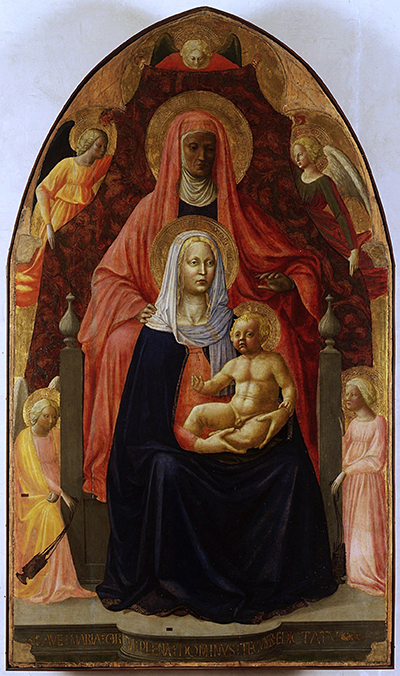
Emotional Intimacy. Fra Filippo also develops emotional intimacy in ways that connect with Masaccio’s broader humanisation of sacred figures. The relationship between mother and child becomes increasingly physical and psychologically immediate. Masaccio’s Madonna Casini demonstrates that this tender direction was already possible within his own art. Lippi expands it into a fuller lyrical language.
Filippino Lippi. Filippino Lippi’s relationship with Masaccio is the most literally architectural. In the 1480s he was commissioned to complete unfinished frescoes in the Brancacci Chapel itself. This meant he had to work beside Masaccio physically. Influence became collaboration across time.
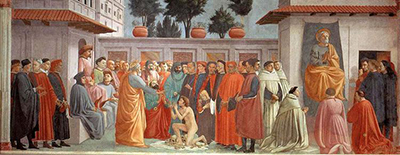
Completing Masaccio. Filippino faced an unusual problem: how to finish a revered earlier work without destroying its unity. He adapted his figures and architecture to Masaccio’s visual severity while remaining recognisably part of a later generation. The result is one of the most sophisticated acts of historical adaptation in Renaissance painting.
Raising of the Son of Theophilus
The fresco of Raising of the Son of Theophilus and Saint Peter Enthroned contains contributions by both Masaccio and Filippino. The wall therefore makes influence visible at the level of plaster. Filippino does not merely study Masaccio. He enters his composition.
A Family Transmission. Filippino’s father, Fra Filippo Lippi, had already been shaped by the Carmine environment. Filippino therefore inherits Masaccio through both direct visual study and familial artistic tradition. This creates an extraordinary chain: Masaccio influences Fra Filippo, and Fra Filippo’s son later completes Masaccio’s chapel.
Influence as Genealogy. The Brancacci Chapel can therefore be understood almost like an artistic family tree. Ideas pass from one painter to another, changing character each time. Masaccio’s weight becomes Lippi’s lyricism and then Filippino’s historically conscious completion. Influence is transformation.
Leonardo da Vinci. Florentine institutional tradition includes Leonardo among the later artists associated with study of the Brancacci Chapel. For a painter interested in bodies, movement, expression and spatial organisation, Masaccio offered an ideal local precedent. Leonardo’s art is very different, but the basic problem of making figures psychologically alive within coherent space belongs to the same tradition.
Leonardo and Grouping
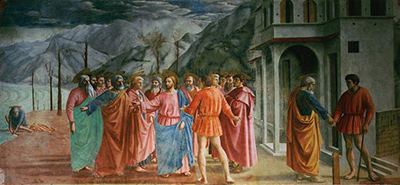
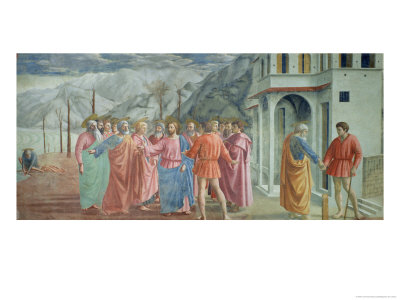
Masaccio’s apostles in The Tribute Money provide an early example of how a group can remain unified while every figure responds individually. Leonardo would later transform this principle dramatically, especially in works such as the Last Supper. Group psychology becomes one of the defining concerns of mature Renaissance narrative.
Leonardo and Gesture. Masaccio uses gesture economically to direct attention and narrative. Leonardo expands gesture into a far more elaborate language of psychological response. The relationship again demonstrates influence through principle. One artist opens a problem that another later develops far beyond its original form.
Leonardo and Light. Masaccio’s coherent light gives bodies volume and shared atmosphere. Leonardo later develops much subtler sfumato and atmospheric transitions. The technical language changes, but the idea that light unifies figure and environment remains fundamental.
Michelangelo. Michelangelo’s relationship with Masaccio became one of the most famous examples of Renaissance artistic study. He is repeatedly associated with drawing from the Brancacci Chapel as a young artist. The connection is especially strong through the body. Masaccio’s monumental figures provided a model of physical seriousness that Michelangelo would amplify enormously.
Michelangelo and the Nude
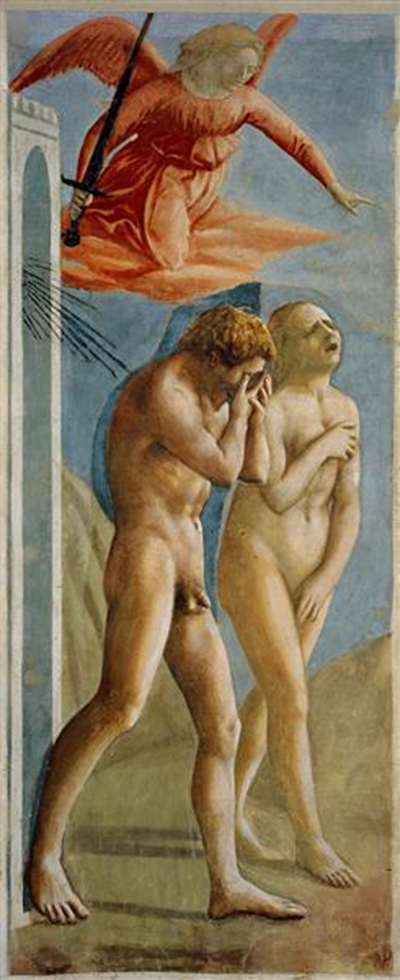
The Expulsion from the Garden of Eden showed how naked bodies could carry shame, grief and theological meaning. Michelangelo later made the nude body one of the central languages of his art. The difference is scale and intensity rather than principle. Masaccio proves the body can carry doctrine; Michelangelo makes that body heroic and monumental.
Michelangelo’s Sistine Chapel. Michelangelo’s own Fall and Expulsion on the Sistine ceiling inevitably invites comparison with Masaccio. The compositions differ, but both make Adam and Eve’s transformation visible through bodily movement. Masaccio’s deeper legacy lies in that conviction. Theology becomes anatomy in action.
Michelangelo and Monumentality. Masaccio’s apostles possess gravity without exaggerated musculature. Michelangelo turns bodily monumentality into a much more overtly powerful anatomy. The later development should not obscure the earlier foundation. Masaccio had already made weight central to sacred meaning.
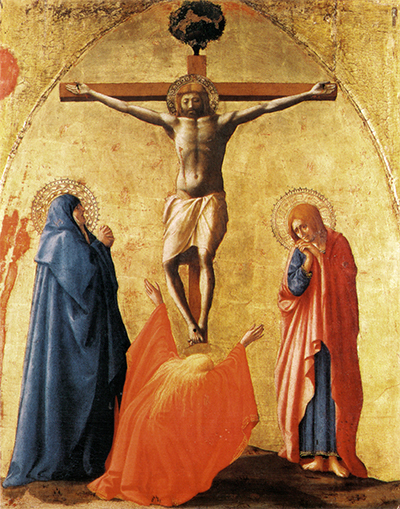
Michelangelo and Gesture. Adam covering his face and Magdalene raising her arms in the Pisa Crucifixion demonstrate Masaccio’s belief that gesture can carry overwhelming emotion. Michelangelo repeatedly uses the whole body similarly. Emotional meaning becomes inseparable from pose.
Perspective after Masaccio
By the later fifteenth century, perspective had become normal rather than revolutionary. Artists such as Filippino, Leonardo and Perugino inherited a spatial language Masaccio had helped establish. This is one of the paradoxes of influence. The more successful an innovation becomes, the less visible its origin can seem.
From Innovation to Convention. Masaccio’s perspective is historically dramatic because it is early. Later painters use similar systems so naturally that the technique no longer announces itself. Influence therefore becomes embedded in normal practice. What was once radical becomes grammar.
Bodies after Masaccio. The same is true of bodily mass. Later Florentine painters could assume that figures should possess weight and occupy coherent space. Masaccio’s achievement therefore becomes invisible through success. The body he made new becomes standard.
Domenico Veneziano. Domenico Veneziano represents another Florentine response to the new spatial world. His colour and light are quite different from Masaccio’s, yet his figures inhabit measured architectural settings with confidence. This demonstrates how widely the new vocabulary spread. Masaccio becomes one source within a broader Renaissance synthesis.
Piero della Francesca
Piero della Francesca developed perspective and geometrical order with unprecedented theoretical sophistication. His work is not simply an extension of Masaccio, but the historical pathway between them is clear. Masaccio showed what measured space could do emotionally. Piero later made geometry itself one of the defining intellectual structures of painting.
Uccello. Paolo Uccello became famous for intense perspectival experimentation. His work demonstrates how a technical problem central to Masaccio’s generation could become almost an obsession in the next. The comparison reveals branching development. Renaissance perspective did not have one destination.
Botticelli. Botticelli is much more linear and decorative than Masaccio, yet even his figures inhabit a Florentine visual culture transformed by earlier spatial and bodily innovations. This is another example of influence becoming indirect. Later style can diverge significantly while retaining structural assumptions inherited from predecessors.
Ghirlandaio. Ghirlandaio’s large narrative fresco cycles combine contemporary portraiture, coherent architecture and monumental groups. These features belong to the mature development of problems Masaccio had already confronted in the Brancacci Chapel. By Ghirlandaio’s generation, such integration had become part of Florentine mural practice. Masaccio’s revolution had become tradition.
Raphael
Raphael did not train in Florence from childhood, but his Florentine years exposed him to the city’s accumulated tradition of figure composition and perspective. Masaccio therefore influences him indirectly through generations of painters shaped by the Brancacci legacy. Artistic influence often travels through chains rather than direct encounters.
The School of Florence. Masaccio is often described as a founder of the Florentine school because his solutions became foundational to the city’s artistic identity. That label should not imply exclusivity. Florence’s Renaissance emerged through Brunelleschi, Donatello, Ghiberti, Masolino, Fra Angelico and many others. Masaccio’s importance lies in painting’s response to that shared revolution.
The Body as Florentine Language. One of Florence’s great artistic strengths became the monumental human figure. Sculpture and painting both placed exceptional emphasis on bodily structure. Masaccio sits at the centre of this development. He translates sculptural seriousness into pictorial form.
Light as Florentine Language. Coherent light likewise becomes increasingly important. It allows bodies to share atmosphere and architecture. Later painters develop different approaches, but the basic principle remains. Light organises reality.
Perspective as Florentine Language
Perspective becomes perhaps the most famous Florentine contribution to Renaissance painting. Masaccio’s early adoption helped prove its expressive power. The technique then spreads beyond Florence. A local experiment becomes European visual language.
Emotional Economy. Masaccio’s emotional restraint also influenced later narrative. Rather than filling scenes with exaggerated gesture, he often chooses one or two decisive actions. This economy gives emotion weight. Later artists could either preserve or intensify it.
The Social Body. Masaccio also expands the social range of sacred painting. Poor people, tax collectors, sick bodies and converts occupy serious visual space. Later Renaissance narrative increasingly includes socially differentiated crowds. The sacred world becomes populated like a city.
Portrait-Like Faces. The Brancacci Chapel also encourages later portrait traditions. Figures appear individualized enough to invite identification as contemporary Florentines. This contributes to the Renaissance merging of sacred history and contemporary social identity. The past looks increasingly like the present.
The Chapel and Artistic Memory
By the time Filippino worked there, the Brancacci Chapel was already historic. Later artists encountered not simply frescoes but a monument recognised as foundational. This matters because influence is strengthened by reputation. Artists study what their culture tells them is important.
Vasari and Masaccio’s Reputation. Vasari helped codify Masaccio’s place in a progressive history of Renaissance art. His biography portrays the painter as a decisive step towards greater naturalism. Modern scholarship is more cautious about linear progress, but Vasari’s influence on reputation was enormous. He helped make Masaccio a canonical ancestor.
The Problem of Heroic Narratives. The traditional story can exaggerate Masaccio’s isolation, as though one genius transformed painting alone. The surviving evidence shows a network of collaboration with Masolino, proximity to Donatello and a spatial culture shaped by Brunelleschi. Influence should therefore be understood within exchange. Masaccio is central, not solitary.
Influence without Copying. This is the most important methodological point. Fra Angelico does not look like Masaccio, Filippo Lippi is more lyrical and Michelangelo is far more muscular. Yet all can absorb his principles. Influence works beneath surface style.
Structural Influence
Structural influence includes how figures occupy space, how light creates mass and how groups remain coherent. These are deeper than motifs. Once absorbed, they become difficult to trace because they feel natural. This is precisely why Masaccio’s influence became so pervasive.
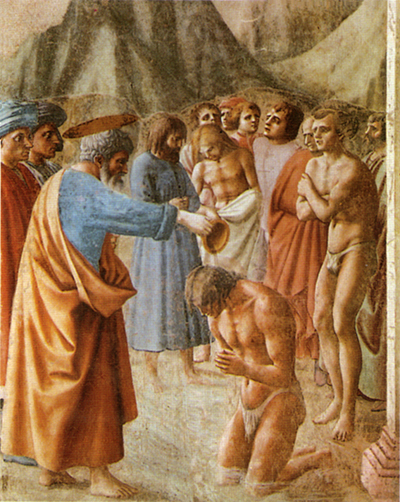
Emotional Influence. Masaccio also proves that sacred emotion can be bodily and direct. Adam hides his face, Eve cries, a convert shivers and Magdalene raises her arms. Later artists inherit the freedom to let the body speak. Gesture becomes theology.
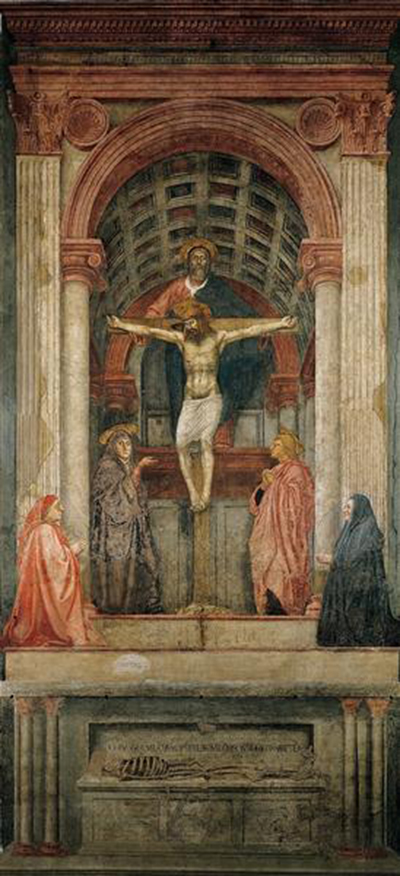
Influence through the Viewer. The Holy Trinity adds another legacy: the viewer’s physical position matters. Painting becomes increasingly conscious of spectatorship. This principle would transform Renaissance illusionism. Space is designed for someone standing somewhere specific.
Influence beyond Florence. Masaccio’s ideas spread through Florentine artists, travelling commissions and the broader prestige of the city. Perspective and bodily monumentality became European concerns. The influence therefore exceeds any list of direct followers. Masaccio helps change what ambitious painting is expected to achieve.
Why Fra Angelico Matters in the Story
Fra Angelico proves that Masaccio’s innovations could enter a radically different emotional language. Monumentality becomes luminous and contemplative. This shows the flexibility of influence. New structure does not dictate one style.
Why Fra Filippo Lippi Matters. Fra Filippo demonstrates how Masaccio’s bodily credibility could combine with tenderness, line and lyrical colour. His Carmelite connection also gives the transmission unusual physical immediacy. He grew artistically in the shadow of the Brancacci walls.
Why Filippino Matters. Filippino turns influence into direct historical dialogue. He must complete Masaccio rather than merely remember him. His work therefore shows Renaissance artists becoming conscious of their own artistic past.
Why Leonardo Matters. Leonardo develops group psychology, gesture and atmosphere far beyond Masaccio while remaining within a tradition of bodies inhabiting coherent worlds. Masaccio’s contribution lies in helping make that ambition normal. Painting becomes a study of human action in space.
Why Michelangelo Matters
Michelangelo reveals the ultimate power of Masaccio’s bodily legacy. The human figure becomes capable of carrying enormous intellectual, theological and emotional meaning. Masaccio’s severe bodies become ancestors to the heroic nude of the High Renaissance.
Why Masaccio’s Influence Matters. Masaccio’s influence matters because he changed not simply what later painters copied but what they expected painting to do. Bodies should feel heavy, light should behave coherently, architecture should create believable space and sacred stories should be inhabited by recognisable human beings. Fra Angelico transformed these lessons into contemplative luminosity, Fra Filippo Lippi into lyrical intimacy and Filippino into a conscious dialogue with an earlier master.
Leonardo developed group psychology and atmosphere, while Michelangelo pushed the expressive body towards unprecedented monumentality. The Brancacci Chapel made this transmission possible by remaining physically available. Artists could return to the walls, draw and study, turning Masaccio’s short life into a long institutional presence. His greatest influence therefore lies in normalization. Perspective, bodily weight and emotional realism eventually became so standard that later Renaissance art could hardly imagine ambitious painting without them. Masaccio’s revolution succeeded when it stopped looking revolutionary.
Frequently Asked Questions
Discussion
Use this space to discuss Influence on Renaissance Florence | Masaccio, its source evidence and how it fits into Masaccio's wider cluster.
Keep comments focused on close looking, attribution language, object evidence and page-specific caveats.
Reader Insights
Which detail on this page most changes how you read the work?
How does this page connect to Masaccio's paintings, fresco technique or Florentine setting?
Where should the wording stay cautious because the source evidence is qualified?
Join the Conversation
Share your reading of Influence on Renaissance Florence | Masaccio below.
References and Research Sources
- National Gallery, London, Masaccio artist biography, for his historical influence, monumental figures, light, Giotto, Donatello and perspective. View Source
- Museo Nacional del Prado, research on Fra Angelico and the Early Renaissance, for Angelico’s response to Masaccio and Masolino.
- Comune di Firenze / Musei Civici Fiorentini, Brancacci Chapel history, for the chapel’s later role and Filippino Lippi’s completion. View Source
- FeelFlorence, Brancacci Chapel, for Masaccio’s revolutionary role and later artistic study. View Source
- MUS.E Firenze, Brancacci Chapel resources, for the chapel’s historical and institutional importance. View Source
- Smarthistory, Brancacci Chapel resources, for Michelangelo’s later study and the frescoes’ influence on Renaissance figure painting. View Source