 by Tom Gurney
Tom Gurney BSc (Hons) is an art history expert with over 20 years experience
Published on June 19, 2020 / Updated on October 14, 2023
Email: tomgurney1@gmail.com / Phone: +44 7429 011000
Introduction
The relationship between Masaccio and Filippo Brunelleschi stands at the centre of one of the most important questions in Early Renaissance art: how did a new understanding of measured space move from architecture into painting? Brunelleschi is widely credited with developing the Florentine single-point perspective system, while Masaccio became one of the first painters to demonstrate how radically that system could transform sacred images.
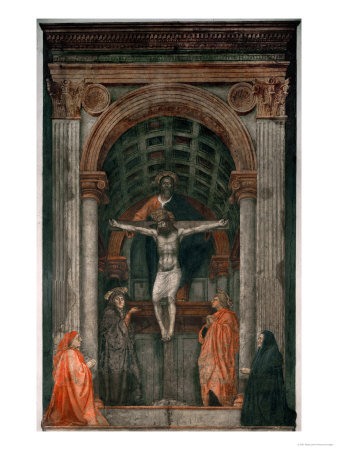
The two men should not be turned into a tidy master-and-pupil pairing. No document proves that Brunelleschi formally taught Masaccio, and no surviving contract records them collaborating on a painting, but the visual evidence makes Brunelleschi’s importance unmistakable. The San Giovenale Triptych of 1422 already shows Masaccio organising three physically separated panels through one perspectival ground, while the Holy Trinity at Santa Maria Novella creates one of the most convincing fictive architectural spaces of the fifteenth century.
Santa Maria Novella itself notes that the extraordinary perspectival construction has long encouraged the hypothesis that Brunelleschi helped devise it, though the idea remains unproven. The strongest interpretation is therefore one of intellectual proximity. Brunelleschi developed a way of thinking about space from a fixed spectator’s position, and Masaccio showed how that way of thinking could make sacred bodies, architecture and theology feel physically present.
At a Glance
- Filippo Brunelleschi1377–1446
- Masaccio1401–1428/29
- Brunelleschi’s principal relevancedevelopment of single-point linear perspective
- Masaccio’s principal rolerevolutionary early pictorial application
- Earliest key Masaccio exampleSan Giovenale Triptych, 1422
- Major mature exampleHoly Trinity, Santa Maria Novella
- Brunelleschi hypothesispossible assistance with the Holy Trinity perspective
- Documentary statusno surviving proof of direct collaboration
- Shared Florentine contextarchitecture, sculpture, perspective and humanist revival
- Core principleBrunelleschian geometry becomes pictorial experience in Masaccio
Contents
- Brunelleschi’s Perspective Experiments
- Why San Giovenale Matters
- Brunelleschi and Donatello
- The Pisa Polyptych
- Why Scholars Suspect Brunelleschi
- Two Fields of Vision
- Donors and Real Space
- Perspective and Humanism
- Practical Intelligence
- Why Masaccio and Brunelleschi Matter Together
- Frequently Asked Questions
- References and Research Sources
Brunelleschi’s Perspective Experiments
Brunelleschi’s experiments in perspective belong to the first decades of the fifteenth century. Later accounts describe him producing small painted demonstrations of Florentine views that required the spectator to look from a fixed point, helping establish the principle that receding parallel lines could be organised around one vanishing point. The National Gallery describes the single-point linear system as developed by Brunelleschi in relation to architecture. This gives him a fundamental role in the history of Renaissance representation, but the system only became transformative for painting when artists began adapting it to complex pictorial problems.
Perspective and Architecture. Brunelleschi approached perspective as an architect. Buildings could be understood through proportion, measured recession and the relationship between a real observer and a constructed space. Masaccio inherited this architectural logic but applied it to painted worlds. Instead of simply drawing more convincing buildings, he used the system to determine where sacred figures stand, how viewers approach them and how the painted image relates to real architectural space.
A Shared Florentine Culture. Masaccio did not encounter Brunelleschian ideas in isolation. Florence in the 1420s was an intensely collaborative visual environment in which Donatello, Ghiberti, Brunelleschi, Masolino and other artists were exchanging solutions across painting, sculpture and architecture. This makes direct lines of influence difficult to reconstruct precisely. Ideas could move through conversations, shared patrons, workshop assistants, public monuments and simple observation without leaving contracts behind.
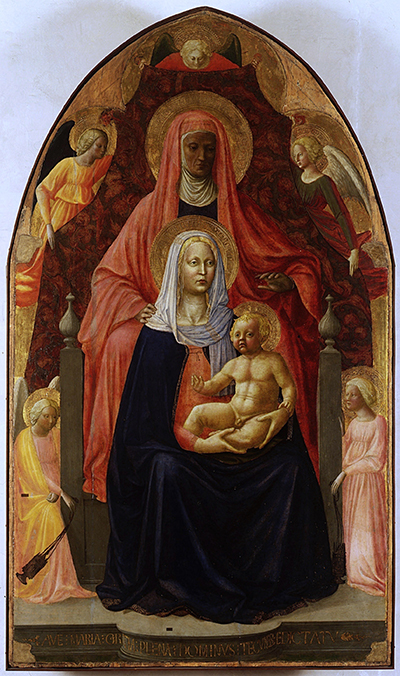
The San Giovenale Triptych. The San Giovenale Triptych provides the earliest surviving evidence for Masaccio’s perspectival thinking. Museo Masaccio identifies it as the young painter’s first known work and emphasises the central perspective that unifies all three compartments. Orthogonal lines in the green floor converge near the Virgin’s neck, creating one common spatial field beneath a traditional gold ground. The frame divides the work materially, but the perspective reunites it optically.
Why San Giovenale Matters
This is one reason Masaccio’s perspective should not be understood merely as a mature technical flourish. By 1422 he was already using spatial geometry to solve structural problems within an inherited devotional format. The triptych is particularly important because it predates the Holy Trinity by only a few years. Masaccio’s later mastery therefore grows from an interest visible at the very beginning of his known career.
The Virgin as Spatial Centre. The vanishing point at or near Mary’s neck has both technical and devotional significance. Perspective directs the eye towards the Virgin and Child, making sacred hierarchy and spatial construction reinforce one another. This is an early sign of Masaccio’s distinctive use of geometry. The system is never neutral; it serves the religious purpose of the image.
Brunelleschian Architecture in Painting. Brunelleschi’s buildings relied on clear geometric relationships, pale wall surfaces and pietra-serena-like structural accents. Similar architectural vocabularies appear increasingly in Florentine painting, where artists used them to create spaces that felt contemporary and rational. The National Gallery notes that the pale grey architectural stone in Masaccio’s Pisa Virgin and Child would have reminded viewers of the pietra serena used in Brunelleschi’s churches. Architectural fashion and pictorial space were therefore developing together.
Masaccio’s Bodies inside Architecture. The importance of Brunelleschi to Masaccio lies partly in the fact that measured architecture gives bodily mass a convincing environment. A monumental Virgin becomes more believable when the throne and room around her obey a coherent spatial logic. Masaccio’s achievement is therefore not architecture alone. He makes body and setting belong to one system, allowing painted figures to feel almost as physically present as sculpture.
Brunelleschi and Donatello
Brunelleschi’s relationship with Donatello reinforces this broader network. The two sculptors and architects shared interests in antiquity, proportion and perspective, while Masaccio absorbed similar concerns through painting. This is why Early Renaissance innovation cannot be reduced to one isolated workshop. Architecture, relief sculpture and fresco painting were solving related problems simultaneously.
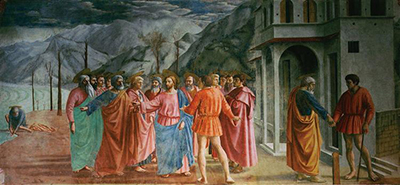
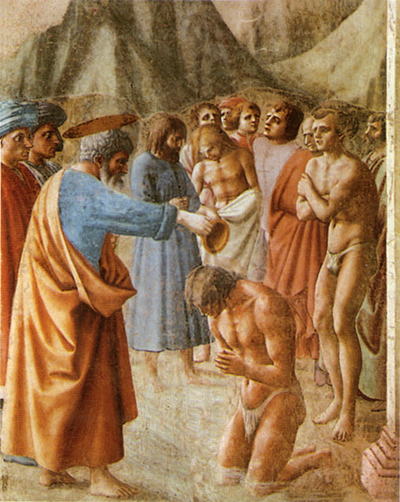
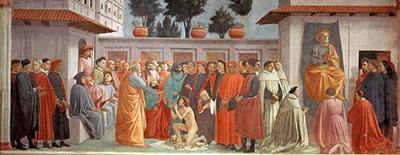
The Brancacci Chapel. The Brancacci Chapel demonstrates Masaccio’s ability to apply perspectival thinking to more complex narrative settings. Streets, buildings and landscapes create believable environments without turning every fresco into a conspicuous geometrical demonstration. Perspective here becomes almost invisible because it serves social action. Apostles, tax collectors, the sick and the poor occupy spatially coherent settings that feel continuous with the viewer’s own world.
Perspective as Narrative Support. In The Tribute Money, several moments of one Gospel episode unfold across a single setting. The viewer can move visually between Christ’s central group, Peter at the lake and the final payment because the landscape and architecture remain stable. The system therefore allows narrative time to unfold inside continuous space. This is one of Masaccio’s great innovations and one reason Brunelleschian geometry became so useful to painters.
Perspective without Architectural Display. Some Brancacci scenes contain relatively little architecture, yet still feel spatially coherent. Masaccio does not need columns and grids everywhere because relative scale, overlap, ground planes and consistent light also establish depth. This shows how quickly he moved beyond mechanical perspective. Once the spatial logic was internalised, it could support the entire scene without announcing itself.
The Pisa Polyptych
The Pisa Polyptych adds another Brunelleschian dimension because the altarpiece itself was an architectural object. Painted panels occupied different heights and positions, requiring Masaccio to think not only about depth inside each panel but about the spectator’s real viewpoint below the ensemble. This concern with actual sightlines brings painting even closer to architecture. The object is designed for a person standing in a specific chapel, not for a modern museum wall.
Pietra Serena and the Pisa Madonna. The central Pisa Virgin and Child includes pale grey architectural elements that the National Gallery connects with Brunelleschi’s use of pietra serena. The association would have made the painted throne feel strikingly modern to contemporary Florentine viewers. Masaccio therefore imports the visual language of new architecture into sacred panel painting. Mary sits within a space that belongs to the Renaissance city rather than to an abstract medieval throne.
Brunelleschi in Pisa. National Gallery research also notes that Brunelleschi was present in Pisa in 1426, the same year Masaccio was working on the polyptych. This does not prove collaboration, but it adds another layer of physical proximity between the architect and painter during a major commission. As with Donatello, the historical situation is strongest when described as shared presence and possible exchange rather than as an undocumented formal partnership.
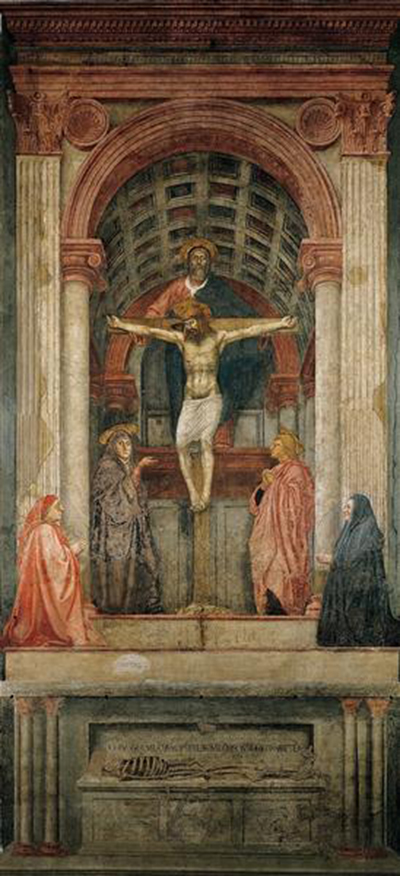
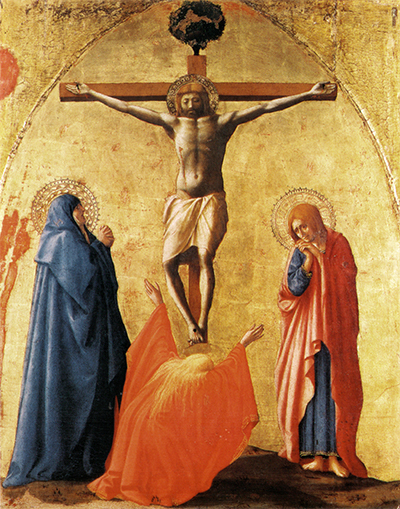
The Holy Trinity. The Holy Trinity is the work in which the Brunelleschi question becomes unavoidable. Painted at Santa Maria Novella around 1425–26, though some technical scholarship proposes a slightly earlier date, the fresco creates the illusion of a barrel-vaulted chapel opening through the wall. The perspective is so persuasive that it has long been regarded as a pictorial manifesto of the new Florentine spatial system. Santa Maria Novella itself notes the traditional hypothesis that Brunelleschi devised the construction, citing the sophisticated geometrical knowledge required.
Why Scholars Suspect Brunelleschi
The argument rests on both complexity and style. The fictive chapel uses a classical architectural vocabulary associated closely with Brunelleschi’s built work, while the geometry assumes a level of perspectival planning consistent with his known experiments. None of this establishes direct authorship. The evidence demonstrates compatibility and intellectual connection rather than documentary proof.
No Contract, No Drawing, No Witness. No surviving contract records Brunelleschi working on the Trinity, and no contemporary drawing establishes his hand in the design. There is also no secure eyewitness account describing a collaboration between architect and painter. This absence matters because later art history has often repeated the collaboration as though it were certain. The strongest phrasing is that Brunelleschi’s involvement is a long-standing and plausible hypothesis, while Masaccio’s execution and authorship remain secure.
The Fictive Chapel. The fresco appears to cut a deep architectural opening into the wall of Santa Maria Novella. Coffers recede across the barrel vault, columns and pilasters establish order, and sacred figures occupy a space that seems physically continuous with the real church. The illusion works because the architectural system begins from the spectator’s viewpoint. Perspective therefore creates not only depth but a relationship between real nave and painted chapel.
The Viewer as Part of the System. A major Brunelleschian principle is that perspective assumes a viewer standing somewhere specific. Masaccio uses that principle brilliantly by placing the vanishing point near the eye level of a standing spectator. The result makes the fictive architecture seem to continue naturally from the viewer’s own world. The spectator is no longer outside an abstract image; the entire construction is built around the fact of being seen.
Two Fields of Vision
Santa Maria Novella has drawn attention to the fresco’s relationship with both a distant approach from the church entrance and a closer central viewpoint near the tomb slabs in the nave. This dual viewing situation suggests that Masaccio’s geometry was adapted to real movement through the building. The point complicates simplistic textbook diagrams. Renaissance perspective could be rigorous without being mechanically pure, because the artist had to make the painting work for actual bodies moving through actual architecture.
Bending the Rules. National Gallery research makes the same point from another direction, noting that the Trinity bends strict one-point perspective rules in places, probably because the resulting image worked better visually. This is an important corrective to the myth of mathematical perfection. Perspective served painting, not the reverse. Masaccio’s genius lies partly in knowing when geometrical consistency should yield to optical persuasion.
Classical Architecture. The fictive chapel also reveals Brunelleschi’s importance through classical architectural language. Rounded arches, Corinthian or classically derived orders and carefully proportioned structural elements place Christian theology inside a revived antique visual world. This does not secularise the fresco. Classical form becomes a dignified framework for the Trinity and Crucifixion.
God the Father and the Architecture. God the Father stands behind the Cross within the deepest sacred zone of the fictive chapel. The geometry therefore does more than create an impressive room; it places divine hierarchy inside a measurable spatial order. Perspective becomes theological architecture. The invisible mystery of the Trinity is given a visual structure that human viewers can enter conceptually.
Donors and Real Space
The kneeling donors occupy a shallower zone closer to the viewer. Their placement creates a transition between the real spectator and the deeper sacred vision. This layered spatial hierarchy is crucial. Masaccio uses perspective to distinguish levels of access without abandoning the unity of the scene.
The Skeleton Below. The skeleton and memento-mori inscription occupy a lower zone associated with death. Above, the fictive chapel opens towards divine salvation. The vertical arrangement therefore turns architectural space into a devotional journey. Mortality, intercession, sacrifice and eternity are placed in a spatial hierarchy.
Brunelleschi’s Crucifix at Santa Maria Novella. Santa Maria Novella also preserves Brunelleschi’s wooden Crucifix, dated around 1410–15. This means that Masaccio’s Trinity and Brunelleschi’s sculpture ultimately inhabited the same church environment, even though no direct project link is documented. The coincidence reinforces the broader artistic atmosphere of the building. Santa Maria Novella became one of the places where new sculpture, painting and architecture could be experienced in relation to one another.
Architecture as a Language of Modernity. For a fifteenth-century viewer, Brunelleschian architectural forms would have appeared strikingly current. Masaccio’s use of similar structures therefore helped make biblical theology feel contemporary rather than archaeologically remote. This is a recurring Renaissance strategy. Sacred history is translated into the visual language of the viewer’s own city.
Perspective and Humanism
Brunelleschi’s recovery of classical proportion and Masaccio’s adoption of measured space also belong to the broader humanist culture of Florence. Antiquity provided forms and intellectual models, but artists transformed them rather than copying them passively. The Trinity demonstrates this synthesis especially clearly. A Christian mystery inhabits an architectural world inspired by classical Rome and rational geometry.
The Difference between Architect and Painter. Brunelleschi builds actual spaces; Masaccio constructs fictive ones. This difference matters because a painted chapel can defy real material constraints while still appearing plausible. Masaccio therefore uses architectural thinking imaginatively. He does not reproduce one Brunelleschi building but creates a painted architecture that behaves according to Brunelleschian principles.
Perspective as Translation between Media. The relationship between the two artists is best understood as translation between media. Brunelleschi’s architectural and perspectival discoveries provide conceptual tools, while Masaccio turns those tools into pictorial space inhabited by human figures. This translation changes perspective itself. In painting, geometry becomes capable of organising narrative and theology as well as buildings.
Was Masaccio Mathematically Trained? No surviving evidence tells us exactly how much formal mathematical instruction Masaccio received. His paintings demonstrate practical mastery of perspective, but that does not require us to imagine him as a theoretical mathematician. Renaissance workshops often absorbed complex knowledge through demonstration and practice. Masaccio could use geometry effectively without leaving treatises or diagrams.
Practical Intelligence
This distinction helps explain why his perspective bends rules when needed. Masaccio is not producing proofs; he is producing paintings designed to look convincing from real viewpoints. The success of the Trinity lies in perceptual intelligence rather than mathematical purity.
Brunelleschi and Masaccio as Collaborators in a Broader Sense. Even if no direct collaboration on the Trinity can be proved, the two artists collaborated historically in a broader cultural sense. Brunelleschi changed the possibilities of spatial representation, and Masaccio demonstrated what those possibilities could do inside painting. Their achievements are therefore interdependent without requiring one undocumented workshop partnership.
Influence after Masaccio. Later painters inherited Masaccio’s pictorial application of Brunelleschian space. Fra Angelico, Filippo Lippi, Domenico Veneziano, Piero della Francesca and many others developed perspective according to their own needs. The system gradually became part of the standard language of Renaissance painting. Masaccio’s early examples mattered because they proved its expressive potential.
Brunelleschi after Masaccio. Brunelleschi’s own architectural career continued long after Masaccio’s death, allowing the new spatial language to become increasingly visible across Florence. Churches such as San Lorenzo and Santo Spirito made measured proportion part of the city’s lived environment. Painting and architecture therefore reinforced one another culturally. Viewers learned to recognise a Renaissance language across media.
Why Masaccio and Brunelleschi Matter Together
Masaccio and Brunelleschi matter together because they show how a technical discovery becomes an artistic revolution only when it acquires expressive purpose. Brunelleschi’s perspective provided a system for organising space from a fixed viewpoint, but Masaccio demonstrated that such space could transform how sacred figures and viewers relate to one another. The San Giovenale Triptych begins this process modestly by unifying a traditional altarpiece. The Pisa Polyptych extends perspectival thinking into real installation and viewing height, while the Holy Trinity turns a church wall into a fictive chapel whose geometry places the spectator inside a theological hierarchy. The famous question of whether Brunelleschi personally helped design the Trinity remains unresolved.
It is plausible and historically meaningful, but it should remain a hypothesis rather than a fact. What is secure is more important. Masaccio’s painting would be almost unimaginable without the spatial culture Brunelleschi helped create, and Brunelleschi’s perspective became historically transformative in part because painters such as Masaccio proved what it could achieve.
Frequently Asked Questions
Discussion
Use this space to discuss Masaccio and Brunelleschi | Masaccio, its source evidence and how it fits into Masaccio's wider cluster.
Keep comments focused on close looking, attribution language, object evidence and page-specific caveats.
Reader Insights
Which detail on this page most changes how you read the work?
How does this page connect to Masaccio's paintings, fresco technique or Florentine setting?
Where should the wording stay cautious because the source evidence is qualified?
Join the Conversation
Share your reading of Masaccio and Brunelleschi | Masaccio below.
References and Research Sources
- National Gallery, London, perspective glossary and Filippo Brunelleschi biography. View Source
- National Gallery, London, Building the Picture: Putting Perspective into Perspective. View Source
- National Gallery, London, Place Making, on Brunelleschi’s experiments and perspective as a means of depicting place. View Source
- Santa Maria Novella, Masaccio’s Holy Trinity. View Source
- Santa Maria Novella, Brunelleschi’s Crucifix. View Source
- Museo Masaccio, San Giovenale Triptych. View Source
- National Gallery, London, Masaccio, Virgin and Child from the Pisa Polyptych. View Source
- National Gallery, London, scholarly catalogue for the Pisa Polyptych. View Source