 by Tom Gurney
Tom Gurney BSc (Hons) is an art history expert with over 20 years experience
Published on June 19, 2020 / Updated on October 14, 2023
Email: tomgurney1@gmail.com / Phone: +44 7429 011000
Introduction
Masaccio and Giotto were separated by roughly a century, yet the relationship between them is fundamental to understanding why Masaccio’s paintings appeared so revolutionary in fifteenth-century Florence. The National Gallery explicitly identifies Giotto as the earlier Florentine painter who had already modelled monumental figures through light, and it presents Masaccio as the artist who revived and extended that approach while combining it with the new language of linear perspective.
The connection should not be reduced to a simple claim that Masaccio “copied Giotto.” Their works belong to different historical moments, and Masaccio’s Florence possessed new architectural, sculptural and optical knowledge that Giotto could not have shared in the same form. What Masaccio seems to recover from Giotto is a deeper artistic principle: sacred figures should possess bodily seriousness, narrative actions should be emotionally intelligible and architecture should support rather than distract from human drama.
Masaccio then reworks those principles through the technical and intellectual discoveries of the early fifteenth century. The result is one of the most important examples of artistic inheritance in the Renaissance. Innovation comes not from rejecting the past completely but from identifying an earlier tradition that could be made newly useful.
At a Glance
- Giottoc. 1267–1337
- Masaccio1401–1428/29
- Historical gaproughly one century
- Shared centreFlorence and Tuscany
- Key inheritancemonumental bodies, gravity, emotional clarity and coherent narrative
- Major differenceMasaccio adds systematic linear perspective and a more unified treatment of light
- Important Masaccio works for comparisonSan Giovenale Triptych, Brancacci Chapel, Pisa Polyptych and Holy Trinity
- Core ideaMasaccio revives Giotto’s seriousness rather than simply imitating his style
Contents
- Giotto’s Florentine Legacy
- Emotion through the Body
- San Giovenale and Giotto
- Light in the Brancacci Chapel
- The Pisa Crucifixion
- Why Giotto Again?
- Hierarchy
- Progress without Simplicity
- Why Masaccio and Giotto Matter Together
- Frequently Asked Questions
- References and Research Sources
Giotto’s Florentine Legacy
Giotto had already transformed Italian painting in the early fourteenth century by giving sacred figures a new sense of weight and emotional credibility. His paintings move away from purely linear or hieratic arrangements and towards bodies that seem capable of standing, sitting, grieving and embracing inside a shared world. This legacy remained fundamental to Florentine artistic identity even as later Gothic styles emphasised elegance, ornament and surface refinement. By Masaccio’s lifetime, Giotto had become part of the city’s historical artistic memory rather than a contemporary model, which made his rediscovery especially significant.
Monumental Bodies. The most obvious connection lies in bodily mass. Giotto’s figures have weight, and Masaccio pushes that quality further by combining it with directional light, perspective and a more analytical understanding of how bodies occupy space. The difference is therefore one of intensity and system rather than complete conceptual break. Giotto establishes the possibility of monumental sacred figures; Masaccio places them inside a more rigorously ordered Renaissance world.
Weight rather than Decoration. Both painters resist treating the body as a decorative contour. Drapery falls around mass, gestures arise from physical posture and figures appear to possess gravity rather than floating against the surface. This is one reason Masaccio can feel unexpectedly severe beside more courtly contemporaries. His interest lies less in ornamental elegance than in the structural credibility of the human figure, a priority that finds one of its strongest precedents in Giotto.
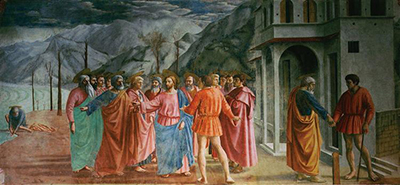
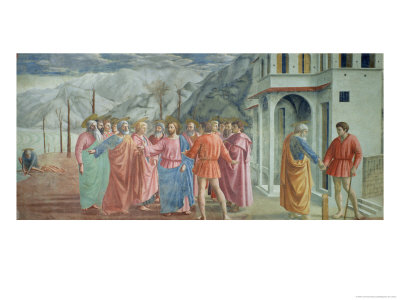
Giotto’s Narrative Clarity. Giotto also offers a model for clear sacred narrative. His compositions tend to organise figures around one dominant emotional or theological action, allowing viewers to understand the event without becoming lost in decorative detail. Masaccio adopts the same discipline. Even when The Tribute Money contains several moments from the story, the central group around Christ remains the visual anchor, and the rest of the narrative is subordinated to that structure.
Emotion through the Body
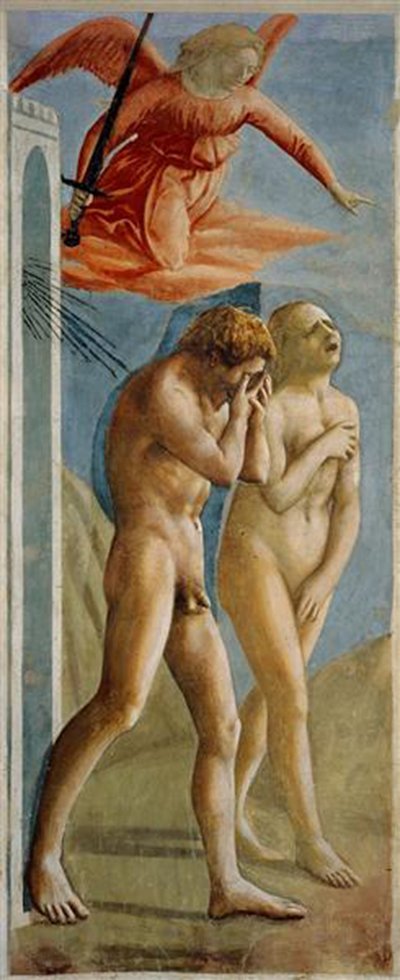
Giotto’s emotional power often depends upon bodily gesture rather than elaborate facial expression alone. Mourners lean, embrace, reach and collapse, creating emotional relationships that can be understood almost before individual faces are examined. Masaccio develops this approach with extraordinary force in the Expulsion from the Garden of Eden. Adam’s covered face and Eve’s entire bodily posture carry the grief, making the scene emotionally legible through anatomy and movement.
Expulsion and Giotto’s Grieving Figures. The comparison is especially useful because Masaccio does not make Adam and Eve elegant sufferers. Their bodies become awkward through grief, and emotional truth takes priority over idealised beauty. Giotto’s mourning figures had established a similar willingness to let the body become emotionally expressive. Masaccio intensifies the effect through nudity, directional light and a stronger sense of the figures moving through real space.
Architecture in Giotto. Giotto’s architecture is often compact and functional. Buildings create rooms, thresholds and stages for action, but they do not usually obey the mathematically consistent single-viewpoint system associated with Brunelleschi’s later perspective. Masaccio inherits the idea that architecture should support narrative while possessing a new method for making it spatially coherent. The result is an important continuity beneath a technical revolution.
From Empirical Space to Perspective. Giotto could create persuasive spatial effects through observation and pictorial judgement. Masaccio works in a culture increasingly interested in mathematical construction, so his buildings and floors can be organised around common vanishing structures. The distinction does not make Giotto primitive. It shows how Masaccio brought an older Florentine concern with believable sacred space into a new optical system.
San Giovenale and Giotto
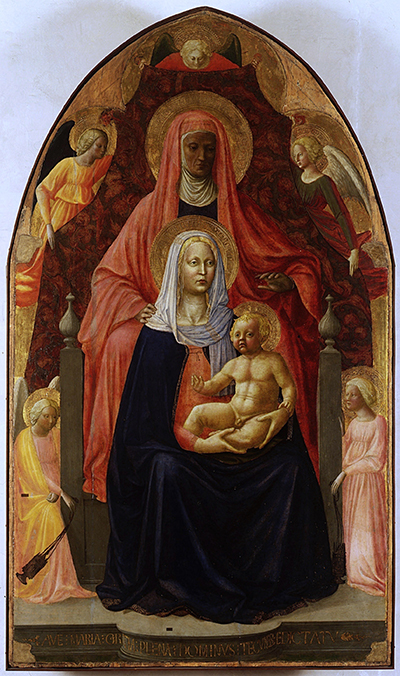
The San Giovenale Triptych is already useful for this comparison. Its gold background and compartmental structure preserve medieval convention, but the Virgin’s physical mass and the throne’s recession recall the seriousness of Giotto while moving decisively towards the Renaissance. Masaccio therefore begins not by erasing the older Florentine tradition but by reactivating it. The triptych can be understood as a bridge between Giottesque monumentality and Brunelleschian spatial logic.
The Virgin as Monument. Giotto frequently gave the Virgin a strong bodily and architectural presence, particularly in enthroned images. Masaccio’s Madonnas continue this tradition but increase the sense that the body has measurable depth and occupies a physically rational throne. The central Virgin in the Pisa Polyptych is one of the clearest examples. Mary appears massive enough to belong almost to sculpture, while the throne uses perspective to make the sacred figure part of a spatial system Giotto’s generation had not yet possessed.
Pisa Virgin and Giotto’s Maestà Tradition. The connection also works at the level of sacred hierarchy. Both painters can make Mary monumental without making her emotionally inaccessible, allowing physical scale and devotional intimacy to coexist. Masaccio’s child eating grapes adds a particularly fifteenth-century naturalism. The sacred image becomes more observational while retaining the gravity of the older Florentine Maestà tradition.
Giotto and Light. The National Gallery highlights Giotto’s use of light to model monumental figures and identifies Masaccio as an artist who revived that approach. Light in Giotto helps distinguish planes and give bodies volume, but Masaccio makes illumination still more consistent across groups and architecture. This coherence becomes one of his defining innovations. In the Brancacci Chapel, figures seem subject to the same source of light, allowing separate bodies to belong to one atmosphere.
Light in the Brancacci Chapel
The effect is particularly powerful in The Tribute Money. Apostles are not individually modelled under separate idealised illumination; shadow moves across the group with enough consistency to make the entire gathering feel physically present. Masaccio therefore extends a Giottesque concern into a more systematic naturalism. Light becomes not only a modelling tool but a means of unifying space.
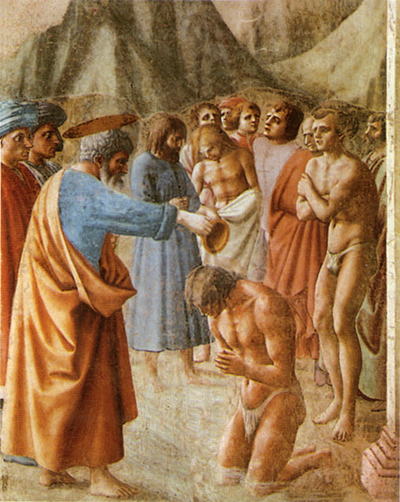
Human Scale. Both painters also resist making sacred history impossibly remote. Their figures are monumental, yet their bodies remain recognisably human, and ordinary physical responses are allowed to carry religious meaning. This quality is especially evident in Masaccio’s Baptism of the Neophytes, where one man shivers from cold. The detail belongs to a new observational culture, but the basic belief that sacred history becomes more powerful through human credibility has a strong Giottesque precedent.
Crowd Organisation. Giotto had already demonstrated how groups could reinforce narrative rather than merely fill space. Masaccio takes this further by organising crowds through perspective, directional light and carefully varied bodily responses. The apostles in Tribute Money form a social group rather than a decorative row. Their arrangement shows how an older narrative principle becomes newly powerful when combined with Renaissance spatial tools.
The Lamentation Tradition. Giotto’s famous treatment of mourning at Padua became one of the great models for emotionally structured religious painting. Although Masaccio’s surviving corpus contains no directly equivalent large Lamentation, his Expulsion and Crucifixion reveal the same conviction that theology can be communicated through bodily grief. The connection is conceptual rather than compositional. Both artists understand that religious emotion becomes convincing when figures respond physically to sacred events.
The Pisa Crucifixion
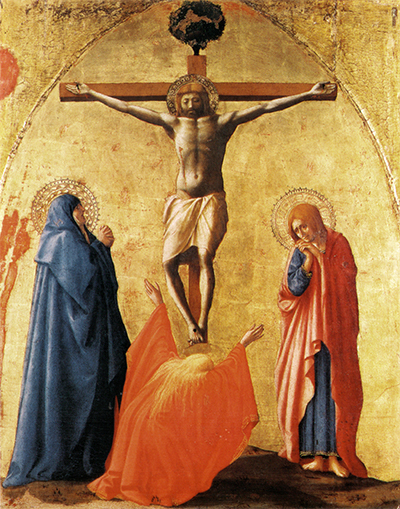
Masaccio’s Pisa Crucifixion compresses grief into a narrow upper panel. Mary, John and Mary Magdalene respond around Christ while the elevated viewpoint shapes the body of the crucified figure. Here Masaccio moves beyond Giotto through a new concern with the spectator’s actual position below the work. Yet the emotional seriousness remains rooted in the same Florentine tradition of making sacred suffering bodily intelligible.
Giotto and Fresco. Both artists were also masters of fresco, a medium that encourages large forms, clear compositions and architectural integration. Giotto’s major cycles demonstrated how walls could become coherent narrative environments, providing an important precedent for the Brancacci Chapel. Masaccio inherits the idea of fresco as an architectural system rather than a collection of independent pictures. He then introduces a more Renaissance concern with perspectival consistency between painted and real space.
Wall Painting as Environment. This distinction matters because the Brancacci Chapel is experienced bodily. Viewers stand inside an architectural setting while figures and streets continue across surrounding walls, creating a relationship between real and painted space. Giotto had already shown how fresco cycles could transform interiors through narrative unity. Masaccio intensifies the illusionistic dimension while preserving that broader environmental ambition.
Giotto and the Florentine School. The National Gallery describes Masaccio as one of the founders of the Florentine school while simultaneously identifying Giotto as the earlier Florentine origin of monumental light-modelled figures. This framing makes the relationship almost genealogical: Masaccio is revolutionary partly because he reconnects with a local tradition whose potential had not been exhausted. Renaissance renewal therefore includes recovery. Florence becomes new partly by remembering what one of its greatest earlier painters had already achieved.
Why Giotto Again?
By the early fifteenth century, International Gothic elegance had become highly sophisticated. Artists such as Lorenzo Monaco and Gentile da Fabriano could produce extraordinarily beautiful figures, textiles and gold surfaces, and there was no obvious technical necessity to abandon that language. Masaccio’s attraction to a more severe Giottesque monumentality therefore represents an artistic choice. He identifies weight, clarity and emotional seriousness as qualities capable of supporting the new Renaissance interest in naturalism.
Giotto versus International Gothic. This comparison should not turn into a crude hierarchy in which one style is serious and the other merely decorative. International Gothic contributed colour, line, observation and luxury to Renaissance painting, and Fra Angelico would demonstrate how those qualities could coexist with Masaccian monumentality. Masaccio’s significance lies in shifting the balance. He gives physical and spatial credibility unusual priority, which makes Giotto especially relevant to his artistic ancestry.
Masaccio and Fra Angelico. The relationship becomes clearer when Fra Angelico is introduced. Prado research describes Angelico as absorbing both refined Gothic traditions and Masaccio’s revolutionary art, effectively demonstrating that fifteenth-century Florence could combine these inheritances rather than choose one exclusively. Masaccio represents one particularly concentrated route. His work places Giottesque gravity closer to the centre of Renaissance painting again.
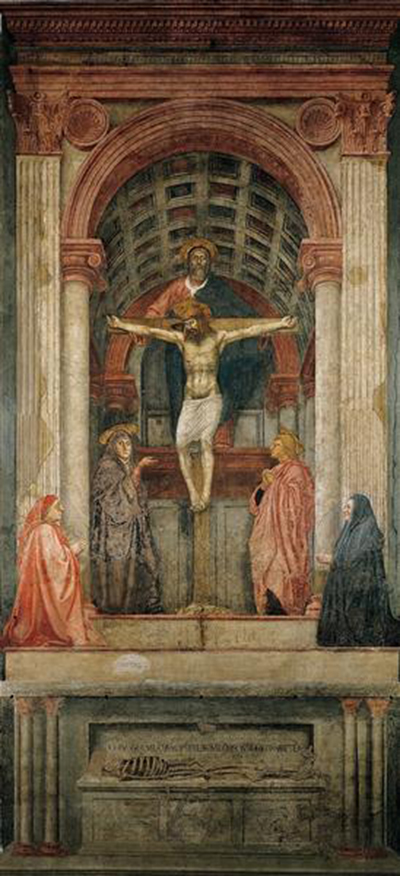
The Holy Trinity and Giotto. The Holy Trinity appears at first to have little to do with Giotto because its mathematical architecture feels distinctly fifteenth-century. Yet beneath the perspective lies the same concern with monumental, hieratically ordered bodies that possess real physical gravity. The innovation lies in placing that older seriousness inside a fictive classical chapel. Giotto’s legacy survives not through copied motifs but through the conviction that sacred figures must carry visual weight.
Hierarchy
Giotto often uses scale, placement and bodily orientation to establish sacred hierarchy. Masaccio continues to organise viewers’ attention through similar structural clarity, even when perspective becomes the dominant spatial tool. In the Trinity, God, Christ, Mary, John and the donors occupy distinct levels of access while remaining physically coherent. Hierarchy is therefore preserved inside a naturalistic system rather than replaced by it.
Giotto and the Viewer. Both painters also assume that the viewer should understand sacred action immediately. Compositions are not puzzles designed only for learned decoding; their emotional and spatial logic is clear enough to produce direct engagement. Masaccio’s innovation is to make the viewer’s physical position still more explicit. The Trinity uses a vanishing point tied to standing eye level, turning spectatorship into part of the architecture.
Tradition and Revolution. The relationship between Giotto and Masaccio is therefore one of the best arguments against viewing the Renaissance as a complete break with the Middle Ages. Masaccio’s most radical features emerge partly through the recovery of an earlier Florentine naturalism. What changes is the technical framework. Giotto’s monumentality enters a world transformed by Brunelleschian perspective, Donatellesque sculpture and new observational habits.
Vasari’s Historical Narrative. Vasari later played an enormous role in connecting Giotto and Masaccio within a progressive history of Tuscan art. His biographies present artists as stages in a movement towards greater naturalism, a structure that shaped art history for centuries. That model can be too linear, but it preserves an important historical perception: later Florentines themselves understood Masaccio as belonging to a tradition in which Giotto had been a foundational figure.
Progress without Simplicity
Modern scholarship is more cautious about describing art as one inevitable march towards realism. Different styles coexisted, revived and transformed one another, and artistic change depended upon patrons, institutions and materials as much as technical discoveries. Masaccio’s relationship with Giotto therefore works best as selective inheritance. He does not simply advance one step beyond Giotto; he reuses certain older priorities inside a radically different cultural environment.
The Body as Continuity. If one principle links the two painters most clearly, it is the belief that the human body should carry meaning. Bodies kneel, grieve, embrace, recoil and stand with enough weight that emotion becomes inseparable from physical experience. Masaccio strengthens this principle through anatomy, perspective and coherent light. The resulting figures become among the most influential bodies in Renaissance art.
Narrative as Continuity. A second continuity lies in narrative economy. Both painters organise scenes around actions that viewers can grasp quickly, allowing emotional or theological meaning to emerge through relationships between figures. Masaccio’s more complicated perspective never overwhelms this clarity. Geometry remains subordinate to story.
Space as Transformation. Space is where the greatest historical difference lies. Giotto creates convincing environments through empirical construction, while Masaccio works in a world transformed by single-point perspective and more systematic optical thinking. This difference allows Masaccio to make the viewer’s own position increasingly important. The Renaissance painting becomes not only a world represented but a world seen from somewhere.
Why Masaccio and Giotto Matter Together
Masaccio and Giotto matter together because their relationship reveals the Renaissance as both innovation and recovery. Masaccio’s revolution did not begin from a blank surface; it drew strength from an earlier Florentine tradition in which sacred figures already possessed unusual bodily gravity and emotional force. What Masaccio adds is the fifteenth century. Brunelleschian perspective gives space a new structure, Donatello’s sculpture sharpens the sense of mass and directional light binds figures into coherent environments. The result is not Giotto repeated but Giotto reactivated.
Masaccio takes an older conviction that human bodies can make sacred history emotionally present and gives it the spatial and optical tools of the Early Renaissance. This helps explain why his paintings were so influential. Later Florentine artists inherited not one isolated innovation but a renewed tradition of bodily seriousness extending from Giotto through Masaccio and into the mature Renaissance.
Frequently Asked Questions
Discussion
Use this space to discuss Masaccio and Giotto | Masaccio, its source evidence and how it fits into Masaccio's wider cluster.
Keep comments focused on close looking, attribution language, object evidence and page-specific caveats.
Reader Insights
Which detail on this page most changes how you read the work?
How does this page connect to Masaccio's paintings, fresco technique or Florentine setting?
Where should the wording stay cautious because the source evidence is qualified?
Join the Conversation
Share your reading of Masaccio and Giotto | Masaccio below.
References and Research Sources
- National Gallery, London, Masaccio artist biography, identifying Giotto’s precedent for monumental figures modelled by light. View Source
- National Gallery, London, collection and Early Renaissance contextual resources. View Source
- Museo Nacional del Prado, Fra Angelico and the Rise of the Florentine Renaissance, on Masaccio’s revolutionary role within Florentine painting.
- Museo Masaccio, San Giovenale Triptych. View Source
- Comune di Firenze / Musei Civici Fiorentini, Brancacci Chapel history and restoration. View Source
- Santa Maria Novella, Masaccio’s Holy Trinity. View Source
- National Gallery, London, Pisa Polyptych research. View Source