 by Tom Gurney
Tom Gurney BSc (Hons) is an art history expert with over 20 years experience
Published on June 19, 2020 / Updated on October 14, 2023
Email: tomgurney1@gmail.com / Phone: +44 7429 011000
Introduction
The Brancacci Chapel is one of the most revealing places in Renaissance art because three major painters worked there across two very different historical moments. Masolino da Panicale and Masaccio began the programme in the 1420s, while Filippino Lippi returned more than half a century later to complete the unfinished cycle. This makes the chapel more than a masterpiece by one artist. It is a layered record of artistic change, in which late-Gothic elegance, revolutionary Early Renaissance naturalism and a later fifteenth-century style coexist within one architectural and theological programme. Masolino and Masaccio differ visibly in body, light and spatial logic, but they also collaborate within the same project.
Filippino then faces an even more difficult task: he must complete the walls in a style recognisably his own while adapting to Masaccio’s already canonical monumentality. The result is one of the clearest surviving demonstrations of how Renaissance artists inherited, revised and respected earlier painting. The chapel does not present progress as a clean replacement; it shows continuity negotiated physically on the wall.
At a Glance
- LocationBrancacci Chapel, Santa Maria del Carmine, Florence
- Initial artistsMasolino da Panicale and Masaccio
- Initial campaign1420s
- Later completionFilippino Lippi, 1481–83, with the chapel broadly completed by the mid-1480s
- Primary subjectSaint Peter and the early Church
- Masolino’s general characterelegant contour, refined surface, lighter bodily modelling
- Masaccio’s general charactermonumental mass, unified light, strong perspective and emotional directness
- Filippino’s challengeadapt a later style to an already authoritative earlier programme
- Key collaborative frescoRaising of the Son of Theophilus and Saint Peter Enthroned
- Major conservation valuerestoration and technical study help distinguish campaigns and working methods
- Historical significanceone room contains several generations of Florentine painting
Contents
- One Chapel, Several Moments in Time
- The Initial Brancacci Campaign
- Why This Comparison Matters
- Masaccio’s Light
- Masolino and Continuous Narrative
- Distribution of Alms
- The Chapel before Filippino
- Adapting to Masaccio
- Bodily Weight as Inheritance
- Three Artists, One Architecture
- The 1980s Restoration
- Masolino after Brancacci
- Michelangelo and the Chapel
- Why Filippino Matters
- Why Masaccio, Masolino and Filippino Matter Together
- Frequently Asked Questions
- References and Research Sources
One Chapel, Several Moments in Time
The most important thing to understand about the Brancacci Chapel is that its present unity is historical rather than simultaneous. The walls were not completed in one uninterrupted campaign, and the cycle only reached its surviving form after a long gap. This means the chapel contains visible historical time. Different painters respond to the same architecture while carrying different assumptions about the human body, surface, perspective and narrative.
Masolino’s Generation. Masolino was significantly older than Masaccio and had been formed within a culture that still valued the refined elegance of International Gothic painting. His figures often emphasise contour, graceful pose and polished surface. That does not make him technically backward. Masolino was fully capable of complex spatial construction and later developed sophisticated Renaissance solutions of his own.
Masaccio’s Generation. Masaccio entered the chapel as a much younger painter but developed a radically different visual language. Bodies become denser, light becomes more directional and space becomes more coherent. The result is not simply greater realism. Masaccio changes the emotional and physical authority of sacred narrative.
Filippino’s Generation. Filippino Lippi belonged to a later fifteenth-century world shaped by the achievements of Masaccio, Fra Angelico, Fra Filippo Lippi, Botticelli and others. By the time he entered the Brancacci Chapel, Masaccio was already part of the canon. Filippino therefore did not encounter Masaccio as a contemporary colleague. He encountered him as a historical authority.
The Initial Brancacci Campaign
The early campaign began under Felice Brancacci in the 1420s. Masolino appears to have played an important initiating role, with Masaccio becoming deeply involved as the programme developed. The cycle was devoted principally to Saint Peter, making it an unusually rich visual account of apostolic authority, baptism, healing, charity and the early Church.
Masolino’s Upper Register. Recent restoration evidence has strengthened the understanding that Masolino contributed significantly to the original upper programme. Surviving sinopie from lost sections help reconstruct material that was later destroyed. This is important because the current chapel underrepresents Masolino relative to the original ensemble. Some of his contribution disappeared with eighteenth-century remodelling.
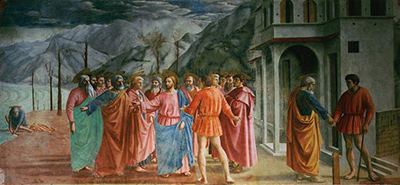
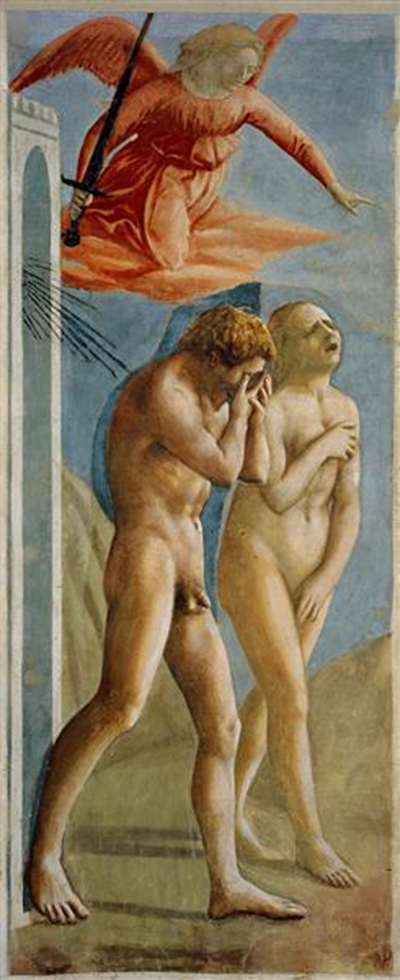
Masaccio’s Lower Monumentality. Masaccio’s surviving scenes dominate modern perceptions because they are among the most powerful works in the chapel. The Tribute Money, Expulsion from the Garden of Eden and other frescoes established a new standard for bodily weight, perspective and unified light. Their authority became so great that later completion had to accommodate them. Masaccio’s style effectively set the visual terms for the chapel’s future.
Temptation and Expulsion. The most famous direct comparison is between Masolino’s Temptation of Adam and Eve and Masaccio’s Expulsion from the Garden of Eden. The two scenes belong to the same salvation narrative but express radically different bodily and emotional states. Masolino’s figures are elegant and composed. Masaccio’s are exposed, grieving and psychologically shattered.
Why This Comparison Matters
The contrast is often used as a textbook demonstration of International Gothic versus Renaissance naturalism. That distinction is useful, but it should not become a crude judgement of competence. Masolino’s scene succeeds because its elegance suits Eden before the Fall. Masaccio’s scene succeeds because bodily anguish becomes the meaning of expulsion.
Masolino’s Contour. Masolino tends to define bodies more through contour and surface refinement. His figures can appear smoother, more idealised and less burdened by gravity. This gives them a courtly quality. Sacred figures remain visually elevated from ordinary physical life.
Masaccio’s Mass. Masaccio uses light, shadow, drapery and stance to make bodies feel structurally dense. Figures seem to possess bones, weight and balance beneath their clothing. This monumentality gives ordinary actions unusual gravity. A tax collector or poor man can feel as physically serious as an apostle.
Masolino’s Light. Masolino’s illumination is generally softer and less directionally dominant. Figures can glow within the surface without appearing as strongly governed by one common atmospheric condition. This creates grace and visual polish. The pictorial world remains slightly more idealised.
Masaccio’s Light
Masaccio increasingly uses one coherent light source across groups. Bodies cast shadows and architecture participates in the same illumination. The result is a more unified physical world. Sacred events appear to occur under the same light as ordinary human experience.
Masolino’s Space. Masolino can create convincing space, but his figures often remain more independent from the environments around them. Architecture and body do not always feel fused into one system. This gives his compositions a more decorative rhythm. Spatial depth and surface elegance coexist.
Masaccio’s Space. Masaccio integrates bodies and architecture more aggressively. Perspective determines where people stand, how buildings recede and how groups occupy depth. Space therefore becomes structural rather than atmospheric alone. The viewer experiences the scene as a world.
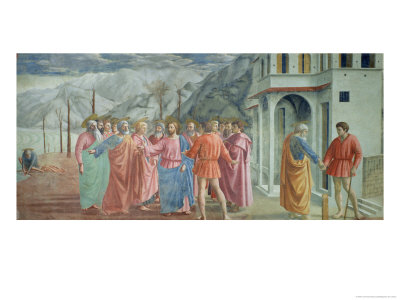
The Tribute Money. The Tribute Money is one of the strongest examples. Several narrative moments share one continuous landscape, while figures cast shadows and stand in a perspectivally coherent environment. The fresco demonstrates how far Masaccio moves beyond decorative compartmentalisation. Narrative time becomes spatially unified.
Masolino and Continuous Narrative
Masolino also worked within narrative traditions involving multiple figures and episodes. The difference lies less in whether he can tell a story than in how physically those figures inhabit the world. Masaccio’s innovation is the fusion of narrative with bodily and spatial credibility.
The Expulsion. Masaccio’s Expulsion strips the scene almost entirely to bodies and movement. The emotional force depends on shame, nakedness and bodily gesture. This radical economy became one of the chapel’s most influential lessons. Human experience could carry theological meaning without elaborate decoration.
Masolino’s Temptation. Masolino’s Temptation offers the opposite mood. The figures remain serene and idealised, making temptation appear seductive rather than catastrophic. The pair therefore demonstrates that style can reinforce narrative stage. Before and after the Fall look fundamentally different.
Saint Peter Healing the Sick. Masaccio’s Saint Peter Healing the Sick with His Shadow shows how far his naturalism extends socially. Sick and poor figures occupy urban space with monumental dignity. Masolino’s surviving work does not emphasise this kind of social physicality as strongly. Masaccio expands the range of bodies considered worthy of serious representation.
Distribution of Alms
The same is true in Distribution of Alms and Death of Ananias. Economic need, charity and death become monumental sacred subjects. This social seriousness is one reason later artists found Masaccio so compelling. Human vulnerability becomes central rather than marginal.
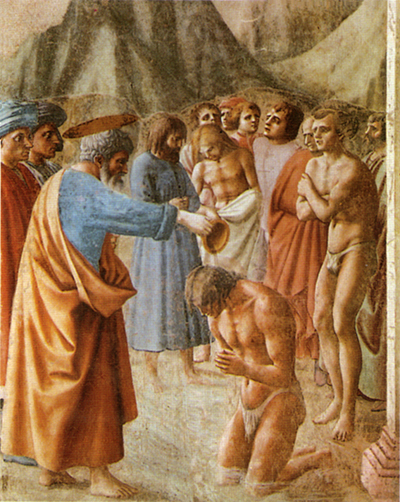
Baptism of the Neophytes. The famous shivering convert demonstrates Masaccio’s observational intelligence. A tiny bodily reaction to cold transforms sacramental narrative into lived experience. Masolino’s refinement and Masaccio’s observation therefore represent different artistic priorities. One gives sacred form elegance; the other gives it embodied immediacy.
The Chapel Is Left Unfinished. The first campaign ended before the cycle was complete. Masolino pursued other work, Masaccio eventually left Florence and died in Rome, and Felice Brancacci’s political fortunes deteriorated. The unfinished walls therefore record interruption at several levels. Artistic, political and patronal histories all contribute.
Felice Brancacci’s Exile. Brancacci’s exile under Medici dominance made his family chapel politically sensitive. The patronal identity that had launched the commission no longer functioned in the same way. This helps explain the long delay before completion. The chapel had to survive a change in political meaning before another major campaign could resume.
The Chapel before Filippino
By the later fifteenth century, Masaccio’s frescoes had become admired examples of Florentine painting. Their unfinished state therefore presented a difficult problem: completion was desirable, but any new painter risked competing visibly with a revered predecessor. Filippino Lippi was chosen to solve that problem.
Why Filippino Was Well Suited. Filippino had both artistic sophistication and a particularly relevant lineage. He was the son of Fra Filippo Lippi, whose own formation had been strongly connected with Santa Maria del Carmine and the Brancacci environment. This gave Filippino a historical relationship with the site even before he painted there. He inherited a Florentine tradition that Masaccio had helped create.
Filippino’s Campaign. The Comune di Firenze places Filippino’s completion campaign in 1481–83, while FeelFlorence describes the overall cycle as completed around the mid-1480s. His task included finishing earlier incomplete scenes and adding substantial new sections. He therefore works both as completer and independent contributor. The chapel requires continuity but still leaves room for authorship.
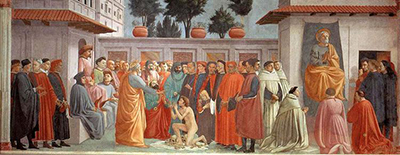
Filippino and Masaccio on One Wall. Raising of the Son of Theophilus and Saint Peter Enthroned is the clearest case. Masaccio began the composition, while Filippino completed substantial areas decades later. The fresco becomes a literal meeting between two generations. Viewers can study how Filippino enters Masaccio’s visual system without simply disappearing into it.
Adapting to Masaccio
FeelFlorence notes that Filippino adapted figures and architecture to Masaccio’s severity. This means his usual mature elegance had to be moderated by context. The result demonstrates artistic intelligence rather than mere imitation. Filippino understands which aspects of his own style must be restrained for the ensemble to remain coherent.
Filippino’s Line. Filippino generally works with a more elaborate contour than Masaccio. Faces can become more intricate, gestures more animated and decorative detail more pronounced. In the Brancacci Chapel, those qualities are deliberately controlled. The earlier frescoes create a visual discipline.
Filippino’s Architecture. His architectural settings are also more developed in a later fifteenth-century sense. By the 1480s, perspective had become a standard component of Florentine painting rather than a revolutionary novelty. Filippino therefore inherits a system Masaccio helped establish. What was radical in the 1420s has become part of the language of painting.
Perspective as Inheritance. This is one of the most important historical changes visible in the chapel. Masaccio uses perspective as an innovation; Filippino uses it as a normal artistic resource. The same technique therefore carries different historical meanings across the two campaigns.
Bodily Weight as Inheritance
Masaccio’s bodily monumentality also becomes part of later Florentine vocabulary. Filippino does not paint exactly like him, but his figures inhabit space with an ease that depends upon the earlier revolution. Influence therefore becomes invisible when it turns into convention. Later artists no longer need to resemble Masaccio closely to owe him something fundamental.
Filippino and Portraiture. Filippino’s contribution includes carefully differentiated faces and portrait-like figures. His later fifteenth-century interest in individual physiognomy enriches the social presence of the cycle. This creates another point of contrast with Masaccio. Masaccio’s heads are highly individual, but Filippino’s later world places even greater emphasis on descriptive identity.
Portrait Traditions. Several figures in the chapel have traditionally been identified as artists and intellectuals. Such identifications include Masaccio, Masolino, Brunelleschi and Alberti in the Theophilus fresco. These traditions should remain qualified. Their importance lies as much in later reception as in documentary certainty.
Three Artists, One Theology. Despite stylistic differences, all three painters serve the same broad theological architecture. Peter acts as the link between Christ’s redemptive mission and the continuing Church. This shared programme helps unify the chapel. Iconography provides continuity where style changes.
Three Artists, One Architecture
The physical chapel also imposes unity. Wall dimensions, registers and existing frescoes constrain each new intervention. Architecture therefore becomes another author. Every painter must negotiate the same room.
Collaboration in the 1420s. Masolino and Masaccio represent collaboration between contemporaries. They work within one initial campaign, sometimes close enough that attribution requires careful connoisseurship and technical study. Their relationship is horizontal in time. They share the same professional world.
Collaboration across Decades. Filippino’s relationship is different. He collaborates with absent predecessors whose work cannot be altered freely. This is a form of historical collaboration. The earlier wall determines the later painter’s choices.
Restoration and Attribution. Modern restoration has been essential to distinguishing the separate campaigns. Cleaning, plaster analysis and close technical study reveal differences in working method, surface and later intervention. Attribution therefore depends partly on material evidence. Style alone is not always sufficient.
The 1980s Restoration
The major restoration of the 1980s transformed understanding of the chapel. Colour became clearer, overpainting was removed and distinctions between artists could be reassessed. This project helped shift Masaccio away from the dark, austere appearance produced by centuries of grime. His palette proved more varied than earlier reproductions suggested.
Recent Conservation. The 2022–24 diagnostic campaign continued that work. Close examination of plaster, paint and surface condition provided new evidence for both conservation and art history. A multi-authored monument benefits especially from such study. Physical boundaries can reveal chronology that stylistic impression alone cannot secure.
Lost Upper Frescoes. The destruction of the upper register in the eighteenth century complicates comparisons between the artists. Masolino lost a greater proportion of his work, while Masaccio’s surviving lower scenes became more dominant visually. Modern reputation is therefore shaped partly by survival. What remains is not necessarily what was originally most important.
Historical Imbalance. Because Masaccio’s greatest scenes survive so powerfully, the chapel can appear to confirm a simple narrative of his superiority. The lost Masolino material warns against overconfidence. Historical comparison always depends on what survives. Absence can distort judgement.
Masolino after Brancacci
Masolino’s later career demonstrates that he continued to develop rather than disappear. His work elsewhere shows increasing interest in perspective and spatial organisation. This complicates the idea that Masaccio alone carried the Renaissance forward. Multiple artists absorbed and transformed the new visual language.
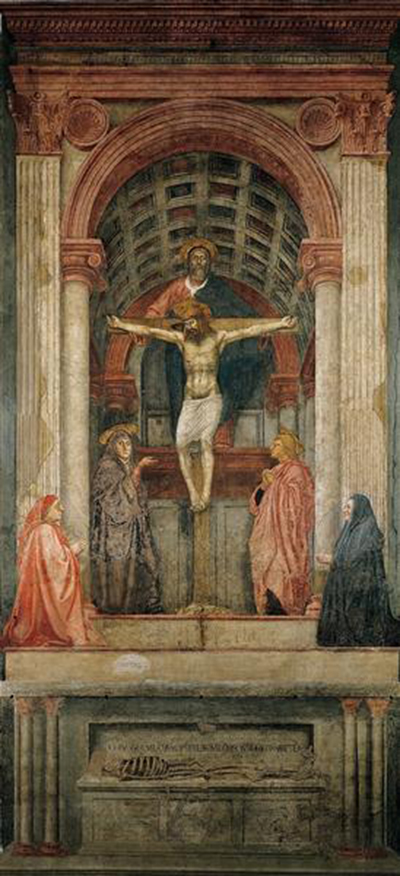
Masaccio after Brancacci. Masaccio’s own career continued only briefly. The Pisa Polyptych and Holy Trinity show him extending body, perspective and viewer relationship beyond the chapel. His early death froze his reputation around a remarkably concentrated group of works. The Brancacci Chapel therefore became one of the main sites through which later generations knew him.
Filippino after Brancacci. Filippino went on to produce some of the most inventive paintings of the later fifteenth century, including works with much more elaborate line, fantasy and classical detail. His Brancacci contribution is therefore unusually restrained within his career. The chapel demonstrates how strongly historical context can shape an artist.
Fra Filippo Lippi between Masaccio and Filippino. Fra Filippo Lippi forms a crucial bridge. His own formation in the Carmine environment exposed him to Masaccio’s frescoes, and he absorbed their bodily credibility while developing a more lyrical style. Filippino therefore inherits Masaccio partly through his father as well as through direct study. Artistic transmission becomes familial and institutional at once.
Michelangelo and the Chapel
Michelangelo later studied the Brancacci frescoes, reinforcing the chapel’s role as a school of the figure. He could compare Masolino, Masaccio and Filippino directly. The site therefore taught history as well as anatomy. Students saw how different generations solved the same problems.
Leonardo and the Chapel. Leonardo is likewise associated in Florentine institutional tradition with study of the chapel. For him, the frescoes offered examples of grouping, gesture, bodily weight and spatial narrative. The Brancacci walls therefore became a shared visual textbook for artists whose own work would transform Renaissance painting again.
Why Masaccio Became Dominant. Masaccio’s reputation eventually overshadowed Masolino because his figures and spaces aligned so strongly with the later Renaissance emphasis on bodily monumentality and perspective. This retrospective fit matters. Later artists recognised in Masaccio a predecessor to problems they themselves considered central.
Why Masolino Still Matters. Masolino remains essential because he shows that Renaissance change did not begin from stylistic emptiness. Elegance, surface refinement and Gothic tradition continued to have artistic value. Without Masolino, Masaccio’s difference would be harder to see. Contrast itself becomes evidence.
Why Filippino Matters
Filippino demonstrates what happens after innovation becomes history. He has to negotiate a predecessor rather than compete with a contemporary. His work therefore shows the Renaissance becoming self-conscious about its own past.
The Chapel as Art History before Art History. In this sense, the Brancacci Chapel became an art-historical space before formal art history existed. Later artists could stand inside it and compare styles across generations. The walls provided direct evidence of development, continuity and difference. Looking at the chapel meant looking at the history of painting.
A Multi-Generational Masterpiece. Modern museum culture often celebrates single authorship, but the Brancacci Chapel resists that model. Its power comes partly from being shared. Masolino, Masaccio and Filippino contribute different strengths. The monument becomes richer because it records change rather than hiding it.
Why Masaccio, Masolino and Filippino Matter Together
Masaccio, Masolino and Filippino Lippi matter together because the Brancacci Chapel turns artistic development into something visible on one set of walls. Masolino’s elegance, Masaccio’s bodily and spatial revolution and Filippino’s later adaptation reveal three different relationships with Renaissance naturalism. The chapel also demonstrates that innovation is collaborative. Masaccio’s radical style develops beside Masolino rather than in isolation, while Filippino’s later work shows how a new generation can absorb an earlier master without merely copying him.
This layered authorship makes the Brancacci Chapel one of the most important sites for understanding influence. Perspective, bodily weight and narrative clarity move from experiment to convention across the decades. Restoration strengthens that lesson by revealing the physical boundaries between campaigns. The history of painting is embedded in plaster, pigment and revision as much as in biographies. Most importantly, the chapel shows that the Renaissance was not one moment. It was a process of inheritance, disagreement, adaptation and return, and Masolino, Masaccio and Filippino make that process visible in extraordinary detail.
Frequently Asked Questions
Discussion
Use this space to discuss Masaccio Masolino Filippino at the Brancacci Chapel | Masaccio, its source evidence and how it fits into Masaccio's wider cluster.
Keep comments focused on close looking, attribution language, object evidence and page-specific caveats.
Reader Insights
Which detail on this page most changes how you read the work?
How does this page connect to Masaccio's paintings, fresco technique or Florentine setting?
Where should the wording stay cautious because the source evidence is qualified?
Join the Conversation
Share your reading of Masaccio Masolino Filippino at the Brancacci Chapel | Masaccio below.
References and Research Sources
- Comune di Firenze / Musei Civici Fiorentini, Brancacci Chapel history and restoration documentation. View Source
- FeelFlorence, Brancacci Chapel, for chronology, stylistic distinctions and Filippino Lippi’s completion. View Source
- MUS.E Firenze, Brancacci Chapel resources, for patronage, Saint Peter programme and the three principal painters. View Source
- Comune di Firenze, L’ultimo restauro, for the 2022–24 conservation campaign and technical investigation. View Source
- Web Gallery of Art, Raising of the Son of Theophilus and Saint Peter Enthroned, for the legendary subject and traditional portrait identifications.
- National Gallery, London, Masaccio artist biography, for his role in the development of monumental figures and perspective. View Source