 by Tom Gurney
Tom Gurney BSc (Hons) is an art history expert with over 20 years experience
Published on June 19, 2020 / Updated on October 14, 2023
Email: tomgurney1@gmail.com / Phone: +44 7429 011000
Introduction
Masaccio’s style changed the course of Early Renaissance painting because several innovations that had often existed separately were brought together with unusual consistency. Bodies possess weight, light travels coherently across figures, architecture obeys perspectival logic and human emotion is expressed through posture and movement rather than decorative gesture alone. His importance therefore cannot be reduced to perspective. A mathematically convincing room filled with weightless figures would not have produced the same revolution, and a monumental body without coherent light or spatial relation would have remained visually isolated. Masaccio’s achievement lies in integration.
Perspective establishes the world, light gives bodies volume, anatomy and drapery make those bodies credible, gesture directs narrative and the physical conditions of fresco or tempera shape how each effect is achieved. The result is a style at once severe and humane. Masaccio avoids unnecessary ornament, but his restraint allows ordinary physical details—a cast shadow, a shivering body, a hand raised in grief—to carry extraordinary emotional and theological force.
At a Glance
- Principal mediafresco and tempera on panel
- Key stylistic qualitiesbodily mass, unified light, perspective, emotional directness and compositional economy
- Major fresco siteBrancacci Chapel
- Major perspective frescoHoly Trinity
- Major tempera commissionPisa Polyptych
- Earliest known workSan Giovenale Triptych, 1422
- Key sculptural comparisonDonatello
- Key architectural/perspective comparisonBrunelleschi
- Earlier Florentine precedentGiotto
- Major technical principlebody, light and space operate as one system
- Narrative principlegesture and grouping make complex stories immediately legible
- Historical importanceMasaccio made naturalism structural rather than decorative
Contents
- The Myth of One Innovation
- Giotto and Monumentality
- Chiaroscuro
- San Giovenale
- Perspective and the Viewer
- Classical Form
- Emotion through Posture
- Almsgiving
- Sinopie
- Pigments
- Punchwork and Sacred Surface
- Lo Scheggia
- Foreshortening
- Colour
- The Holy Trinity and Wall Construction
- Why Short Sentences Are Not His Visual Language
- Influence on Fra Angelico
- Why Masaccio’s Style Matters
- Frequently Asked Questions
- References and Research Sources
The Myth of One Innovation
Masaccio is often introduced as “the painter who used perspective,” but that description is too narrow. Brunelleschi’s spatial experiments were crucial, yet Masaccio’s distinctive contribution lies in giving perspectival space convincing inhabitants. His figures feel substantial because every part of the pictorial system supports them. Light, drapery, stance, architecture and ground plane reinforce one another.
Bodies First. The most consistent feature of Masaccio’s mature art is bodily weight. Whether the figure is Christ, an apostle, a poor man or a naked Adam, the body appears structured by gravity. This weight creates seriousness. Sacred authority and ordinary vulnerability both become visually credible because figures seem capable of occupying the viewer’s world.
Drapery as Anatomy. Masaccio’s drapery does not float independently from the body. Folds respond to knees, shoulders, torsos and hips, allowing clothing to reveal rather than conceal structure. This treatment connects painting with contemporary sculpture. The body remains legible beneath fabric.
Donatello and Mass. Donatello provides one of the clearest sculptural contexts. His saints and prophets had demonstrated how bodily weight, contrapposto and psychological force could transform religious figures. Masaccio translates similar principles into paint. Light becomes the means through which a flat surface can behave almost sculpturally.
Giotto and Monumentality
Giotto offers an earlier Florentine precedent for heavy figures, emotional clarity and narrative economy. Masaccio revives that seriousness while adding the spatial and optical discoveries of the fifteenth century. The relationship is therefore one of renewal rather than simple imitation. Giottesque gravity enters Brunelleschian space.
Light as Structure. Masaccio’s light is unusually coherent for his period. Figures within the same scene appear illuminated from a common direction, giving bodies the sense of belonging to one atmosphere. This unity is crucial. Light becomes structural rather than decorative.
Cast Shadows. In the Brancacci Chapel, figures cast shadows onto the ground. This makes them appear to block actual light, one of the most persuasive signs of physical presence. A cast shadow proves relationship between body, ground and illumination. Masaccio therefore uses a simple optical fact to make sacred history feel materially real.
Light and the Real Chapel. In several Brancacci scenes, painted light corresponds broadly with actual illumination entering the chapel. This relationship helps fuse fictive and real space. The viewer experiences painted figures as though they stand under the same environmental conditions. Art and architecture cooperate.
Chiaroscuro
Masaccio models faces and drapery through transitions between light and dark. Chiaroscuro turns flat colour into volume. His modelling is generally broad rather than fussy. Large tonal masses remain legible across architectural distance.
Why Broad Modelling Matters in Fresco. Fresco is usually viewed from farther away than a small panel. Subtle detail can disappear, while broad shadow survives. Masaccio’s technique is therefore well adapted to the medium. Monumentality depends partly upon clarity of tonal structure.
Perspective. Masaccio’s perspective is revolutionary because it becomes a general language rather than one trick. At San Giovenale it unifies a triptych, in the Brancacci Chapel it supports narrative, in Pisa it adjusts bodies to viewing height and in the Holy Trinity it creates an entire fictive architecture. This range matters more than any claim that Masaccio was simply “first.” He understood how perspective could serve different visual problems.
Single-Point Perspective. Single-point perspective assumes that parallel receding lines converge towards one vanishing point. Brunelleschi’s experiments helped establish this system in Florence. Masaccio became one of its earliest great users in painting. His innovation was practical and expressive rather than theoretical alone.
San Giovenale
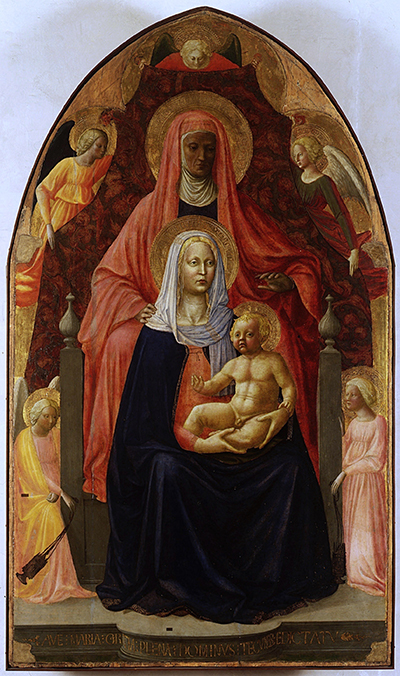
The San Giovenale Triptych already uses a central perspectival construction in 1422. The floor extends across the three panels and converges near the Virgin, unifying compartments that remain physically divided by the frame. This early work proves that Masaccio’s spatial thinking developed from the beginning of his known career. Perspective is not a late addition.
The Brancacci Chapel. In the Brancacci Chapel, perspective becomes less conspicuous but more socially complex. Streets, groups and landscapes organise multiple figures within one believable environment. Masaccio therefore demonstrates mastery by making the system almost disappear. The viewer experiences clarity rather than geometry.
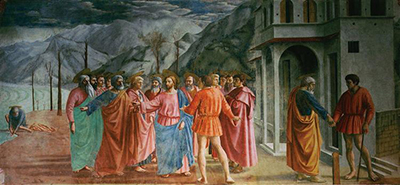
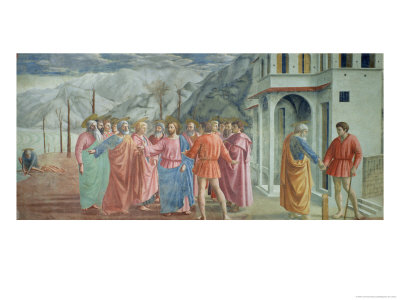
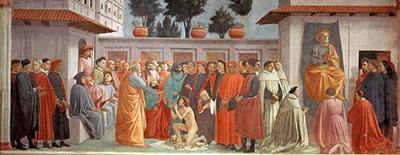
The Tribute Money. The Tribute Money shows several narrative moments inside one continuous space. The architecture helps establish depth, but the apostles remain the emotional centre. This balance is characteristic of Masaccio. Perspective supports narrative hierarchy.
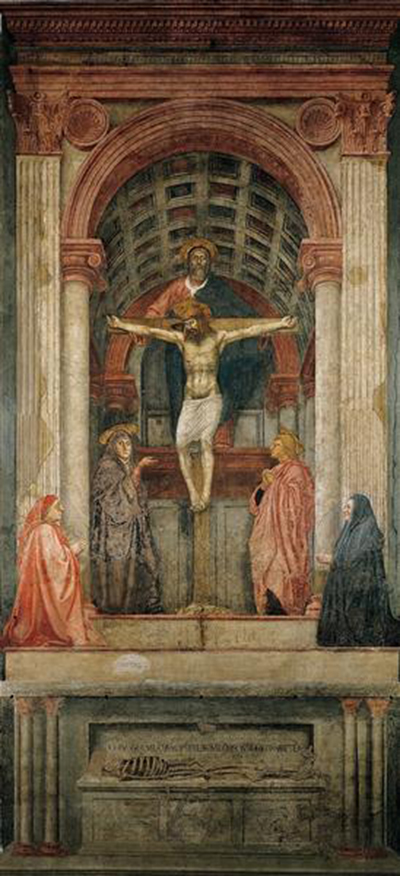
The Holy Trinity. The Holy Trinity represents the most spectacular application. A church wall appears to open into a barrel-vaulted chapel organised around the viewer’s eye level. Here perspective itself becomes part of the devotional meaning. The spectator is physically located in relation to the sacred vision.
Perspective and the Viewer
Masaccio repeatedly considers where the viewer stands. This is especially clear in the Holy Trinity and the elevated panels of the Pisa Polyptych. The painted image is therefore not autonomous. It is designed for a body occupying real architectural space.
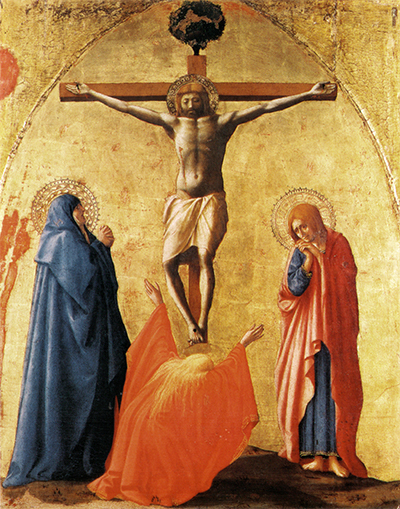
Viewing from Below. The Pisa Crucifixion and Saint Andrew demonstrate how Masaccio adjusts figures for elevated viewing. Bodies appear compressed when seen straight on because they were designed for spectators below. This is a practical extension of perspectival thinking. Anatomy itself becomes viewpoint-dependent.
Brunelleschi. Brunelleschi’s influence lies both in perspective and architectural language. Masaccio’s fictive structures share the new Florentine interest in measured classical form. Direct collaboration on the Holy Trinity remains unproven. The important point is that Masaccio worked inside the spatial culture Brunelleschi helped create.
Architecture. Masaccio’s architecture is usually functional. Buildings establish depth, social setting and narrative zones without becoming decorative spectacle. This restraint keeps attention on bodies. Architecture serves human action.
Classical Form
Rounded arches, columns and proportioned structures connect Masaccio with Renaissance revival of antiquity. The Holy Trinity is the clearest example. Classical form becomes a Christian language. Antiquity is adapted rather than copied mechanically.
Composition. Masaccio’s compositions are economical. Even complex scenes tend to organise around one dominant action or central group. This clarity allows viewers to grasp narrative quickly. Decorative detail never overwhelms structure.
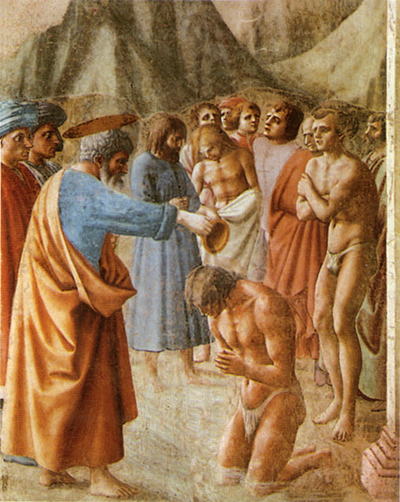
Grouping. Groups are one of Masaccio’s great strengths. Apostles cluster around Christ, converts gather around baptism and crowds respond to miracles without losing individual identity. This ability became crucial to later Renaissance narrative painting. Social bodies become compositional units.
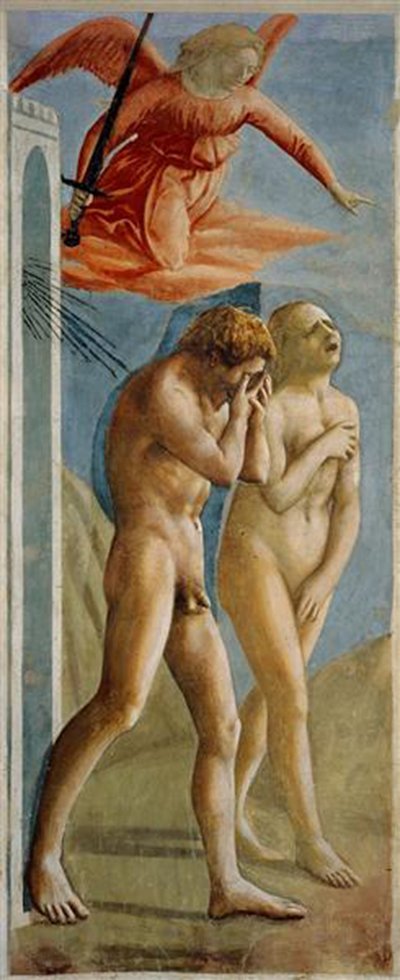
Gesture. Gesture often carries narrative more effectively than facial expression. Christ points, Peter responds, Magdalene raises her arms and Adam covers his face. Masaccio’s gestures are usually simple. Their power comes from direct physical meaning.
Emotion through Posture
Emotion rarely depends upon theatrical facial display alone. Grief bends bodies, cold contracts them and shame changes how they move. This makes psychology structural. The whole body participates in emotion.
Expulsion from Eden. The Expulsion is the clearest example. Adam hides his face while Eve cries out and covers herself, allowing two bodies to communicate radically different forms of grief. Masaccio removes decorative distraction. Emotion becomes the architecture of the scene.
Baptism of the Neophytes. The shivering convert provides another key example. His cold body makes sacred ritual physically immediate. This detail is famous because it feels observed rather than symbolic. Naturalism enters through experience.
Healing the Sick. In Saint Peter Healing the Sick with His Shadow, bodily difference and vulnerability become central. Masaccio gives sick figures dignity through physical seriousness. His naturalism therefore expands the social range of sacred painting. Monumentality is not reserved for ideal bodies.
Almsgiving
Distribution of Alms and Death of Ananias shows money changing hands among poor people and apostles. Ordinary economic action receives sacred gravity. This demonstrates that Masaccio’s realism is ethical as well as formal. Social relationships become worthy of monumental painting.
Buon Fresco. In true fresco, or buon fresco, pigment is applied to wet lime plaster. As the plaster dries, the pigment becomes chemically bound within the surface. The method requires careful planning because the artist must complete each prepared area before it dries. Large frescoes are therefore built in daily sections known as giornate.
Giornate. A giornata represents the amount of plaster prepared for one working day. Boundaries can sometimes be detected technically where one day’s work meets another. Close study of the Brancacci Chapel reveals such working structures. Monumental illusion therefore rests upon segmented manual labour.
Arriccio and Intonaco. Fresco walls generally involve a rougher underlayer, or arriccio, followed by a finer wet painting layer, or intonaco. Preparatory drawing could be transferred or worked out across these surfaces. This layered process makes fresco fundamentally architectural. Painting becomes part of the wall rather than sitting entirely upon it.
Sinopie
Sinopie are preparatory drawings made on underlying plaster before the final painted layer. Surviving Brancacci sinopie have been important for reconstructing lost upper-register compositions. They reveal planning beneath finished image. What viewers see is only the final layer of a more complex process.
Cartoons and Transfer. By the fifteenth century, artists could also use cartoons and transfer methods to establish figures across plaster. The exact methods varied by project and painter. What matters is that monumental fresco required significant preparation. Apparent spontaneity depended on advance design.
Fresco Speed. Wet plaster imposes time pressure. Once the surface begins to dry, pigment no longer integrates in the same way. Masaccio’s broad, decisive handling suits this requirement. Forms must be established efficiently.
A Secco Work. Some details could be added a secco, on dry plaster, especially where pigments did not behave well in true fresco. Such passages are generally more vulnerable over time. This helps explain why certain colours or details disappear differently. Technique influences survival.
Pigments
Fresco pigments must tolerate lime and alkaline conditions. Earth colours and mineral pigments often survive well, while some more delicate materials require different handling. Masaccio’s palette therefore reflects both aesthetic choice and technical possibility. Colour is inseparable from chemistry.
Panel Painting. Masaccio’s panel works use tempera, typically egg tempera on prepared wood. This medium permits controlled layering and fine detail. The difference from fresco is substantial. Panel painting offers more time and precision but requires different strategies for achieving volume.
Egg Tempera. Egg yolk binds pigment into a fast-drying paint. Artists build form through carefully placed strokes and layers rather than through the blending familiar from later oil painting. Masaccio nevertheless achieves strong modelling. His bodies feel broad despite the precise medium.
Gold Ground Technique. Traditional panel paintings often used gold leaf over prepared surfaces. Masaccio retains gold in works such as San Giovenale and the Pisa Polyptych. This demonstrates his selective innovation. New naturalism operates within old materials.
Punchwork and Sacred Surface
Gold could be tooled or punched decoratively, creating patterns around halos and sacred areas. Such craftsmanship connected painting with luxury object-making. Masaccio’s work therefore remained part of a broader material culture. Renaissance innovation did not eliminate artisanal richness.
Panel Construction. Large polyptychs required carpenters, frame makers and other craftsmen. The Pisa commission demonstrates this collaborative reality particularly clearly. Painting was only one part of producing an altarpiece. Architecture, woodwork and gilding helped determine the final experience.
Workshop Practice. Masaccio did not work alone on every commission. The Pisa documents name Andrea di Giusto and connect Lo Scheggia with the project. This workshop context matters because Renaissance authorship includes design, supervision and varying degrees of execution. The master’s style can extend beyond the master’s hand.
Andrea di Giusto. Andrea appears as Masaccio’s garzone. Some predella passages of lower quality have been associated with him. This provides rare documentary support for workshop differentiation. Style can be compared against named labour.
Lo Scheggia
Masaccio’s brother Giovanni, later known as Lo Scheggia, also appears in the Pisa payment record. His involvement reinforces the family dimension of workshop practice. Masaccio’s professional world therefore includes kinship as well as artistic collaboration.
Drawing. Although relatively little preparatory material survives securely, Masaccio’s compositions imply disciplined drawing. Perspective, group arrangement and foreshortening all require planning. Drawing therefore underlies the apparent simplicity. Economy is designed.
Anatomy. Masaccio’s anatomy is generally observed through mass rather than through display of muscle. Bodies feel structurally convincing even when anatomical detail remains restrained. This distinguishes him from Michelangelo’s later approach. Masaccio’s realism is heavy rather than anatomically exhibitionist.
Contrapposto. Standing figures often shift weight naturally across hips and legs. The tax collector in The Tribute Money is an obvious example. Contrapposto connects Masaccio with classical and Donatellesque bodily language. The body becomes internally balanced.
Foreshortening
Foreshortening appears in feet, halos, bodies and elevated panels. Masaccio understands that forms compress according to viewpoint. This optical consistency contributes enormously to spatial credibility. Nothing is exempt simply because it is sacred.
Halos. In The Tribute Money, halos appear elliptical when seen at an angle. This is a small but telling detail. Masaccio preserves traditional sacred symbols while making them obey natural vision. Convention is absorbed into space.
Landscape. Masaccio uses landscape selectively. Mountains and open spaces support narrative depth rather than serving as independent subjects. Atmospheric recession helps extend space beyond architecture. Distant forms lose contrast as they recede.
Atmospheric Perspective. This technique is especially visible in The Tribute Money. Distant mountains become paler and less distinct. Masaccio therefore combines linear and optical methods of depth. Space is both measured and observed.
Colour
Masaccio’s colour can be stronger than older reproductions suggest. Restoration of the Brancacci Chapel revealed a more varied and luminous palette beneath grime and altered surface coatings. This is important because his severity has sometimes been confused with chromatic dullness. Monumentality does not require brownness.
Red, Blue and Earth Tones. Strong reds, blues and earth colours help separate groups and reinforce hierarchy. Broad colour masses remain legible at architectural distance. Masaccio uses colour structurally rather than decoratively. It clarifies bodies.
Fresco Restoration. The 1980s Brancacci restoration dramatically changed modern understanding of Masaccio’s surface. Cleaning exposed clearer modelling and stronger colour. Restoration therefore affects stylistic interpretation. A darkened fresco can make an artist appear more austere than intended.
Modern Technical Study. Recent conservation campaigns use imaging, plaster analysis and close inspection to study working methods. Such evidence can help distinguish artists, campaigns and later additions. Technique therefore becomes historical evidence. Material science contributes directly to attribution.
The Holy Trinity and Wall Construction
The Holy Trinity demonstrates how deeply Masaccio understood wall architecture. The fictive chapel is painted onto real masonry but designed to appear continuous with it. Fresco becomes virtual architecture. Painting changes the perceived structure of the church.
Fresco and Permanence. Because fresco becomes part of the wall, it carries a sense of permanence different from portable panel painting. This made it especially suitable for major chapel programmes. Masaccio’s Brancacci figures therefore belong physically to the architecture they transform. Their monumentality is material as well as visual.
Panel and Portability. Panel painting, by contrast, is movable. The later dispersal of the Pisa Polyptych demonstrates both the advantage and danger of portability. Objects can survive after churches change, but their original relationships can be lost. Medium shapes historical fate.
Masaccio’s Economy. Across both media, Masaccio avoids unnecessary display. His compositions tend towards directness. This economy allows individual innovations to reinforce one another. Nothing competes strongly with the central action.
Why Short Sentences Are Not His Visual Language
Masaccio’s paintings themselves are not visually fragmented. Bodies, light and space connect continuously across scenes. The same principle should guide writing about him: individual observations matter most when joined into larger relationships. His art is structural rather than episodic.
Style and Theology. Every major technical innovation ultimately serves sacred meaning. Perspective makes the Trinity accessible, bodily weight strengthens Incarnation and shadow makes apostolic miracles believable. Masaccio’s naturalism therefore remains theological. Physical credibility becomes a path towards religious conviction.
Style and Humanism. His humanism lies in taking ordinary bodily experience seriously. Cold, grief, poverty and touch become worthy of sacred representation. This does not secularise the paintings. It gives Christian narratives human depth.
Style and Social Life. Masaccio’s urban frescoes also expand the social world of painting. Beggars, tax collectors and converts share monumental space with apostles. The sacred world becomes socially diverse. Renaissance naturalism broadens who can matter visually.
Influence on Fra Angelico
Fra Angelico absorbed bodily weight and perspective into a more luminous, contemplative style. The relationship demonstrates that Masaccio’s techniques could be transformed without being copied literally. Influence operates through principles. Monumentality becomes a shared Florentine resource.
Influence on Fra Filippo Lippi. Fra Filippo Lippi likewise combines Masaccian physicality with greater lyrical tenderness. His close Carmelite connection made the Brancacci Chapel especially relevant. Masaccio’s technical revolution therefore becomes part of later Florentine normality. What was radical becomes inherited.
Influence on Michelangelo. Michelangelo’s study of the Brancacci Chapel demonstrates the later prestige of Masaccio’s bodies. The younger artist would intensify anatomy dramatically, but the principle that the body can carry emotional and theological meaning remains central. Masaccio’s figures therefore become ancestors of the High Renaissance nude.
Why Masaccio’s Technique Matters. Masaccio’s technique matters because it is inseparable from his artistic meaning. Fresco, tempera, perspective, light and bodily modelling are not independent skills displayed for virtuosity. They operate as one system designed to make sacred figures believable. A body occupies space because architecture, light and viewpoint agree. This integration is the real source of his historical importance. Later artists could borrow one element, but Masaccio demonstrated the power of coordinating them all.
Why Masaccio’s Style Matters
Masaccio’s style matters because it redefined pictorial seriousness. Weight replaces decorative weightlessness, gesture replaces ornamental rhetoric and coherent space replaces loosely assembled settings. Yet the result is not cold. The same system that makes architecture rational also makes grief, cold, poverty and maternal touch more immediate. Masaccio therefore helped establish one of the central ambitions of Renaissance art: to make the human body sufficiently convincing that it can carry history, theology and emotion at once.
Frequently Asked Questions
Discussion
Use this space to discuss Style Light Perspective and Fresco Technique | Masaccio, its source evidence and how it fits into Masaccio's wider cluster.
Keep comments focused on close looking, attribution language, object evidence and page-specific caveats.
Reader Insights
Which detail on this page most changes how you read the work?
How does this page connect to Masaccio's paintings, fresco technique or Florentine setting?
Where should the wording stay cautious because the source evidence is qualified?
Join the Conversation
Share your reading of Style Light Perspective and Fresco Technique | Masaccio below.
References and Research Sources
- National Gallery, London, Masaccio artist biography, for monumental figures, light, Giotto, Donatello and perspective. View Source
- National Gallery, London, Building the Picture: Putting Perspective into Perspective, for Renaissance single-point perspective and practical flexibility. View Source
- Museo Masaccio, San Giovenale Triptych, for early perspective and Masaccio’s 1422 technique. View Source
- Comune di Firenze / Musei Civici Fiorentini, Brancacci Chapel restoration and technical documentation. View Source
- J. Paul Getty Museum, Masaccio: Saint Andrew and the Pisa Altarpiece, for viewpoint, workshop practice and the Pisa commission. View Source
- National Gallery, London, scholarly catalogue for the Pisa Polyptych, for Andrea di Giusto, Lo Scheggia, Donatello and workshop organisation. View Source
- Santa Maria Novella, Masaccio’s Holy Trinity, for perspective, architecture and spectator relationship. View Source