


Night changes what a painter can describe and what a viewer must infer. Edges soften, distances become uncertain, and familiar places are reorganised around a few intense lights. A moon may make the sea appear vast while reducing people to silhouettes. Stars can puncture a coloured sky, street lamps can compete with celestial light, and reflections can double every visible source.
The ten paintings here trace different answers to that condition from 1796 to 1919. They are not a complete history of art after sunset, but a focused sequence in which the sky or its light is indispensable. Interiors and narrative scenes set at night are outside the frame when the sky has no structural role. So are astronomy lessons, constellation charts and arguments about whether a painted heaven is scientifically exact.
The Paintings hub opens onto other subjects, while Famous Paintings provides a broader directory of individual works. Several examples belong to Landscape Art, yet this page remains narrower than that genre's history. The early pictures intersect with Romanticism, and the later movement from observed colour toward expressive construction can be followed through Post-Impressionism. Here, however, the connecting question is visual: how did artists make night visible without turning it back into day?
Moonlight, sea and Romantic scale
The first two paintings rely on the moon, water and small human presences. Turner makes the sea threatening and the fishermen precarious. Aivazovsky offers a wider city panorama whose radiance appears almost theatrical. Both use reflection to carry light across darkness, but their emotional temperatures differ sharply.
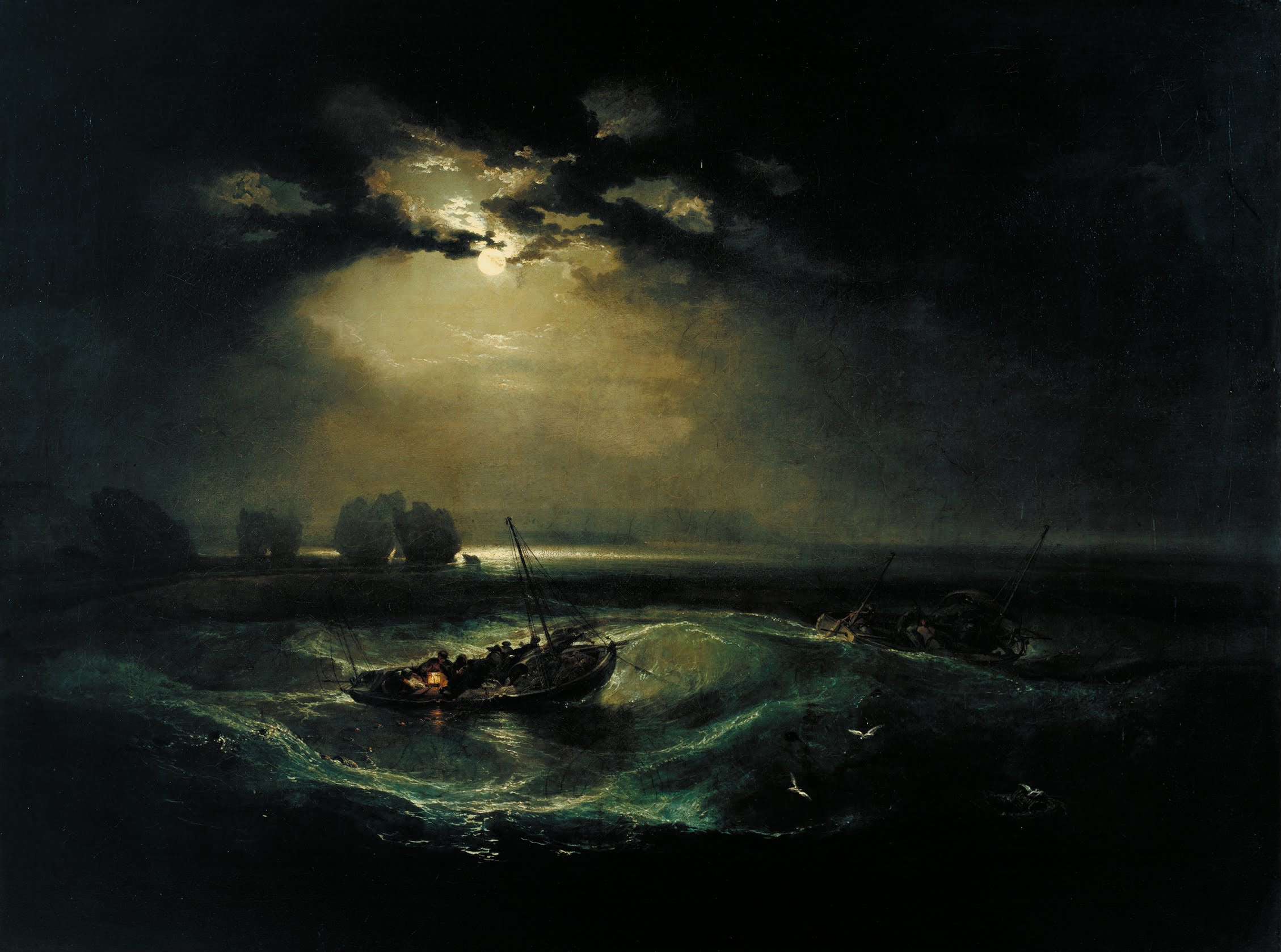
1. Fishermen at Sea — J. M. W. Turner, 1796
In Fishermen at Sea, moonlight breaks through heavy cloud and falls in a broad, cold beam across rough water. A fishing boat rises on a wave near the centre, its occupants gathered around a tiny warm lantern. Other boats are harder to distinguish, and the surrounding darkness seems to absorb the limits of sea and sky.
Tate records the 1796 work by J. M. W. Turner as oil on canvas, accession N00544, measuring 91.4 by 122.2 centimetres.[1] Those dimensions give the seascape enough breadth for the moonlit opening to dominate, yet Turner keeps the fishermen near enough for their lamp to matter. The contrast is not merely one of size. Natural light spreads through cloud and water, while the human-made light stays local, fragile and dependent on the boat that carries it.
The brightest passage does not clarify the whole scene. Instead, it reveals the instability of the waves and makes the unlit water seem deeper. Dark masses at either side contain barely readable vessels. The moon creates uncertainty as well as visibility: it shows the force acting on the fishermen without providing a secure route.
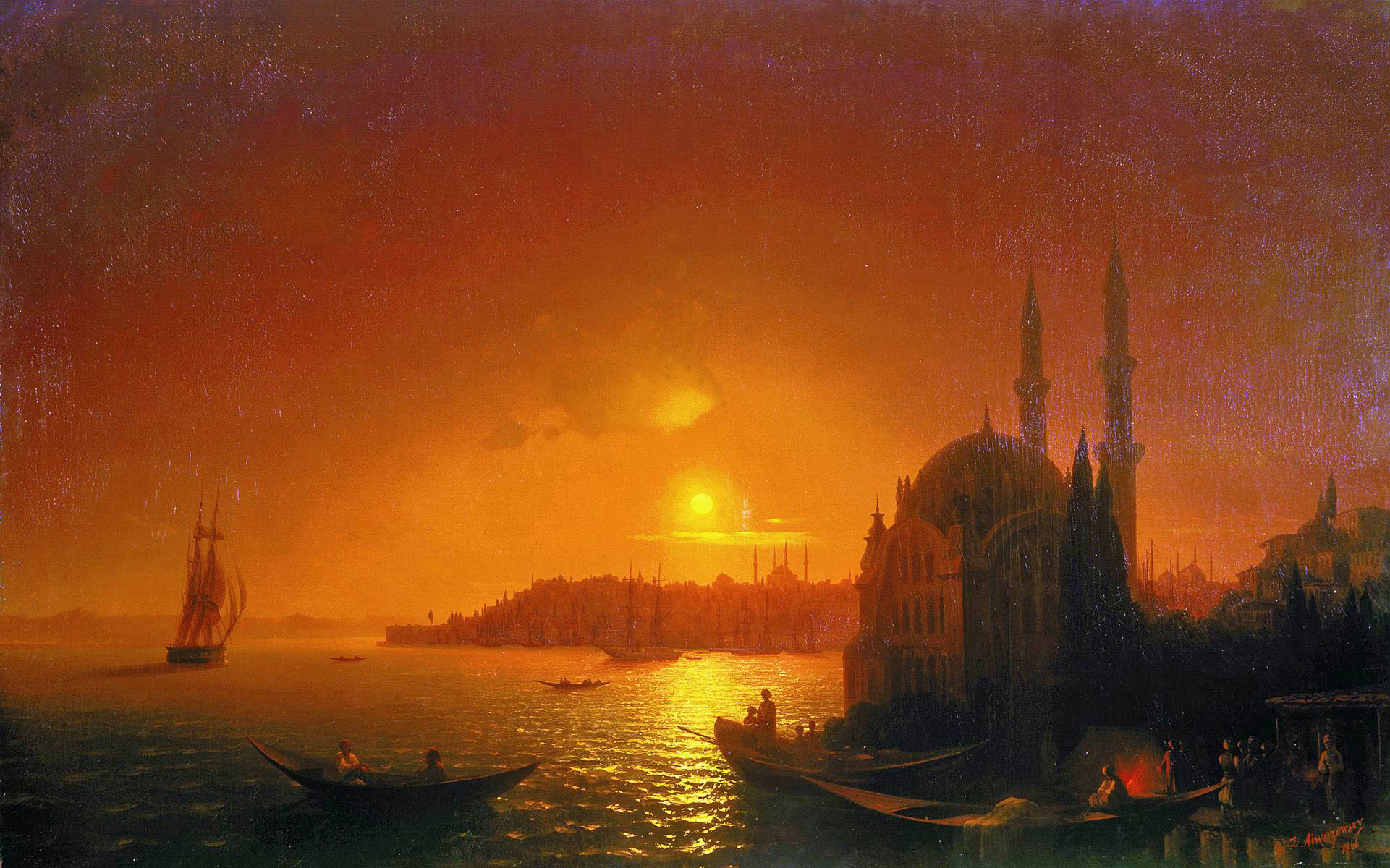
2. A View of Constantinople by Moonlight — Ivan Aivazovsky, 1846
Half a century later, A View of Constantinople by Moonlight expands the night seascape into an urban panorama. The moon hangs above the distant city, and its orange-gold path stretches across the water toward the foreground. Domes and minarets form a dark, recognisable skyline; sailing vessels and small boats move at different distances; figures and architecture gather along the near shore.
The State Russian Museum identifies this 1846 oil on canvas by Ivan Aivazovsky as object Ж-1787, measuring 124 by 192.5 centimetres. Its record notes that the artist began the painting in January 1846 and completed it in March, following earlier travel that included Turkey, Greece and Asia Minor.[2]
Aivazovsky lets the moon coordinate the entire composition. It silhouettes the city, separates ships from the horizon and produces a liquid avenue through the centre. Yet the foreground retains independent activity: boats cross the radiance, people occupy the shore, and the nearest buildings rise in shadow. Night concentrates Constantinople into a pattern of luminous distance and dark architectural profile.
Rural and harbour darkness
Millet and Manet reduce the range of visible information. One turns the plain into a working environment organised around a shepherd and flock; the other builds a port from cloud, mast and scattered points of light. Their darkness is inhabited, but neither painter needs a fully described setting.
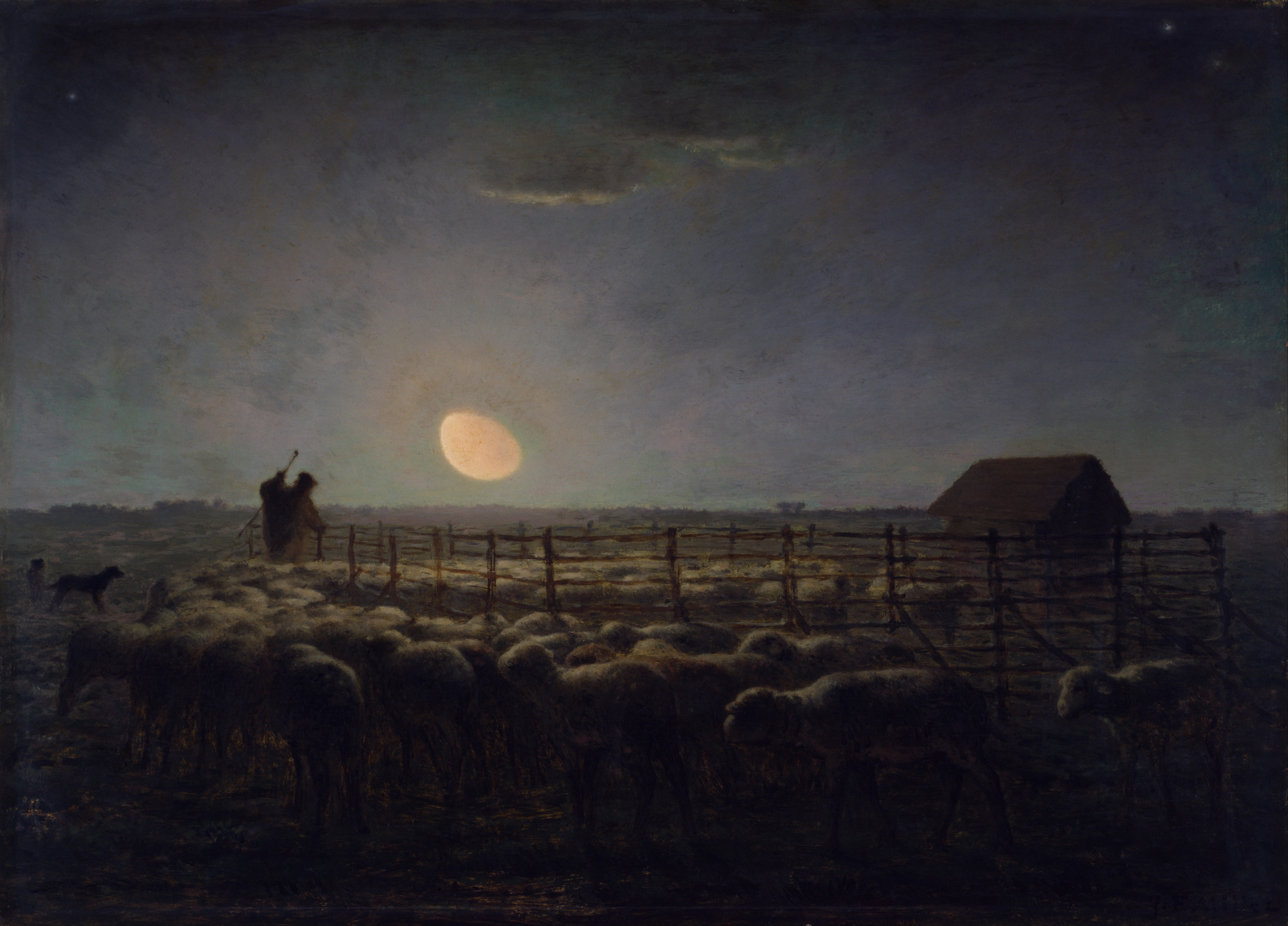
3. The Sheepfold, Moonlight — Jean-François Millet, 1856–60
The Sheepfold, Moonlight places a low moon above an open plain. Sheep crowd the foreground as a dark, uneven band. A shepherd stands near the fence with one arm raised, a dog waits at the left, and a shed anchors the right side. The scene is quiet, but it is not empty: people and animals continue their routines within the limited visibility of night.
The Walters Art Museum dates this oil-on-panel painting by Jean-François Millet to 1856–60. Accession 37.30 measures 45.3 by 63.4 centimetres. The museum describes the setting as the plain between Barbizon and Chailly and connects the work with Millet's sustained attention to peasant life.[3] The fence, fold and shepherd identify a particular kind of labour.
Millet suppresses sharp detail across most of the surface. The flock is built from clustered backs, while the fence repeats thin vertical and horizontal strokes. The moon is unusually large and low, its warm disc softened by the surrounding haze. Its light does not produce Turner's violent contrasts or Aivazovsky's brilliant reflections. Instead, it establishes a muted interval in which the shepherd's gesture becomes legible. Night here has duration: it is lived time, with tasks still being performed even as the landscape approaches obscurity.
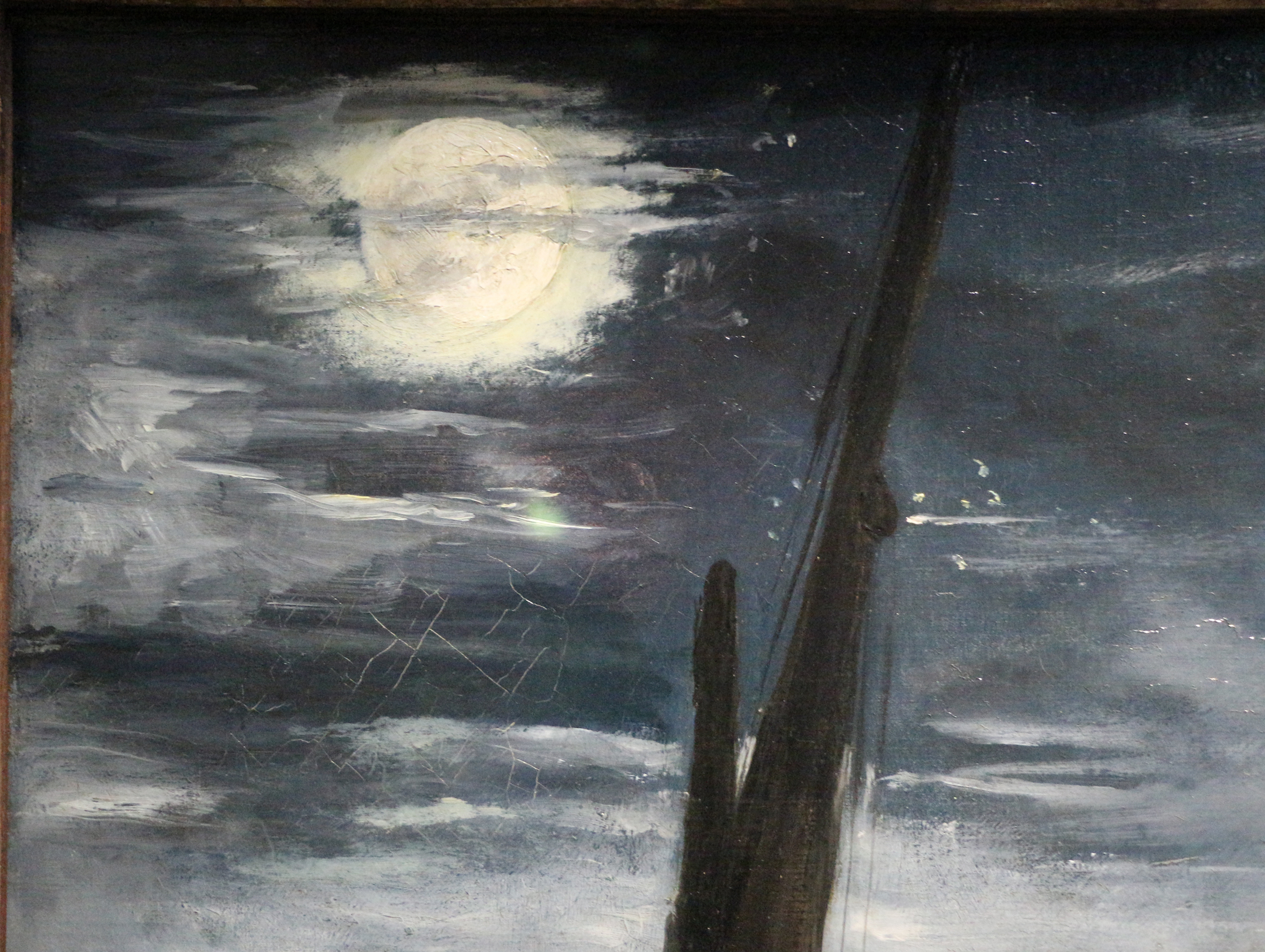
4. Moonlight over the Port of Boulogne — Édouard Manet, 1869
Manet's Moonlight over the Port of Boulogne makes a harbour from very little. A pale moon is crossed by cloud at the upper left. Near-black masts and rigging rise through the centre, while small strokes of light suggest distant activity along the water. Large areas remain unresolved, so the eye moves among a few cues rather than surveying a continuous port.
Musée d'Orsay records the painting by Édouard Manet under its French title, Clair de lune sur le port de Boulogne. It is an 1869 oil on canvas, accession RF 1993, measuring 81.5 by 101 centimetres.[4] The museum's 1869 date governs this work.
Manet lets the rigging act almost like drawing laid over broad tonal zones. The moon is not delicately modelled, and the clouds are streaked rather than smoothed into atmospheric illusion. The port emerges as a spare arrangement of verticals, patches and glints. Darkness becomes a principle of selection: only a few elements are needed for harbour, weather and distance to register.
Image credit for the selected reproduction: Sailko / Wikimedia Commons, licensed under CC BY 3.0.

The nocturne becomes modern
Whistler and Van Gogh both paint rivers under artificial light, yet their methods pull in different directions. Whistler narrows colour and detail until the scene approaches abstraction. Van Gogh intensifies separate blues, yellows and oranges, making the distinction between starlight and gaslight part of the picture's structure.
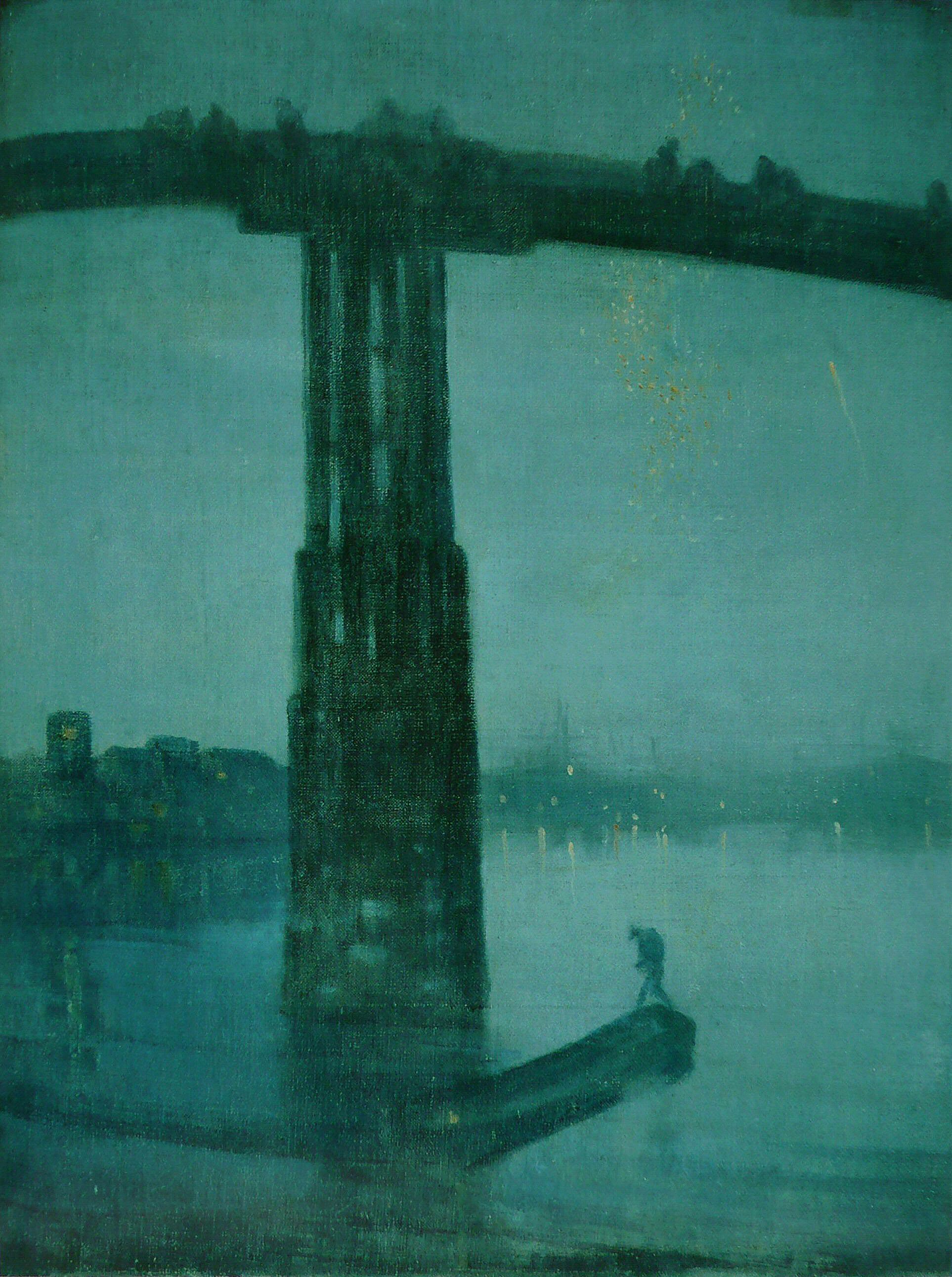
5. Nocturne: Blue and Gold—Old Battersea Bridge — James Abbott McNeill Whistler, 1872–75
The old bridge in Nocturne: Blue and Gold—Old Battersea Bridge rises as a massive dark shape through a blue-green field. A boatman appears low in the composition, the far shore is a softened strip, and the newer Albert Bridge glimmers in the distance. Flecks of gold above the horizon suggest fireworks, but they remain dispersed rather than descriptive.
Tate dates this oil on canvas by James Abbott McNeill Whistler to 1872–75. Accession N01959 measures 68.3 by 51.2 centimetres. The University of Glasgow's Whistler catalogue connects the work to his use of musical titles for Thames subjects.[5] “Nocturne” directs attention from topographical inventory toward tonal relation, interval and mood.
Whistler's bridge is both a recognisable structure and a near-abstract interruption. Its pier descends through the centre, while the roadway crosses high above the small boat. Scale is felt through those relationships, not through detailed masonry. The restricted palette also changes how the gold accents operate: distant lamps and sparks become events precisely because the rest of the picture is so quiet. Night permits Whistler to reduce the city without losing it. The result is less a record of every visible object than an arrangement whose few lights behave like notes held against a sustained colour.
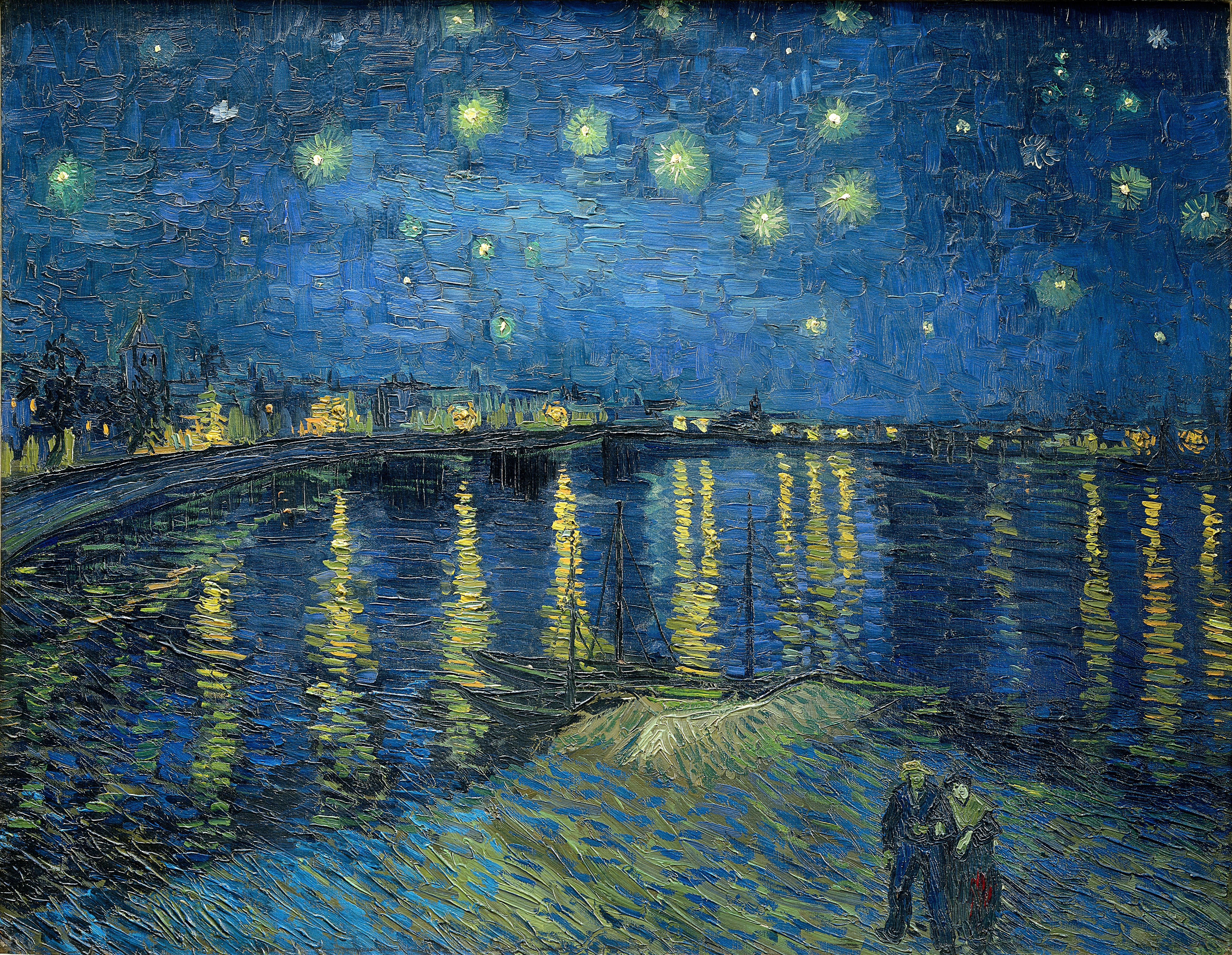
6. Starry Night over the Rhône — Vincent van Gogh, 1888
Starry Night over the Rhône multiplies the sources of illumination. Stars shine across a deep blue sky, while gas lamps along Arles produce stronger orange-yellow points. Their reflections descend in long, broken columns through the river. Two figures stand in the foreground, small but distinct against the brightened bank.
Musée d'Orsay identifies this 1888 oil on canvas by Vincent van Gogh as La Nuit étoilée, accession RF 1975 19, measuring 73 by 92 centimetres. Its account emphasises his sustained interest in night effects and the opposition between blue darkness and orange gaslight.[6]
Unlike Whistler's fused atmosphere, Van Gogh's surface is insistently articulated. Short and directional strokes distinguish sky, water, embankment and reflection. The stars have pale haloes, but their light does not imitate the vertical trails cast by the lamps. Celestial and urban illumination remain visibly different. The couple introduces intimacy without becoming the painting's narrative centre; the larger drama belongs to colour travelling between sky, city and river. Night is not neutralized into grey. It becomes a field in which blues can be varied and made more intense by the presence of complementary light.
Coastal mood and direct looking
Munch and Homer paint coastal nights only a year apart. Munch compresses remembered place into an ambiguous blue environment. Homer strips the sea to horizontal divisions, breaking surf and one concentrated zone of moonlight. Both avoid decorative stars, but their forms of restraint lead to different experiences.
7. Starry Night — Edvard Munch, 1893
In Starry Night, a white fence cuts across the foreground and bends around a dark, rounded group of trees. Beyond it, shore and water are difficult to separate. Small stars punctuate an expansive blue sky, while the foreground viewpoint feels close and enclosed despite the open coast.
The J. Paul Getty Museum records this 1893 oil on canvas by Edvard Munch as accession 84.PA.681, measuring 135.9 by 140.3 centimetres. Getty scholarship identifies the setting as Åsgårdstrand, where Munch spent summers, and notes the landscape's unusually abstract character and ambiguous scale.[7]
Blue does much of the emotional work. It moves across sky, water and land, weakening their boundaries while allowing the black tree mass and pale fence to assert themselves. The fence is ordinary, but its sharp curve turns it into a threshold between the viewer and the dim coast. Sparse stars do not map a constellation or clarify the geography. They make the sky feel immeasurable above the compressed foreground. Munch uses night to transform local landmarks into a psychological space—recognisable enough to hold memory, unstable enough to resist simple description.
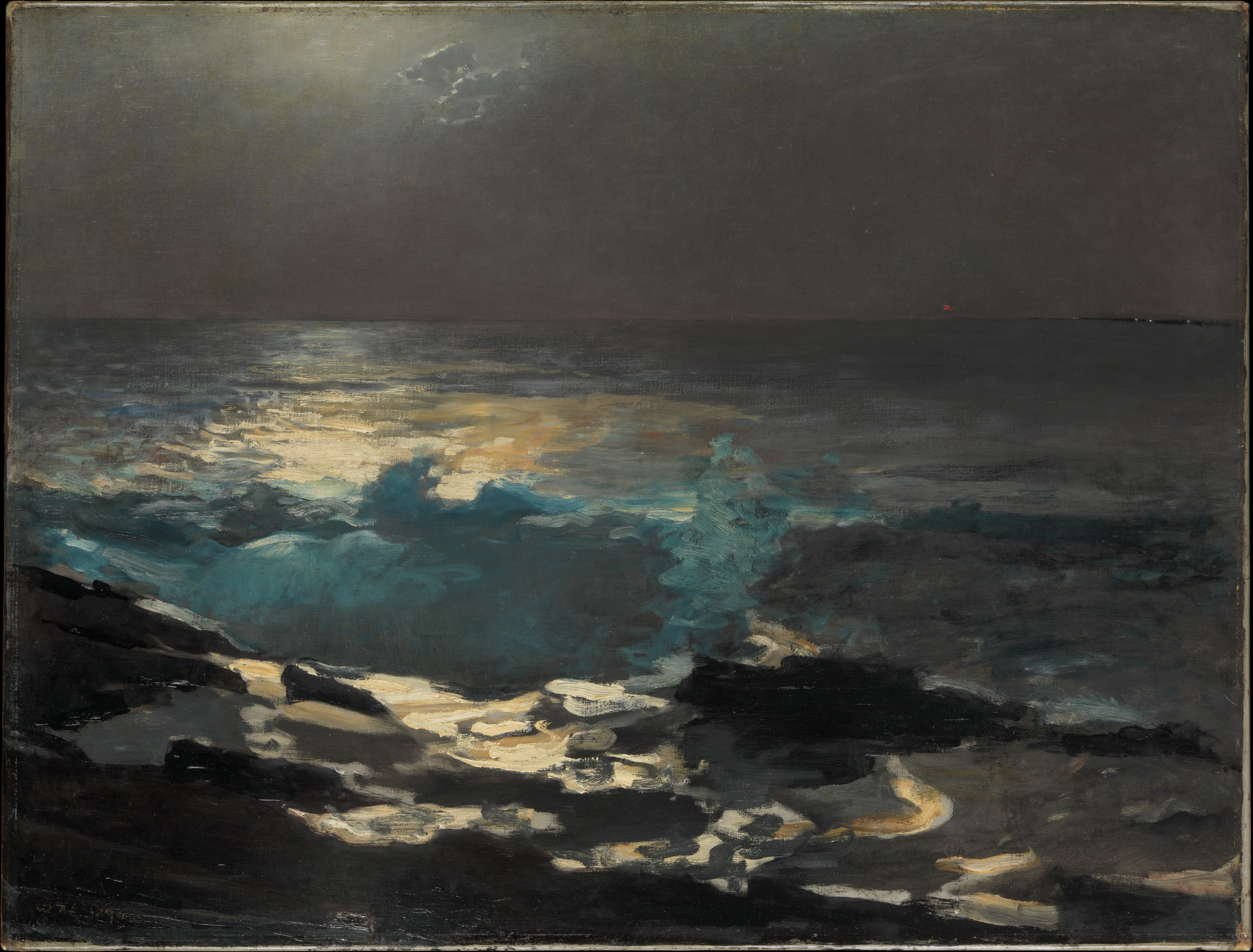
8. Moonlight, Wood Island Light — Winslow Homer, 1894
Homer's Moonlight, Wood Island Light is divided into broad horizontal bands. Dark sky occupies the upper half, the distant sea forms a narrow interval, and waves break over black rocks below. A limited patch of moonlight opens through cloud and catches the moving water without revealing a bright lunar disc.
The Metropolitan Museum of Art dates this oil on canvas by Winslow Homer to 1894. Accession 11.116.2 measures 78.1 by 102.2 centimetres, and its image is part of the museum's Open Access programme.[8] The title points to Wood Island Light, but light is experienced across atmosphere and sea rather than centred on a described lighthouse.
Homer's economy is physical. Grey-brown sky meets a nearly level horizon; blue-green waves curl against heavy black forms; pale paint catches spray and wet rock. Where Munch's space feels filtered through memory, Homer's seems concentrated around immediate differences of surface and motion. Yet the image is not a literal transcription. Its power comes from selection—the rejection of incident until the viewer attends to a few pressure points: horizon, reflection, wave and shore. Night makes the sea readable through rhythm rather than detail.
Electric city and Expressionist night
The final pair breaks with moonlit naturalism in different ways. Pissarro studies a city whose own technologies produce the visible night. Kirchner remembers an Alpine phenomenon but translates it into heightened colour. One picture multiplies urban lights; the other makes the moon strange again.

9. The Boulevard Montmartre at Night — Camille Pissarro, 1897
The Boulevard Montmartre at Night looks from a high window along a Parisian street after rain. Buildings form diagonal walls around the roadway. Carriages, pedestrians and shop fronts dissolve into dabs and strokes, while white, yellow, orange and red lights repeat into the distance. The sky remains a dark wedge, but illumination now rises mainly from the city below.
The National Gallery identifies this 1897 oil on canvas by Camille Pissarro as NG4119, measuring 53.3 by 64.8 centimetres. It belongs to a group of fourteen Boulevard Montmartre views and is Pissarro's only night painting. The museum distinguishes the cool electric street lamps from gas-lit shop windows and the oil lamps of waiting cabs.[9] These technologies are not background facts; their different colours organise the image.
Wet pavement extends the lights and loosens solid forms. Pissarro does not describe each person or vehicle, but repeated touches make the crowd and traffic feel continuous. The elevated viewpoint supplies perspective, while the brushwork keeps the street restless. With neither visible moon nor stars, the modern boulevard generates its own constellation.
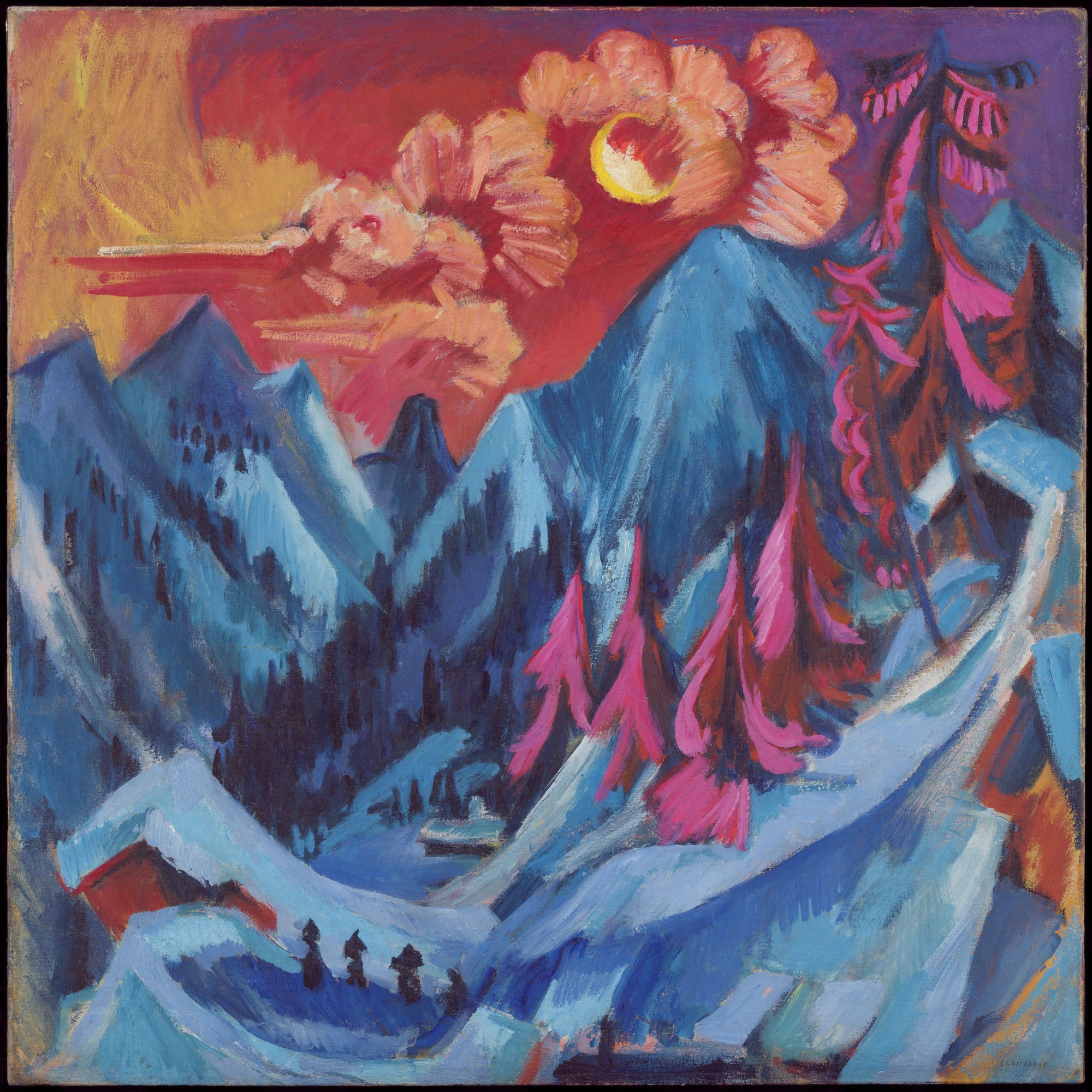
10. Winter Landscape in Moonlight — Ernst Ludwig Kirchner, 1919
In Winter Landscape in Moonlight, blue and turquoise mountains rise behind pink trees and snow-covered roofs. Orange clouds gather across a red-violet sky, and the moon glows as a yellow-centred disc. The palette does not imitate ordinary nocturnal vision, yet it makes the landscape's illumination feel immediate and uncanny.
The Detroit Institute of Arts records this 1919 oil on canvas by Ernst Ludwig Kirchner as accession 40.58, measuring 120.7 centimetres square. The museum relates the painting to unusually coloured moonlight Kirchner witnessed over the Swiss Alps and explains that he painted the scene from memory.[10] It also identifies the flat-topped Tinzenhorn in the distance, connecting expressive colour to a specific mountain environment.
Kirchner does not dissolve the view into darkness. He sharpens its parts into interlocking colour zones. Snow fields zigzag forward, peaks rise like cut forms, and clouds curl around the moon. The few buildings and trees give scale, but the whole landscape seems animated by the sky. Memory frees colour from descriptive restraint without severing it from observation. At the end of the sequence, moonlight is neither Turner's cold natural force nor Millet's muted working atmosphere. It is a remembered event rebuilt through Expressionist contrast.
How to compare paintings of the night sky
Start with the source of light. Turner, Aivazovsky, Millet and Manet all show the moon, but it performs a different task in each painting: exposing danger, unifying a panorama, sustaining rural work or reducing a harbour to silhouettes. Whistler lets fireworks and distant lamps disturb a restricted field. Van Gogh separates stars from gaslight. Pissarro removes celestial light altogether and lets modern Paris illuminate itself. Kirchner returns to the moon only to make its colour unfamiliar.
Then consider reflection. Water can widen a small source into a path, as in Aivazovsky, or break it into unstable flashes, as in Turner and Homer. Van Gogh's long orange trails distinguish lamps from the stars above them. On Pissarro's wet roadway, reflection belongs to traffic and commerce rather than sea or river. The reflecting surface is never passive; its texture determines whether light feels continuous, fractured, intimate or spectacular.
Visibility also governs human scale. Turner's fishermen cluster around one lantern, Millet's shepherd works beside an indistinct flock, and Van Gogh's couple pauses before the Rhône. In Aivazovsky and Pissarro, many small figures contribute to a larger urban rhythm. Munch nearly removes people from the scene, but the fence positions the viewer as strongly as a painted figure might. Night can therefore make people vulnerable, anonymous, companionable or simply implied by the place from which we look.
Finally, compare observation and memory. Homer condenses a directly encountered marine effect; Pissarro studies several kinds of current urban lighting; Van Gogh intensifies colours he described as richer than those of day. Munch and Kirchner transform familiar places through emotional recollection. None of these approaches is more inherently truthful. Each selects a different truth about seeing after sunset: the eye cannot hold everything, so the painter decides which relationships will carry the scene.
Across these ten works, darkness moves from Romantic moonlit immensity to the modern city's self-generated glow and the Expressionist freedom of remembered colour. What persists is the productive limit night imposes. Forms must be chosen, light must be ranked, and distance must be rebuilt from fewer signals. That is why night-sky painting is more than a collection of dark landscapes. It is a sustained experiment in how little can remain visible while a place, atmosphere and human position still become clear.
Frequently Asked Questions
J. M. W. Turner's Fishermen at Sea, dated 1796, opens the sequence with moonlight exposing danger on rough water. [1]
The selected works are outdoor scenes in which the sky or its light is structurally indispensable, but their purposes range from marine danger and rural labour to city illumination and remembered colour. [4]
Painters contrast moonlight or stars with lanterns, gas lamps, electric street lights and shop windows through differences in colour, scale and reflection. [6]
Ernst Ludwig Kirchner's Winter Landscape in Moonlight, dated 1919, closes the guide with remembered Alpine light rebuilt through Expressionist colour. [10]
Discussion
Use this work-led guide to compare how painters rank moonlight, starlight and artificial illumination after sunset.
Share an observation about how reflection, visibility or memory changes one of these night scenes.
Reader Insights
Which small light most strongly guides your eye, and what remains deliberately difficult to see?
How does reflection change when it falls on rough sea, calm river or rain-wet pavement?
When does remembered or expressive colour communicate night more strongly than naturalistic description?
Join the Conversation
Add your reading below, keeping observations specific and evidence clear.
References
- Tate, “Fishermen at Sea”.
- The State Russian Museum, “A View of Constantinople by Moonlight”.
- The Walters Art Museum, “The Sheepfold, Moonlight”.
- Musée d'Orsay, “Clair de lune sur le port de Boulogne”.
- University of Glasgow, Whistler catalogue raisonné, “Nocturne in Blue and Gold”.
- Musée d'Orsay, “La Nuit étoilée”.
- J. Paul Getty Museum, Masterpieces of Painting in the J. Paul Getty Museum.
- The Metropolitan Museum of Art, “Moonlight, Wood Island Light”.
- The National Gallery, “The Boulevard Montmartre at Night”.
- Detroit Institute of Arts, “Winter Landscape in Moonlight”.