


A mountain can dominate a painting without filling it. It may rise as a remote landmark, press against a travelling army, hold a sacred encounter above ordinary ground, or become a pattern of coloured planes. What matters is not simply that a peak appears, but that height, mass and distance organise the picture. Human figures then acquire their meaning in relation to it: pilgrims climb, armies disappear, tourists sketch, communities occupy valleys, and solitary viewers stop at the edge of darkness.
These ten mountain paintings follow that changing relationship from the early fourteenth century to the early twentieth. The sequence is selective rather than exhaustive. It concentrates on works in which the mountain is a principal subject, an indispensable narrative setting or the compositional force that holds everything else together. It also asks a practical viewing question: how does a painter turn immense terrain into a bounded image?
The Paintings hub places mountains among other visual subjects, while Famous Paintings opens a wider route through individual works. Mountain pictures naturally touch the history of Landscape Art, yet this is not a replacement for that broad genre. Landscapes include rivers, coasts, gardens, cities and cultivated fields; the comparison here stays with mountains and the distinct problems they bring. The nineteenth-century works intersect with Romanticism, and the later shift toward constructed colour and repeated observation can be followed through Post-Impressionism.
Sacred height and the mountain as a map
In the first two works, mountains are not neutral scenery. Duccio compresses biblical temptation into a small panel where rocky height separates spiritual choices. El Greco turns Sinai into a place that can be imaginatively travelled, joining a named sacred summit to paths, buildings and episodes spread across the terrain.
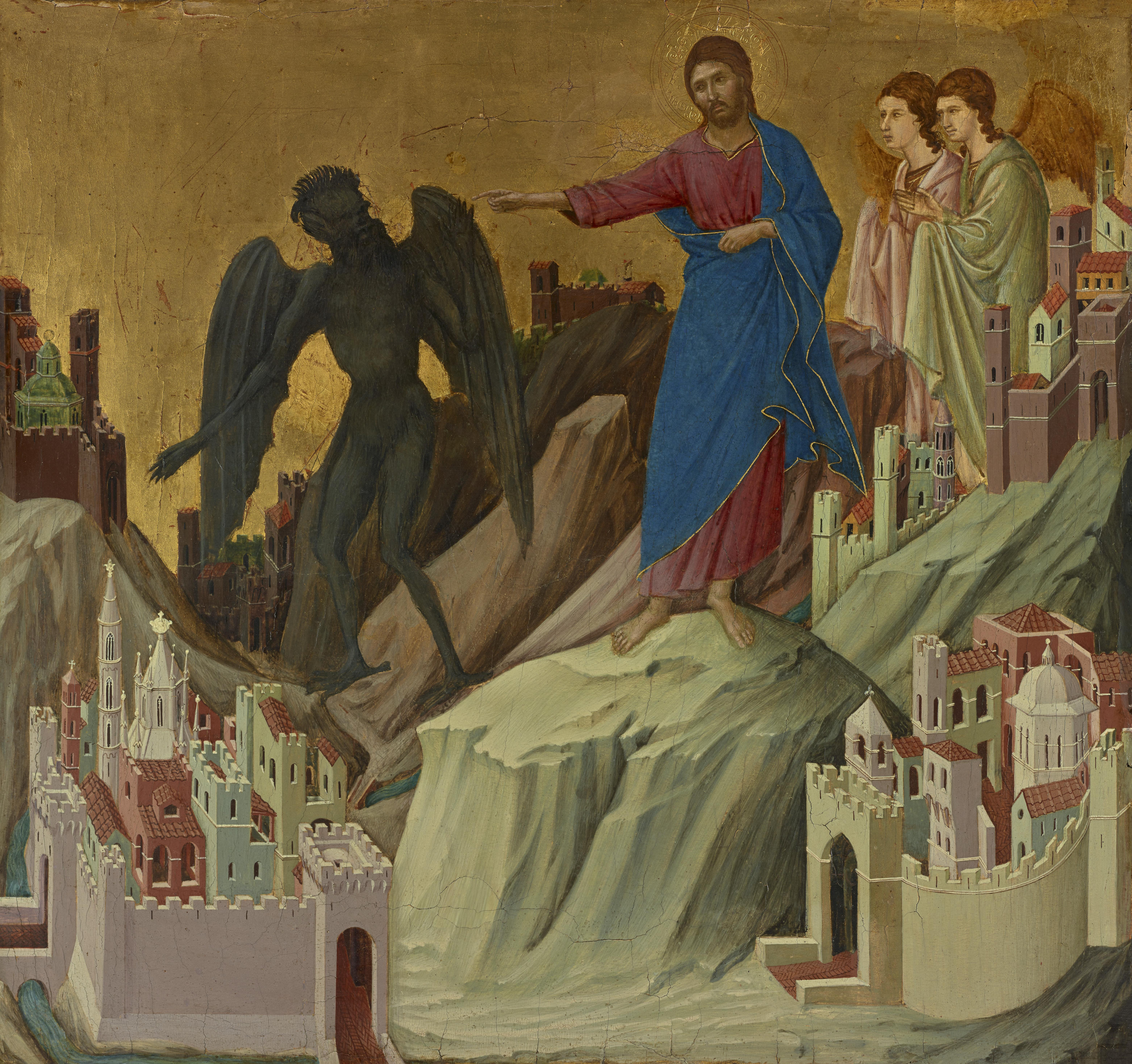
1. The Temptation of Christ on the Mountain — Duccio di Buoninsegna, 1308–11
In The Temptation of Christ on the Mountain, Christ and the devil stand on a jagged ridge above miniature cities. The landscape does not obey a single natural viewpoint. Peaks rise like separate stages, buildings cluster at a much smaller scale, and angels wait at the right. That deliberate compression allows several kinds of distance—physical, moral and spiritual—to coexist.
The Frick Collection records this 1308–11 work by Duccio as tempera on a cradled poplar panel, accession 1927.1.35, measuring 43.2 by 46 centimetres. It belonged to the rear predella of the Maestà, the monumental altarpiece made for Siena Cathedral.[1] Its present size helps explain the remarkable economy of the design: mountains, kingdoms and figures must remain legible within less than half a metre.
The devil points toward the worldly realms below, while Christ’s upright gesture refuses the offer. Rock ridges guide the eye between them and then toward the angels. Scale is expressive rather than geographic. The cities signify kingdoms without pretending to be a continuous observed panorama, and the mountain lifts the encounter above their crowded architecture. Duccio makes height a form of emphasis: the decisive exchange occupies the exposed summit. The wider work of Duccio di Buoninsegna shows how carefully he could organise sacred narrative within compact painted fields.
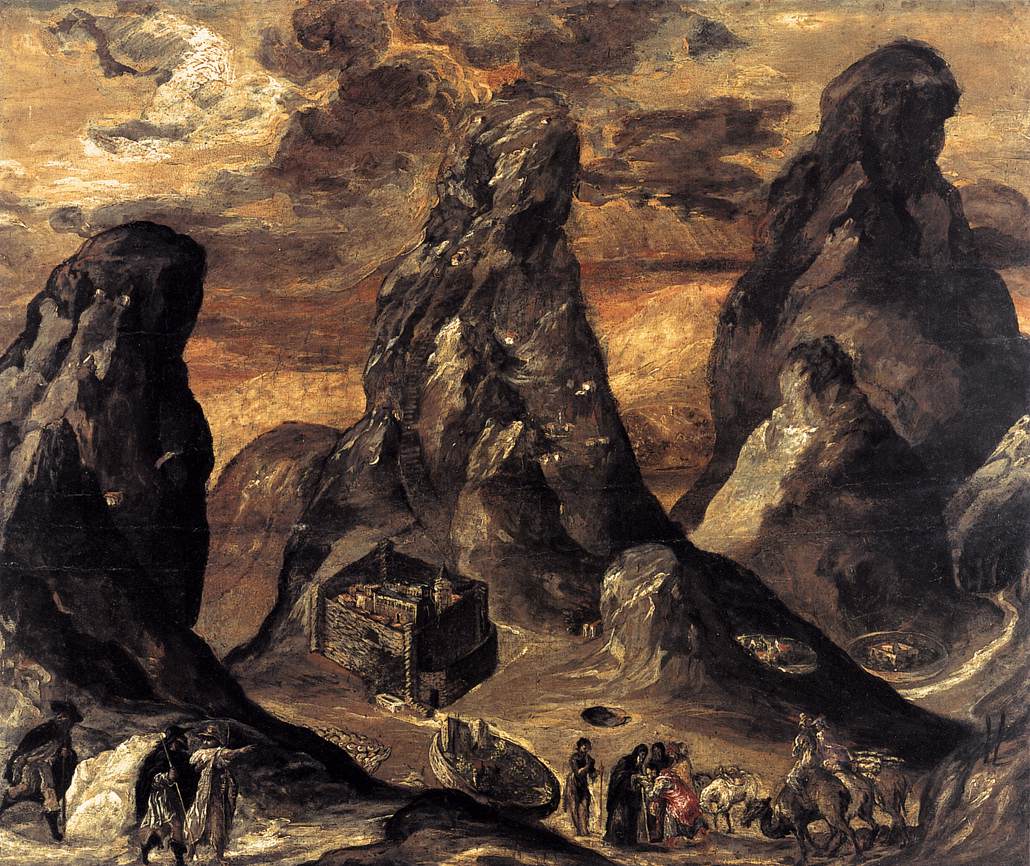
2. View of Mt. Sinai and the Monastery of St. Catherine — El Greco, 1570–72
El Greco’s View of Mt. Sinai and the Monastery of St. Catherine presents a named sacred landscape as both vision and itinerary. Three sharp peaks rise above an arid foreground. The monastery sits below, while small figures and routes distribute movement through the terrain. Unlike Duccio’s compressed biblical stage, this mountain invites the eye to travel from site to site.
The Historical Museum of Crete identifies the work as an oil-and-tempera painting on panel from 1570–72 in its collection. The panel measures 41 by 47.5 centimetres; no public accession number is given in the museum’s record.[2] The institution connects the composition with Mount Sinai and the Monastery of Saint Catherine, making the specificity of place essential to the painting rather than incidental.
El Greco combines steep, stylised landforms with an almost diagrammatic clarity. Winding paths carry tiny travellers across broad zones of ochre and brown, and the monastery provides an architectural point of recognition below the peaks. The mountain is therefore seen in more than one way at once: as forbidding physical terrain, as a destination, and as a setting dense with religious memory. This early work also reveals a different side of El Greco from the elongated figures and turbulent skies of his mature Spanish paintings.
Solitude, storm and the sublime
Around 1800, mountain painting increasingly tested the viewer’s emotional position. Friedrich places one person before an ungraspable distance. Turner nearly dissolves an army within weather. Cole gives a recognisable American pass the drama of exposure, movement and remembered catastrophe. In all three, terrain exceeds human control.
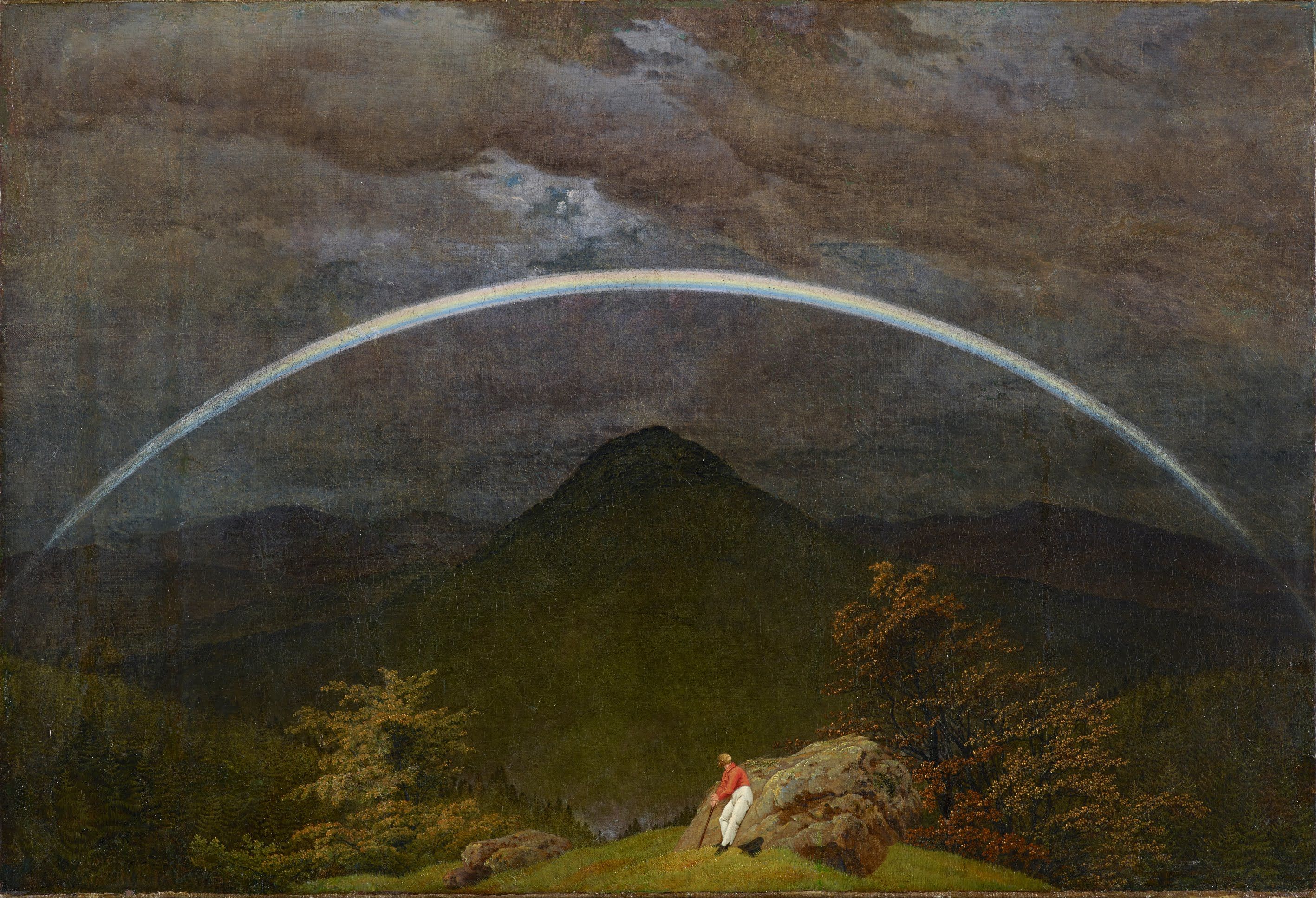
3. Mountain Landscape with Rainbow — Caspar David Friedrich, 1809/10
Mountain Landscape with Rainbow begins with a stopped figure. A man stands in the dark foreground, leaning on a staff and facing a pale mountain beyond a deep valley. Above him, a faint arc spans the sky. The picture withholds an easy route from near ground to distant summit; the viewer shares the figure’s pause rather than mastering the terrain.
Museum Folkwang records Friedrich’s 1809/10 oil on canvas as accession G 46, measuring 69 by 102 centimetres. The museum’s Friedrich anniversary account discusses the unusual nocturnal rainbow or moonbow and the contrast between dark foreground and illuminated distance.[3] That uncertainty is productive. The arc looks like a promise of coherence, but it does not turn the landscape into a simple allegorical code.
Friedrich constructs depth through separation. Rock and vegetation remain close but obscure, the valley opens as an unreadable interval, and the mountain appears almost weightless in cool light. The solitary viewer supplies scale, yet his back denies us a facial response. We must infer experience from posture and position. In the context of Caspar David Friedrich, the mountain becomes characteristic of his ability to make looking itself the central action.
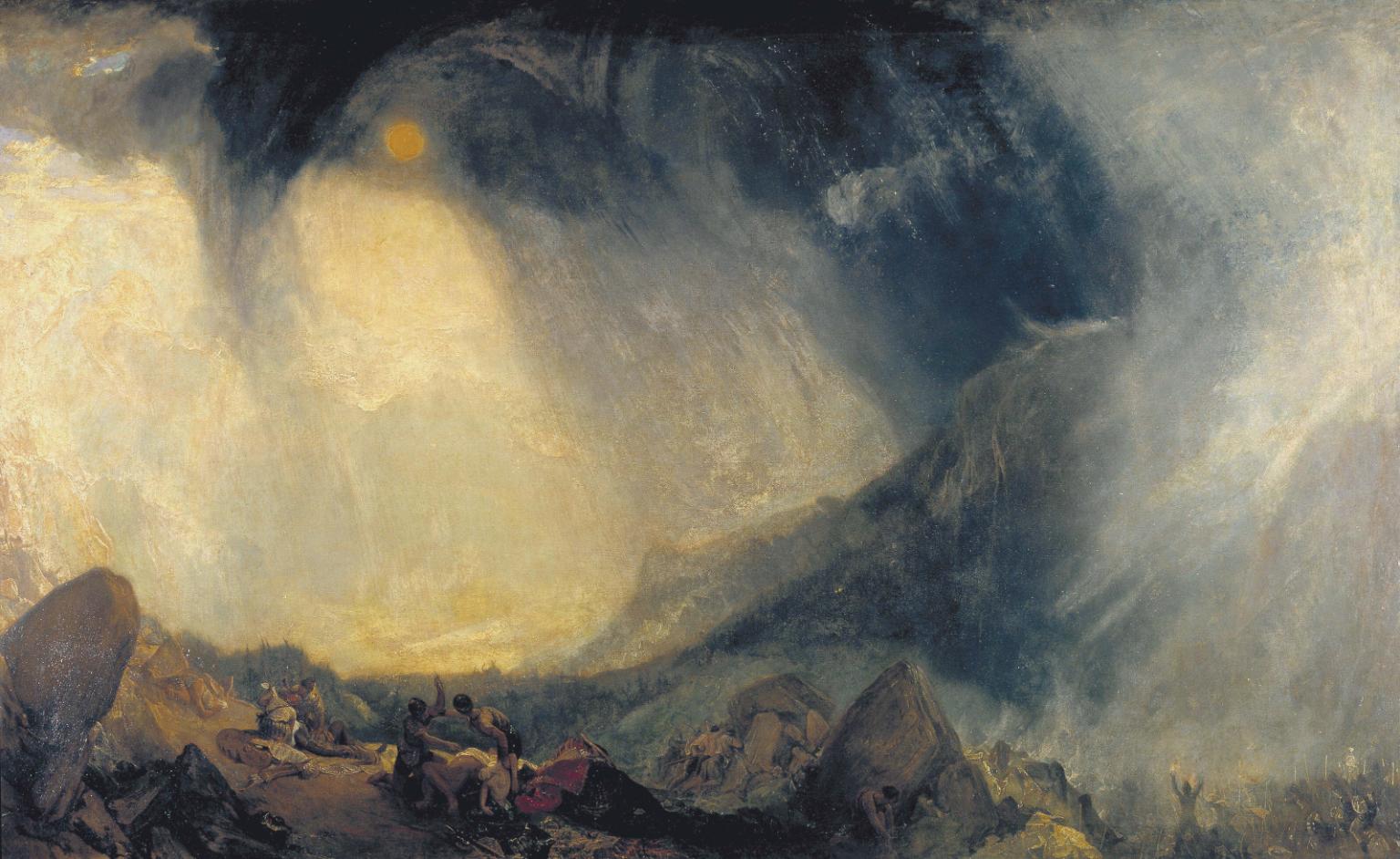
4. Snow Storm: Hannibal and his Army Crossing the Alps — J. M. W. Turner, 1812
Turner’s Snow Storm: Hannibal and his Army Crossing the Alps refuses the clear summit view. A dark, curling storm sweeps across the sky and descends toward a tiny army. Figures struggle in the foreground, but the supposed military hero is not granted visual command. Weather and mountain scale overwhelm historical ambition.
Tate identifies this 1812 oil on canvas as N00490, measuring 126 by 237.5 centimetres. Its catalogue relates the subject to Hannibal’s Alpine crossing and notes how the painting subordinates the army to destructive natural forces.[4] The very wide canvas gives the storm room to gather laterally, while the low human activity remains vulnerable beneath it.
Turner does not describe the Alps ridge by ridge. Instead, curved bands of cloud, snow and shadow produce an unstable vortex. A patch of light beyond the storm offers depth without safety. The painting belongs to the historical imagination, but its strongest event is atmospheric: visibility collapses at the moment a grand campaign is meant to proceed. Through J. M. W. Turner, this canvas can be compared with later works in which sea, fire and rain similarly undo firm boundaries.
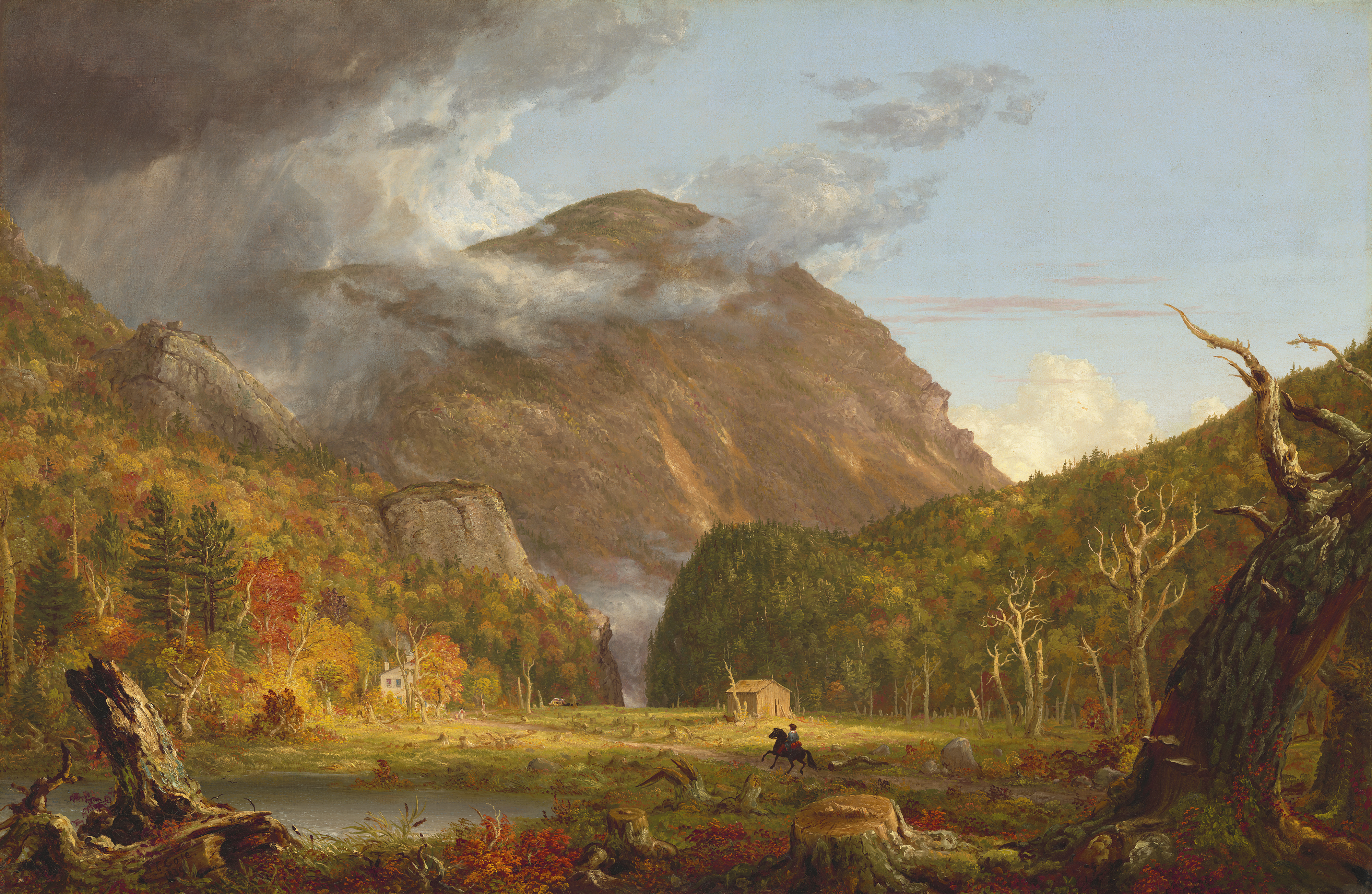
5. A View of the Mountain Pass Called the Notch of the White Mountains (Crawford Notch) — Thomas Cole, 1839
Thomas Cole’s Crawford Notch makes a real pass legible through signs of passage. A road threads into the narrowing valley, riders move along it, a distant building marks settlement, and storm clouds press over the mountain walls. The picture offers access into the landscape while repeatedly reminding us how exposed that access is.
The National Gallery of Art records the 1839 oil on canvas as accession 1967.8.1, measuring 102 by 155.8 centimetres. Its account connects the site with the 1826 Willey family disaster, when a landslide killed the family after they fled their house, which survived.[5] That history gives the advancing weather and steep slopes a specific emotional charge without making the canvas a literal reconstruction of the event.
Cole balances invitation and warning. The road is a conventional path for the eye, but it bends toward a darkened constriction. Small figures establish the immense scale of the pass, while patches of sunlight prevent the whole view from becoming uniformly threatening. The scene belongs within the American landscape tradition associated with Thomas Cole, yet its mountain is neither untouched wilderness nor a simple national emblem. It is travelled, inhabited and remembered as dangerous.
Panorama, territorial spectacle and the act of viewing
The next three paintings shift attention from confrontation toward possession, display and representation. Church constructs an encompassing South American panorama. Bierstadt stages western terrain at monumental scale while placing Indigenous life within a vision shaped for eastern audiences. Homer, working on a much smaller panel, shows artists making pictures of mountains and turns observation itself into the subject.
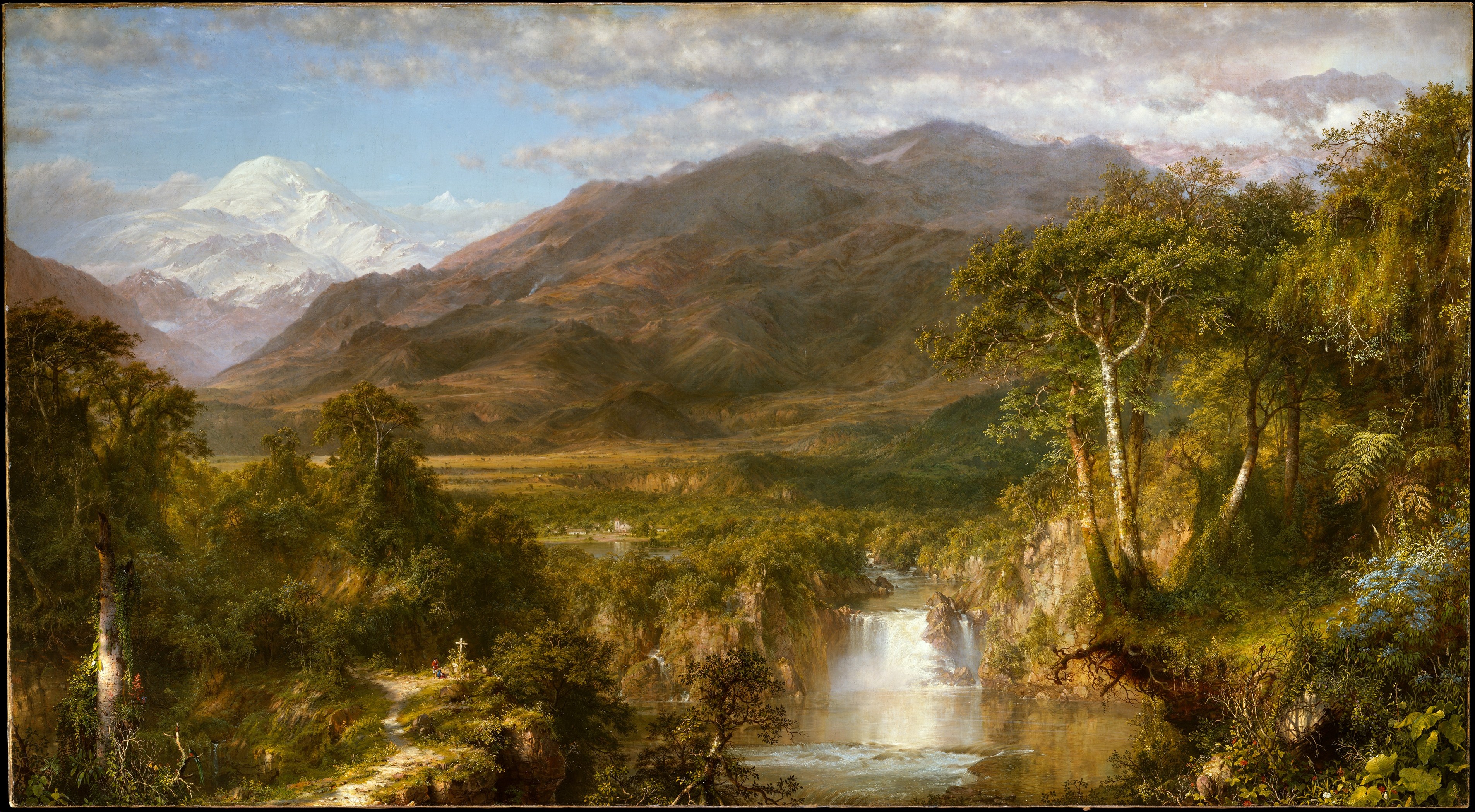
6. Heart of the Andes — Frederic Edwin Church, 1859
Heart of the Andes leads the eye through a vast composite world. Tropical plants occupy the foreground; water, settlement and forest extend through the middle distance; a snow-covered peak rises at the horizon. No single glance could contain all these zones in life, but the painting joins them into a continuous visual journey.
The Metropolitan Museum of Art identifies the 1859 oil on canvas as accession 09.95, measuring 168 by 302.9 centimetres. Its catalogue connects the picture to Church’s travels in South America and to the scientific writings of Alexander von Humboldt, while describing the work’s unusually elaborate public display.[6] Those contexts matter because the mountain view was built from observation but designed as an immersive spectacle.
Church uses minute detail to delay arrival at the summit. A cross beside the path, tiny buildings and figures reward close looking; layers of vegetation and haze gradually recalibrate scale. The peak remains distant enough to appear almost visionary, yet the foreground insists on material abundance. The canvas turns altitude into a sequence of climates and textures. In the work of Frederic Edwin Church, technical precision and theatrical presentation are not opposites: together they make the viewer feel both informed and overwhelmed.
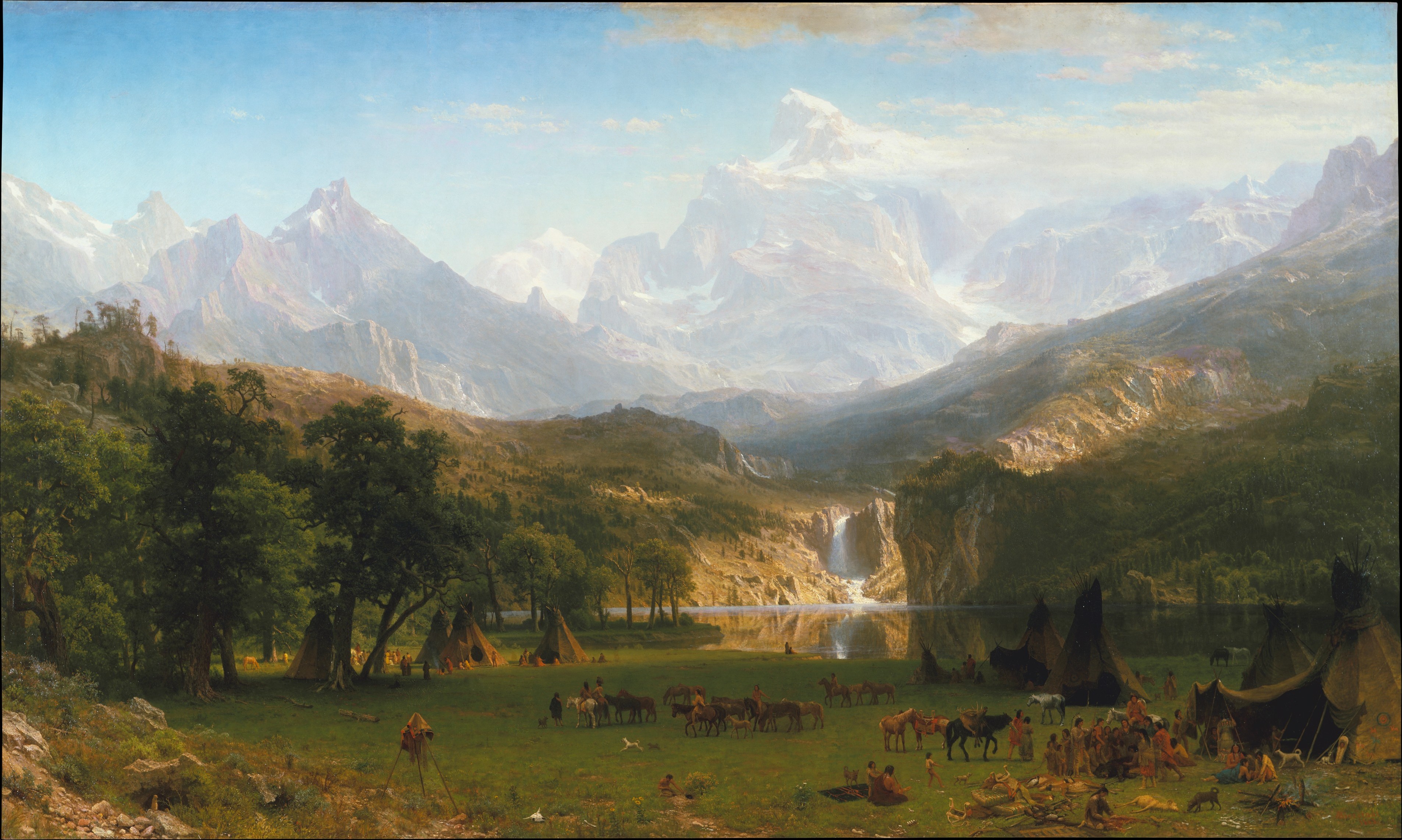
7. The Rocky Mountains, Lander’s Peak — Albert Bierstadt, 1863
Albert Bierstadt’s The Rocky Mountains, Lander’s Peak also unfolds from foreground water to a brilliant distant summit. A Shoshone encampment occupies the valley, with people, horses and tipis set beneath an enormous mountain wall. Calm reflections and carefully graduated distance give the scene a persuasive visual order.
The Metropolitan Museum of Art records the 1863 oil on canvas as accession 07.123, measuring 186.7 by 306.7 centimetres. Its account states that Bierstadt drew on sketches made during Frederick W. Lander’s 1859 survey expedition and describes the finished scene as an idealised construction rather than a straightforward record of one view.[7] The museum also places the painting within Manifest Destiny-era ideas, a context necessary to reading its apparent harmony.
The Shoshone presence must not be treated as decorative scale alone. It locates an existing community within land that the survey, title and eastern exhibition culture framed through expansion. Bierstadt’s polished light and immense format can make the valley seem timeless even as the picture belongs to a period of territorial transformation. The mountain is simultaneously observed terrain, manufactured spectacle and national claim. More of that tension appears across Albert Bierstadt, but this exact work remains distinct from similarly titled local pages.
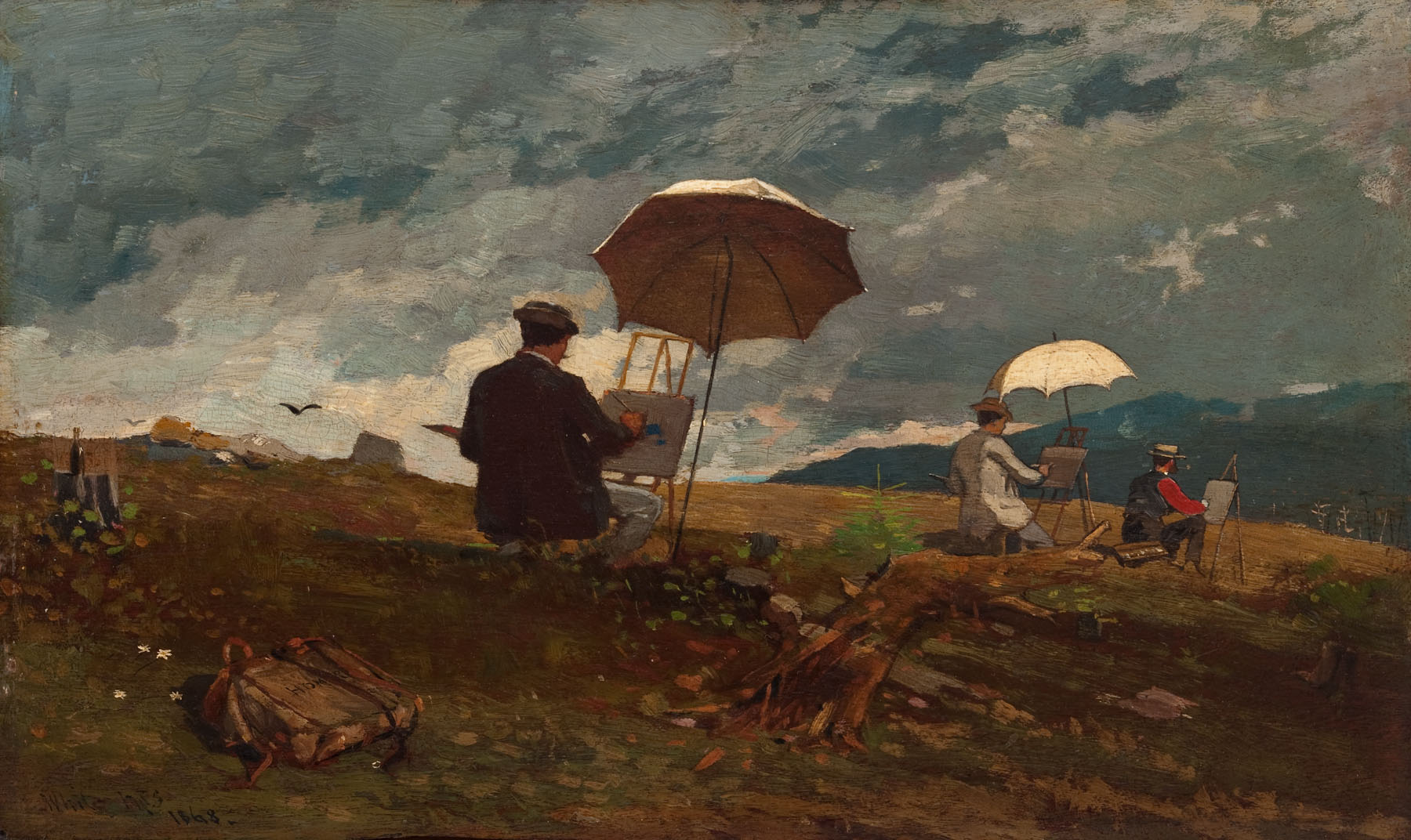
8. Artists Sketching in the White Mountains — Winslow Homer, 1868
In Artists Sketching in the White Mountains, the act of making a mountain image comes into view. Three painters sit or stand with sketching materials beneath umbrellas. The distant peaks are present, but Homer gives comparable emphasis to the artists’ temporary arrangement in the foreground.
The Portland Museum of Art identifies the 1868 oil on panel as accession 1988.55.4, measuring 23.97 by 40.16 centimetres. The museum’s object record and the Smithsonian inventory both identify the scene, medium and White Mountains subject.[8] The modest panel is markedly different from Church’s and Bierstadt’s vast exhibition canvases, and that difference changes the terms of attention.
Umbrellas make the viewing conditions tangible: artists need shade, equipment and time. One figure looks outward while another bends toward work, so seeing and recording become separate but related actions. Mountain tourism and artistic labour meet in a scene that is observant without claiming limitless command. Within Winslow Homer, the painting belongs to an early period before the forceful marine works for which he is often best known.
Repeated landmarks and modern structure
The final pair no longer asks only how to represent remote grandeur. Cézanne revisits a familiar mountain and admits modern infrastructure into the composition. Marc turns a mountain path into interlocking planes whose colour and rhythm matter as much as topographic recognition.
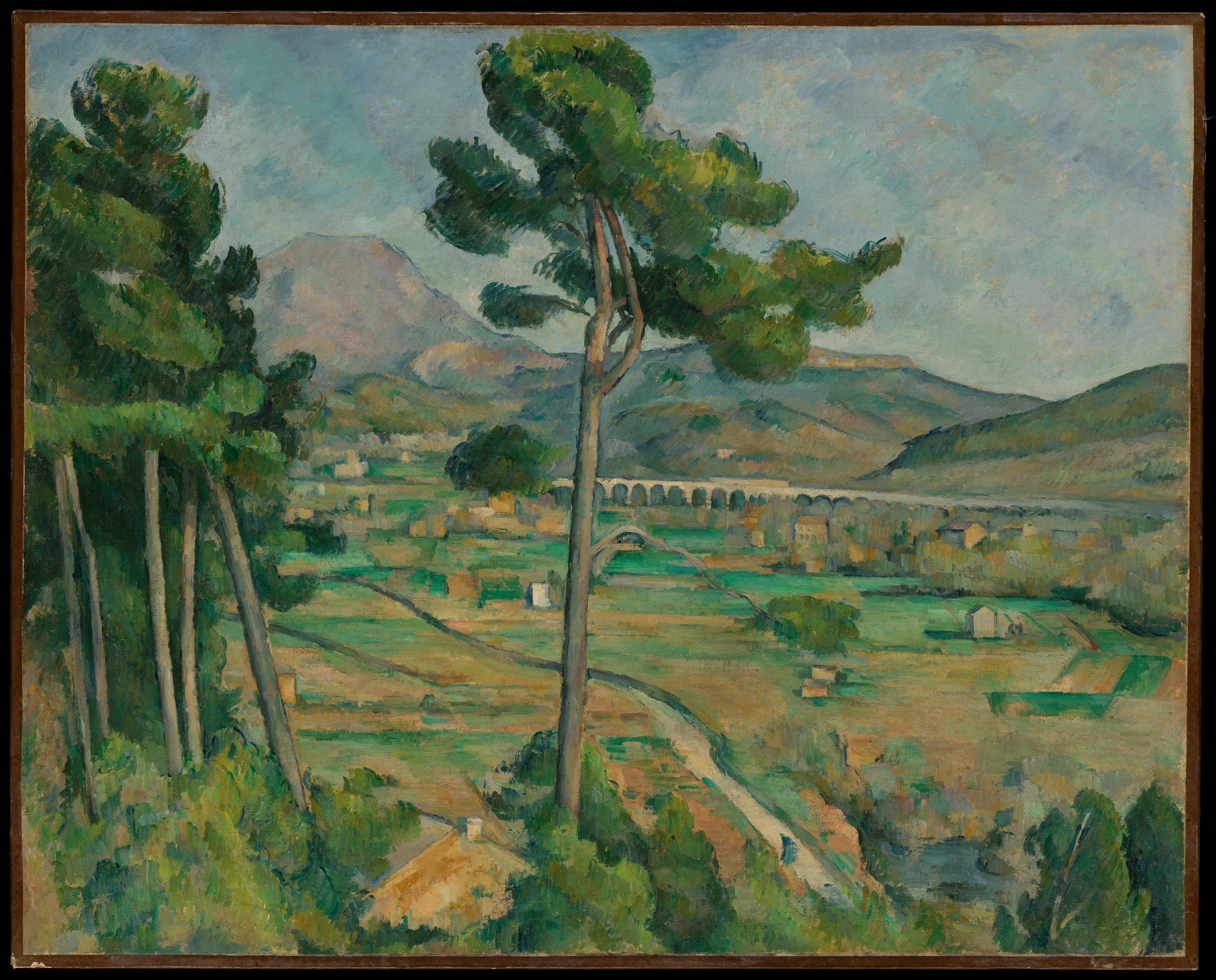
9. Mont Sainte-Victoire and the Viaduct of the Arc River Valley — Paul Cézanne, 1882–85
Mont Sainte-Victoire and the Viaduct of the Arc River Valley frames the mountain through pine branches. A railway viaduct crosses the middle distance, linking cultivated valley and pale ridge. The peak is identifiable, but it is neither isolated from human intervention nor treated as a theatrical climax.
The Metropolitan Museum of Art records this 1882–85 oil on canvas as accession 29.100.64, measuring 65.4 by 81.6 centimetres. Its catalogue notes Cézanne’s repeated engagement with Mont Sainte-Victoire and identifies the viaduct in the Arc River valley.[9] Repetition matters here: familiarity allows the mountain to become a stable motif through which relationships of colour, edge and depth can be reconsidered.
Branches form a partial screen rather than a neat repoussoir. Their diagonals answer the mountain’s slopes, while warm buildings and the long viaduct interrupt the greens below. Cézanne makes distance through overlapping planes without smoothing away the separate touches of paint. The result is observed and constructed at once. The broader development of Paul Cézanne explains why this repeatedly viewed peak became so important to later accounts of pictorial structure.
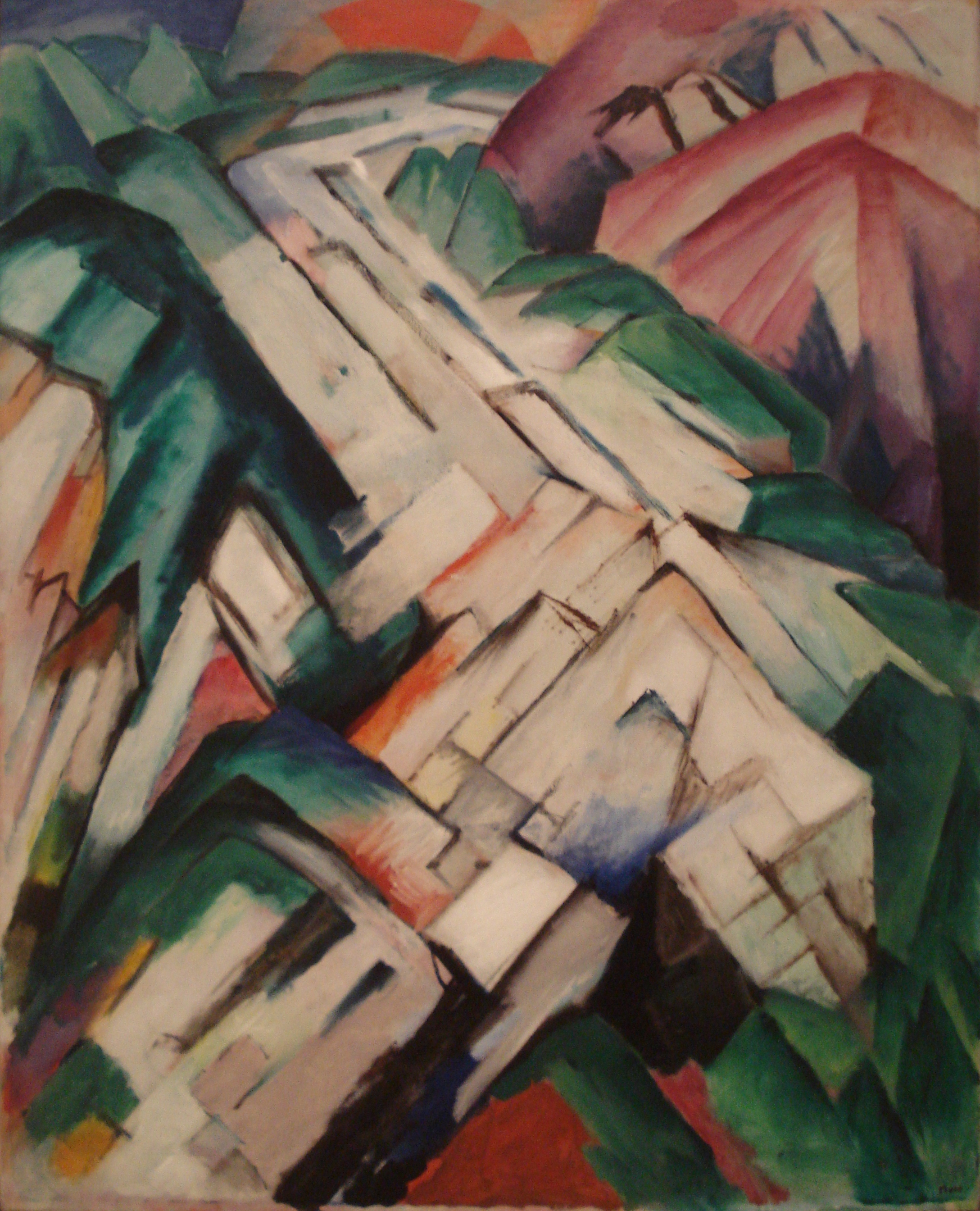
10. Steiniger Weg (Stony Path), formerly Gebirge/Landschaft (Mountains/Landscape) — Franz Marc, 1911/1912
Franz Marc’s Stony Path brings the sequence to a mountain image built from angular colour. A narrow route climbs through interlocking blue, red, green and yellow planes. There is no distant panoramic summit to possess. Instead, the picture makes ascent and obstruction felt through the collision of forms.
The San Francisco Museum of Modern Art records the oil on canvas as accession 51.4095, measuring 130.8 by 101.1 centimetres, and dates it 1911/1912. The museum gives the preferred title Steiniger Weg (Stony Path) while preserving the former titles Gebirge and Landschaft.[10] That naming history is useful: the work can still be recognised as a mountain landscape, but the current title directs attention to movement through it.
Marc’s colours do not describe local appearance in a conventional sense. They divide and bind the terrain, turning slopes into a compressed structure that pushes upward. The path gives the eye a foothold, yet it repeatedly disappears between planes. Mountain, route and painted surface become difficult to separate. In relation to Franz Marc, the work shows how his modern colour language could transform landscape even without the animals that dominate many of his best-known paintings.
How to compare mountain paintings
Begin with the mountain’s job. In Duccio it elevates a decisive sacred encounter; in El Greco it maps pilgrimage and memory. Friedrich uses distance to stage inward response, whereas Turner removes stable distance within a storm. Cole makes a pass both accessible and threatening. The same subject can therefore organise narrative, travel, feeling or danger without carrying one fixed meaning.
Next, compare where people appear. Tiny figures often establish scale, but they are never merely measuring devices. Hannibal’s army embodies frustrated ambition. Cole’s travellers enter a vulnerable corridor. Church’s foreground signs imply settlement and belief, Bierstadt’s encampment raises questions of community and territorial power, and Homer’s painters reveal the practical work behind apparently effortless views. Human presence changes what kind of mountain we think we are seeing.
Named peaks invite another distinction. Sinai gathers sacred associations; Crawford Notch carries a remembered disaster; Lander’s Peak reflects expeditionary naming; Mont Sainte-Victoire becomes meaningful through repeated looking. Yet named terrain is not automatically documentary. Church and Bierstadt combine observed material into carefully designed wholes, while Cézanne makes a familiar landmark newly unstable through paint. Accuracy, memory and construction operate together.
Finally, look at the path offered to the eye. Duccio’s ridges separate actors; El Greco’s routes distribute episodes; Church’s detail encourages slow visual travel. Friedrich blocks easy entry, Turner dissolves it, and Marc fractures it. These choices determine whether height feels attainable, forbidding, sacred, spectacular or abstract. A mountain painting is thus not simply an image of geology. It is an arrangement of access and distance.
Across six centuries, the mountain changes from narrative stage to named destination, sublime obstacle, national spectacle, familiar motif and modern structure. What persists is the challenge of scale. Every painter must decide what can be shown, what must be compressed, and where the viewer stands in relation to the height. Looking closely at those decisions keeps the subject distinct from a general survey of landscape and makes each peak more than background.
Frequently Asked Questions
Duccio's The Temptation of Christ on the Mountain, dated 1308–11, opens the sequence with sacred narrative compressed into a rocky height. [1]
Mountain paintings make a peak, range, pass or mountain route the principal subject, compositional anchor or indispensable narrative setting. [5]
Figures establish scale, but they also introduce pilgrimage, danger, community, territorial history, tourism and the act of making art. [7]
Franz Marc's Steiniger Weg (Stony Path), dated 1911/1912, closes the guide by turning mountain terrain into interlocking colour planes. [10]
Discussion
Use this work-led guide to compare how height, distance and access shape the experience of a mountain in paint.
Share an observation about how viewpoint, weather or human presence changes one of these mountain scenes.
Reader Insights
Which path, ridge or colour transition most strongly guides your eye through a painting?
How does the role of the mountain change between sacred narrative, sublime danger and observed landmark?
When does a constructed panorama feel persuasive, and what historical assumptions does that persuasion carry?
Join the Conversation
Add your reading below, keeping observations specific and evidence clear.
References
- The Frick Collection, The Temptation of Christ on the Mountain in Director’s Choice.
- Historical Museum of Crete, “View of Mt. Sinai and the Monastery of St. Catherine”.
- Caspar David Friedrich anniversary and Museum Folkwang, “Mountain Landscape with Rainbow”.
- Tate, “Snow Storm: Hannibal and his Army Crossing the Alps”.
- National Gallery of Art, “A View of the Mountain Pass Called the Notch of the White Mountains (Crawford Notch)”.
- The Metropolitan Museum of Art, “Heart of the Andes”.
- The Metropolitan Museum of Art, “The Rocky Mountains, Lander’s Peak”.
- Portland Museum of Art, “Artists Sketching in the White Mountains”.
- The Metropolitan Museum of Art, “Mont Sainte-Victoire and the Viaduct of the Arc River Valley”.
- San Francisco Museum of Modern Art, “Steiniger Weg (Stony Path)”.