 by Tom Gurney
Tom Gurney BSc (Hons) is an art history expert with over 20 years experience
Published on June 19, 2020 / Updated on August 2, 2026
Email: tomgurney1@gmail.com / Phone: +44 7429 011000
Contents
- Introduction
- What The Painting Shows
- The White Mountains Context
- Homer In 1868
- Relation To The Bridle Path, White Mountains
- Why This Work Belongs In The Homer Cluster
Introduction
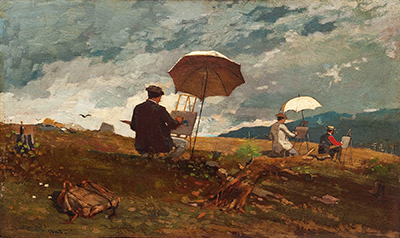
Winslow Homer's Artists Sketching in the White Mountains is a small 1868 oil on panel about art-making itself. Instead of presenting the White Mountains as a pure, empty wilderness, Homer shows three artists at work, seated or standing with easels under umbrellas. The subject is simple at first glance: people have come to draw the landscape. But the painting is sharper than a straightforward record of a scenic excursion. It turns the popular mountain view into a scene of looking, labor, tourism and gentle self-awareness. [1]
The Portland Museum of Art records the work as an oil on panel measuring 9 7/16 x 15 13/16 inches. It belongs to the museum through the Bequest of Charles Shipman Payson and carries accession number 1988.55.4. The Smithsonian Inventory record also identifies the work as an 1868 painting by Homer, located at the Portland Museum of Art, and summarizes the scene as three artists sketching on easels under umbrellas in the White Mountains. [2]
This article is best rebuilt as a concise support article within the Winslow Homer cluster. The painting connects directly to Homer's post-Civil War range in the late 1860s, when he was moving between illustration, oil painting, landscape, leisure and modern American subjects. It also gives readers a useful route into The Bridle Path, White Mountains, another 1868 White Mountains work, and into Drawings, because the image is fundamentally about sketching as a public and artistic practice. [3]
What The Painting Shows
The scene is built around repetition. Three artists face the landscape with their equipment arranged before them. Their umbrellas form a visual rhythm across the panel, turning an outdoor sketching session into something almost theatrical. Homer does not ask the viewer to admire only mountains, sky and trees. He asks the viewer to notice the people who have come to convert that landscape into art. [4]
That is why the umbrellas matter. They are practical objects, shielding the artists as they work, but they also mark the scene as a particular kind of nineteenth-century outdoor activity. These figures are not simply wandering through the mountains. They have arrived with tools, expectations and a routine. Easels, umbrellas, seated bodies and sketching positions make the act of looking visible. [5]
The scale of the work reinforces the point. This is not a grand, panoramic White Mountains canvas. It is a compact oil panel, small enough to keep the human comedy of the scene in view. Homer's landscape is important, but the joke, if there is one, lies in the line of artists trying to capture it. The painting turns the famous view into a workplace and the artists into part of the scenery. [1]
The Smithsonian topic fields help keep that reading grounded. The record tags the work through figure group, artist occupation, mountain landscape, New Hampshire, easels and umbrellas. Those categories show how the object straddles landscape and genre painting. It is a mountain scene, but also a scene of people performing an identifiable modern activity. [2]
The White Mountains Context
The White Mountains of New Hampshire became one of the major American landscape destinations of the nineteenth century. White Mountain Art & Artists describes the region as a subject for hundreds of artists, many of whom traveled from northeastern cities to sketch, paint and sell views of the mountains. The area's appeal grew from scenery, tourism, improved travel, hotels, artist networks and the circulation of mountain images to audiences who might never visit in person. [3]
By the time Homer painted Artists Sketching in the White Mountains in 1868, the region already carried a deep art-historical identity. Earlier painters had treated the mountains as dramatic, sublime and nationally meaningful. By mid-century, the region was also a tourist economy, a summer destination and a place where artists could be seen making art in public. Homer enters that tradition from a slightly different angle. He paints not only the place but the social machinery around the place. [4]
That difference is important for the rescue. A thin article might describe the painting as a mountain view and stop there. A better article shows that Homer is interested in the culture of viewing. The artists are part of the subject because the White Mountains had become a place where artistic labor, tourism and local identity overlapped. The landscape is still present, but the act of sketching has become the visible event. [5]
This makes the painting useful for readers who are learning how Homer developed after the Civil War. He had already worked as an illustrator and artist-correspondent. He understood how images were made for audiences, circulated and consumed. In this painting, that awareness turns back on the artist figure. The people in the scene are not heroic explorers. They are image-makers in a known destination, doing the practical work of translating scenery into portable form. [1]
Homer In 1868
The date matters. Homer painted this work shortly after the Civil War and shortly after his stay in France. The local biography packet places the late 1860s and 1870s as a period of broad experimentation: rural scenes, resort subjects, children, leisure, White Mountains, Adirondacks, Gloucester and other settings. Artists Sketching in the White Mountains belongs to that searching phase. [2]
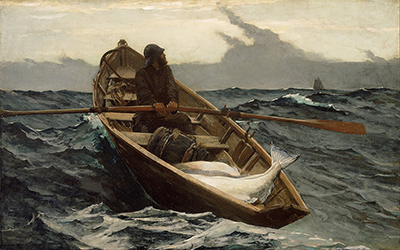
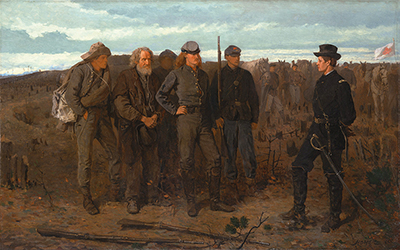
The painting does not need to be made to carry more weight than the sources support. It is not a major national-history canvas like Prisoners from the Front, and it is not a late marine drama like The Gulf Stream or The Fog Warning. Its value is quieter. It shows Homer testing how landscape, figure grouping and social observation could work together. [3]
That testing connects to his illustration background. Homer knew how to stage a legible group, how to make tools and gestures tell a story, and how to build a scene around a small behavioral detail. In Artists Sketching in the White Mountains, the key behavior is looking. Each artist is occupied with the landscape, but Homer turns our attention toward them. The result is a painting about mediation: nature seen through artists, then seen again through Homer's painting of artists. [4]
The link to Drawings is best handled through that idea. The work is an oil, not a drawing, but its subject is drawing practice. It reminds readers that Homer's career was never only a sequence of finished oils. It grew from sketching, illustration, graphic discipline and the habit of converting observed life into images. [5]
Relation To The Bridle Path, White Mountains
Artists Sketching in the White Mountains is best paired carefully with The Bridle Path, White Mountains. Both works date to 1868 and both use the White Mountains as a stage for human presence. The Bridle Path, White Mountains turns mountain tourism into a scene of travel, class, gender and movement along a rocky route. Artists Sketching in the White Mountains turns the same regional culture toward art-making. [1]
Together, the two pages can help the cluster explain that Homer's White Mountains subjects are not just scenic footnotes. They show him observing how people use landscape: riders pass through it, artists draw it, tourists seek it out, and the art market turns it into an image. This is a useful bridge between the paintings hub and the biography. It shows Homer between the reported world of illustration and the later landscapes and marine subjects for which he is better known. [2]
The relationship does not need to be overstated. There is no need to claim that one painting explains the other completely. Their value is comparative. Each work uses the White Mountains to show a human activity shaped by place. Each also resists a purely empty or untouched wilderness view. Homer brings people, tools, routes and habits into the landscape. [3]
Why This Work Belongs In The Homer Cluster
This article remains modest, but it does not need to remain thin. The object is documented by the Portland Museum of Art and the Smithsonian Inventory, and the White Mountain Art educational route gives enough regional context to support a concise retained article. The painting has clear internal-link value for Paintings, Biography, Drawings and The Bridle Path, White Mountains. [4]
The main interpretive task is to keep the work from being flattened into generic scenery. Homer is painting artists in the act of looking. That makes the picture both a White Mountains subject and a small meditation on how landscape art is produced. The umbrellas and easels are not decorative extras. They identify the scene as organized work in a place already shaped by art, tourism and expectation. [5]
For now, the article does useful work through text. Artists Sketching in the White Mountains gives the Homer cluster a compact early landscape article with a lively subject: artists making art inside a landscape already famous for being painted. It strengthens the 1860s and 1870s portion of the cluster without pretending to be a flagship. That is exactly the sort of support page a rescue needs: sourced, restrained, internally useful and clear about what remains unresolved. [1]
Discussion
Winslow Homer rewards close looking because his strongest images rarely close down into one easy meaning. Use the prompts below to test how the work changes as you move between subject, place, medium and history.
Reader Insights
First Look
What detail in Artists Sketching in the White Mountains changes how the whole work feels?
Homer's Method
Where do you see Homer's balance between clear observation and unresolved meaning?
Cluster Context
Which related Homer work helps you read this page more carefully?
Join the Conversation
Share a thoughtful observation below, especially if a detail, source connection or related Homer page changed the way you read the work.
References
- Portland Museum of Art collections record, Artists Sketching in the White Mountains, Winslow Homer, 1868, accession
1988.55.4: https://collections.portlandmuseum.org/objects-1/info/18617 - Smithsonian Institution Inventory record, Artists Sketching in the White Mountains, (painting), record ID siris_ari_219679: https://www.si.edu/object/artists-sketching-white-mountains-painting%3Asiris_ari_219679
- White Mountain Art & Artists object page for Artists Sketching in the White Mountains: https://www.whitemountainart.com/about-3/history/who001/
- White Mountain Art & Artists history page for nineteenth-century White Mountain art and tourism context: https://www.whitemountainart.com/about-3/history/
- Local Winslow Homer Phase 1 approval brief, URL decision matrix, homepage/biography packet, medium-hub packet, internal-link ledger, quote ledger, glossary ledger and Tom image-policy ledger dated 2026-07-20.
 Winslow Homer.jpg)