 by Tom Gurney
Tom Gurney BSc (Hons) is an art history expert with over 20 years experience
Published on June 19, 2020 / Updated on August 2, 2026
Email: tomgurney1@gmail.com / Phone: +44 7429 011000
Contents
- Introduction
- The Bridle Path, White Mountains by Winslow Homer
- What The Painting Adds To Homer's 1868 Work
- White Mountains Tourism And Landscape Culture
- Relation To Homer's Paintings Hub
- How To Read The Scene
- Why This Work Belongs Here
Introduction
URL: The Bridle Path, White Mountains [1]
The Bridle Path, White Mountains by Winslow Homer
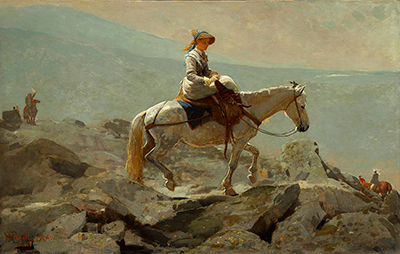
Winslow Homer's The Bridle Path, White Mountains belongs to the artist's post-Civil War turn toward American places where leisure, travel and landscape meet. Painted in 1868, it shows the White Mountains not as an empty wilderness but as a route being used. The subject is mountain scenery, but the human activity matters just as much: a rider, a horse, a path, a ledge, a view and the social world of tourism that made such a scene recognizable to nineteenth-century viewers. [2]
This article is best kept as a concise retained artwork article. It does not need a split, a broad White Mountains history essay or a long biography of Homer. Its value is more focused. It gives the Homer cluster a useful 1868 landscape and leisure node, and it pairs naturally with Artists Sketching in the White Mountains, another White Mountains work from the same year. Together, the two pages show Homer looking at landscape as a lived and visited place. [3]
What The Painting Adds To Homer's 1868 Work
Homer's 1868 White Mountains subjects sit in a transitional moment. The local biography packet places the late 1860s and 1870s as a period of broad experiment after the Civil War and after Homer's stay in France. During this phase he worked across rural scenes, resort subjects, children, leisure, Adirondack and White Mountains material, Gloucester shore scenes and other modern American settings. The Bridle Path, White Mountains belongs inside that range. [4]
The painting therefore not be treated as a generic mountain view. Homer's subject is a landscape with a social use. A bridle path is not untouched nature; it is a route cut by movement and habit. The rider does not simply decorate the view. The figure gives the landscape scale, purpose and class context. The horse brings leisure, money, access and travel into the scene. The path suggests that the White Mountains are already a destination, not a remote place outside culture. [5]
That is why the article should lean toward travel and leisure rather than pure wilderness. The White Mountains had become one of the major nineteenth-century American landscape destinations. Artists, tourists, hotels, roads, guidebooks and pictures all helped create the region's reputation. Homer enters that world with a lighter, more observational approach than many grand mountain painters. He does not need to monumentalize the range. He can make a smaller scene carry the evidence of how people actually moved through it. [6]
White Mountains Tourism And Landscape Culture
The White Mountains of New Hampshire attracted painters throughout the nineteenth century. The region was admired for dramatic scenery, but it was also made accessible through improved travel, inns, resort hotels and a steady traffic of artists and visitors. The White Mountain Art & Artists history route describes the area as a major subject for nineteenth-century painters and as a destination promoted through images, travel and tourist culture. [7]
This background helps explain why The Bridle Path, White Mountains matters to the Homer cluster. The painting is not a detached scenic souvenir. It is a scene of participation. Someone is riding through a place that has already become part of American visual culture. The path, horse and rider bring the viewer into the mechanics of visiting, consuming and remembering landscape. [8]
The regional setting also clarifies the relationship to Artists Sketching in the White Mountains. In that companion work, Homer shows artists making images in the mountains. In The Bridle Path, he shows a traveler moving through the same kind of landscape culture. One painting is about the production of scenery as art; the other is about the experience of scenery as travel. Neither image treats the mountains as empty. Both make human presence central. [1]
Relation To Homer's Paintings Hub
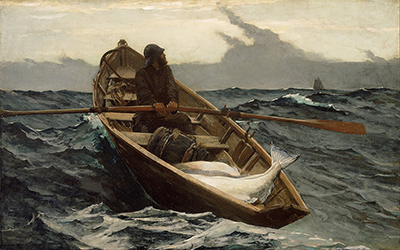
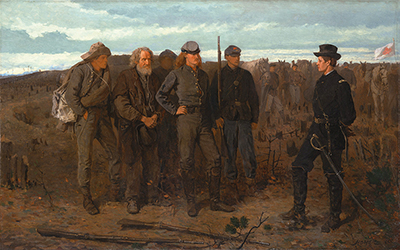
The paintings hub uses The Bridle Path, White Mountains as part of Homer's early postwar range. It is not a flagship painting like The Gulf Stream, The Fog Warning or Prisoners from the Front, but it performs a different kind of cluster work. It helps show that Homer did not move in a straight line from war illustration to late marine drama. He spent the 1860s and 1870s testing many public and private versions of American life. [2]
This article can support the guide's section on rural childhood, leisure and the 1870s. The subject overlaps with resort culture, outdoor recreation, landscape tourism and the presence of women in postwar leisure imagery. The rider's position inside a mountain route gives the scene a social structure that a bare landscape would not have. The viewer is asked to think about where the figure is going, how the path was made and what kind of visitor could occupy such a scene. [3]
The article should avoid overclaiming. It does not need to argue that this painting explains all of Homer's landscape practice. It should simply make the work legible as a compact but useful part of the early career: an oil painting that joins mountain scenery to travel, leisure and looking. [4]
How To Read The Scene
The most useful reading begins with the title. A bridle path is a designed route for riding, and that term changes the landscape from open scenery into a passage. The rider is not lost or overwhelmed. The figure is moving through a known leisure environment, with the mountain view framing the activity rather than replacing it. [5]
That movement gives the painting a different tone from a dramatic wilderness picture. Homer is interested in the encounter between person and place, but he keeps the encounter everyday enough to feel observed rather than staged as an epic. The small scale recorded in the assignment's Clark data also supports a more intimate reading. This is a work to see as a compact study of movement, access and atmosphere, not as a vast public panorama. [6]
The painting also belongs with Homer's graphic instincts. His early career as an illustrator trained him to make social details readable. Here, the path and rider do narrative work without requiring a complicated story. The viewer can understand the situation quickly, but the implications keep opening outward: landscape as destination, leisure as social sign, travel as an image, and nature as something already framed by routes and expectations. [7]
Why This Work Belongs Here
The Bridle Path, White Mountains deserves a retained concise page because it strengthens a specific gap in the Winslow Homer cluster. It gives readers a White Mountains travel and leisure route, connects to the companion Artists Sketching in the White Mountains page, and fills in the late-1860s period that can otherwise be overshadowed by the Civil War paintings and later sea subjects. [8]
The source depth is modest, so the article stays in the lower half of the 1,200-2,500 band. That restraint is a strength. The article can answer the reader's likely questions without padding: what the work is, where it sits in Homer's career, why the White Mountains mattered, how it relates to the painting of artists sketching, and what image or object checks remain before publication. [1]
Discussion
Winslow Homer rewards close looking because his strongest images rarely close down into one easy meaning. Use the prompts below to test how the work changes as you move between subject, place, medium and history.
Reader Insights
First Look
What detail in Winslow Homer: The Bridle Path, White Mountains - Manuscript v1 changes how the whole work feels?
Homer's Method
Where do you see Homer's balance between clear observation and unresolved meaning?
Cluster Context
Which related Homer work helps you read this page more carefully?
Join the Conversation
Share a thoughtful observation below, especially if a detail, source connection or related Homer page changed the way you read the work.
References
- Clark Art Institute object route, The Bridle Path, White Mountains, Winslow Homer, 1868: https://www.clarkart.edu/ArtPiece/Detail/The-Bridle-Path,-White-Mountains
- White Mountain Art & Artists history page for nineteenth-century White Mountains art, tourism and artist culture: https://www.whitemountainart.com/about-3/history/
- Portland Museum of Art collections record, Artists Sketching in the White Mountains, Winslow Homer, 1868, used for companion-page relationship: https://collections.portlandmuseum.org/objects-1/info/18617
- Winslow Homer Phase 1 approval brief draft, dated 2026-07-20.
- Winslow Homer provisional URL decision matrix, dated 2026-07-20.
- Winslow Homer homepage/biography source packets, dated 2026-07-20.
- Winslow Homer medium-hub source packets, dated 2026-07-20.
- Winslow Homer internal-link ledger, quote ledger, glossary ledger and Tom image-policy ledger, dated 2026-07-20.
 Winslow Homer.jpg)