 by Tom Gurney
Tom Gurney BSc (Hons) is an art history expert with over 20 years experience
Email: tomgurney1@gmail.com / Phone: +44 7429 011000
How Klee made a picture
A Paul Klee work may have more layers than its museum label suggests. A drawing can be made on newspaper, attached to a sheet of card that Klee cut to a particular size, bordered with paint and inscribed with its title. A painting can place gauze over cardboard, chalk beneath oil colour, or paper over jute. Those choices change the marks, the surface and the way the image meets its edge. They also shape what a museum must protect and what a photograph may leave out.[1][2]
Klee worked across drawing, watercolour, oil, tempera, coloured paste, prints and paintings on glass. He cut and remounted some compositions, worked on both sides of a support, traced lines through a transfer sheet and sprayed paint through or around barriers. These procedures are not a single signature recipe. Each work has its own construction, sometimes altered after it left his studio. Looking at the materials gives us a way to ask better questions about a particular picture, rather than treating technique as an inventory of tricks.[1][3]
Contents
- First, what is the picture made on?
- Watercolour and the work beneath it
- A line that arrives by transfer
- Spraying, scraping and building colour
- Paste paint is a material question
- The mount is part of the work
- Cutting, turning and the other side
- Two material stacks, two very different pictures
- When later treatment changes the appearance
- What a reproduction can and cannot tell us
First, what is the picture made on?
The support is the material carrying the image. It may be paper, board, wood, cloth or glass. Klee's selection was unusually broad. The Zentrum Paul Klee lists many papers and cardboards, wood, canvas, jute, silk, cotton and gauze, along with more specific kinds of cloth. Sometimes he glued a textile to a larger, firmer material; sometimes he mounted it over a stretcher. The visible margin of that larger support could serve as a border. A fabric's weave could remain part of the image, either because it was unprimed or because thin colour left its structure apparent.[1]
The support is only the beginning. A ground is a preparatory layer placed over it. Klee could work on an untreated surface or add chalk, gypsum, paste or other preparations. He varied their thickness and texture, smoothing some and roughening others. He drew into or scraped away material and sometimes introduced sand or textile pieces. The resulting ridges and depressions catch light and interrupt a painted line. A flat reproduction can carry the colours while suppressing this relief.[1]
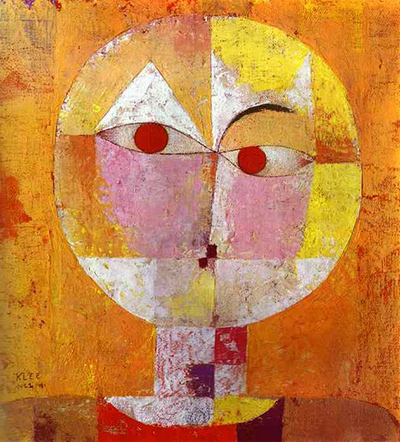
Consider Senecio, painted in 1922. Kunstmuseum Basel records oil over a chalk ground on gauze, with the gauze on cardboard. Its face and arcs are usually described through shape and colour. The museum's material description adds another level: the colour sits over a prepared textile, rather than on a neutral sheet or conventional stretched canvas. To say exactly how each part of the weave or ground affects a particular passage would require close technical examination; the verified stack already tells us that the surface is constructed.[4]
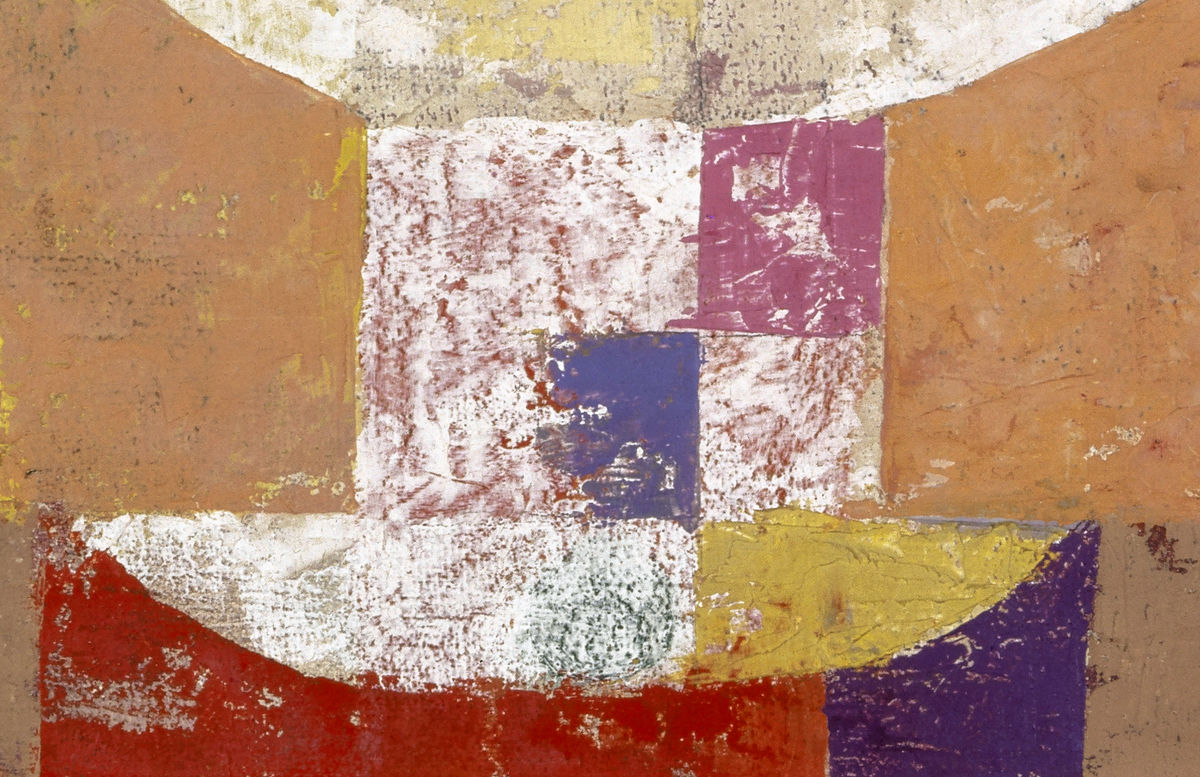
The terminology of a museum record is a starting point, not a promise that the image consists of only one layer. Centre Pompidou lists its 1926 Florentinisches Villen Viertel (Villas florentines) as oil on cardboard. Its own curatorial analysis explains more: a thick preparation of plaster and paste was cut into while fresh, then coloured. Lines in the wet ground leave shallow relief and shadows. What might look in a photograph like lines drawn over paint can be grooves in the material itself. This object shows why the construction beneath a medium label matters to the visible image.[5]
Watercolour and the work beneath it
Klee did not approach watercolour as a single transparent wash. The Zentrum Paul Klee describes early work in greys, followed by experiments with coloured, translucent layers. It reports that he sometimes applied very dilute paint to paper he had already moistened. Overlapping washes can let one hue show through another, while an underlying line or a paper's texture remains visible. Klee's 1914 Tunisia pictures are often discussed as a turning point in his handling of colour, but the museum's account also traces a longer technical development before and after the journey.[1]
Hammamet with Its Mosque makes the relation between sheet and mount unusually concrete. A Metropolitan Museum of Art acquisition note identifies watercolour and pencil on two sheets of laid paper mounted to cardboard. The title, year and catalogue number are written on the cardboard below the image. The coloured scene and the inscribed secondary support are thus parts of one assembled object. A crop that shows only the painted area removes evidence of Klee's chosen presentation and the way he recorded the work.[6]
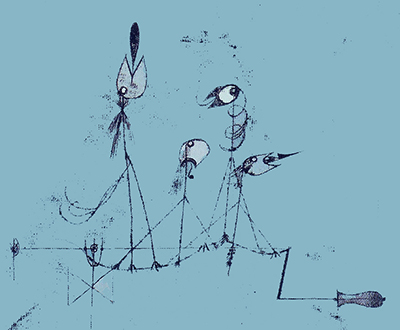
Watercolour also appears beside media that resist simple categories. The Metropolitan Museum describes Static-Dynamic Gradation as oil and gouache on paper, with a border combining gouache, watercolour and ink, mounted on cardboard. MoMA's Twittering Machine is an oil-transfer drawing with watercolour and ink on paper, while gouache and ink mark the board around it. The words in those records are useful because they stop us from identifying the whole work by its most immediately visible colour. The watercolours page follows Klee's handling of that medium in greater detail.[7][8]
A line that arrives by transfer
Klee's oil-transfer method lets an earlier drawing pass through a physical process before it appears in a new work. MoMA describes the procedure for Twittering Machine: he placed an original drawing over a transfer sheet carrying oil paint, with another sheet underneath, and traced the drawing with a pointed tool. Pressure deposited the transferred line on the receiving sheet. Where pressure varied or the hand touched the stack, marks and smudges could appear that were not present in an ordinary pen drawing. Klee then added colour and other marks to the result.[8]
The Yokohama Museum of Art describes a different 1922 oil transfer in its collection, The Attack's Matter, Spirit and Symbol. Its account stresses the uneven, textured line produced by differences in tracing pressure and the friction of paper. This is an important distinction: transfer involved planning and repetition, yet the physical contact introduced variation. It is inaccurate to describe every such work as an untouched mechanical copy, or as a line drawn directly onto the final sheet.[9]
Transfer can make the order of work difficult to recover from catalogue numbers alone. In their study of Klee drawings, Elizabeth Kaiser Schulte, Margaret Holben Ellis and Antoinette King examined a drawing and a second drawing traced from it. The catalogue sequence suggests the reverse order from the visible physical relationship. They propose that Klee may have formally recorded a sheet only after mounting it. This is their inference from the evidence, not a rule established for every entry in his register.[3]
Art historian Tamara Trodd interprets Klee's oil transfers, made mainly between 1919 and 1925, in relation to contemporary debates about mechanisation and the artist's hand. Her published abstract draws attention to the tactile, blurred quality of the resulting line. That reading sits alongside the museums' physical descriptions without making every transfer a picture about machines. The drawings page considers how this procedure belongs within Klee's wider work with line.[10]
Spraying, scraping and building colour
The Zentrum Paul Klee says Klee used sprayed colour occasionally before 1920 and made it a more important means of composition around the middle of that decade. It describes passing watercolour from a brush through a sieve, using grids, perforated plates and stencils to control what reached the support. A sprayed ground could appear cloudy behind drawn forms, while a stencil could hold an edge against diffuse droplets. These are several possible visual results, not a single look shared by all sprayed works.[1]
An individual museum record helps test the general account. The Metropolitan Museum's In the Manner of a Leather Tapestry (1925) is described as brush and ink with spattered tempera on paper mounted on board. An earlier Met acquisition essay calls its method a spray technique and mentions an atomizer or a mouth-blown device. That differs from the sieve procedure in the Zentrum Paul Klee's overview. The evidence shows a repertoire of ways to disperse paint, but does not establish which device made every droplet in the Met picture.[11]
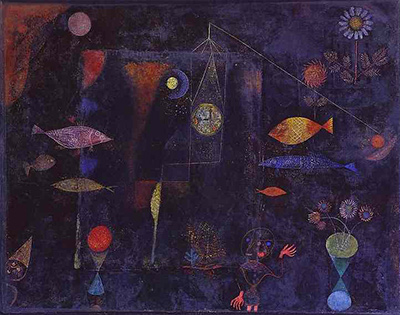
Klee could work in the opposite direction too: instead of adding tiny marks over the ground, he could remove or displace wet colour. Philadelphia Museum of Art describes Fish Magic as a coloured underlayer covered by black paint. Klee scratched through the dark surface to disclose the colour beneath. The museum also records a square of muslin glued to the canvas at the centre. The picture's aquatic and celestial forms are therefore joined to a literal patch of cloth and to an image made partly by uncovering, rather than laying colour only on top.[12]
Across his work, the Zentrum Paul Klee records brush, palette knife, spatula and stamp marks, as well as scraping, smoothing, incision and sanding. A letter to Lily in March 1932, reproduced in its exhibition account, says he was testing new grounds, some with sand. This does not make every granular Klee surface a sand ground. It shows that preparation itself was part of his experimentation and that a precise account of a work needs its own material evidence.[1]
Paste paint is a material question
The German word Kleisterfarbe is often translated as “paste paint” or “coloured paste.” Paste could bind a ground or be mixed with colour. According to the Zentrum Paul Klee, Klee used paste as a binder for broad grounds from the 1920s and experimented from about 1930 with paste in the paint itself. The museum describes mixtures with watercolour, pastel and oil, then a thick, opaque paste colour in which dry pigment was probably stirred into paste. That probable formulation cannot stand as a known recipe for every work.[1]
The ratio and method affected the surface. A thick paste could be spread with a knife; a wetter mixture remained workable while Klee moved it with a tool or finger. Paint gathered along some displaced edges. The Zentrum Paul Klee also describes brush application in late work. “Paste paint” on a label consequently tells us something important about the binder but not, by itself, whether a given area was knifed, brushed or redistributed while wet.[1]
The term tempera needs similar care. Patrizia Zeppetella, Stefan Zumbühl and Nathalie Bäschlin have studied Klee's own catalogue terms against material analyses. Their abstract states that he first used “tempera” in his handwritten oeuvre catalogue in 1905, often left the medium unspecified and used the term in combinations with watercolour, gouache or oil. The catalogue word alone therefore does not prove a single modern recipe, and it should not be silently equated with Kleisterfarbe.[13]
Bäschlin's directly examined Legende vom Nil (Legend of the Nile), 1937,215, makes the risk of a one-word medium label concrete. Klee called its material “Pastellfarben” and described white cotton on jute on a stretcher. He glued the smaller cotton cloth onto the jute and painted it with both pastel-like sticks and a brushable version of the colour. The weave remains visible between the ochre signs and blue, green and lilac fields. Bäschlin identifies a later, opaque yellow-ochre border applied with a knife in Kleistertempera; that layer is absent from Klee's short catalogue technique line. Here “pastel” does not mean only dry chalk marks on paper.[21]
Micro-samples showed a lean paint system with protein binder and varying amounts of oil; traces of shellac were found, while possible wax requires more caution. Bäschlin relates the colour's saturation and matte surface to the small amount of binder, and the same weak binding leaves the paint mechanically fragile on its flexible textile support. Her 2014 conservation stabilised losses while preserving the original stretcher and paint surface. These findings belong to this examined work; they cannot be used to assign the same mixture to every late Klee painting or to identify binders from a web image.[21]
Late work shows why layer-by-layer descriptions matter. The current Zentrum Paul Klee image-request record gives Insula dulcamara (1938) as oil and coloured paste on newsprint on jute on a stretcher, with original frame strips. An older ZPK guide says simply “paper on jute.” The newer caption names the kind of paper more precisely; both describe a monumental surface assembled from different layers rather than oil paint on bare canvas.[14]
The mount is part of the work
Many Klee works on paper have a primary sheet carrying the image and a secondary support, usually card, to which he attached it. These cards were not merely backing material. The 1986 conservators' study, based on examining numerous objects and asking Felix Klee about his father's practice, records dates, catalogue numbers and titles on them. It also finds painted borders, coloured papers, metallic paint and foil. Their sizes could be chosen to complement the image. Klee sometimes attached a drawing with scattered adhesive spots and sometimes adhered it more completely.[3]
The choice could alter the visible sheet. Spots of paste pull on paper as it dries, creating shallow rises and hollows. Some movement belongs to how an object was made; more severe local tension can later tear or weaken it. The conservators' treatment of Bauchtanz distinguished its original paper character from harmful distortion. They did not simply assume that the flattest possible sheet would be truest to Klee. In another case, separating Wachsendegras from its mount disclosed an earlier Klee etching on the back; the authors later questioned whether that discovery justified taking the compound object apart. Their paper is valuable both for its findings and for the way it revisits its own treatment decision.[3]
Nina Quabeck's later research at the Kunstsammlung Nordrhein-Westfalen compared one hundred Klee works with archival photographs and surviving original components. She shows that some works on paper had mounts cut down, toned or replaced after leaving Klee's hands. Fragments carrying his writing can remain on the back of a later support. For Zwischenzeit gegen Ostern and Gedanken bei Schnee, she uses those fragments, early photographs and the catalogue to reconstruct former presentations. A caption or photograph of the present object may thus describe a later arrangement as well as Klee's original one.[15]
Quabeck also describes Der Boulevard der Abnormen (1938), coloured paste on newsprint mounted on card. A 1990s treatment flattened the sheet and changed the three-dimensional topography produced by spot attachment. The conservator at the time had a reason: concern that the buckling threatened the paint. Quabeck's comparison asks what was lost when a material condition was read only as damage. It is an object-specific conservation history, not permission to leave every distorted work untreated.[15]
The framing question extends beyond paper. Some Klee paintings had simple wooden strip-frames, recorded in his catalogue and visible in early photographs. Quabeck found surviving strips on Bunter Blitz but also a later ornate frame that concealed them and reduced the visibility of its relief. Moderna Museet's conservators likewise opened frames around their Klee works and found folded or cut original mounts, discolouration and old tapes. Their new framing solution sought to reveal the proportions of Klee's card while protecting fragile surfaces. Quabeck observes that such modern choices, however careful, are themselves historically situated. The point for a viewer is to notice the edge as evidence, not to assume every current frame is by Klee.[15][2]
Cutting, turning and the other side
Klee also changed the identity of an image by changing its shape. The Zentrum Paul Klee documents works he turned, repainted, cut apart and recombined, particularly from the period after his Tunisia journey into the early 1920s. It identifies Friedhof and Mädchen am Fenster as two of seven pieces from an earlier single picture. In another instance, Kränze für M and Garten=Rhythmus came from a support divided during the making process. A later independent title should not conceal the earlier physical relationship, and a join or edge can be a record of artistic decision rather than damage.[1]
The reverse of a work could also be an active surface. In 2026, Zentrum Paul Klee curator Marie Kakinuma reported finding work on the backs of about 600 of Klee's roughly 9,600 works. That is a dated research finding, not a fixed proportion beyond further examination. Thin paper may let a reverse image show through; opaque canvas or card may keep it unseen until restoration or technical study. On the back of Glass Façade, restoration revealed another depiction beneath a later covering layer. Kakinuma also points to Child and Kite / Flower and Snake, two worked sides for which Klee did not settle a front in his own catalogue; Felix Klee designated one only after his father's death.[16]
These cases resist a simple rule that the back is always a rejected sketch. Sometimes Klee reused material. Sometimes a reverse was deliberately worked and related to the front. In a group of late drawings described by ZPK, coloured paste on the back helped create a faint ground on the front. Each object's support controls what can be seen and what a conservator can discover. The verso may change how we date, title or understand the side we thought we already knew.[16]
Two material stacks, two very different pictures
MoMA records Cat and Bird (1928) as oil and ink on gessoed canvas mounted on wood. The rounded head and small bird can seem disarmingly simple. Its construction is not: a prepared canvas surface carries distinct paint and ink, and the whole is attached to a rigid board. The museum's interpretation concerns the cat's inward image of a bird, while the medium entry reminds us that an apparently spare design can involve several physical decisions. It would be wrong to replace that entry with the looser phrase “oil on canvas” if the mount and ink matter to the viewer's question.[17]
Museum Folkwang's Fire at Full Moon (1933) offers a different combination: watercolour over paste colour on prepared canvas. Its broad areas of colour do not mean that the picture was made with one opaque paint. The institutional record distinguishes the preparatory surface, the paste-colour layer and the watercolour above it. Folkwang dates its making to the summer of 1933 only as probable. The work belongs to a politically charged year, but the museum frames a political reading as a question rather than a documented statement of Klee's intent. The material record is secure enough to explain a layered surface without forcing a single symbolic interpretation of its red cross or yellow disc.[18]
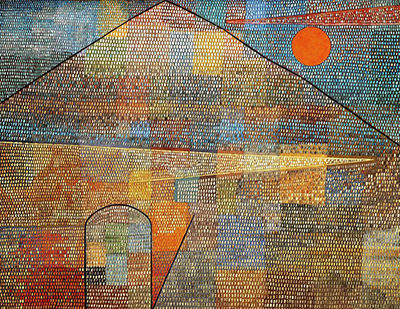
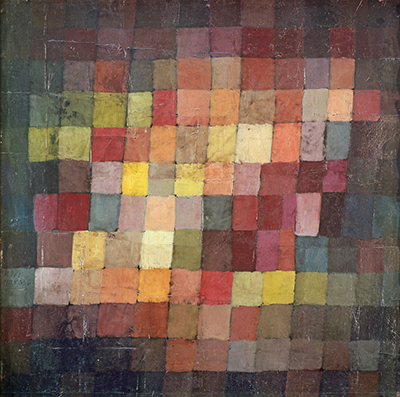
Ancient Harmony (Alter Klang, 1925) makes a useful counterexample. An official loan record transcribing Kunstmuseum Basel's description calls it oil on cardboard nailed to a frame. The near-square painting's many coloured rectangles invite us to think about relationships among hues, yet its support is a rigid, framed card rather than the prepared canvas, worked newsprint or gauze in the examples above. We can describe the visible colour intervals without claiming a specific stamping, spraying or scraping process that Basel has not documented for this object. A picture can be materially distinctive even where the established record names only one paint medium.[19]
When later treatment changes the appearance
The way a Klee painting looks today may depend on work done after it left his hands. Conservator Barbara Scheibli describes Kleines Haus (Small House), 1928, 28 (L 8), made with oil and watercolour on cardboard. Its paint developed raised cracking and losses. In 1965, a treatment arranged by Felix Klee impregnated the paint with wax to keep more material from flaking away. Scheibli reports that the thick wax later yellowed and became cloudy, changing both colour and surface texture. The treatment had protected a fragile picture while creating a new problem for how it appeared.[20]
Before its 2016 presentation, conservators removed the wax with a specially developed micro-aspiration device, working into the surface's recesses for more than 100 hours. Scheibli presents before-and-after views and describes a reconstructed frame. Her account shows why a historical photograph and a current photograph of one work may not be interchangeable evidence of Klee's intended colour. It does not mean every Klee picture was waxed, that all colour differences between reproductions are damage, or that the procedure used for Kleines Haus would suit another object. Its value is a precisely documented case of material history changing what viewers see.[20]
What a reproduction can and cannot tell us
A digital image is useful for following a colour arrangement, comparing motifs and seeing parts of a work unavailable in person. It is less reliable for the height of a paste ridge, the slight shadow of a raised paper edge, the weave beneath thin paint or the full proportions of an artist's mount. Cropping can erase dates and titles. A front photograph cannot show a worked reverse. Brightness and colour reproduction also vary with photography and display. These limits do not make looking online futile; they tell us what questions to take back to an object record, conservation study or museum visit.[3][15][16]
For any one Klee work, begin with its current owning museum: check the original title, date, catalogue number, support and mount. Ask whether the medium line describes all visible layers, whether the border is by Klee and whether the frame or backing has changed. Then look at the picture itself: where does colour soak in, sit up, scrape away or pass through another layer? The paintings hub and the individual artwork pages offer work-specific routes; the colour page considers relationships among hues, and the drawings and prints pages follow line and transfer further. Materials make these questions visible. They do not replace the image's other meanings.[1][3]
Explore selected works from Klee’s much larger oeuvre. Titles without a link have an authenticated catalogue identity but no reviewed article yet.
Artworks directory
| Name | Date | Medium |
|---|---|---|
| A Gate | 1939 | Painting and mixed media |
| A Woman for Gods | 1938 | Watercolour and mixed media |
| Ab Ovo | 1917 | Watercolour and mixed media |
| Above Mountain Summit | 1917 | Drawing and mixed media |
| Abstract Trio | 1923 | Drawing and mixed media |
| Acrobats | 1915 | Watercolour and mixed media |
| Actor's Mask | 1924 | Painting and mixed media |
| Ad Marginem | 1930 | Drawing and mixed media |
| Ad Parnassum | 1932 | Painting and mixed media |
| Adventurer Ship | 1927 | Drawing and mixed media |
| Affected Place | 1922 | Drawing and mixed media |
| After a Sketch from Zurich | 1914 | Watercolour and mixed media |
| After Drawing | 1919 | |
| After The Floods | 1936 | Watercolour and mixed media |
| All Souls' Picture | 1921 | |
| Ancient Harmony | 1925 | Painting and mixed media |
| Angel Applicant | 1939 | Drawing and mixed media |
| Angel Serves the Desired | 1920 | |
| Angel, Still Female | 1939 | Painting and mixed media |
| Angelus Novus | 1920 | Drawing and mixed media |
| Animal Terror | 1926 | Painting and mixed media |
| Arab Song | 1932 | Painting and mixed media |
| Archangel | 1938 | Painting and mixed media |
| Architecture | 1923 | Painting and mixed media |
| Architecture of the Plain | 1923 | Drawing and mixed media |
| Around the Fish | 1926 | Painting and mixed media |
| Arrival of the Air Steamer | 1921 | Drawing and mixed media |
| Asiatic God | 1924 | Painting and mixed media |
| Astrological Fantasy Portrait | 1924 | Drawing and mixed media |
| Athlete's Head | 1932 | Watercolour and mixed media |
| Aufgehender Stern | 1931 | Painting and mixed media |
| Autumn Flower | 1922 | Painting and mixed media |
| Bad Band | 1920 | Drawing and mixed media |
| Baroque Centaur | 1939 | Painting and mixed media |
| Before the Blitz | 1923 | Drawing and mixed media |
| Before the Snow | 1929 | Drawing and mixed media |
| Besessenes Madchen | 1924 | Watercolour and mixed media |
| Bird Garden | 1924 | |
| Bird Wandering Off | 1926 | Watercolour and mixed media |
| Blossoms in the Night | 1930 | Watercolour and mixed media |
| Blue-Bird-Pumpkin | 1939 | Painting and mixed media |
| Boats in the Flood | 1937 | Painting and mixed media |
| Botanical Theatre | 1934 | Drawing and mixed media |
| Boy in Fancy Dress | 1931 | Watercolour and mixed media |
| Broken Key | 1938 | |
| Brother and Sister | 1930 | Watercolour and mixed media |
| But the Red Roof | 1935 | Painting and mixed media |
| C - C = Fisch | 1931 | Watercolour and mixed media |
| Cacti | 1912 | Painting and mixed media |
| Camel (in Rhythmic Landscape with Trees) | 1920 | Drawing and mixed media |
| Captive Pierrot | 1923 | Drawing and mixed media |
| Castle and Sun | 1928 | Drawing and mixed media |
| Cat and Bird | 1928 | Drawing and mixed media |
| Cathedrals | 1925 | Watercolour and mixed media |
| Chalice of the Heart | 1937 | Painting and mixed media |
| Characters in Yellow | 1937 | Painting and mixed media |
| Chosen Site | 1927 | Mixed media |
| Christmas Picture | 1923 | Drawing and mixed media |
| City of Towers | 1916 | Painting and mixed media |
| Clarification | 1932 | Painting and mixed media |
| Collection of Figurines | 1926 | Painting and mixed media |
| Colorful Architecture | 1917 | Painting and mixed media |
| Comedians' Handbill | 1938 | |
| Comic Opera Singer | 1927 | Painting and mixed media |
| Composition | 1939 | Painting and mixed media |
| Composition with Figures | 1915 | Drawing and mixed media |
| Composition with the Yellow Half-Moon and the Y | 1918 | Watercolour and mixed media |
| Conch–Still Life II | 1939 | Watercolour and mixed media |
| Cosmic Composition | 1919 | Painting and mixed media |
| Crystal Gradation | 1921 | Drawing and mixed media |
| Dance of the Grieving Child | 1922 | Painting and mixed media |
| Dancing Girl | 1940 | Painting and mixed media |
| Das Licht und Etliches | 1931 | Mixed media |
| Death and Fire | 1940 | Painting and mixed media |
| Death for the Idea | 1915 | |
| Demon as Pirate | 1926 | Watercolour and mixed media |
| Diana | 1931 | Painting and mixed media |
| Diavolo Player | 1923 | Drawing and mixed media |
| Die Kapelle | 1917 | Watercolour and mixed media |
| Die Vase | 1938 | Painting and mixed media |
| Doctor | 1930 | Drawing and mixed media |
| Dredger and Sailboat | 1931 | Watercolour and mixed media |
| Ein Tor | 1939 | Painting and mixed media |
| Ein Weib fur Gotter | 1938 | Mixed media |
| Embrace | 1939 | Watercolour and mixed media |
| Episode before an Arab Town | 1923 | |
| Equals Infinity | 1932 | Painting and mixed media |
| Eros | 1923 | Drawing and mixed media |
| Error on Green | 1930 | Watercolour and mixed media |
| Evening Figure | 1935 | Drawing and mixed media |
| Falling Bird | 1919 | |
| Fermata | 1932 | Watercolour and mixed media |
| Fire Clown | 1921 | Watercolour and mixed media |
| Fire Full Moon | 1933 | Watercolour and mixed media |
| Fire in the Evening | 1929 | Painting and mixed media |
| Fish in the Harbour | 1916 | Watercolour and mixed media |
| Fish Magic | 1925 | Watercolour and mixed media |
| Flock of Birds | 1917 | Drawing and mixed media |
| Flora on Sand | 1927 | Watercolour and mixed media |
| Flower Myth | 1918 | |
| Flower Stand with Watering Can and Bucket | 1910 | Watercolour and mixed media |
| Flowering Tree (Abstraction with Reference to a Flowering Tree) | 1925 | Painting and mixed media |
| Flowers in Pots | 1923 | |
| Flowers in Stone | 1939 | Painting and mixed media |
| Forest Witch | 1938 | Painting and mixed media |
| Fright of a Girl | 1922 | Drawing and mixed media |
| Fruits on Red | 1930 | Drawing and mixed media |
| Full Moon | 1919 | Mixed media |
| Föhn Wind in Franz Marc's Garden | 1915 | Watercolour and mixed media |
| Garden in St Germain, The European Quarter near Tunis | 1914 | Watercolour and mixed media |
| Ghost Chamber with the Tall Door (New Version) | 1925 | |
| Ghost of a Genius | 1922 | Drawing and mixed media |
| Girl in Mourning | 1939 | Painting and mixed media |
| Glance of a Landscape | 1926 | Watercolour and mixed media |
| Gluht Nach | 1939 | Drawing and mixed media |
| Golden Fish | 1925 | Watercolour and mixed media |
| Goldfish Wife | 1921 | Watercolour and mixed media |
| Green Plant, Blood, Louse | 1924 | Drawing and mixed media |
| Hafenbild | 1918 | Mixed media |
| Hammamet with Mosque | 1914 | Watercolour and mixed media |
| Harbour with Sailing Ships | 1937 | Painting and mixed media |
| Hauptweg und Nebenwege | 1929 | Painting and mixed media |
| Heavenly and Earthly Time | 1927 | Drawing and mixed media |
| Heroic Fiddling | 1938 | Painting and mixed media |
| Heroic Roses | 1938 | Painting and mixed media |
| Heroic Strokes of the Bow | — | Mixed media |
| Highway and Byways | 1929 | Drawing and mixed media |
| Houses near the Gravel Pit | 1913 | Watercolour and mixed media |
| Howling Dog | 1928 | Painting and mixed media |
| In the Current Six Thresholds | 1929 | Painting and mixed media |
| In the Style of Kairouan | 1914 | Drawing and mixed media |
| Individualized Altimetry of Stripes | 1930 | Painting and mixed media |
| Insula Dulcamara | 1938 | |
| Interior with the Clock | 1913 | Watercolour and mixed media |
| Irma Rossa the Animal Tamer | 1918 | Drawing and mixed media |
| Journey in Corsica | 1927 | Drawing and mixed media |
| Landscape with Bluebirds | 1919 | Watercolour and mixed media |
| Legend of the Nile | 1937 | Painting and mixed media |
| Lemon Harvest | 1937 | Watercolour and mixed media |
| Likeness in the Bower | 1930 | Watercolour and mixed media |
| Limits of Reason | 1927 | Painting and mixed media |
| Little Hope | 1938 | Watercolour and mixed media |
| Magdalena before the Conversion | 1938 | Drawing and mixed media |
| Mask of Fear | 1932 | Painting and mixed media |
| May Picture | 1925 | Painting and mixed media |
| Monument in a Cemetery | 1922 | Watercolour and mixed media |
| Monuments at G | 1929 | Watercolour and mixed media |
| Municipal Jewel | 1917 | Watercolour and mixed media |
| Mural from the Temple of Longing Thither | 1922 | |
| Nach der Uberschwemmung | 1936 | Watercolour and mixed media |
| New Harmony | 1936 | Painting and mixed media |
| New House in the Suburbs | — | Mixed media |
| Old Steamboat | 1922 | Drawing and mixed media |
| On the Edge | 1930 | Drawing and mixed media |
| Once Emerged from the Gray of Night | 1918 | Drawing and mixed media |
| One Who Understands | 1934 | Painting and mixed media |
| Oriental Pleasure Garden | 1925 | Painting and mixed media |
| Park of Idols | 1939 | Watercolour and mixed media |
| Passing by Red Pillars | 1928 | Watercolour and mixed media |
| Persian Nightingales | 1917 | Drawing and mixed media |
| Popular Wall Painting | 1922 | Painting and mixed media |
| Prestidigitator | 1927 | Watercolour and mixed media |
| Rainy Day | 1931 | Watercolour and mixed media |
| Red and White Domes | 1914 | Watercolour and mixed media |
| Red Balloon | 1922 | Drawing and mixed media |
| Redgreen and Violet-Yellow Rhythms | 1920 | Drawing and mixed media |
| Refuge | 1930 | Watercolour and mixed media |
| Rhythmic Rythmical | 1930 | Painting and mixed media |
| Saint of the Inner Light | 1921 | |
| Scaffolding of a New Building | 1930 | Painting and mixed media |
| Scholar in Dealing with Stars | 1926 | Watercolour and mixed media |
| Seated Woman | 1930 | Drawing and mixed media |
| Senecio | 1922 | Painting and mixed media |
| Separation in the Evening | 1922 | Drawing and mixed media |
| Sinbad the Sailor | 1923 | Drawing and mixed media |
| Skeptically Smiling | — | Mixed media |
| Small House in the Garden City | 1928 | Watercolour and mixed media |
| Small Portrait of a Girl in Yellow | 1925 | Painting and mixed media |
| Southern Gardens | 1919 | Watercolour and mixed media |
| Static-Dynamic Gradation | 1923 | Drawing and mixed media |
| Still Life | 1927 | Painting and mixed media |
| Still Life with Gladioli | 1932 | Watercolour and mixed media |
| Strange Garden | 1923 | Drawing and mixed media |
| Stricken City | 1936 | Painting and mixed media |
| Strong Dream | 1929 | Watercolour and mixed media |
| Struck from the List | 1933 | Drawing and mixed media |
| Structural I | 1924 | Drawing and mixed media |
| Sumpflegende | 1919 | Painting and mixed media |
| Temple Gardens | 1920 | Drawing and mixed media |
| The Arrow before the Target | 1921 | Drawing and mixed media |
| The Barbed Noose with the Mice | 1923 | Watercolour and mixed media |
| The Flora of the Heath | 1925 | Watercolour and mixed media |
| The Goldfish | 1925 | Watercolour and mixed media |
| The Hour Before One Night | 1940 | Painting and mixed media |
| The Man in Love | 1923 | |
| The Mask with the Flag | 1925 | Mixed media |
| The Pathos of Fertility | 1921 | |
| The Rhine at Duisburg | 1937 | Painting and mixed media |
| The Way to the Citadel | 1937 | Painting and mixed media |
| Three Houses and a Bridge | 1922 | Watercolour and mixed media |
| Tightrope Walker | 1923 | |
| Tomb in Three Parts | 1923 | Watercolour and mixed media |
| Tomcat's Turf | 1919 | Watercolour and mixed media |
| Tower in Orange and Green | 1922 | Drawing and mixed media |
| Tree and Architecture - Rhythms I | 1920 | Watercolour and mixed media |
| Tree and Architecture - Rhythms II | 1920 | Painting and mixed media |
| Tropical Dawn with the Owl | 1921 | Mixed media |
| Tropische Dammerung | 1921 | Painting and mixed media |
| Twittering Machine | 1922 | Drawing and mixed media |
| Variations (Progressive Motif) | 1927 | Watercolour and mixed media |
| Ventriloquist and Crier in the Moor | 1923 | |
| Viaducts Break Ranks | 1937 | Drawing and mixed media |
| Villa R | 1919 | Painting and mixed media |
| Village Carnival | 1926 | Painting and mixed media |
| Vor dem Blitz | 1923 | Drawing and mixed media |
| Wald-Hexen | 1938 | Painting and mixed media |
| Young Forest | 1925 | Drawing and mixed media |
Discussion
Klee's supports, grounds, mounts and paint layers can change what an image looks like and how it survives.
A museum record or conservation study can reveal details that are difficult to see in a reproduction.
Reader Insights
Which Klee picture changed for you when you learned how its surface was made?
Have you seen an artist's mount, inscription or worked reverse that altered your reading of a Klee work?
Which material claim would you want a conservator or collection record to check next?
Join the Conversation
Share the work and the evidence you used. Please distinguish a visible feature from a proposed technique.
References
- Zentrum Paul Klee, “Paul Klee. Ich bin Maler” (German, 2016), exhibition sections on supports, grounds, watercolour, spray, paste colour, cutting and two-sided works, View source.
- Tora Hederus and Alison Norton, Moderna Museet, “The conservation and re-framing of Paul Klees works of art on paper from the Moderna Museet collection” (English, 2016), View source.
- Elizabeth Kaiser Schulte, Margaret Holben Ellis and Antoinette King, “An Approach to the Conservation Treatment of Paul Klee Drawings,” The Book and Paper Group Annual 5 (English, 1986), View source.
- Kunstmuseum Basel, Basel 1937 exhibition booklet (German; French edition), Senecio object entry, View German source.
- Christian Derouet, Centre Pompidou, “Florentinisches Villen Viertel (Villas florentines),” object analysis (French), View source.
- The Metropolitan Museum of Art, Notable Acquisitions 1984–1985, Berggruen Klee collection entry for Hammamet with Its Mosque (English), View source.
- The Metropolitan Museum of Art, “Static-Dynamic Gradation,” object record (English), View source.
- The Museum of Modern Art, “Twittering Machine,” object record and 2019 publication excerpt (English), View source.
- Matsunaga Shintaro, Yokohama Museum of Art, “The Attack's Matter, Spirit and Symbol,” object record (Japanese title; English interpretation), View source.
- Tamara Trodd, “Drawing in the Archive: Paul Klee's Oil-Transfers,” Oxford Art Journal 31, no. 1 (English, 2008), abstract only, View source.
- The Metropolitan Museum of Art, “In the Manner of a Leather Tapestry,” object record and Notable Acquisitions 1981–1982 essay (English).
- Philadelphia Museum of Art, “Fish Magic,” object record (English), View source.
- Patrizia Zeppetella, Stefan Zumbühl and Nathalie Bäschlin, “Then egg, then watercolour or tempera paints, then alcohol resin: Paul Klee's tempera painting techniques,” abstract in Tempera Painting 1800–1950 (English, 2019), View abstract and publisher listing.
- Zentrum Paul Klee, image-request object caption (German; Italian interface) and Kosmos Klee easy-language guide (German), Insula dulcamara.
- Nina Quabeck, “Change the Frame and You Change the Game? Research and Reevaluation of the Presentation Formats of the Kunstsammlung Nordrhein-Westfalen's Paul Klee Collection,” The Book and Paper Group Annual 31 (English, 2012), View source.
- Zentrum Paul Klee, Fokus. Klee's versos press kit (English, 2026), pp. 1–2, curator Marie Kakinuma's research, View source.
- The Museum of Modern Art, “Cat and Bird,” object record and MoMA Highlights interpretation (English), View source.
- Museum Folkwang, “Feuer bei Vollmond / Fire at Full Moon,” collection record (German and English), View source.
- Boletín Oficial del Estado, Spanish state loan guarantee transcribing Kunstmuseum Basel's object details for Alter Klang (Spanish with German object entry, 2015), View source; Kunstmuseum Basel, 1960 accession list.
- Barbara Scheibli, “Klees Kleines Haus, 1928, 28 (L8), restauriert und wieder ausgestellt,” Zwitscher-Maschine 2 (German, 2016), direct conservator account with before/after and reconstructed-frame captions, View source.
- Nathalie Bäschlin, Fragile Werte: Diskurs und Praxis der Restaurierungswissenschaften 1913–2014 (German, 2020), pp. 37–44 and the direct object examination of Legende vom Nil, pp. 181–90, with sample analyses in the appendix. Her technical findings were read directly; the printed catalogue and Klee's original handwritten entry were not independently inspected. Its photographs and diagrams have separate rights and are not reproduced here, View source.