 by Tom Gurney
Tom Gurney BSc (Hons) is an art history expert with over 20 years experience
Published on June 19, 2020 / Updated on August 16, 2026
Email: tomgurney1@gmail.com / Phone: +44 7429 011000
Pieter Bruegel the Elder Landscapes and Seasons: Introduction
Pieter Bruegel the Elder made landscape feel like a thinking system. Fields, valleys, villages, roads, rivers, mountains and weather do not sit behind his figures as scenery. They organize human life. They measure work against time, hunger against abundance, movement against rest, and local daily activity against a much larger world.
That is why Bruegel's landscapes and season paintings matter so much within his art. They are not detached views of nature, and they are not simple peasant scenes enlarged into panoramic settings. They are paintings in which the natural world, the built world and the human world are inseparable. A harvest field is also a social order. A winter valley is also a test of endurance. A stormy road is also a way to think about the passage of the year.
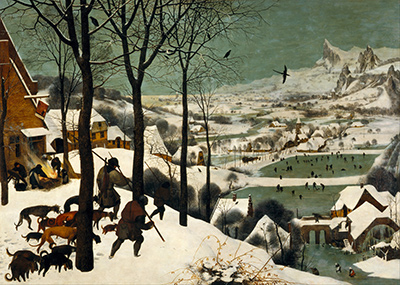
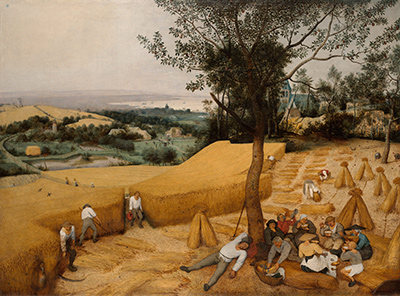
The center of this subject is the 1565 seasons cycle, made for the Antwerp merchant and collector Niclaes Jongelinck. Five large panels survive: The Gloomy Day, Haymaking, The Harvesters, The Return of the Herd and Hunters in the Snow. A spring panel is lost. Together, the surviving works make one of the great statements of landscape painting in European art.
This overview follows the cycle as a group and places it beside Bruegel's wider landscape imagination. For the artist's full career, see the Pieter Bruegel the Elder biography. For a broader list of works, see Pieter Bruegel paintings.
At a Glance
- Main focusBruegel's landscapes, the 1565 seasons cycle and related winter and village scenes
- Key patronNiclaes Jongelinck, an Antwerp merchant and collector
- Original settingA country house near Antwerp, probably with the large panels arranged across more than one wall
- Cycle structureSix parts, reflecting a six-period division of the year in the sixteenth-century Low Countries
- Surviving panelsThe Gloomy Day, Haymaking, The Harvesters, The Return of the Herd, Hunters in the Snow
- Lost panelSpring
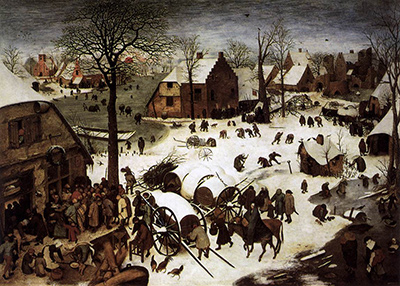
- Related worksWinter Landscape with a Bird Trap and The Census at Bethlehem
- Why it mattersBruegel makes landscape the main subject: a world of weather, labor, seasonal rhythm and human smallness
Contents
- Introduction
- Why Landscape Mattered to Bruegel
- The Six-Season Cycle
- Surviving and Lost Panels
- Jongelinck's Country-House Setting
- High Viewpoints and World Landscape
- Work, Weather and Human Scale
- Winter Scenes Beyond the Cycle
- Landscape and Technical Looking
- Where to Go Next
Why Landscape Mattered to Bruegel
Landscape was one of Bruegel's great inheritances, but he did not merely repeat what he received. Netherlandish art before him had already developed wide views with distant horizons, sharply observed towns, fields and rivers, and tiny figures moving through expansive worlds. Bruegel absorbed that tradition and made it more physical, more social and more seasonally exact.
His travels also mattered. Museum accounts of his career emphasize his journey through the Alps and Italy, and his close observation of nature. The Alpine experience helps explain why mountains could enter his art with such authority, even when the social world of a painting remains tied to the Low Countries. In The Return of the Herd, for example, the subject of cattle coming down from high pasture is unusual for the Netherlands and has often been connected with Bruegel's memory of travel through Switzerland and the Alpine region.
Yet Bruegel's landscapes are never just travel memories. They bring far horizons into contact with local work. They make room for broad valleys and minute incidents, for weather seen from above and workers seen at ground level. The result is a landscape art that is both panoramic and intimate. A viewer may first notice the sweep of hills and sky, then discover a worker asleep under a tree, a dog straining in snow, a herd crowding a road, or a village absorbed in winter play.
This is also why Bruegel belongs naturally beside questions of style and technique. His landscapes depend on composition, viewpoint, scale, panel construction and patient looking. They feel natural because they are so carefully built.
The Six-Season Cycle
The 1565 seasons cycle was not a four-season sequence in the modern calendar sense. In the sixteenth-century Low Countries, the year could be divided into six periods. Bruegel's cycle appears to have followed that rhythm, giving each panel a particular seasonal phase rather than a single abstract season.
The surviving works move through a year of rural labor and weather. The Gloomy Day shows a late winter or early spring world of bare trees, rough weather and workers cutting branches. Haymaking turns toward early summer, with figures moving through the fields and a sunlit landscape opening behind them. The Harvesters presents late summer, usually understood as July or August, when grain is cut, gathered and paused over. The Return of the Herd belongs to autumn, when cattle descend from pasture under a darkening sky. Hunters in the Snow gives winter its most famous image: hunters and tired dogs returning above a frozen village world.
Because spring is lost, the cycle now has a gap at the very point where renewal would have been most direct. That absence changes how modern viewers experience the group. We read the surviving works with spring missing, which makes the surviving progression feel less complete than it once was. Even so, the five panels preserve the cycle's essential ambition: to make the year visible as a changing relationship between land, weather, work and communal life.
The panels are large, painted on oak, and dated to 1565. Their scale matters. These were not small cabinet pictures made for private handling. They were made to occupy a room, to surround viewers with a moving year. Seen as a group, they ask the eye to travel from one seasonal world to another, comparing sky, labor, color, temperature and human energy.
Surviving and Lost Panels
Each surviving panel has its own visual identity, and each deserves a full treatment of its own. This overview keeps the group in view.
The Harvesters is one of the clearest examples of Bruegel's ability to turn rural labor into monumental landscape. The Metropolitan Museum of Art identifies the picture as oil on oak, dated 1565, and as a late-summer harvest scene for a wealthy urban patron. The picture shows work and rest together: grain being cut, carried and stacked, while figures eat and sleep in the foreground. It is sympathetic to rural labor, but not a documentary snapshot. It is an idealized image made for elite viewing, and its spaciousness is part of that refinement.
Hunters in the Snow is the winter panel and perhaps the most famous landscape Bruegel ever painted. The hunters return with exhausted dogs, while below them a village has become a world of frozen ponds, skaters, fires, roofs and distant mountains. Its power does not come from one detail alone. The whole painting evokes cold: dark figures against snow, birds in black branches, distant ice, pale sky and a valley held in winter.
The Return of the Herd is autumn, but its drama is not simply seasonal color. Cattle crowd the foreground road, herders drive them on, and the landscape opens into a mountainous distance under stormy weather. The motif of herds returning from high pasture gives the picture an Alpine resonance unusual in a Netherlandish setting. Here landscape becomes the main event: humans and animals move through it, but the weather and terrain dominate the emotional register.
The Gloomy Day sits near the difficult turn between winter and spring. The trees are bare, the sky is unsettled, and the human work feels rougher than in the bright harvest panel. It is a painting about transition, with nature not yet renewed and the weather still pressing hard on daily labor.
Haymaking represents a warmer phase of the year. Its paths, workers and fields make seasonal abundance visible before the grain harvest reaches its late-summer fullness. Because this panel is now in the Lobkowicz collection, while three of the other surviving panels are in Vienna and The Harvesters is in New York, the original unity of the cycle has to be reconstructed through comparison.
The missing spring panel matters because Bruegel's cycle was designed as six parts. Its loss should not be filled with guesswork. The surviving five already show how carefully Bruegel distinguished one period of the year from another without reducing any panel to a simple seasonal label.
Jongelinck's Country-House Setting
The cycle was made for Niclaes Jongelinck's country house near Antwerp, probably for the dining room. That context changes the way the paintings should be imagined. These were works for a wealthy urban patron's rural retreat, not paintings made for a peasant household or village hall. Their view of rural labor is therefore shaped by distance: affectionate, observant and idealized, but also framed by elite ownership.
The country-house setting also helps explain the cycle's scale and rhythm. The panels were likely displayed like a broad sequence, possibly as a frieze across several walls. A viewer in the room would not experience one isolated image at a time. The works would have formed an environment: winter across from harvest, storm across from sun, labor across from rest, and human time set inside the larger order of nature.
This kind of setting does not make the works less serious. It makes them more complex. A dining room is a place of consumption, conversation and social display. To hang images of planting, cutting, herding, resting, hunting and village life in such a room is to bring the labor of the countryside into the world of urban wealth. Bruegel's paintings do not lecture the viewer, but they do make that relationship visible.
The later history of the cycle also reveals its prestige. The panels eventually entered the Habsburg collection after being given in Antwerp to Archduke Ernest. That movement from a merchant's country house into dynastic collecting is part of why the cycle came to stand near the center of Bruegel's reputation.
High Viewpoints and World Landscape
Bruegel often uses high viewpoints, and the seasons cycle depends on them. The viewer is placed above the action, looking down into valleys, villages, roads and fields. This height makes human activity legible as pattern. Workers, hunters, herders, skaters and travelers become small points within a vast design.
The high viewpoint also lets Bruegel join different distances in one painting. In Hunters in the Snow, the foreground hunters are close enough to read as tired and heavy, but the eye quickly drops into the valley below, then travels across frozen ponds and into distant mountains. In The Harvesters, the foreground workers are physically present, with food, tools and bodies at rest, while the background opens to fields, buildings and water. In The Return of the Herd, the cattle press close to the viewer while mountains and weather pull the scene outward.
This is where the phrase "world landscape" becomes useful. Bruegel's paintings do not simply show a plot of land. They suggest a whole ordered world, made of near and far, human and natural, ordinary and cosmic. The viewer can scan across them almost like reading a map, but the effect is warmer and stranger than cartography. The landscape is not neutral information. It is felt through weather, color, seasonal pressure and human movement.
High viewpoint does not mean emotional distance. In Bruegel, distance often makes human beings more poignant. The smallness of the figures does not make them irrelevant; it shows them inside a world they cannot control.
Work, Weather and Human Scale
Bruegel's season paintings are built on the relation between work and weather. The year is not an abstract cycle. It is a set of tasks, conditions and bodily states. People cut branches, make hay, harvest grain, drive cattle, hunt, skate, carry, eat, rest and return home.
Weather is never decorative. It changes the meaning of every action. Winter makes the hunters slow and the dogs tired. Late summer makes the harvesters pause in heat and abundance. Autumn weather darkens the return of the herd and gives the road a sense of urgency. In The Gloomy Day, unsettled air and bare trees make labor feel exposed.
The human figures are small, but Bruegel gives them weight. A sleeping worker in The Harvesters is not a symbol only; he is a body that has worked. A hunter in Hunters in the Snow is not a heroic figure; he is part of a cold return. Herdsmen in The Return of the Herd are pressed into the movement of animals and weather. Bruegel's scale tells us that people live inside nature, not above it.
This is one reason his landscapes still feel modern. They resist easy separation between nature and society. A field is a food system. A frozen pond is a recreation ground and a weather event. A mountain view is a memory of travel and a compositional structure. A village is a collection of tiny actions taking place under a sky that dwarfs them all.
Winter Scenes Beyond the Cycle
Bruegel's winter imagination extends beyond Hunters in the Snow. Two related works are especially useful for seeing how he used cold, village life and biblical or moral subjects in landscape settings.
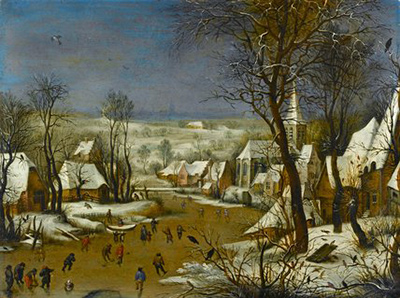
Winter Landscape with a Bird Trap presents a frozen village with skaters, buildings, trees and a trap set near birds. It is quieter and more concentrated than Hunters in the Snow, but it shares the fascination with winter as a social landscape. Ice turns the village into a stage for movement. People skate and gather while danger sits almost unnoticed at the side.
The Census at Bethlehem moves a biblical subject into a snowy Netherlandish village. The setting is not an ornamental backdrop for scripture. It makes the sacred event appear within ordinary winter life: people queue, carry, travel, work and endure cold. Bruegel's landscape imagination lets biblical time and contemporary rural time occupy the same visual world.
These winter works show why Bruegel cannot be reduced to either genre comedy or pure landscape. He uses seasonal setting to transform subject matter. Cold affects bodies, roads, roofs, ponds, light and community. It also slows the viewer down. To look at these works well is to move between the whole village and its many small incidents.
Landscape and Technical Looking
Bruegel's landscape art also invites technical looking. The surviving season panels are oak paintings, and modern research has used non-invasive methods, panel study and imaging to understand how such works were made, altered, preserved and restored. This does not replace visual interpretation. It deepens it.
Panel construction matters because these paintings were large objects built from wood before they became painted worlds. Research into Baltic oak and dendrochronology gives material context for Bruegel's panels and for northern European painting more broadly. The support is not incidental. It affects scale, surface, survival and the way the paintings could be handled and displayed.
Technical imaging also helps viewers understand Bruegel's discipline. His paintings can feel crowded with anecdote, but their clarity depends on controlled design. Paths, horizons, figure groups, tree lines, rooftops, water and weather all need to hold together. The visible world rests on decisions about drawing, layering and structure.
This is especially important for the seasons cycle because its apparent naturalness can make the artistry seem effortless. Bruegel makes complex compositions readable. He gives each panel a strong seasonal atmosphere while keeping countless small actions alive. The more closely one looks, the more the paintings reveal themselves as constructed environments rather than simple views.
Where to Go Next
Start with the cycle's two most famous anchors: The Harvesters for late summer and Hunters in the Snow for winter. Together they show Bruegel's range: heat and cold, abundance and fatigue, harvest and return.
Then compare the other surviving season panels: The Gloomy Day, The Return of the Herd and Haymaking. Their differences make clear that Bruegel was not making interchangeable rural scenes. He was painting phases of the year, each with its own work, air, movement and emotional temperature.
For winter beyond the seasons cycle, continue to Winter Landscape with a Bird Trap and The Census at Bethlehem. For the wider artist context, return to Pieter Bruegel the Elder, the biography, the paintings overview and style and technique.
Discussion
Which detail most changes how you read Landscapes and Seasons: the subject, the setting, the social context, the handling of space, or the way Bruegel directs attention across the surface?
Reader Insights
Start with the part of Landscapes and Seasons that first catches your eye, then follow the smaller incidents around it. Bruegel often makes meaning accumulate through repeated acts of noticing rather than through one obvious focal point.
Think about how this page's evidence connects image, audience and setting. A Bruegel composition can be comic, observational, devotional, political or all of these at once depending on how its details are organized.
Where does the work leave interpretation deliberately unsettled? The strongest Bruegel pages often turn on tensions between delight and warning, ordinary life and moral structure, or invention and later copying.
Join the Conversation
Share the detail, source question or comparison that would most help another reader look again.
References
- Kunsthistorisches Museum Wien, "Six Seasons for a Dining Room": https://www.bruegel2018.at/en/six-seasons-for-a-dining-room/
- The Metropolitan Museum of Art, "The Harvesters": https://www.metmuseum.org/art/collection/search/435809
- Kunsthistorisches Museum Wien, "Hunters in the Snow (Winter)": https://www.khm.at/en/artworks/hunters-in-the-snow-winter-327
- Kunsthistorisches Museum Wien, "Return of the Herd (Autumn)": https://www.khm.at/en/objectdb/detail/326
- Kunsthistorisches Museum Wien, "Researching Bruegel": https://www.bruegel2018.at/en/researching-bruegel/
- Kunsthistorisches Museum Wien, "Revealing Glimpses into the Heart of Panel Paintings": https://www.bruegel2018.at/en/revealing-glimpses-into-the-heart-of-panel-paintings/
- Kunsthistorisches Museum Wien, "Pieter Bruegel the Elder": https://www.khm.at/en/digital/artists/pieter-bruegel-the-elder
- Kunsthistorisches Museum Wien, "The Seasons a la Bruegel": https://zeitendernatur.khm.at/en/chapter-ii-the-seasons-a-la-bruegel/