 by Tom Gurney
Tom Gurney BSc (Hons) is an art history expert with over 20 years experience
Published on June 19, 2020 / Updated on August 16, 2026
Email: tomgurney1@gmail.com / Phone: +44 7429 011000
Pieter Bruegel Proverbs and Iconography: Introduction
Pieter Bruegel the Elder turned familiar sayings, festive customs, children's play, moral warnings and monstrous invention into pictures that ask to be read slowly. His art often begins with ordinary activity: a person carrying a basket, a child playing in a street, a crowd gathering between an inn and a church, a fish swallowing a smaller fish, a skeleton army advancing across a burnt landscape. Yet the longer one looks, the more these actions become a language of signs.
This is the world of Bruegel's proverb and iconographic art. It includes the great painted gathering of sayings in Netherlandish Proverbs, the compact moral designs associated with Twelve Proverbs, proverb-like prints such as Big Fish Eat Little Fish, and crowd pictures such as Children's Games and The Fight Between Carnival and Lent. It also reaches into darker works such as The Triumph of Death and The Fall of the Rebel Angels, where moral imagery expands into apocalypse, chaos and monsters.
Bruegel's genius is not simply that he packed pictures with details. It is that he made detail carry thought. His crowded works reward scanning, comparison and return. A single figure may be funny, coarse, beautiful, absurd or unsettling; the whole composition may be a village, a theatre, an encyclopaedia, a warning or all of these at once. This guide introduces the main ways to read that world without reducing it to a checklist.
At a Glance
- Main focusBruegel's proverb pictures, moral imagery, crowd scenes and symbolic detail
- Key paintingNetherlandish Proverbs, 1559, Berlin Gemäldegalerie
- Related proverb worksTwelve Proverbs and Big Fish Eat Little Fish
- Crowd encyclopaediasChildren's Games and The Fight Between Carnival and Lent
- Dark moral imageryThe Triumph of Death and The Fall of the Rebel Angels
- Related traditionThe inventive, moral and monstrous world of Hieronymus Bosch
- Best reading habitMove between the whole scene and selected details, but avoid treating every object as a solved code
- Wider contextSee Pieter Bruegel the Elder, his biography, prints and paintings
Contents
- Introduction
- What Iconography Means for Bruegel
- Proverb Pictures
- Netherlandish Proverbs
- Prints, Proverbs and Satirical Graphic Work
- Crowd Encyclopaedias
- Bosch and Monsters
- Death and Rebel Angels
- How to Read Without Overclaiming
- Routes to Related Pages
What Iconography Means for Bruegel
Iconography, in Bruegel's case, is not a secret dictionary hidden inside the picture. It is the study of how visible things carry meaning: gestures, tools, costume, animals, settings, saints, devils, food, play, crowds, weather and repeated social actions. Some signs are inherited from biblical or medieval traditions. Some come from popular sayings. Some belong to festival custom, printed satire or the culture of collecting. Others are ordinary things made strange by where Bruegel places them.
That matters because Bruegel rarely lets one meaning exhaust a scene. A broom, a fish, a barrel, a roof, a knife, a spindle, a mask or a child's toy can be a concrete object first. It may also point toward a proverb, a social habit, a ritual season, a moral caution or a comic reversal. In strong Bruegel paintings, those meanings do not float away from the physical world. They stay attached to bodies and actions.
His high viewpoints are essential to this kind of reading. By looking down on streets, squares, villages and landscapes, the viewer can see many incidents at once. The eye moves like a wanderer through a town. It notices one group, then another, then a distant passage that changes the meaning of the foreground. Bruegel's pictures often feel open and noisy, but their design is controlled. They invite active looking, not passive decoding.
This is why his moral imagery is more complicated than a sermon. Bruegel can show folly without standing outside humanity. He can make a crowd ridiculous and tender in the same picture. He can adapt the world of Hieronymus Bosch without becoming a mere imitator of monsters. He can build a proverb painting in which no single proverb is enough to explain the whole. The result is art that behaves like common speech: memorable, witty, sharp, ambiguous and alive.
Proverb Pictures
Proverbs were a natural subject for Bruegel because they were already images in language. A proverb compresses experience into a visual turn of phrase: a world upside down, a fish eating another fish, a blind person leading another blind person, a fool caught in his own action. The saying is brief, but it carries a whole judgment about human behavior.
Bruegel gave such sayings bodies. Instead of writing a moral lesson beneath a picture, he often made the picture itself perform the saying. The action may look literal and absurd: someone doing something that no sensible person would do. That absurdity is part of the force. A proverb works because it turns ordinary behavior into a sharp mental picture. Bruegel returns the mental picture to the visible world.
The danger is to treat his proverb art as a puzzle that must be solved one square inch at a time. That can be enjoyable, and Bruegel clearly invites close searching, but it can also flatten the painting. A proverb picture is not only a list of identifications. It is a world in which many forms of folly happen at once. The viewer sees repetition, contradiction and social pattern. People are greedy, shortsighted, self-deceived, opportunistic, resigned, ridiculous and sometimes simply busy. The moral energy comes from the accumulation.
Big Fish Eat Little Fish shows how powerful that compression could be in print culture. The design turns predation into an unforgettable image: large creatures swallowing smaller ones in a chain of appetite. The Metropolitan Museum of Art notes that the print issued by Hieronymus Cock attributed the design to Bosch, although later engravings credited Bruegel as inventor [8]. That fact is more than a bibliographic curiosity. It shows how Bruegel worked in a market that still wanted Boschian moral fantasy, while also developing his own sharper language of popular wisdom, satire and vernacular imagery.
Twelve Proverbs belongs to the same field of concentrated moral design, while Netherlandish Proverbs expands the principle to large-panel scale. Together, these works show the range of Bruegel's proverb art: from pointed emblem-like images to a whole village world built out of sayings.
Netherlandish Proverbs
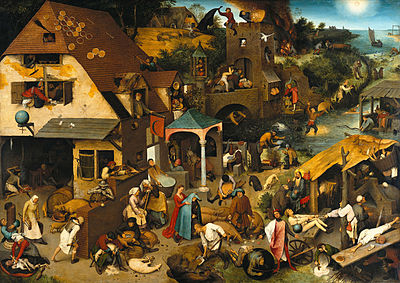
Netherlandish Proverbs is the centre of Bruegel's proverb imagery. The Deutsche Digitale Bibliothek object record identifies the work as Die niederlandischen Sprichworter, by Pieter Bruegel the Elder, in the Gemäldegalerie, Staatliche Museen zu Berlin, inventory number 1720. It gives the support as oak, the size as 117 x 163 cm, and the date as 1559; the record also notes the signature and dating at the lower right [1].
The physical facts matter because they help correct a common mistake. This is not a marginal illustration or a small proverb sheet. It is a large painting on panel, built as a full pictorial world. Bruegel gives the proverbs a village with roofs, water, pathways, interiors, streets and open ground. The scale lets many sayings operate at once without collapsing into a row of emblems.
The DDB record is also valuable because it links the painting to many separate detail records. Those linked details name individual proverb passages and date them to 1559 [1]. That structure reflects the modern desire to identify and catalogue the sayings, but it also shows why the painting should be approached carefully. A viewer can isolate details, yet the painting's meaning depends on how those details coexist.
The work has often been associated with the idea of the "world upside down." The DDB classification refers to the inverted world as one of the painting's subjects [1]. Bruegel makes that idea visible not by flipping the panel, but by filling a familiar village with actions that are foolish, vain, wasteful, hypocritical or self-defeating. The world looks ordinary at first. Then it begins to reveal its errors.
This doubleness is central to the painting's appeal. On one level, Netherlandish Proverbs is comic. It is full of odd gestures and ridiculous situations. On another level, it is bleakly observant. Human beings repeat mistakes. They harm themselves and others. They waste effort. They miss the obvious. They follow appetite, habit and pride. Bruegel's brilliance lies in making that diagnosis feel social rather than abstract. Folly is not a single villain. It is distributed through the whole village.
The painting should not be turned into a complete inventory here. Many proverb identifications exist, and some are more secure than others. The better first reading is compositional: notice how Bruegel arranges many small moral incidents into one lived environment. Look for the relation between inside and outside, roof and ground, land and water, foreground and distance. Ask why a proverb world needs a village at all. Bruegel's answer seems to be that sayings are not detached verbal ornaments. They belong to daily life.
Prints, Proverbs and Satirical Graphic Work
Bruegel's printed work is essential for understanding his proverb and moral imagery. KBR emphasizes that in the sixteenth century Bruegel was widely known through graphic work, not only through paintings. Its account of the exhibition The World of Bruegel in Black and White describes Flanders around the middle of the century as an international centre for the production and trade of prints, with Bruegel and the publisher Hieronymus Cock playing key roles [2].
This print culture changed what moral imagery could do. A painting on oak might be seen by a limited circle of owners and visitors. A print could circulate through editions, states, collectors and markets. It could carry Bruegel's inventions far beyond the place where the original design was made. That helps explain why his satirical and moral images could have such a long afterlife.
The Met similarly stresses Bruegel's association with Cock's Antwerp publishing house and notes that between 1555 and 1563 he produced more than forty designs for engravings [8]. Those designs covered landscapes, parables, moral subjects, Boschian imagery and scenes of human folly. They also trained viewers in a particular way of looking: to move across a sheet, compare incidents, read inscriptions or titles, and connect the visual joke to a broader lesson.
Proverb imagery suited the print market because it was portable and memorable. A saying could be recognized by viewers who knew the language of popular wisdom. A bold design could travel even when the exact wording changed. Big Fish Eat Little Fish is the clearest example in this group: the moral idea is instantly legible, but the image remains rich enough to reward close looking.
Bruegel's prints also complicate the division between "high" and "popular" art. Proverbs, sins, fools, monsters and festival customs belonged to shared culture, but the designs were made for sophisticated urban networks of publishers, collectors and connoisseurs. Bruegel's achievement was to make vernacular imagery intellectually durable. He did not leave popular sayings as verbal commonplaces. He made them into visual systems.
Crowd Encyclopaedias
Some of Bruegel's most famous paintings are not proverb pictures in the strict sense, but they use a similar method. They gather many actions into one field and ask the viewer to read a crowd as a pattern.
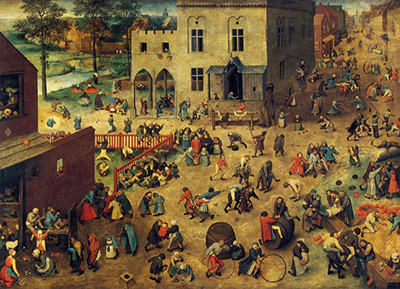
Children's Games is the most generous example. KHM's material on the painting describes a bird's-eye view over a wide square where more than 230 children are occupied with 83 different games. It presents the painting as an encyclopaedic view of children's games, and cautions against forcing a purely moralising reading onto the scene [4]. That caution is important. The picture may invite reflection on adulthood, imitation and social order, but it is not best approached as a simple condemnation of play.
Instead, Children's Games shows how Bruegel could make activity itself into structure. The square is taken over by children. No single game controls the scene. Meaning comes from multiplication. The viewer compares rolling, climbing, balancing, chasing, pretending, processing, hiding and tumbling. The painting becomes a study of learning, mimicry, energy and public space. Like Netherlandish Proverbs, it asks the eye to move locally while keeping the whole in view.
The Fight Between Carnival and Lent is more overtly moral and social. The KHM object page dates it to 1559, identifies it as signed, and describes it as an encyclopaedia of Netherlandish customs related to Carnival and Lent. The museum stresses that Bruegel's invention is the simultaneity of the action: everything appears in the same place at the same time [3].
That simultaneity is one of Bruegel's great pictorial ideas. He does not isolate a single festival moment. He compresses a whole seasonal and social world into one town square. Carnival and Lent face each other like comic combatants, but around them are shops, churchgoing, begging, food, charity, play, drink, masks, trades and everyday movement. The painting is not simply about two calendar seasons. It is about a community divided among appetites, rituals, public performances and private motives.
These crowd encyclopaedias show why Bruegel is so difficult to paraphrase. A sentence can name the subject, but the painting's intelligence lies in the distribution of attention. The crowd is not background noise. It is the subject.
Bosch and Monsters
Bruegel worked in the shadow of Hieronymus Bosch, but not as a passive follower. The Met notes that the market demand for images in Bosch's manner helped shape Bruegel's print designs, especially in the years of his association with Hieronymus Cock [8]. That demand helps explain why devils, hybrids, grotesques and moral fantasies mattered in Bruegel's early graphic world.
The link to Bosch is clearest when Bruegel turns moral disorder into bodily invention. Monsters are not random decorations. They are combinations of fear, appetite, knowledge, comedy and judgment. A creature can be part animal, part object, part human weakness. It may be funny at first glance and disturbing at the next.
The Fall of the Rebel Angels is especially important because it shows Bruegel transforming Boschian inheritance into something encyclopaedic and contemporary. The Royal Museums of Fine Arts of Belgium identify the work as La chute des anges rebelles, 1562, oil on oak, signed and dated at lower left, measuring 117 x 162 cm [5]. Google Arts and Culture, using RMFAB material, notes that the painting was acquired in 1846 under an attribution to Pieter Brueghel the Younger, then attributed to Bosch until the date and signature were found in 1898 [6].
That attribution history is a useful reminder: the painting looked Boschian enough to be mistaken for Bosch until physical evidence corrected the name. Yet Bruegel's own invention is distinctive. The same RMFAB material describes hybrid monsters, apocalyptic combat, naturalia, artificialia, exotic animals, musical instruments, arms, armour and collecting culture [6]. Bruegel turns the fall from heaven into a collapsing cabinet of the world.
The monster imagery therefore belongs to iconography in a broad sense. It is not only about identifying species or objects. It is about seeing how knowledge itself can become unstable. Natural history, global trade, biblical combat, courtly collecting and demonic transformation collide. The result is a picture of disorder made out of too much order: too many things, too many categories, too many forms falling into one another.
Death and Rebel Angels
Bruegel's moral imagery becomes darkest in The Triumph of Death and The Fall of the Rebel Angels. These works move beyond proverbs into cosmic and apocalyptic vision, but the reading habits remain related. The viewer must scan a crowded surface, connect incidents, recognize inherited motifs and resist the urge to force the whole picture into one tidy moral.
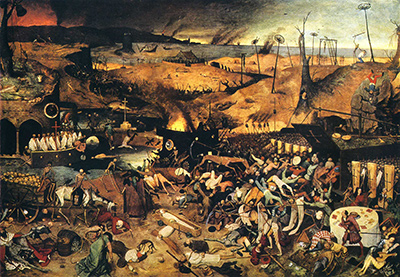
The Prado identifies The Triumph of Death as a 1562-1563 oil on panel and gives its dimensions as 117 x 162 cm [7]. Its account describes Death's victory over earthly things through an army of skeletons, a barren landscape of destruction, and the inability of power or devotion to save the living [7]. That is a far more severe subject than the comic follies of Netherlandish Proverbs, but Bruegel's method remains cumulative. Death is everywhere, not confined to one emblem.
The painting's horror comes from its completeness. Kings, soldiers, lovers, musicians, gamblers and ordinary people are all caught in the same sweep. Social distinctions collapse. Music, money, games, war and pleasure continue for a moment under a sky that has already lost mercy. The moral image is not a slogan that says everyone dies. It is a whole world in which every human attachment is overtaken.
In The Fall of the Rebel Angels, the moral field is vertical rather than horizontal: heaven above, hell below, angels descending into monstrous form. RMFAB's material stresses the central combat of Michael and the rebel angels, while also drawing attention to Bruegel's unusual combination of biblical stories, apocalyptic imagery and hybrid creatures [6]. The painting is therefore both theological and visual. It is about pride, fall and cosmic order, but it is also about the eye's struggle to sort what it sees.
Together, these works show that Bruegel's iconography is not limited to proverbs and peasant comedy. It can become tragic, infernal and cosmic. Yet even at this scale, he thinks through crowds and details. The moral image is built from many small acts of looking.
How to Read Without Overclaiming
The best way to read Bruegel is to accept both clarity and uncertainty. Some details are strongly supported by object records, inscriptions, titles, comparative works and long scholarly tradition. Others remain debated, partial or tempting but insecure. A good reading does not need to solve everything.
Begin with the whole composition. Where is the viewer placed? Is the scene a village, a square, a battlefield, a landscape or a supernatural space? How does Bruegel organize near and far? What kinds of actions repeat? Which groups face each other? What feels ordinary, and what feels inverted?
Then move to selected details. Ask what a figure is doing before asking what the figure "means." Bruegel's signs usually begin as actions. Someone carries, eats, falls, watches, hides, plays, fights, begs, prays or ignores what is happening nearby. Meaning grows from behavior.
Next, connect the detail to a larger pattern. In Netherlandish Proverbs, one foolish action matters because it sits among many foolish actions. In Children's Games, one game matters because it belongs to a whole square of play. In The Fight Between Carnival and Lent, one custom matters because it shares space with many customs happening at once. In The Triumph of Death, one skeleton matters because death has become a total social force.
Be careful with single-key explanations. Bruegel lived in a time of religious tension, political strain, expanding print markets, humanist collecting and inherited medieval imagery. These contexts matter, but no one context unlocks every picture. A painting may speak to moral folly without naming a specific political event. It may draw on Bosch without being by Bosch. It may show peasant custom without being a documentary record of peasant life. It may contain satire without reducing every figure to ridicule.
Finally, keep pleasure in the reading. Bruegel's art is serious, but it is not dry. His pictures were made for looking, discovery, wit and return. The viewer who pauses over a roof, a fish, a child, a mask, a skeleton or a monster is doing what the paintings ask: entering a world where ordinary things have become signs, and signs have become human behavior.
Routes to Related Pages
Start with Pieter Bruegel the Elder for the wider artist overview, then move to the biography for the Antwerp, Brussels and patronage context behind the works.
For the medium and circulation of Bruegel's moral imagery, continue to Bruegel prints. For the painted works as a group, use the Bruegel paintings overview.
For proverb imagery, begin with Netherlandish Proverbs, then compare Twelve Proverbs and Big Fish Eat Little Fish.
For crowd-reading, move to Children's Games and The Fight Between Carnival and Lent. For darker moral and apocalyptic imagery, continue to The Triumph of Death and The Fall of the Rebel Angels.
For the older northern tradition of moral fantasy and hybrid monsters, compare Bruegel with Hieronymus Bosch. The comparison is useful, but the difference matters: Bosch gave Bruegel a powerful precedent for moral imagination, while Bruegel made proverb, crowd and social observation into a language unmistakably his own.
Discussion
Which detail most changes how you read Proverbs and Iconography: the subject, the setting, the social context, the handling of space, or the way Bruegel directs attention across the surface?
Reader Insights
Start with the part of Proverbs and Iconography that first catches your eye, then follow the smaller incidents around it. Bruegel often makes meaning accumulate through repeated acts of noticing rather than through one obvious focal point.
Think about how this page's evidence connects image, audience and setting. A Bruegel composition can be comic, observational, devotional, political or all of these at once depending on how its details are organized.
Where does the work leave interpretation deliberately unsettled? The strongest Bruegel pages often turn on tensions between delight and warning, ordinary life and moral structure, or invention and later copying.
Join the Conversation
Share the detail, source question or comparison that would most help another reader look again.
References
- Deutsche Digitale Bibliothek / Deutsches Dokumentationszentrum fur Kunstgeschichte - Bildarchiv Foto Marburg, Die niederlandischen Sprichworter: https://www.deutsche-digitale-bibliothek.de/item/LVRIYC62CBFXOJ63EFZB34LYJOIJ66IO
- KBR, The World of Bruegel in Black and White: https://www.kbr.be/en/the-world-of-bruegel-in-black-and-white/
- Kunsthistorisches Museum Wien, The Fight between Carnival and Lent: https://www.khm.at/en/artworks/the-fight-between-carnival-and-lent-320
- Kunsthistorisches Museum Wien, Children's Games: https://www.khm.at/en/artworks/children-s-games-321
- Royal Museums of Fine Arts of Belgium, La chute des anges rebelles: https://fine-arts-museum.be/fr/la-collection/pieter-i-bruegel-la-chute-des-anges-rebelles?string=brueghel
- Royal Museums of Fine Arts of Belgium / Google Arts and Culture, The Fall of the Rebel Angels: https://artsandculture.google.com/story/9gXx-oPTgMeLKg
- Museo Nacional del Prado, The Triumph of Death: https://www.museodelprado.es/en/the-collection/art-work/the-triumph-ofdeath/d3d82b0b-9bf2-4082-ab04-66ed53196ccc
- The Metropolitan Museum of Art, Pieter Bruegel the Elder (ca. 1525-1569): https://www.metmuseum.org/essays/pieter-bruegel-the-elder-ca-1525-1569