 by Tom Gurney
Tom Gurney BSc (Hons) is an art history expert with over 20 years experience
Published on June 19, 2020 / Updated on August 16, 2026
Email: tomgurney1@gmail.com / Phone: +44 7429 011000
Pieter Bruegel the Elder Style and Technique: Introduction
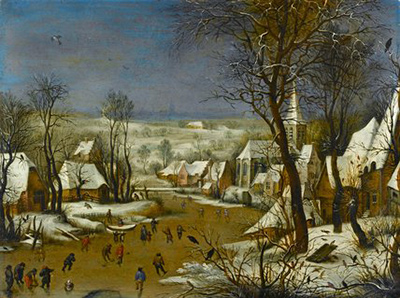
Pieter Bruegel the Elder's style is often described through subject matter: peasants, proverbs, children, winter, harvest, towers, crowds and wide landscapes. Yet the force of his art depends just as much on how those subjects are made. His paintings are built from oak panels, pale prepared grounds, planned underdrawing, adjusted compositions, high viewpoints, layered landscapes, sharp graphic design and disciplined paint handling. Bruegel's worlds feel crowded, but they rarely feel confused. They ask to be read from a distance, then searched inch by inch.
This page explains the main traits of Bruegel's style and technique for readers moving between the Pieter Bruegel the Elder overview, the biography, the paintings, the prints and the drawings. It is not a catalogue of every technical finding. Modern research is strongest for particular groups of surviving works, especially the twelve Bruegel panel paintings in the Kunsthistorisches Museum Vienna. Where technical study has revealed work-specific evidence, such as the late addition of the foremost hunter in Hunters in the Snow, that evidence is identified through the relevant source.
Bruegel's art rewards two kinds of looking at once. The first is panoramic: the eye grasps a whole village, valley, field or building site. The second is investigative: the viewer notices a tiny gesture, a tool, a child at play, a proverb acted out, a change in scale or a path that quietly directs attention. His technique joins those two experiences. It makes large structures feel immediate and small incidents feel part of a world.
At a Glance
- SupportsBruegel painted many surviving works on oak panels; KHM research studied panel construction, condition and provenance in depth [KHM Research; KHM Panels Project].
- WoodDendrochronology on KHM panels identified Baltic oak, valued for slow, straight growth and stable long planks [2].
- GroundKHM describes a chalk ground with animal glue binder, applied in layers and sanded smooth [2].
- UnderdrawingInfrared photography and infrared reflectography reveal planning beneath paint, including changes between drawing and painting [KHM Research; KHM Glimpses].
- ViewpointBruegel often uses elevated views to make large scenes readable and to pull the eye through deep space.
- CrowdsHis figure-rich scenes depend on grouping, spacing, diagonals, repeated actions and a strong overall design.
- LandscapeBruegel constructs landscapes rather than copying a single real view; he can combine imagined visibility with observed everyday detail [6].
- Paint handlingPale grounds, carefully graded color and layered foreground forms help create depth, light and atmosphere [2].
- Graphic thinkingHis painted compositions share a close relationship with drawing and print culture, especially the Antwerp world of publishers and engravers [7].
- Best viewing methodStart with the whole composition, follow the main routes, then move slowly through details and compare them with the structure.
Contents
- Introduction
- Panels and Materials
- Underdrawing and Technical Imaging
- Composition and High Viewpoint
- Crowded Scenes Without Chaos
- Landscape Construction
- Paint and Graphic Thinking
- The Print Design Relation
- A Method for Close Looking
- Why Technical Study Matters
Panels and Materials
Bruegel's surviving paintings are inseparable from panel painting. KHM's Bruegel research began in 2012 with Getty Foundation support and focused on the museum's twelve panel paintings by the artist. The project studied how the panels were constructed, the materials used, their condition, art-historical questions and provenance [KHM Research; KHM Panels Project]. The Getty Foundation's Panel Paintings Initiative supported conservation training and research projects across institutions, including KHM's work on Bruegel panels [4].
The support is not just a neutral backing. In sixteenth-century Netherlandish painting, a panel was a carefully made object before it became an image. KHM's discussion of the Bruegel panels notes that Bruegel, like many contemporaries, painted on panels. Dendrochronology, which studies tree-ring evidence, helped identify the wood and its provenance. The trees used for the KHM panels grew in the Baltic region, in areas now part of Poland and Russia. KHM describes this as high-quality oak: slow-growing, straight and able to produce stable long planks [2].
That material stability mattered for ambitious pictures. Large scenes such as The Tower of Babel, The Harvesters and Hunters in the Snow are not only inventions of composition. They are also constructed things, dependent on joined planks, prepared surfaces and later survival through centuries of handling, display and conservation. KHM's research into panel structure also shows how later interventions could alter the works. In the KHM group, only Christ Carrying the Cross retained its original format; other panels had been cropped to varying degrees [2].
After the wood was selected, joined and prepared, Bruegel worked on a ground layer. KHM describes the ground as chalk with an animal glue binder, applied in several layers and sanded to produce a smooth surface typical of contemporary Netherlandish practice. This pale ground contributed to the handling of light: it could reflect light through paint layers and help colors appear more luminous [2].
The panel, then, is part of Bruegel's style. His small figures and crisp incidents need a surface able to hold precision. His broad spaces need a stable support. His color and depth depend in part on the light-bearing preparation beneath the paint. The technical object and the visual world cannot be separated.
Underdrawing and Technical Imaging
Modern technical imaging has changed how Bruegel can be studied. KHM's research used non-invasive methods, including infrared photography, infrared reflectography, X-rays, X-ray fluorescence analysis and 3D mapping [1]. Each method answers a different kind of question. Infrared photography and infrared reflectography reveal underdrawing beneath paint. X-rays help study the support, ground and pigments. X-ray fluorescence analysis helps identify elemental composition related to pigments. 3D mapping measures the paintings and renders them in three dimensions [1].
The value of these tools is not that they make visible looking obsolete. They make looking more accountable. Bruegel's surfaces can appear astonishingly complete, as though the whole scene arrived fully formed. Imaging shows that his finished works grew from drawing, planning, revision and painted decision.
KHM's discussion of underdrawing describes changes across Bruegel's career. In early works such as The Battle between Carnival and Lent, he carefully delineated numerous miniature details in the underdrawing and then followed that planning closely in paint. KHM notes that even tiny elements, such as fingers or skewered sausages, can be identified in the underdrawing. In the built setting of the same painting, however, his brushwork could become freer, with the painted stage not always adhering to the drawn plan [2].
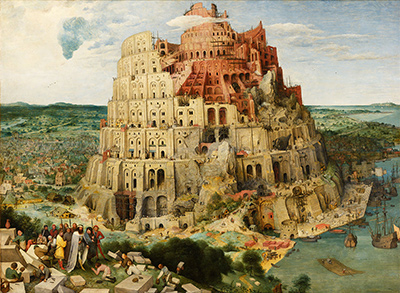
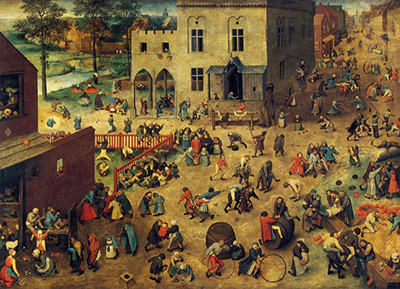
KHM also notes a shift in works made soon afterward. In Children's Games, Bruegel relied on preparatory drawings for far fewer details. In The Tower of Babel, KHM describes a break in his use of underdrawing, with Bruegel introducing numerous changes during painting [2]. This does not mean he became careless. It means the relation between preparation and execution became more flexible. He could use drawing as structure, then allow the painted image to develop.
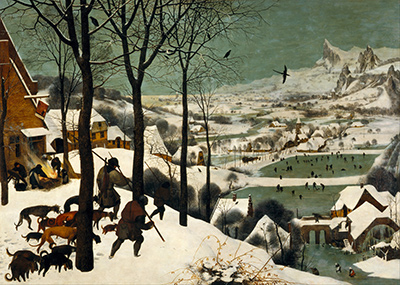
The best-known example from KHM's public research concerns Hunters in the Snow. Technical images show that the foremost hunter was not part of the initial concept. Bruegel painted him over already executed snow-covered ground and a tree trunk, when the painting was far advanced. KHM explains that the added figure functions as a repoussoir, leading the viewer into the composition [1]. The discovery is important because the figure now feels inevitable. Technical study reveals that one of the painting's most natural-looking entry points was a late compositional decision.
Composition and High Viewpoint
Bruegel's compositions often begin from an elevated viewpoint. The viewer looks down on fields, squares, valleys, building sites and villages, then across them into distance. This high position lets Bruegel include many actions without surrendering clarity. It also gives the viewer a special role: not a participant at ground level, but an observer asked to understand relations across a whole scene.
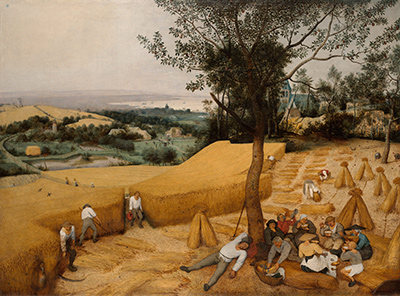
High viewpoint is essential in Bruegel's landscapes and seasons. In The Harvesters, foreground workers eat, rest and cut grain while the landscape opens behind them. The Met describes the painting as a constructed landscape rather than a record of an actual Flemish view. It emphasizes that Bruegel creates a wide fantasy of visibility and maps onto it many real details from everyday life [6]. That phrase helps explain his method more broadly. He is not simply copying what could be seen from one place. He is building a world that can be searched.
In Hunters in the Snow, the high viewpoint creates a descent. The hunters stand near the viewer, but the eye follows their movement down into the village and then across frozen ponds toward distant mountains. KHM's object page emphasizes that the painting's importance lies not in the sum of delightful details, such as skaters on frozen ponds, but in the overall effect by which Bruegel evokes lasting cold [5]. That overall effect depends on composition. The diagonal slope, dark trees, small figures, pale snow and deep valley all work together.
In The Tower of Babel, a high view serves another purpose. The viewer can see the tower as an enormous structure, but also the harbor, city, workers, scaffolding and countless building activities. The height makes the impossible scale legible. It lets Bruegel turn architecture into an ecosystem of labor.
High viewpoint is not emotional distance. Bruegel's figures are often small, but their smallness is meaningful. It places them inside weather, labor, architecture and social order. His technique asks viewers to feel both human energy and human limitation.
Crowded Scenes Without Chaos
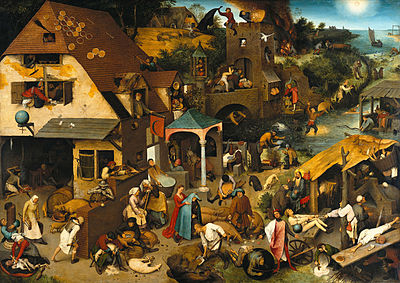
Bruegel is one of the great painters of crowds. Children's Games fills a town square with play. Netherlandish Proverbs turns everyday activity into a field of sayings and social behavior. The Tower of Babel fills a monumental building project with workers and equipment. His paintings can teem with figures, but they remain readable because they are organized in layers and groups.
One reason the crowds work is that Bruegel rarely treats figures as isolated ornaments. They belong to groups of action. A pair, a small group, a line of workers, a circle of children or a procession gives the eye a unit to understand. Many such units can coexist if the larger design controls them. Streets, paths, rooftops, slopes, walls, trees and shadows divide the field into zones.
Another reason is rhythm. Bruegel repeats and varies actions. In a proverb picture, similar gestures can echo across the surface. In a children's scene, forms of play become a catalogue, but not a shapeless list. In a landscape, workers, animals and travelers appear at different scales, so the viewer feels movement through space as well as abundance of detail.
The high viewpoint helps, but it does not solve everything by itself. Bruegel also manages scale. Foreground figures establish the viewer's bodily entry. Middle-ground figures create narrative density. Distant figures become signs of activity. This scaling lets him crowd a scene while preserving hierarchy. The eye knows where to begin, where to wander and how to return to the whole.
This is why Bruegel's busy pictures are so different from visual clutter. Clutter competes for attention without order. Bruegel's crowds invite attention because each small incident is held within an architectural or landscape structure. The viewer may discover the picture slowly, but the composition has already done the work of making discovery possible.
Landscape Construction
Bruegel's landscapes often feel observed because their details are so exact, but their larger spaces are constructed. The Met's audio discussion of The Harvesters is especially useful here: the painting is not a real landscape, and flat Flanders could not supply the sweeping visibility that Bruegel creates. He builds an invented landscape and fills it with real details from everyday life [6].
KHM's technical discussion describes how Bruegel created depth in landscape through a layered approach inherited from Netherlandish tradition. Instead of depending on a strict low-horizon perspective system, he constructed landscapes from the back, with foreground details hiding more distant ones. KHM uses branches in The Gloomy Day as an example: branches painted further back are hidden or obscured by branches added in the foreground, creating space through overlapping and incorporation [2].
This layered method matters for the seasons cycle. In The Harvesters, the foreground tree, resting workers, standing grain, distant fields and far water do not sit in one uniform plane. They unfold through overlapping zones. In Hunters in the Snow, the foreground trees and descending hunters frame the valley and make the distant ice and mountains seem deep. Bruegel builds space by placing one thing in front of another, then leading the eye around and through those obstructions.
The result is a landscape that can be both believable and impossible. It feels true because tools, bodies, animals, roads, rooftops and seasonal actions are sharply noticed. It feels larger than reality because the viewpoint and visibility are invented. Bruegel's technique depends on that productive tension. He does not need to choose between observation and construction. He uses construction to organize observation.
Paint and Graphic Thinking
Bruegel's paint handling serves clarity. KHM's research emphasizes the role of the pale ground in luminosity and depth, and its discussion of color notes carefully graded hues chosen for different paintings [2]. The wintry mood of Hunters in the Snow, for example, depends on cool blue tones, muted whites, dark trees and figures, and controlled contrast. KHM describes the mood as built from warm yet frosty shades of blue [2].
The pigments KHM identifies through X-ray fluorescence are typical for Bruegel's time and region: earth pigments in red and yellow ochres and umber, lead-tin yellow, vermilion, bone black, plant black and lead white. Green was usually produced by mixing azurite and lead-tin yellow [2]. These material facts do not reduce the paintings to chemistry. They help explain how Bruegel could make color feel atmospheric without sacrificing legibility.
His paint often has a graphic intelligence. Forms read clearly. Silhouettes matter. Dark figures against snow, children against pale architecture, workers against golden grain and ships against water all depend on shape as much as color. Bruegel's world can be full of small parts because he thinks like a designer: a line, contour or patch of contrast can carry meaning across a crowded surface.
This graphic quality links his paintings to his drawings and prints. It also explains why close looking is so satisfying. A figure may be tiny, but if its contour is exact and its action clear, it can hold attention. Bruegel's technique gives smallness authority.
The Print Design Relation
Bruegel was famous in his own century not only as a painter but through graphic work. KBR's exhibition on Bruegel in black and white stresses that in the sixteenth century his reputation rested strongly on prints, and that Flanders was an international center for print production and trade around the middle of the century. Bruegel and the publisher Hieronymus Cock both played key roles in that world [7].
Printmaking shaped how images moved. A drawing could become a design, an engraver could translate that design onto a plate, and a publisher could distribute impressions across a wide market. KBR describes the long process from drawing to print and highlights Bruegel's preparatory drawings, landscapes, virtues, sins and other printed inventions [7]. This matters for style because Bruegel's imagination was trained in images that had to survive translation into line.
The relation between painting and print should not be flattened. An oil painting on oak and an engraving on paper are different objects with different surfaces, audiences and forms of labor. But Bruegel's painted clarity, his ability to organize many incidents and his love of telling detail make sense beside the demands of print design. In prints, a figure's action must often be legible through contour and hatch. In paintings, Bruegel carries a related discipline into color, atmosphere and scale.
The print relation also helps explain his taste for series and categories. Virtues, sins, proverbs, landscapes, ships, seasons and social types all lend themselves to comparison. His art often teaches the eye to move from one example to another. That habit belongs naturally to a culture of printed images, where invention could circulate beyond the single painted panel.
For readers, this means the prints and drawings are not side rooms to the paintings. They are central to understanding how Bruegel thought visually.
A Method for Close Looking
The best way to look at Bruegel is to resist choosing too quickly between the whole and the detail. Begin with the whole composition. Ask where the eye starts, what direction it is encouraged to travel and what large shapes control the picture. In Hunters in the Snow, the foreground slope, hunters and trees pull the viewer down into the valley. In The Harvesters, the tree, resting workers and fields create a balance between bodily closeness and broad seasonal space.
Next, look for zones. Bruegel often divides activity across foreground, middle ground and distance. Each zone has a different scale and pace. Foreground figures may feel tactile and heavy. Middle-ground groups often carry the richest social action. Distant details give the sense of a larger world continuing beyond the main subject.
Then follow routes. Roads, rivers, rows of grain, rooflines, tree trunks, diagonals and lines of figures often guide the eye. Bruegel's scenes are not random accumulations. They have paths through them. Finding those paths helps the viewer understand why a crowded composition remains clear.
Finally, move into the small incidents. This is where Children's Games and Netherlandish Proverbs are especially rewarding. A viewer can move from one action to the next, but each discovery should be related back to the whole. Bruegel's details are not loose decorations. They are parts of a system.
Modern digital tools support this kind of looking. KHM launched Inside Bruegel on 2 October 2018, making high-definition images and technical views available for close study [1]. The project reflects something already built into Bruegel's art: his paintings invite viewers to zoom in mentally, long before digital zoom existed.
Why Technical Study Matters
Technical study matters because Bruegel's art can deceive the eye in the best sense. It can make invention look natural, complexity look effortless and revision disappear into inevitability. Research into panels, grounds, underdrawing, pigments and compositional changes helps restore the work behind that ease.
The late hunter in Hunters in the Snow is a perfect example. Without imaging, the figure reads as part of the painting's original order. With imaging, he becomes evidence of Bruegel revising a nearly finished picture to strengthen its entrance into space [1]. The discovery does not reduce the painting's poetry. It increases admiration for the precision of the decision.
Panel research also changes how viewers understand survival. These paintings are not transparent windows onto the sixteenth century. They are wooden objects that have been cropped, thinned, cradled, restored, studied and preserved. KHM's research into the twelve Vienna panels addresses structural condition and provenance as well as technique [3]. That history matters because the Bruegel seen today is both a sixteenth-century achievement and a material survivor.
At the same time, technical evidence should be used with discipline. It should clarify what can be known, not license speculation. Bruegel's style is visible in the paintings themselves: high viewpoints, crowd control, sharp detail, layered landscapes, graphic design and atmospheric color. Technical research explains how some of those effects were made and revised. The strongest interpretation keeps both kinds of evidence together.
That is the heart of Bruegel's technique. He gives the viewer a world large enough to enter and exact enough to study. His panels hold landscapes, crowds and jokes, but also decisions about wood, ground, drawing, color and line. The more closely one looks, the less his art seems like simple observation and the more it appears as a disciplined art of construction.
Discussion
Which detail most changes how you read Style and Technique: the subject, the setting, the social context, the handling of space, or the way Bruegel directs attention across the surface?
Reader Insights
Start with the part of Style and Technique that first catches your eye, then follow the smaller incidents around it. Bruegel often makes meaning accumulate through repeated acts of noticing rather than through one obvious focal point.
Think about how this page's evidence connects image, audience and setting. A Bruegel composition can be comic, observational, devotional, political or all of these at once depending on how its details are organized.
Where does the work leave interpretation deliberately unsettled? The strongest Bruegel pages often turn on tensions between delight and warning, ordinary life and moral structure, or invention and later copying.
Join the Conversation
Share the detail, source question or comparison that would most help another reader look again.
References
- Kunsthistorisches Museum Wien, "Researching Bruegel": https://www.bruegel2018.at/en/researching-bruegel/
- Kunsthistorisches Museum Wien, "Revealing Glimpses into the Heart of Panel Paintings": https://www.bruegel2018.at/en/revealing-glimpses-into-the-heart-of-panel-paintings/
- Kunsthistorisches Museum Wien, "The Panels by Pieter Bruegel the Elder in the Kunsthistorisches Museum, Vienna": https://www.khm.at/forschung/forschungsprojekte/abgeschlossene-projekte/the-panels-by-pieter-bruegel-the-elder-in-the-kunsthistorisches-museum-vienna
- Getty Foundation, "Panel Paintings Initiative: Grants Awarded": https://www.getty.edu/projects/panel-paintings-initiative/grants-awarded/
- Kunsthistorisches Museum Wien, "Hunters in the Snow (Winter)": https://www.khm.at/en/artworks/hunters-in-the-snow-winter-327
- The Metropolitan Museum of Art, "The Harvesters": https://www.metmuseum.org/art/collection/search/435809
- KBR, "The World of Bruegel in Black and White": https://www.kbr.be/en/the-world-of-bruegel-in-black-and-white/